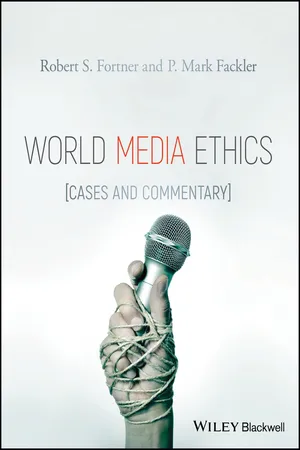
- Emphasizing the intertwined concepts of freedom of the press and social responsibility, this is the first book to cover media ethics from a truly global perspective. Case studies on hot topics and issues of enduring importance in media studies are introduced and thoroughly analyzed, with particular focus on ones involving social media and public protest
- Written by two global media ethics experts with extensive teaching experience, this work covers the whole spectrum of media, from news, film, and television, to advertising, PR, and digital media
- End-of-chapter exercises, discussion questions, and commentary boxes from a global group of scholars reinforce student learning, engage readers, and offer diverse perspectives
- English
- ePUB (mobile friendly)
- Available on iOS & Android
eBook - ePub
About this book
Information
1
Introduction: Contexts for Ethical Decision-Making
Ethics is not practiced in a vacuum. Choosing how to act occurs in particular contexts that exert various kinds of pressure on those making choices. So we will begin this book with attention to the various aspects of society and culture that affect the ethical choices made within them. Although we are presenting these as separate entities, it will become clear in the reading that they are so intertwined that it is difficult to speak of them separately. The value of doing so is to highlight them as important considerations. Once our initial analysis is complete, we will be able to show how various ethical perspectives relate to them, and then provide comments on how ethical decisions might reasonably be made within complex contexts.
Each of the following characteristics of societies and cultures forms a part of the overall context of moral choice. This differs not only from society to society, but from individual to individual. Some people in a society make choices based in large measure on religious commitments. Others are driven by the perceived demands of media technology or professions, and still others by ideological commitments. To fully understand the choices made, then, it is necessary to give some thought to how each of the following contexts may impact on them. We do not mean that ethics is relative, but that it is situational. People of goodwill may, within a given socio-cultural context, come to different decisions. Are all decisions equally ethical? We would say “no,” but to evaluate the ethics of choice it is useful to understand the context within which choices are made. Then we will have the basis for conversation as to whether a decision can be defended on ethical grounds.
Does the “Global Village” Imply a Global Media Ethics?
The first hurdle to overcome when thinking about global media ethics is the belief that a global village exists. It doesn't. There are markers of its existence, to be sure, but they are misleading, especially for those who see them from a Western perspective. Since the nineteenth century, the so-called century of progress, Western pundits and the popular media have touted the role of new communications technologies in “shrinking” the world, annihilating time and space, and allowing for universal connectivity for the world's peoples. The world wars of the twentieth century did little to dampen the enthusiasm, for global connection and expectations rose to new heights with the arrival of satellite communication, global media networks, and real-time reports from far-flung regions via, first, satellite telephony and then video feeds. The arrival and rapid spread of the internet continued the trend. The final burst of expectation (so far) was unleashed by the development of mobile smartphones using broadband systems and wireless capability. It seemed that all the barriers that had prevented global universal communication had been overcome by technological progress.
It is not difficult to find claims that the global village has arrived. The International Monetary Fund trumpeted its arrival in September 2012 (Mahbubani, 2012, p. 1). Kishore Mahbubani claimed the milestone that justified this claim was that teledensity had reached the point that people had “become interconnected at a level never seen before in history,” and that such technology (mobile telephones and the internet) had generated global convergence that, along with education, had improved human lives (Ibid.).
The problem with such claims is that they ignore more than they reveal. There is little doubt that connectivity among people is more widely distributed, and used in greater measure, than ever before. In 2014 the International Telecommunication Union (ITU) estimated that there were 6.9 billion mobile-cellular subscriptions around the world, nearly equal to the total population of the planet. However, somewhat fewer than three billion people had access to the internet, with access in developing countries reaching only 32% (ITU, 2014). The main reason for the difference is the much lower access to mobile broadband internet services in the developing world where wired infrastructure is not available.
Related to this difference in access to technology is the problem with seeing all connections as equally capable of accessing content. For instance, although the teledensity in the continent of Africa has increased several times over in the past decade, much of this development has provided only the barest connection to people. In Ivory Coast, for instance, 3G+ mobile coverage in 2014 was limited to 10 urban areas, and those that were connected to these systems, although they could access the internet, could see YouTube content at only 240p, the site's minimum resolution, while the more highly developed infrastructures in other countries allowed for 1040p HD (high-definition) connections. Rural areas of Ivory Coast were still without any broadband coverage at all, limiting use of mobile telephones to voice and SMS (text). On many of the islands in the Pacific, including those that are part of the Philippines and Indonesia, the only television available is through satellite delivery, and then only when generators are used to provide the power for connection. In mountainous areas, such as Nepal, the same situation applies and even radio is problematic since the most prevalent system employed is frequency modulation (VHF/FM), which uses only line of sight signals that are easily blocked by the terrain. The absence of a power grid also makes people dependent on expensive batteries that can only be replaced by trekking often long distances into towns on treacherous footpaths. Such circumstances make talk of a global village more of a fantasy than a reality.
Besides such access issues, many other obstacles continue to frustrate efforts to think of the world as a global village. People who have the good fortune to see films or television programs made in other countries, for instance, rarely see the reality of people's lives. Television does not thrive on careful documentaries of the lives of ordinary people living ordinary lives. Typically, actors portray others and, in so doing, interpret their scripts according to preconceptions that may have no firm foundation in the ordinary social, cultural, or economic lives of those they purport to represent. Many programs, regardless of source, are formulaic indigenized versions of programs that have attracted audiences in other countries. Often they become caricatures of the original, because the premise of the formula was culture-bound and those in the knock-off have altered their personas to qualify for the program. These two realities are “thin,” barely scratching the surface of authentic portrayal. Even “thicker” programs, such as carefully crafted documentary approaches, are the perceptions of single filmmakers of “the other”; few to none are actually produced by those indigenous to the community portrayed.
So, despite the growth of global telephony, wired and wireless internet services, and widespread distribution of cultural products, the claim of a global village is actually a chimera – at best less than half the world's population could be said to be within range of this ideal. But despite the lack of a single media environment – a truly global village – there are still good reasons to think of ethics in a global perspective. Increasingly citizen reporters, bloggers, tweeters, and YouTube video producers seek global audiences. From #BringBackOurGirls to propaganda and recruitment videos produced by ISIS (Islamic State of Iraq and Syria),1 media producers – amateur and professional – are appealing both to political establishments and to the global public sphere. The same is true of those who parody terrorists in the Middle East in their own viral videos, some using music videos or Lego figures (Zahriyeh, 2015).
The Political-Economic Context of Global Media Ethics
Although there are various political and economic relationships that bind countries together through international conventions and organizations, free trade agreements, trade pacts, and technological connections via fiber optic undersea cables and satellites, such relationships are only operable so long as the countries so bound find them to be in their own best interests. They are all subject to the sovereignty claims of the signatories. All international conventions must be ratified by individual countries to have authority within them. Countries may take reservations when signing to indicate their intention not to be bound by certain aspects of them. Trade pacts can be abrogated, alliances broken, connections shut off at borders. They can also simply be broken when considered inconvenient. There is no universal method of enforcing such agreements or connections.
Political economy is concerned with the moral or ethical results of political and economic practices. Since these practices differ from one country to another, the contests that exist between efforts to reveal (practiced by media practitioners) and those to conceal or control, also differ. Several different political and economic configurations within countries affect both the context for ethical decisions and the fragmentation of the “global village.” Many countries have constitutional, regulatory, or philosophical commitments to free expression, although actual compliance with them is problematic. For instance, questions were raised in the United States as a result of the Obama administration's efforts to uncover leaks claimed to compromise national security, and in Britain as a result of both leaks and a hacking scandal that resulted in prosecutions of staff members of the now-closed News of the World. There have been official efforts to shut down Twitter in Turkey, China has restricted websites that raised moral issues by publishing pornographic images (including bare-breasted female anime characters), and in India the court found that the publication of an academic book (available in other countries for some time) in Hindi could foment religious unrest. In Fiji two journalists received death threats for their reports about a cancelled live television debate between the leading contenders for the post of prime minister. Iran and Russia have been developing their own internet that restricts access to connections outside their own countries and China has established the so-called “Great Firewall” to accomplish the same ends.
In addition, conflicts in various countries have led not only to arrests of journalists and bloggers, but also to denials of entry and manhunts of Russian journalists in Ukraine; expulsion and denial of entry to journalists in Yemen; prosecution of Al-Jazeera journalists in Egypt as terrorists; murders of journalists in Pakistan by Taliban factions (as well as expulsion of Indian journalists) and in the Philippines by Marxist-inspired separatists; street protests against restrictions on journalists in Venezuela; and rewritten laws governing expression in Kenya, Russia, and Libya (although overturned by the Libyan Supreme Court), among many other happenings. Many journalists, videographers, photojournalists, and filmmakers have also died covering the Syrian, Sudanese, and Congolese civil wars, in the Palestinian territories, and in ongoing sectarian conflicts in Iraq and Afghanistan. Many others have found themselves kidnapped or “detained.” The Committee to Protect Journalists (CPJ), for instance, lists 1,054 journalists killed since 1992 (617 of them “with impunity”), and 211 journalists in prison in 2013 (cpj.org). And in Europe a non-governmental organization (NGO) called the European Initiative for Media Pluralism began registering in different countries in the effort to collect signatures to create a new European Commission directive to fight against media monopoly, seeking to “enshrine the severance of ties between media, business and politics in the different media states in a lawful manner on an EU [European Union] level” (Novinite.com, 2014). All of these realities influence the perceived relevance and practice of ethics by media practitioners.
The Cultural-Religious Context of Global Media Ethics
The religious fragmentation of the planet is well documented, but even the division of religion into Christian, Islamic, Buddhist, Hindu, Jewish, Shinto, or “traditional” groups fails to capture the differences that actually exist. There are many variations within each of these groups, some so severe that it is sometimes difficult to see them as part of the same tradition. In addition to the obvious divisions, say between Catholics and Protestants, or Shia and Sunni Muslims, there are many other subgroups and “heretical” sects that could be identified. There are also humanists, non-believers, cultural adherents (or nominal believers), and those who say they are spiritual but not religious. The implication of this fragmentation is that “religious” bases for moral choice abound. Morality is a broad concept. It is, as Bernard Gert defined it, “an informal public system applying to all rational persons, governing behavior that affects others, and has the lessening of evil or harm as its goal” (quoted in “The definition of morality,” 2011). This generic definition of the term does not suggest where any individual's sense of morality is grounded. For the billions of people on the planet who adhere to a religious tradition, however, there is a connection between their faith's requirements for behavior and its adherents' sense of morality. Although not all religions have scriptures (or holy books), all do have parents and teachers (including priests, imams, and gurus, among others) who pass along moral prescriptions to those who are either born into, or choose to follow, the tradition. As Paul Bloom (2012, p. 184) puts it: “Through holy texts and the proclamations of authority figures, religions make moral claims about abortion, homosexuality, duties to the poor, charity, masturbation, just war, and so on. People believe these claims because, implicitly or explicitly, they trust the sources. They accept them on faith.”
Of course, the requirements of each faith differ, sometimes profoundly, from each other. What one faith considers a necessary moral requirement, another doesn't deal with at all. Despite the clear relationship between Judaism and Christianity, for instance, the moral expectations for the treatment of debt, or the appropriate response to insult, differ. And, as suggested above, those within a particular tradition can have quite different ideas about abortion, capital punishment, or the treatment of the poor. Nevertheless, religion remains an important source of moral thought among the world's religious people.
Not only are people divided by religious commitments, there are also cultural divides to consider. Cult...
Table of contents
- Cover
- Series Page
- Title Page
- Copyright
- Preface
- Chapter 1: Introduction: Contexts for Ethical Decision-Making
- Chapter 2: Philosophical Perspectives on Ethical Decision-Making: The Individualist Traditions
- Chapter 3: Philosophical Perspectives on Ethical Decision-Making: The Collectivist Traditions
- Chapter 4: Ethics and Political Economy
- Chapter 5: Boundaries on Civil Discourse
- Chapter 6: Advertising, Public Relations, and Materialism
- Chapter 7: Global Entertainment
- Chapter 8: Media and the Political Process
- Chapter 9: The Rule of Law
- Chapter 10: Treasuring Persons, Protecting Institutions: The Protection of Minority Voices
- Chapter 11: Religion and Social Responsibility
- Chapter 12: War, Violence, and Media
- Chapter 13: Truth, Conflict, Chronic Problems, and Media Attention
- Chapter 14: Conclusion
- Glossary
- References
- Index
- End User License Agreement
Trusted by 375,005 students
Access to over 1.5 million titles for a fair monthly price.
Study more efficiently using our study tools.
Frequently asked questions
Yes, you can cancel anytime from the Subscription tab in your account settings on the Perlego website. Your subscription will stay active until the end of your current billing period. Learn how to cancel your subscription
No, books cannot be downloaded as external files, such as PDFs, for use outside of Perlego. However, you can download books within the Perlego app for offline reading on mobile or tablet. Learn how to download books offline
Perlego offers two plans: Essential and Complete
- Essential is ideal for learners and professionals who enjoy exploring a wide range of subjects. Access the Essential Library with 800,000+ trusted titles and best-sellers across business, personal growth, and the humanities. Includes unlimited reading time and Standard Read Aloud voice.
- Complete: Perfect for advanced learners and researchers needing full, unrestricted access. Unlock 1.5M+ books across hundreds of subjects, including academic and specialized titles. The Complete Plan also includes advanced features like Premium Read Aloud and Research Assistant.
We are an online textbook subscription service, where you can get access to an entire online library for less than the price of a single book per month. With over 1.5 million books across 990+ topics, we’ve got you covered! Learn about our mission
Look out for the read-aloud symbol on your next book to see if you can listen to it. The read-aloud tool reads text aloud for you, highlighting the text as it is being read. You can pause it, speed it up and slow it down. Learn more about Read Aloud
Yes! You can use the Perlego app on both iOS and Android devices to read anytime, anywhere — even offline. Perfect for commutes or when you’re on the go.
Please note we cannot support devices running on iOS 13 and Android 7 or earlier. Learn more about using the app
Please note we cannot support devices running on iOS 13 and Android 7 or earlier. Learn more about using the app
Yes, you can access World Media Ethics by Robert S. Fortner,P. Mark Fackler in PDF and/or ePUB format, as well as other popular books in Business & Advertising. We have over 1.5 million books available in our catalogue for you to explore.