- English
- ePUB (mobile friendly)
- Available on iOS & Android
About this book
Sustainable environmental control through building design
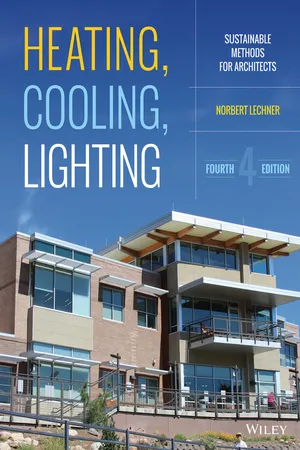
Heating, Cooling, and Lighting is the industry standard text on environmental control systems with the emphasis on sustainable design. By detailing the many factors that contribute to the comfort in a building, this book helps architects minimize mechanical systems and energy usage over the life of the building by siting, building design, and landscaping to maximize natural heating, cooling, and lighting. This new fourth edition includes new information on integrated design strategies and designing for the Tropics. Resources include helpful case studies, checklists, diagrams, and a companion website featuring additional cases, an image bank, and instructor materials.
Designing buildings that require less energy to heat, cool, and light means allowing the natural energy of the sun and wind to reduce the burden on the mechanical and electrical systems. Basic design decisions regarding size, orientation, and form have a great impact on the sustainability, cost, and comfort of a building. Heating, Cooling, and Lighting provides detailed guidance for each phase of a design project. Readers will:
- Understand the concept of sustainability as applied to energy sources
- Review the basic principles of thermal comfort, and the critical role of climate
- Learn the fundamentals of solar responsive design, including active and passive solar systems as well as photovoltaics
- Discover how siting, architectural design, and landscaping can reduce the requirements for mechanical and electrical systems
In sustainable design, mechanical, and electrical systems should be used to only accomplish what the architect could not by the design of the building itself. With this in mind, designers require a comprehensive understanding of both the properties of energy and the human factors involved in thermal comfort. Heating, Cooling, and Lighting is the complete, industry-leading resource for designers interested in sustainable environmental control.
Tools to learn more effectively

Saving Books

Keyword Search

Annotating Text

Listen to it instead
Information
Table of contents
- Cover
- Contents
- Title
- Copyright
- Foreword to the Fourth Edition
- Foreword to the First Edition
- Preface
- Acknowledgments
- Chapter 1: Heating, Cooling, and Lighting as Form-Givers in Architecture
- Chapter 2: Sustainable Design and Energy Sources
- Chapter 3: Basic Principles
- Chapter 4: Thermal Comfort
- Chapter 5: Climate
- Chapter 6: Solar Geometry
- Chapter 7: Passive Solar
- Chapter 8: Photovoltaics and Active Solar
- Chapter 9: Shading and Light Colors
- Chapter 10: Passive Cooling
- Chapter 11: Site Design, Community Planning, and Landscaping
- Chapter 12: Lighting
- Chapter 13: Daylighting
- Chapter 14: Electric Lighting
- Chapter 15: The Thermal Envelope: Keeping Warm and Staying Cool
- Chapter 16: Mechanical Equipment for Heating and Cooling
- Chapter 17: Tropical Architecture
- Chapter 18: Recommended Low Energy Case Studies
- Chapter 19: Checklist for Designing Integrated Sustainable Buildings
- Appendix A: Horizontal Sun-Path Diagrams
- Appendix B: Vertical Sun-Path Diagrams
- Appendix C: Solar Altitude and Azimuth Angles
- Appendix D: Methods for Estimating the Height of Trees, Buildings, etc.
- Appendix E: Sundials
- Appendix F: Sun-Path Models
- Appendix G: The Water Table for Ventilation Studies
- Appendix H: Site Evaluation Tools
- Appendix I: Heliodons
- Appendix J: Tables of R-Values
- Appendix K: Resources
- Appendix L: Conversion Factors between the Inch-Pound (I-P) System and the International System of Units (SI)
- Bibliography
- Index
- Supplemental Images
- End User License Agreement
Frequently asked questions
- Essential is ideal for learners and professionals who enjoy exploring a wide range of subjects. Access the Essential Library with 800,000+ trusted titles and best-sellers across business, personal growth, and the humanities. Includes unlimited reading time and Standard Read Aloud voice.
- Complete: Perfect for advanced learners and researchers needing full, unrestricted access. Unlock 1.4M+ books across hundreds of subjects, including academic and specialized titles. The Complete Plan also includes advanced features like Premium Read Aloud and Research Assistant.
Please note we cannot support devices running on iOS 13 and Android 7 or earlier. Learn more about using the app