- Represents the first volume to offer a complete overview of the reception of ancient drama from antiquity to the present
- Covers the translation, transmission, performance, production, and adaptation of Greek tragedy from the time the plays were first created in ancient Athens through the 21st century
- Features overviews of the history of the reception of Greek drama in most countries of the world
- Includes chapters covering the reception of Greek drama in modern opera and film
- English
- ePUB (mobile friendly)
- Available on iOS & Android
eBook - ePub
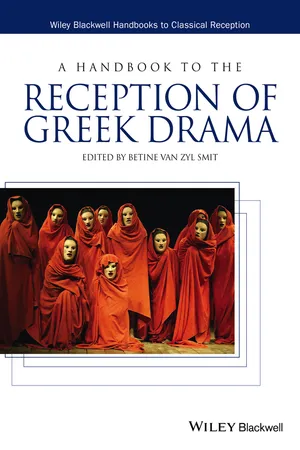
A Handbook to the Reception of Greek Drama
About this book
A Handbook to the Reception of Greek Drama offers a series of original essays that represent a comprehensive overview of the global reception of ancient Greek tragedies and comedies from antiquity to the present day.
Information
Part I
The Ancient World
1
The Reception of Greek Tragedy from 500 to 323 BC
Martin Revermann
When Aeschylus, one of the earlier Greek tragic playwrights and the oldest among the three who would achieve canonical status, died in or around 456 BC, he was not buried in Athens, his home-city in which he had spent all but the last couple of years of his life and where his plays were well known and regularly performed. He died in Sicily, in the city of Gela, as a guest at the court of the local tyrant Hieron, still writing and producing plays. Here, according to his (anonymous) biographer, he was not only sumptuously buried, but his tomb became a site of pilgrimage for theater professionals who “would conduct sacrifices and perform his plays.”1 At the same time, the citizens of his home-town Athens, the biographer continues, passed a decree in the assembly that anyone who wished to reperform an Aeschylean play should be granted a chorus (the necessary prerequisite for public and competitive theater performance). These strongly favorable and clearly exceptional collective responses, in two rather distinct parts of the Greek cultural continuum, provide ample testimony to the impact Aeschylus had been making on his contemporaries and are strong markers of his incipient iconization and canonization, not just in Athens, but in Greece as a whole. They also bring home three key points about the process of reception itself. First, reception is not only a diachronic process that delineates “after the fact” (in this case, the death of the artist) but also a synchronic cultural dynamic between an artist and his or her contemporaries. After all, Aeschylus had been famous enough during his lifetime to receive a most favorable welcome from those in power far away from his own home-city. Secondly, reception is a complex cultural phenomenon which manifests itself in many forms and media beyond the literary and performative, thereby generating new forms of symbolic interaction (in this particular case, religious practice and some kind of institutionalized reperformance). But other modes of reception could, for instance, include political rhetoric or the visual arts. And, thirdly, reception processes are often both local and trans-local (or “international”) phenomena, creating cultural geographies in their own right and with their own dynamics. As an ongoing negotiation over cultural value, reception therefore provides significant insights into both the received and the recipient, whose “receptivity” may well change over time in nature, focus, or intensity.
The reception of Greek tragedy within the time period under scrutiny in this chapter must be considered a model case of the complexities just outlined. This is not only because the nearly two centuries from the artistic beginnings of the young Aeschylus to the year in which Alexander the Great died (with the philosopher Aristotle following a year later) saw tragedy—a young art form created in Athens during the sixth century which integrated and transformed long-existing Ionian and Doric traditions of epic, and especially choral, performance to form an entirely novel polyphony of artistic expression—developing rapidly from an (instant?) local success into a major cultural force with pan-Hellenic appeal. By the end of the fourth century, there are dramatic performances in theaters, some of them seating far more than 10 000 people, all over the Greek world and beyond (as far away as modern Afghanistan);2 people speaking in court liberally quote from or allude to tragedy, assuming that their large and socially diverse audiences will pick this up and respond favorably; tragedy’s rival sibling, comedy, has become much less keen on parodying tragic motifs and techniques, instead using them for a more refined and less aggressive sense of humor; well-paid star actors are highly mobile celebrities, while the majority of tragic playwrights no longer hail from Athens but from all over Greece (even if Athens retains the role as the epicenter of the art); tragedy has become not one but the vehicle for telling traditional tales (replacing, though certainly not obliterating, epic poetry), with its stories and performances inspiring visual artists (especially in Southern Italy and Sicily); and some of the most celebrated intellectuals of the period engage with tragedy as an important object of reflection.
This is not the place for a more detailed account of this remarkable (and remarkably successful) 200-year-long cultural evolution. Instead I will group my narrative around four landmark items of reception while attempting to situate these individual landmarks within the wider cultural landscape.
Aristophanes’ Frogs
The first of these, Aristophanes’ comedy Frogs, was first performed in early 405 and is a response to a traumatic experience, the death of Euripides a few months prior in 406.3 The fact that a comedy should extensively interact with tragedy is not surprising but rather an important feature of the genre: there is evidence to suggest that as early as the beginning of the fifth century already, in the Sicilian (!) comedies of Epicharmus, Aeschylus’ tragic diction was being lampooned.4 Athenian comedy too was deeply invested in exploiting tragedy, its grand and brilliant rival, for its own purposes, in a quite aggressive and parasitical way. This applies in particular to Aristophanes, who appears to have been very interested in paratragedy, perhaps exceptionally so.5
Yet, even by the standard of this metric, Frogs is unusual, both in terms of the extent and the depth of comedy’s engagement with tragedy. Dionysus, the god of theater, and more generally of liminality and transgression, crosses the ultimate boundary, that which separates the living from the dead, in order to resurrect Euripides, with whose work he is infatuated. He is in search of a “decent poet” (poiêtês dexios: Frogs 71) in order to save the city of Athens in its constant state of military crisis and threat of defeat by Sparta (during the events which modern historians refer to collectively as the Peloponnesian War). While Frogs works on, and fuses, political and religious levels (especially by means of the main chorus of Eleusinian initiates), it is the (meta)poetic dimension that pervades the play from start to finish. This fact in itself is reason to pause: in late fifth-century Athens we are evidently dealing with a culture in which large mass audiences (at least 7000, if not far more, spectators at that point in time) are willing and able to engage with a comedy that is deeply concerned with the reception of tragedy. Even more than that, a comic playwright could enter a play like Frogs in the competition for the much-coveted first prize at one of the Athenian dramatic festivals—and win. From ancient scholars we indeed have the information that Frogs won first prize at the Lenaea festival in early 405, and that it was even granted the extraordinary privilege of competitive reperformance, probably at the Lenaea a year later.6 Vase evidence strongly suggests the reperformance of Frogs (and another heavily paratragic comedy by Aristophanes, the Women at the Thesmophoria) in Southern Italy in the fourth century,7 which indicates that the cultural interest and theatrical competence required from the audience by such works of art were far from being an exclusively Athenian phenomenon.
The core of the comedy, its monumental “debate” (agôn) between the characters “Aeschylus” and “Euripides,” which spans almost half of the entire play, is an entertaining contest over poetic value, blending the light and the serious to form a hilarious mix. “Euripides,” as obnoxious when dead as he (in Aristophanes’ presentation) had been when alive, instantly challenges the position of “Aeschylus” as prime tragic poet in the underworld. Much of the ensuing contest between the two tragic poets revolves around matters of craft (technê), i.e., formal skills of diction, versification, or character construction, with either one quoting or referring to ...
Table of contents
- Cover
- Title Page
- Table of Contents
- Foreword
- List of Illustrations
- Notes on Contributors
- Note on Nomenclature and Spelling
- Introduction
- Part I: The Ancient World
- Part II: Transition
- Part III: The Renewal of Ancient Drama
- Part IV: The Modern and Contemporary World
- References
- Index
- End User License Agreement
Trusted by 375,005 students
Access to over 1.5 million titles for a fair monthly price.
Study more efficiently using our study tools.
Frequently asked questions
Yes, you can cancel anytime from the Subscription tab in your account settings on the Perlego website. Your subscription will stay active until the end of your current billing period. Learn how to cancel your subscription
No, books cannot be downloaded as external files, such as PDFs, for use outside of Perlego. However, you can download books within the Perlego app for offline reading on mobile or tablet. Learn how to download books offline
Perlego offers two plans: Essential and Complete
- Essential is ideal for learners and professionals who enjoy exploring a wide range of subjects. Access the Essential Library with 800,000+ trusted titles and best-sellers across business, personal growth, and the humanities. Includes unlimited reading time and Standard Read Aloud voice.
- Complete: Perfect for advanced learners and researchers needing full, unrestricted access. Unlock 1.5M+ books across hundreds of subjects, including academic and specialized titles. The Complete Plan also includes advanced features like Premium Read Aloud and Research Assistant.
We are an online textbook subscription service, where you can get access to an entire online library for less than the price of a single book per month. With over 1.5 million books across 990+ topics, we’ve got you covered! Learn about our mission
Look out for the read-aloud symbol on your next book to see if you can listen to it. The read-aloud tool reads text aloud for you, highlighting the text as it is being read. You can pause it, speed it up and slow it down. Learn more about Read Aloud
Yes! You can use the Perlego app on both iOS and Android devices to read anytime, anywhere — even offline. Perfect for commutes or when you’re on the go.
Please note we cannot support devices running on iOS 13 and Android 7 or earlier. Learn more about using the app
Please note we cannot support devices running on iOS 13 and Android 7 or earlier. Learn more about using the app
Yes, you can access A Handbook to the Reception of Greek Drama by Betine van Zyl Smit in PDF and/or ePUB format, as well as other popular books in Literature & Ancient & Classical Literary Criticism. We have over 1.5 million books available in our catalogue for you to explore.