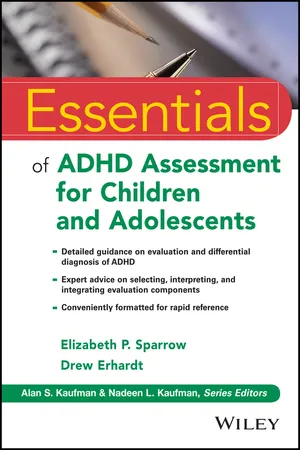
A comprehensive approach to accurate ADHD diagnosis
In Essentials of ADHD Assessment in Children and Adolescents, the authors provide a clear and informative road map for practitioners seeking to conduct state-of-the-art assessments for one of the most common disorders of childhood. Drawing upon years of experience in conducting diagnostic evaluations of ADHD following best-practice standards, they emphasize the importance of a comprehensive evaluation, incorporating data from multiple sources, using multiple methods, and interpreting findings within the appropriate developmental and cultural contexts. The major components of an ADHD evaluation (interviews, rating scales, cognitive testing, observation, record review) are reviewed in detail.
Expert guidance is provided for resolving the most common challenges in assessing ADHD, including differentiating symptoms from normal development, dealing with discrepant data, differential diagnosis, and considering comorbidity. The latest scholarly literature is integrated with the authors' practical recommendations to provide clinicians with the concepts and tools needed for effective and accurate assessment of ADHD, addressing such topics as:
When inattention is ADHD, and when it may be emotional or neurological
Which disorders may masquerade as or present with ADHD
The elements of accurate ADHD testing and the reasons behind them
Integrating results of a multi-modal approach into an ADHD assessment
An indispensable professional resource for practicing clinicians, Essentials of ADHD Assessment for Children and Adolescents is a reader-friendly guide to providing a thorough, responsible ADHD evaluation.
Attention-deficit/hyperactivity disorder (ADHD) is a common neurodevelopmental condition marked by developmentally inappropriate levels of inattention, and/or impulsivity and hyperactivity that often significantly impair functioning across multiple domains and place children at elevated risk for a variety of adverse outcomes. It is important for clinicians who work with youth to possess a basic understanding of ADHD as it is one of the most frequently diagnosed disorders of childhood and among the most common reasons for child mental health referrals in both community and school settings. However, ADHD is frequently misunderstood even by mental health professionals. This is due in part to the confusing array of labels by which it is known, misinformation disseminated through the popular press, social media, and on the web, and to the complex, heterogeneous, and highly variable nature of the disorder itself.
Fortunately, ADHD has been subject to an enormous amount of scientific research (viz. more than 10,000 journal articles and over 100 textbooks) (Barkley, 2013). As a result, we know more about ADHD than any other mental health disorder beginning in childhood. The purpose of this chapter is to provide a brief but informative overview of ADHD, including current scientific knowledge. (Numerous resources exist for readers interested in more detailed descriptions of ADHD; see, for example, Barkley, 2006; DuPaul & Kern, 2011; Evans & Hoza, 2011; Goldstein & DeVries, 2011; Hinshaw & Scheffler, 2013; Jensen & Cooper, 2002). After a short summary of the history of ADHD, the chapter addresses core and associated features of the disorder, common comorbidities, etiology, and epidemiology. Although this book focuses on ADHD in children and adolescents, there is a growing body of literature about ADHD in adults (e.g., see Barkley, Murphy, & Fischer, 2008; Goldstein & Ellison, 2002; Surman, 2013; Weiss, Hechtman, & Weiss, 1999).
Historical Perspective
ADHD has a long and somewhat controversial history (historical landmarks are summarized in Rapid Reference 1.1; for detailed accounts, see Antshel & Barkley, 2011; Taylor, 2011). Early clinical descriptions of the disorder, dating back over 200 years, came from physicians on the basis of children seen in their practices. These took numerous forms, ranging from book chapters (Weikard in 1775; see Barkley & Peters, 2012) and lengthy tomes (Crichton, 1798, 2008), to lectures (Still, 1902) and doggerel poems (Hoffmann's verses, “Fidgety Philip” and “Johnny Head-In-Air”; Hoffmann, 1844; English edition in 1848). Although the inclusion of inattentive, hyperactive, and impulsive symptoms has been relatively constant across clinical and scientific descriptions of the disorder over time, conceptualizations have evolved considerably with respect to presumed defining features, diagnostic labels, etiologic theories, and practice standards for assessment and treatment.
Figure 1.1 Excerpt from “The Story of Fidgety Philip,” a cautionary poem about hyperactivity from the 1840s
Source: Hoffmann, 1844.
Figure 1.2 Excerpt from “The Story of Johnny Head-in-Air,” an 1840s poem about pervasive inattention
Source: Hoffmann, 1844.
Early descriptions of ADHD often included inattention, but focused on hyperactivity as the core feature of the disorder. However, studies from Virginia Douglas' lab in the late 1960s and 1970s firmly reinstated the importance of deficits in sustained attention and impulse control in descriptions of the syndrome (Douglas, 1972, 1976). Influenced largely by this research, deficits in sustained attention rather than overactivity came to be viewed as central to the disorder by the early 1980s (American Psychiatric Association, 1980). Over recent decades, a neuroscience perspective has been applied to examining difficulties with motivation, response to reinforcement, inhibition, and executive functions as possible core problems underlying ADHD (Barkley, 1997; Brown, 2013; Castellanos, Sonuga-Barke, Milham, & Tannock, 2006; Nigg, 2013a; Nigg & Casey, 2005; Sagvolden, Aase, Zeiner, & Berger, 1998; Schachar, Tannock, & Logan, 1993).
Similarly, presumptions about the causes of ADHD have changed considerably over time, reflecting both research findings and prevailing scientific paradigms used to explain cognitive and behavioral functioning (Conners & Erhardt, 1998). Early views centering on defective “moral control” and presumed brain damage along with later environmental theories highlighting diet and child-rearing gradually gave way to more biologically based and data-driven explanations. At various times, research investigations have focused on psychophysiology, motivational deficits, neurotransmitter deficiencies, neuropsychological functioning, and genetic factors. More recently, studies employing increasingly rigorous and sophisticated methods (including brain imaging techniques) have elucidated potential structural and functional neurological bases for ADHD and illuminated how genetically based risk might interact with or be triggered by various environmental factors (e.g., pre- or post-natal environmental toxins such as alcohol, nicotine, and pesticides) to culminate in the self-regulation problems characteristic of ADHD (see the section on etiology below).
Rapid Reference 1.1
Historical Landmarks Related to ADHD in Children and Adolescents
1775—Weikard's medical text has a chapter about “Attention Deficit,” including his recommendations for treatment.
1798—Crichton writes about disordered attention.
1840s—Hoffmann, a German physician, composes moralistic verses for his young son, including characters with features of hyperactivity and inattention.
1902—Still describes patients with features of impulsivity and short attention span as suffering from an “abnormal defect of moral control…without general impairment of intellect and without physical disease.”
1937—Bradley documents benefits of the stimulant Benzedrine (dextroamphetamine sulfate) for children with behavior disorders, marking the beginning of pharmacotherapy for this population.
1950s—Stimulants begin to be used regularly to treat hyperactivity.
1955—FDA approves methylphenidate (Ritalin) for treatment of hyperactivity.
1963—65—Eisenberg publishes studies documenting benefits of stimulant medication in treating hyperkinesis, in comparison to placebo and traditional psychotherapy.
1969—Conners develops the first structured parent and teacher rating scales to reliably assess ADHD symptoms and treatment response.
1970s—Various environmental factors (e.g., food additives, societal tempo, poor parenting) proposed as causes of ADHD; stimulants emerge as treatment of choice for ADHD symptoms; efficacy studies support the use of behavioral treatment, via classroom-based modification and parent training, contributing to the emergence of combined treatments; studies by Douglas contribute to shifting view of attention deficits (rather than hyperactivity) as the defining feature of the disorder.
1975—Public Law 94-142 mandates special education services for children with behavioral (as well as other) disabilities, though exclusion of terms specific to hyperactivity/ADD/ADHD would result in services being denied to many with ADHD.
1980s—Broadband and ADD-specific standardized rating scales published; computerized tests of attention developed; non-stimulants investigated for treatment of ADHD.
1986—Seminal longitudinal study by Weiss & Hechtman demonstrates the persistence of inattention and impulsivity past childhood despite declines in hyperactivity, undermining the view that adolescents “outgrow” the disorder.
1987—Children and Adults with Attention-Deficit/Hyperactivity Disorder (CHADD) founded; this information, support, and advocacy group would play an important role in psychoeducation and in securing access to special education services for youth with ADHD.
1990—1991—Children with ADHD granted eligibili...
Table of contents
Cover
Essentials of Psychological Assessment Series
Title Page
Copyright
Dedication
Foreword
Series Preface
Preface
Acknowledgments
Chapter One: Understanding ADHD
Chapter Two: What the DSM-5 Says About ADHD
Chapter Three: Assessing ADHD: Goals and Guiding Principles
Chapter Four: Components of ADHD Assessment
Chapter Five: Putting it All Together
Chapter Six: Illustrative Case Reports
Annotated Bibliography
About the Authors
Index
End User License Agreement
Trusted by 375,005 students
Access to over 1.5 million titles for a fair monthly price.
Study more efficiently using our study tools.
Frequently asked questions
Yes, you can cancel anytime from the Subscription tab in your account settings on the Perlego website. Your subscription will stay active until the end of your current billing period. Learn how to cancel your subscription
No, books cannot be downloaded as external files, such as PDFs, for use outside of Perlego. However, you can download books within the Perlego app for offline reading on mobile or tablet. Learn how to download books offline
Perlego offers two plans: Essential and Complete
Essential is ideal for learners and professionals who enjoy exploring a wide range of subjects. Access the Essential Library with 800,000+ trusted titles and best-sellers across business, personal growth, and the humanities. Includes unlimited reading time and Standard Read Aloud voice.
Complete: Perfect for advanced learners and researchers needing full, unrestricted access. Unlock 1.5M+ books across hundreds of subjects, including academic and specialized titles. The Complete Plan also includes advanced features like Premium Read Aloud and Research Assistant.
Both plans are available with monthly, semester, or annual billing cycles.
We are an online textbook subscription service, where you can get access to an entire online library for less than the price of a single book per month. With over 1.5 million books across 990+ topics, we’ve got you covered! Learn about our mission
Look out for the read-aloud symbol on your next book to see if you can listen to it. The read-aloud tool reads text aloud for you, highlighting the text as it is being read. You can pause it, speed it up and slow it down. Learn more about Read Aloud
Yes! You can use the Perlego app on both iOS and Android devices to read anytime, anywhere — even offline. Perfect for commutes or when you’re on the go. Please note we cannot support devices running on iOS 13 and Android 7 or earlier. Learn more about using the app
Yes, you can access Essentials of ADHD Assessment for Children and Adolescents by Elizabeth P. Sparrow,Drew Erhardt, Alan S. Kaufman, Nadeen L. Kaufman, Alan S. Kaufman,Nadeen L. Kaufman in PDF and/or ePUB format, as well as other popular books in Psychology & Research & Methodology in Psychology. We have over 1.5 million books available in our catalogue for you to explore.