- Features a unique step-by-step method that can be applied to any research project
- Includes research insights from professionals, along with review exercises, insiders' tips and tools, search screen images utilized by students, and more
- Encourages active inquiry-based learning through the inclusion of various study questions and exercises
- Provides students with effective research strategies to serve them through their academic years and professional careers
- Ensures accessibility and a strong instructional approach due to authorship by a librarian and award-winning English professor
- English
- ePUB (mobile friendly)
- Available on iOS & Android
eBook - ePub
Introduction to Information Literacy for Students
About this book
Introduction to Information Literacy for Students presents a concise, practical guide to navigating information in the digital age.
Information
Part I
The Method
1
Think Like a Detective
Chapter Summary
Prepare to become a master of information, the most powerful tool on earth. In this chapter, we welcome you to the two sides of the “information conversation”: hearing and making yourself heard. We will make the case for both information literacy—the ability to find, evaluate, and use information—and research, a kind of detective work that can be every bit as fascinating and exciting as the investigations we love to watch on television and in movie theaters.
Key Terms: research, information literacy, text, visual literacy, media literacy, academic libraries, librarian
Chapter Objectives
- Describe the role of information and research in the “Information Age.”
- Identify the various components of information literacy and their connection to academic research.
- Describe other literacies that are important for carrying out academic research.
- Explain the connection between academic research and libraries.
Information: The Key to Just about Everything
When you hear the word information, what comes to mind? Thrills and chills? Success and failure? Life and death? Consider the following:
- The FBI, CIA, and other law-enforcement agencies employ thousands of experts who put their information skills to work to track down missing persons, abducted children, and criminal suspects.
- Coaches of college and professional teams depend on information—about their own players’ strengths and weaknesses, as well as the assets and liabilities of their opponents—to win games.
- Before a film's release, researchers behind the scenes deploy their information skills to discover details—of explosives, fashion, language, and more—that will make the movie pop on the silver screen.
Every field—including the one you will choose if you pursue a career—thrives on information, and the people who can find, evaluate, and use it are the ones who will make the difference between success and failure, victory and defeat, even life and death.
This book can help you make a difference. By giving you the knowledge, strategies, and tools you need to master information, it will empower you to solve crimes, win games, make movies, whatever you want to do. You will learn the valuable skill (and fascinating endeavor) of research, a process that all of the occupations mentioned above—and hundreds of others—use to find answers to questions. Along the way, you will learn how to mine sources for clues, follow leads, conduct interviews, collect and manage various kinds of intelligence, and turn it into the kind of knowledge that can move people, organizations, and whole nations. In short, you will learn to deploy information, the most powerful tool in the world, to do great things.
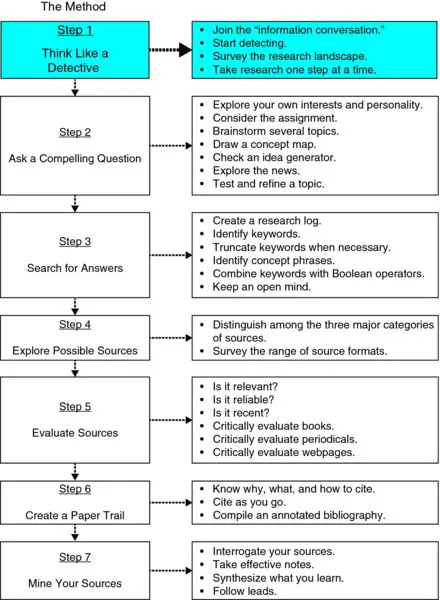
In this chapter, we will help you master the first step, which is to adopt a research mindset:
- Join the “information conversation.”
- Start detecting.
- Survey the research landscape, particularly libraries and the online world.
- Take research one step at a time.
Now let's begin by bringing you into the information conversation.
Insider's Tip: Winners Use Research
Research is vitally important for any professional coach. I have spent many hours researching opponents’ tendencies so I can give my players the best chance to compete. I study the kind of defenses these opponents play throughout the game or what offensive sets they are going to run, and I use statistics to establish which opposing players are very good shooters and which ones aren't. This kind of research is invaluable for my players. For example, it can assist them during the game if they know the player they are guarding is an effective outside shooter or not. We also watch film of opponents to get a sense of their strengths, weaknesses, and tendencies. Research also helps me set my lineups. For example, if I learn that an opponent tends to use a zone defense, I might favor players who are strong outside shooters.
Research helps me to understand my own players, too. I use statistics to gauge their success in various areas. This research starts at the beginning of the season and continues all the way until the end. By tracking the ebbs and flows of shooting percentage, free throw percentage, rebounds per game, deflections, and more throughout a season, I get a sense of where players need to improve and can, in turn, develop appropriate training regimens. For example, if statistics show that players are shooting poorly at the ends of games, I might incorporate certain kinds of conditioning and shooting drills into practice.
Finally, research is a tool for skill improvement in general. When I coach youth players, I look for challenging, enjoyable drills that develop fundamentals. I often develop my own drills, but I also spend a lot of time researching drills that other coaches have used and found effective.
–Mike Oppland, professional basketball player (Black Star Mersch, Luxembourg) and youth basketball coach
Join the Information Conversation
You probably have heard the expression “There's no sense in reinventing the wheel.” Over the thousands of years humans have been on earth, they have figured out a few things, from how to build a fire to how to put satellites into space and use them to track people on the ground. Thanks to the ancient Greek philosopher and mathematician Pythagoras, we can calculate the length of the hypotenuse of a right triangle if we know the lengths of the other two sides. Biologist James Watson and physicist Francis Crick discovered the structure of DNA. Others, through their own research, have revolutionized the way we think about economics, education, psychology, and other fields.
Imagine what life would be like if we lost all of this information. We would have to, well, reinvent the wheel—as well as the telephone, the airplane, the computer, and millions of other devices. We also would have to recount, recalculate, reimagine everything humans have ever known. All this re-ing would take a lot of time and energy, and we might not get everything right this time. When people begin to plan a job or design a product or complete any other complex task without first determining what already is known about it, they are putting themselves in a similar position, setting themselves up to waste time and energy and possibly fail because they don't have the information that others already have discovered or developed. They are, essentially, working in an empty room instead of one filled with knowledgeable experts.
Successful people know better. Rather than going it alone, they get in on the exchange of information that goes on every hour of every day. Some people call it the “information conversation.” Imagine a gigantic room filled with people—professors, lab researchers, doctors, engineers, athletes and coaches, journalists, politicians, police officers, parents, people with every kind of degree and job and personal experience—all talking, sharing what they know about history, science, medicine, technology, sports, news, politics, crime, children, and hundreds of other subjects. You could learn a lot in this room, couldn't you? Gatherings like this one—but on a smaller scale and on a narrower group of subjects—actually occur frequently and go by the name of conferences. Thanks to all the forms of communication we have, though, we don't need to be in the same room to exchange facts and ideas. The information conversation can take place around the clock in the form of email, social media posts, Tweets, blogs and vlogs, YouTube videos, podcasts, newspaper and magazine articles, books, radio talk shows, television documentaries, and dozens of other forms of communication.
Science, politics, sports, and all those other subjects are complex. Sometimes the experts in the room can provide clear answers, but sometimes they don't know the answers, and sometimes they don't agree about the answers. Let's face it: information, though crucial, is not always a definite quantity. Ever since Sigmund Freud invented modern psychology, various scientists have offered different theories for human thought and behavior. Interpreters of art, music, sculpture, and literature regularly offer different ways of understanding these forms of expression. Even science and mathematics, sometimes thought of as disciplines where there are “right” and “wrong” answers and less room for interpretation, have any number of ways of approaching or explaining the same phenomena. In all of these fields and others, theories and interpretations abound, sometimes merely ...
Table of contents
- Cover
- Title Page
- Copyright
- Dedication
- Preface
- Acknowledgments
- Flowchart
- Part I: The Method
- Part II: Types of Sources
- Glossary
- Index
- EULA
Trusted by 375,005 students
Access to over 1.5 million titles for a fair monthly price.
Study more efficiently using our study tools.
Frequently asked questions
Yes, you can cancel anytime from the Subscription tab in your account settings on the Perlego website. Your subscription will stay active until the end of your current billing period. Learn how to cancel your subscription
No, books cannot be downloaded as external files, such as PDFs, for use outside of Perlego. However, you can download books within the Perlego app for offline reading on mobile or tablet. Learn how to download books offline
Perlego offers two plans: Essential and Complete
- Essential is ideal for learners and professionals who enjoy exploring a wide range of subjects. Access the Essential Library with 800,000+ trusted titles and best-sellers across business, personal growth, and the humanities. Includes unlimited reading time and Standard Read Aloud voice.
- Complete: Perfect for advanced learners and researchers needing full, unrestricted access. Unlock 1.5M+ books across hundreds of subjects, including academic and specialized titles. The Complete Plan also includes advanced features like Premium Read Aloud and Research Assistant.
We are an online textbook subscription service, where you can get access to an entire online library for less than the price of a single book per month. With over 1.5 million books across 990+ topics, we’ve got you covered! Learn about our mission
Look out for the read-aloud symbol on your next book to see if you can listen to it. The read-aloud tool reads text aloud for you, highlighting the text as it is being read. You can pause it, speed it up and slow it down. Learn more about Read Aloud
Yes! You can use the Perlego app on both iOS and Android devices to read anytime, anywhere — even offline. Perfect for commutes or when you’re on the go.
Please note we cannot support devices running on iOS 13 and Android 7 or earlier. Learn more about using the app
Please note we cannot support devices running on iOS 13 and Android 7 or earlier. Learn more about using the app
Yes, you can access Introduction to Information Literacy for Students by Michael C. Alewine,Mark Canada in PDF and/or ePUB format, as well as other popular books in Social Sciences & Social Science Research & Methodology. We have over 1.5 million books available in our catalogue for you to explore.