The Economics of Electricity Markets
eBook - ePub

The Economics of Electricity Markets

  1. English
  2. ePUB (mobile friendly)
  3. Available on iOS & Android
eBook - ePub

The Economics of Electricity Markets

About this book

Bridges the knowledge gap between engineering and economics in a complex and evolving deregulated electricity industry, enabling readers to understand, operate, plan and design a modern power system

With an accessible and progressive style written in straight-forward language, this book covers everything an engineer or economist needs to know to understand, operate within, plan and design an effective liberalized electricity industry, thus serving as both a useful teaching text and a valuable reference. The book focuses on principles and theory which are independent of any one market design. It outlines where the theory is not implemented in practice, perhaps due to other over-riding concerns. The book covers the basic modelling of electricity markets, including the impact of uncertainty (an integral part of generation investment decisions and transmission cost-benefit analysis). It draws out the parallels to the Nordpool market (an important point of reference for Europe). Written from the perspective of the policy-maker, the first part provides the introductory background knowledge required. This includes an understanding of basic economics concepts such as supply and demand, monopoly, market power and marginal cost. The second part of the book asks how a set of generation, load, and transmission resources should be efficiently operated, and the third part focuses on the generation investment decision. Part 4 addresses the question of the management of risk and Part 5 discusses the question of market power. Any power system must be operated at all times in a manner which can accommodate the next potential contingency. This demands responses by generators and loads on a very short timeframe. Part 6 of the book addresses the question of dispatch in the very short run, introducing the distinction between preventive and corrective actions and why preventive actions are sometimes required. The seventh part deals with pricing issues that arise under a regionally-priced market, such as the Australian NEM. This section introduces the notion of regions and interconnectors and how to formulate constraints for the correct pricing outcomes (the issue of "constraint orientation"). Part 8 addresses the fundamental and difficult issue of efficient transmission investment, and finally Part 9 covers issues that arise in the retail market.

  • Bridges the gap between engineering and economics in electricity, covering both the economics and engineering knowledge needed to accurately understand, plan and develop the electricity market
  • Comprehensive coverage of all the key topics in the economics of electricity markets
  • Covers the latest research and policy issues as well as description of the fundamental concepts and principles that can be applied across all markets globally
  • Numerous worked examples and end-of-chapter problems
  • Companion website holding solutions to problems set out in the book, also the relevant simulation (GAMS) codes
Frequently asked questions

Yes, you can cancel anytime from the Subscription tab in your account settings on the Perlego website. Your subscription will stay active until the end of your current billing period. Learn how to cancel your subscription.
At the moment all of our mobile-responsive ePub books are available to download via the app. Most of our PDFs are also available to download and we're working on making the final remaining ones downloadable now. Learn more here.
Perlego offers two plans: Essential and Complete
  • Essential is ideal for learners and professionals who enjoy exploring a wide range of subjects. Access the Essential Library with 800,000+ trusted titles and best-sellers across business, personal growth, and the humanities. Includes unlimited reading time and Standard Read Aloud voice.
  • Complete: Perfect for advanced learners and researchers needing full, unrestricted access. Unlock 1.4M+ books across hundreds of subjects, including academic and specialized titles. The Complete Plan also includes advanced features like Premium Read Aloud and Research Assistant.
Both plans are available with monthly, semester, or annual billing cycles.
We are an online textbook subscription service, where you can get access to an entire online library for less than the price of a single book per month. With over 1 million books across 1000+ topics, weโ€™ve got you covered! Learn more here.
Look out for the read-aloud symbol on your next book to see if you can listen to it. The read-aloud tool reads text aloud for you, highlighting the text as it is being read. You can pause it, speed it up and slow it down. Learn more here.
Yes! You can use the Perlego app on both iOS or Android devices to read anytime, anywhere โ€” even offline. Perfect for commutes or when youโ€™re on the go.
Please note we cannot support devices running on iOS 13 and Android 7 or earlier. Learn more about using the app.
Yes, you can access The Economics of Electricity Markets by Darryl R. Biggar,Mohammad Reza Hesamzadeh in PDF and/or ePUB format, as well as other popular books in Physical Sciences & Energy. We have over one million books available in our catalogue for you to explore.

Information

Year
2014
Print ISBN
9781118775752
eBook ISBN
9781118775721
Edition
1
Subtopic
Energy

Part I
Introduction to Economic Concepts

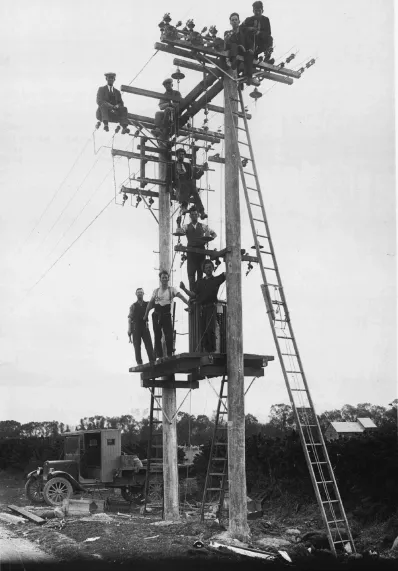
Picture taken sometime back in the year 1925 in New Zealand. Nine persons standing at different levels of a pole-mounted transformer substation construction site.
Construction of a pole-mounted transformer substation, Waitaki Electric Power Board, New Zealand, ca 1925 (Source: Neil Rennie, Power to The People: 100 Years of Public Electricity Supply in New Zealand, Electricity Supply Association of New Zealand)

1
Introduction to Micro-economics

This book is about the economics of electricity markets. It is therefore essential that the reader understands a number of basic concepts in economics. Much of the material here can be found in introductory textbooks in economics. However, we hope that setting out this material at the start of this textbook will assist readers who do not have a background in economics.
Readers who have a background in economics may choose to skip this part. However, this presentation probably contains some new material, even for readers familiar with economics. In addition, we introduce notation and a few key ideas which are used throughout the rest of the book. We recommend at least a review of this material.

1.1 Economic Objectives

Economics is the study of the production, consumption, and exchange of goods and services in an economy โ€“ including how production, consumption, and exchange are organised, how information flows and how participants are rewarded and incentivised for playing their part. Economics seeks to both create theories which explain the patterns of behaviour and organisation that we see in the real world (so-called positive theories), and to develop policies and proposals for changing the arrangements that exist in the real world (normative theories).
But, if we are to recommend changes to existing arrangements, we need a commonly agreed set of objectives that we are trying to achieve. In our view, this common set of objectives must relate, in some way, to a common vision of the overall economic welfare of the society or economy as a whole.
There may be many different ways of articulating the overall economic welfare of a society or economy, if such a thing exists at all. It may never be possible to get consensus over whether or not some alternative state of the world, B, is preferred to the status quo, A. Economists tend to focus on areas where, in principle, there could be consensus โ€“ that is, situations where, in principle, every member of society could agree that B is preferred over A. These tend to be situations where there is what might be described as waste or inefficiency โ€“ where we could reorganise things so that we could achieve the same outcomes with fewer resources, or achieve better outcomes with the same resources. If these situations exist we could, in principle, leave everyone better off.
Although there is some variation in economic theory, in practice most public policy economists make certain assumptions which simplify the task of determining the total economic welfare. Chief amongst these is the assumption that we can ignore income effects. In effect, this means that the benefit of an additional dollar to me is about the same as the benefit to any other member of the society. This assumption rules out the possibility of deriving any benefit from income redistribution alone. Alternatively, we can imagine that such income redistribution has already occurred through some other mechanism.
If we make this assumption, for any public policy change we can envisage, we can value the benefits and the costs imposed using a simple monetary metric. The change in economic welfare brought about by the public policy change is the simple sum of the monetised benefits and costs. An arrangement which maximises the economic benefits less the costs is said to be efficient. This is the usual meaning of the term economic efficiency in public policy analysis.
This notion of economic efficiency does not incorporate everything which the broader public might consider important. In particular, it does not usually directly deal with controversial questions about how income should be distributed in the economy. Neither does it normally directly address questions of fairness or equity.1 Nevertheless, this notion of economic efficiency captures important, and broadly acceptable, notions of social welfare, and for most economists represents a legitimate g...

Table of contents

  1. Cover
  2. Title Page
  3. Copyright
  4. Preface
  5. Nomenclature
  6. Part I: Introduction to Economic Concepts
  7. Part II: Introduction to Electricity Networks and Electricity Markets
  8. Part III: Optimal Dispatch: The Efficient Use of Generation, Consumption and Network Resources
  9. Part IV: Efficient Investment in Generation and Consumption Assets
  10. Part V: Handling Contingencies: Efficient Dispatch in the Very Short Run
  11. Part VI: Managing Risk
  12. Part VII: Market Power
  13. Part VIII: Network Regulation and Investment
  14. Part IX: Contemporary Issues
  15. References
  16. Index
  17. End User License Agreement