Family Relationships and Parenting
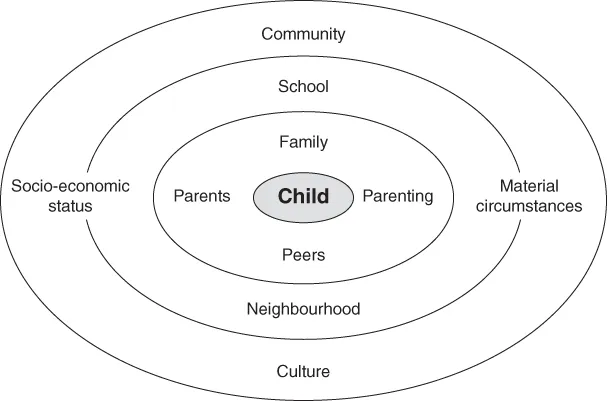
Family relationships are complex: each dyadic relationship is affected by other relationships in the family system, and children influence, as well as being influenced by, those around them [2]. Even very young infants affect interactions with their caregivers, and variations in children's temperamental styles continue to evoke differing responses from carers at older ages. In part, variations of this kind reflect children's inherited characteristics; indeed, many aspects of family relationships and functioning once thought to be purely ‘environmental’ in origin are now known to reflect elements of ‘nature’ as well as ‘nurture’. Children play an active part in shaping the environments they experience; their genetic make‐up also affects individual differences in sensitivity to environmental influences, contributing to both resilience and vulnerability to stress [3].
Families are biologically and culturally evolved to promote children's development [4]. Some of the earliest steps in those processes – pre‐ and postnatal influences on neurobiological regulation, and early attachment relationships – are discussed in other chapters. But family relationships and parenting show ongoing links with the development of children's behavioural control and with the regulation of their attentional, arousal and emotional systems throughout childhood. In addition, parents contribute to children's cognitive development, socialize them into culturally appropriate patterns of behaviour and promote their understanding of moral values and the development of their talents. Parents also select and secure children's access to key resources beyond the family system.
Successful parenting involves numerous skills and capacities, varying with the age of the child, with culture and with social context. Underlying this diversity, most models of parenting highlight two central dimensions, one related to parental involvement and responsiveness (encompassing warmth, availability, positive engagement and support), the second centring on ‘demandingness’ or behavioural control, and incorporating monitoring, expectations and behaviour management. Combinations of these dimensions have been used to characterize four general styles of parenting [5].
- Indulgent (responsive but not demanding) – parents are non‐traditional and lenient, allow considerable self‐regulation, and avoid confrontation.
- Authoritarian (demanding but not responsive) – parents are obedience‐ and status‐oriented, and expect orders to be obeyed without explanation.
- Authoritative (both demanding and responsive) – parents are assertive, but not intrusive or restrictive. Disciplinary methods are supportive rather than punitive. Children are expected to be assertive as well as socially responsible, self‐regulated as well as cooperative.
- Uninvolved (both unresponsive and undemanding) – most parenting of this type falls within the normal range, but in extreme cases it might encompass both rejecting–neglecting and neglectful parenting.
Comparisons across these styles consistently highlight authoritative parenting as associated with more positive child outcomes in a range of domains: self‐discipline, emotional self‐control, positive peer relationships and school performance.
When children are under stress, family life can provide compensatory experiences. Cohesion and warmth within the family, the presence of a good relationship with one parent, close sibling relationships and effective parental monitoring are all known to represent protective influences of this kind. Finally, when parenting is compromised, risks of emotional and behavioural difficulties increase. Problems in four broad aspects of family relationships and parenting seem most important here:
- Discordant/dysfunctional relationships between parents, or in the family system as a whole
- Hostile or rejecting parent‐child relationships, or those markedly lacking in warmth
- Harsh or inconsistent discipline
- Ineffective monitoring and supervision
Many family‐based interventions and parenting programmes are designed to target difficulties of these kinds.
Parent and Family Characteristics
Some parent and family characteristics show systematic links with children's risk of emotional and behavioural problems. Parents' own mental health is among the most important of these. In part, such associations reflect heritable influences; in part, they are also likely to index the effects of parents' mental health on family relationships and parenting. Mothers who are depressed, for example, are known to be less sensitive and responsive to their infants, and attend less, and respond more negatively, to older children [6]. Alcohol and drug abuse and major mental disorders in parents may impair parenting in more wide‐ranging ways. When parents are antisocial, effects may also be mediated through the endorsement of antisocial attitudes and social learning.
Sibling Relationships
Sibling relationships form a further key part of the family system for many children. The dynamics of sibling relationships show transactional links with relationships in other family subsystems and with aspects of parenting. Harsh and authoritarian parenting, for example, is associated with more conflictual relationships among siblings, while sibling conflict can constitute a major stressor for parents [7].
Bonds between siblings are intimate and often emotionally intense. Consequently, their potential for influencing children's trajectories is strong. Warm sibling relationships facilitate the development of social understanding [8] and are protective when families are under stress. Sibling conflict, by contrast, can compromise both emotional and behavioural development [9]. Evidence now suggests that up to 40% of children are bullied by their siblings, and that this intra‐familial aggression can increase risks of being bullied outside the family [10]. In adolescence, siblings often show similar levels of problem behaviours such as delinquency and substance use. In part, these similarities are likely to reflect broader family‐based processes; in part, they appear to reflect direct facilitation and ‘deviancy training’ by siblings. For all of these reasons, a focus on siblings is increasingly recommended as one element in therapeutic work with children and families.
Changing Family Patterns
Recent decades have seen major changes in patterns of family formation, stability and complexity in many western societies [11,12]. Families are formed later, and are smaller, than in the past. Fewer parents now marry and there is more divorce, meaning that many children face transitions in their family lives. Parental separation can be followed by periods in single‐parent households, and later by the establishment of new step‐families. In addition, increasing numbers of children are now conceived following the use of new reproductive technologies, and more are growing up with same‐sex parents – factors that have been examined for their potential to influence children's development. On average, children in single‐parent and step‐families show somewhat higher levels of emotional and behavioural difficulties than those in stable two‐parent homes. [13,14]. Typically, however, these differences are modest and there is much variation within as well as between family types. Importantly, associations between the quality of mother–child relationships and children's adjustment are similar across family settings. Additionally, single‐parent and reconstituted families often face economic and other stresses and may lack social and family supports. Taking these variations into account, research indicates that family type per se shows few consistent links with children's adjustment. Similar conclusions emerge from studies of ‘non‐traditional’ family forms: children's adjustment typically reflects the quality of family relationships and the well‐being of family members to a much greater degree than variations in family structure [15,16].
Parental Separation and Divorce
When parents separate, most children show so...