The novel insights, as well as the main drawbacks of each engineered composites material is extensively evaluated taking into account the strong relationship between packaging materials, environmental and reusability concerns, food quality, and nutritional value.
Composites, by matching the properties of different components, allow the development of innovative and performing strategies for intelligent food packaging, thus overcoming the limitations of using only a single material.
The book starts with the description of montmorillonite and halloysite composites, subsequently moving to metal-based materials with special emphasis on silver, zinc, silicium and iron. After the discussion about how the biological influences of such materials can affect the performance of packaging, the investigation of superior properties of sp2 carbon nanostructures is reported. Here, carbon nanotubes and graphene are described as starting points for the preparation of highly engineered composites able to promote the enhancement of shelf-life by virtue of their mechanical and electrical features.
Finally, in the effort to find innovative composites, the applicability of biodegradable materials from both natural (e.g. cellulose) and synthetic (e.g. polylactic acid – PLA) origins, with the aim to prove that polymer-based materials can overcome some key limitations such as environmental impact and waste disposal.
This chapter includes the recent trends in using montmorillonite (MMT)-based composite materials for food packaging applications. MMT is a naturally available phyllosilicate material that belongs to the group of smectites. Over the last few decades, it has found applications in many areas of nanotechnology such as catalysis, adsorption, and filtration. In recent years, it has also generated a wide range of applications in the food packaging industry. MMT has been used as an ideal nanofiller for polymer and biopolymer plastics, which leads to polymer and biopolymer nanocomposite films for food packaging with enhanced thermal and barrier properties. Incorporation of ions such as Ag+, Cu2+, and Zn2+ in clay platelets leads to nanocomposites with enhanced antimicrobial activity. Additionally, many strategies have been developed for immobilization of oxides, enzymes, essential oils, and other bioactive compounds in these platelets. This feature makes the MMT-based composite materials promising nanocarriers for smart and active packaging applications.
The word “nano” comes from the Greek for “dwarf” and denotes nanometer (10–9 m) [1]. The concept of nanotechnology was introduced by Richard Feynman in 1959 and the National Nanotechnology Initiative (Arlington, VA, USA), and involves the characterization, fabrication, and/or manipulation of structures, devices, or materials that have at least one dimension (or contain components with at least one dimension) that is approximately 1–100 nm in length. When particle size is reduced below this threshold, the resulting material exhibits physical and chemical properties that are significantly different from the properties of macroscale materials composed of the same substance [2]. Despite an explosion of growth in the area of nanotechnology, food nanotechnology is still a lesser known subfield of the greater nanotechnology spectrum, even among professional nanotechnologists. Potential uses of food nanotechnology include: (i) pesticide, fertilizer, or vaccine delivery; animal and plant pathogen detection; and targeted genetic engineering for agriculture, (ii) encapsulation of flavor or odor enhancers; food textural or quality improvement; new gelation or viscosifying agents for food processing, (iii) nutraceuticals with higher stability and bioavailability for nutrient supplements and (iv) pathogen, gas, or abuse sensors; anticounterfeiting devices; UV-protection and stronger more impermeable, antimicrobial, and antioxidant polymer films for food packaging. In order to enhance mechanical, barrier, antimicrobial, and antioxidant properties and to introduce sensor and UV protection ability in polymer and/or biopolymer films, various inorganic nanostructured materials [1] have been used including TiO2, ZnO nanoparticles, SiO2, carbon nanotubes, and nanoclays.
Nanoclays gathered the attention of the food packaging industry, due to their availability, low cost, significant enhancements, and relatively simple processability [1]. Clays and clay minerals belong to the phyllosilicate group (from the Greek “phyllon”: leaf, and from the Latin “silic”: flint). Clay minerals, that is, layered aluminum silicates, are the most abundant minerals of sedimentation basins (both marine and continental), weathering crusts, and soils [3]. Clay minerals are characterized by two-dimensional sheets of corner sharing SiO4 tetrahedra and/or AlO4 octahedra. The sheet units have the chemical composition (Al,Si)3O4. Each silica tetrahedron shares three of its vertex oxygen atoms with other tetrahedra forming a hexagonal array in two dimensions. The fourth vertex is not shared with another tetrahedron and all of the tetrahedra “point” in the same direction; that is, all of the unshared vertices are on the same side of the sheet. In clays, the tetrahedral sheets are always bonded to octahedral sheets formed from small cations, such as aluminum or magnesium, and coordinated by six oxygen atoms. The unshared vertex from the tetrahedral sheet also forms part of one side of the octahedral sheet, but an additional oxygen atom is located above the gap in the tetrahedral sheet at the center of the six tetrahedra. This oxygen atom is bonded to a hydrogen atom forming an OH group in the clay structure. Clays can be categorized depending on the way that tetrahedral and octahedral sheets are packaged into layers. If there is only one tetrahedral and one octahedral group in each layer, the clay is known as a 1:1 clay. The alternative, known as a 2:1 clay, has two tetrahedral sheets with the unshared vertex of each sheet pointing toward each other and forming each side of the octahedral sheet. The most representative 2:1 clay mineral is bentonite that consists of 90% wt. montmorillonite (MMT) and is a weathering product of volcanic glass.
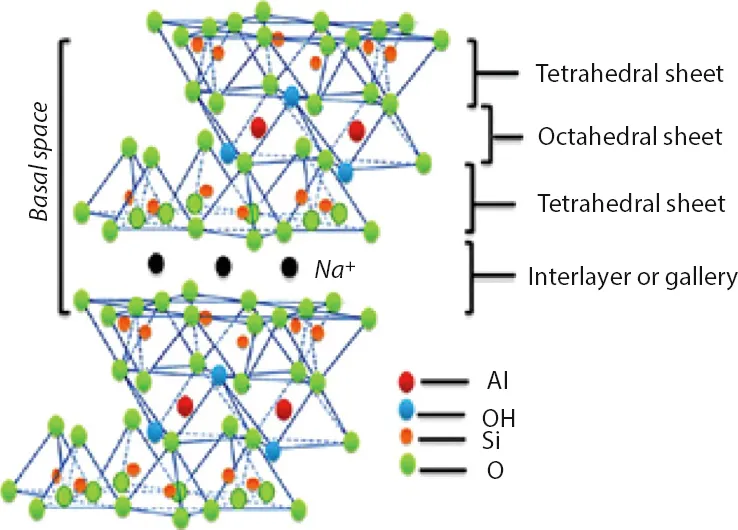
The structural unit of MMT consists of two tetrahedral sheets that cover one octahedral sheet in between (Figure 1.1). This micaceous clay structure has oxide anions at the tip of the tetrahedral subunits that are oriented toward silicone atoms, which are frequently substituted by aluminum, iron, and cations. However, the octahedral subunits contain aluminum ions that are substituted by silicon ions and surround the hydroxyl atoms present at the axial end of tetrahedral [3–5] planes. The MMT [(Na,Ca)0.33 (Al, Mg)2(Si4 O10)(OH)2•nH2O] surface is slightly negatively charged because oxide anions dominate the charge-balancing anions (Si4+, Al3+, Fe2+, Fe3+, Mg2+) present in the interface and impart as light overall negative charge to the surfaces of the sheets clay minerals. The MMT particles are plate-shaped, typically 1 nm in thickness and 0.2–2 microns in diameter [6]. MMT has an excellent sorption property and possesses sorption sites available within its inter-layer space as well as on the outer surface and edges. Depending on the place of origin, MMT contains variable amounts of sodium and calcium along with water for hydration. Sodium montmorillonite (Na-MMT) hydrates more than calcium montmorillonite (Ca-MMT). Cation exchange capacity (cmol/kg), specific surface area (m2/g), and basal interlayer spacing are maximum for MMT compared to other clays such as illite, kaolinite, and muscovite-type layered silicate [6].
Figure 1.1 Structure of Montmorillonite (available online).
Most polymers are considered to be organophilic compounds. In order to render the layered silicates miscible with nonpolar polymers, one must exchange the alkali counter-ions with a cationic–organic surfactant [1, 7, 8]. Alkylammonium ions are mostly used, although other “onium” salts can be used, such as sulfonium and phosphonium. Surfactants can also be used to improve the dispersability of the clay. The surfactants were able to increase spacing between clay layers (d-spacing) to different extents, depending on the number of polar units in the copolymer molecule. The resulting clays are called organomodified layered silicates (OMLS) and in the case of montmorillonite, they are abbreviated as OMMT (organically modified MMT). Organoclays are cheaper than most other nanomaterials, since they come from readily available natural sources and are produced in existing, full-scale production facilities [8]. In Table 1.1, the most cited commercial OMMT are mentioned.
Table 1.1 Chemical composition of the main commercial montmorillonite cited.
Quaternary ammonium salt (MT2EtOH) 90 meq/100 g clay
Cloisites 20A
Modified MMT
Quaternary ammonium salt (2M2HT) 95 meq/100 g clay
Cloisites 93A
Modified MMT
Ternary ammonium salt (M2HT) 90 meq/100 g clay
Cloisites 15A
Modified MMT
Quaternary ammonium salt (2M2HT) 125 meq/100 g clay
Cloisites 10A
Modified MMT
Quaternary ammonium salt (2MBHT) 125 meq/100 g clay
Clay1
Modified MMT
Quaternary ammonium salt (HDTA)6-fold the CEC of raw clay (raw clay with a cation exchange capacity (CEC)¼ 92.6 meq/100 g clay)
Clay2
Modified MMT
Quaternary ammonium salt (HDTAϸACO)HDTA in 5.75-fold and ACO in 0.25-fold of the CEC of raw clay (92.6 meq/100 g clay)
Oligo(styrene-co-acrylonitrile) MMT
Modified MMT
Quaternary ammonium salt of poly(styrene-co-acrylonitrile)(CEC¼ 0.9 meg/g clay)
The main advantages of MMT and OMMT nanoclays that make them ideal nanostructures for food packaging applications are as follows: (i) because of its hydrophil...
Table of contents
Cover
Title page
Copyright page
Preface
Chapter 1: Montmorillonite Composite Materials and Food Packaging
Chapter 2: Halloysite Containing Composites for Food Packaging Applications
Chapter 3: Silver Composite Materials and Food Packaging
Chapter 4: Zinc Composite Materials and Food Packaging
Chapter 5: Silicium-Based Nanocomposite Materials for Food Packaging Applications
Chapter 6: Nanoiron-Based Composite Oxygen Scavengers for Food Packaging
Chapter 7: Carbon Nanotubes (CNTs) Composite Materials and Food Packaging
Chapter 8: Polymer/Graphene Nanocomposites for Food Packaging
Chapter 9: Biodegradability and Compostability of Food Nanopackaging Materials
Chapter 10: Nanocellulose in Food Packaging
Chapter 11: Nanocellulose in Combination with Inorganic/Organic Biocides for Food Film Packaging Applications – Safety Issues Review
Chapter 12: Composite Materials Based on PLA and its Applications in Food Packaging
Chapter 13: Nanomaterial Migration from Composites into Food Matrices
Index
End User License Agreement
Trusted by 375,005 students
Access to over 1.5 million titles for a fair monthly price.
Study more efficiently using our study tools.
Frequently asked questions
Yes, you can cancel anytime from the Subscription tab in your account settings on the Perlego website. Your subscription will stay active until the end of your current billing period. Learn how to cancel your subscription
No, books cannot be downloaded as external files, such as PDFs, for use outside of Perlego. However, you can download books within the Perlego app for offline reading on mobile or tablet. Learn how to download books offline
Perlego offers two plans: Essential and Complete
Essential is ideal for learners and professionals who enjoy exploring a wide range of subjects. Access the Essential Library with 800,000+ trusted titles and best-sellers across business, personal growth, and the humanities. Includes unlimited reading time and Standard Read Aloud voice.
Complete: Perfect for advanced learners and researchers needing full, unrestricted access. Unlock 1.5M+ books across hundreds of subjects, including academic and specialized titles. The Complete Plan also includes advanced features like Premium Read Aloud and Research Assistant.
Both plans are available with monthly, semester, or annual billing cycles.
We are an online textbook subscription service, where you can get access to an entire online library for less than the price of a single book per month. With over 1.5 million books across 990+ topics, we’ve got you covered! Learn about our mission
Look out for the read-aloud symbol on your next book to see if you can listen to it. The read-aloud tool reads text aloud for you, highlighting the text as it is being read. You can pause it, speed it up and slow it down. Learn more about Read Aloud
Yes! You can use the Perlego app on both iOS and Android devices to read anytime, anywhere — even offline. Perfect for commutes or when you’re on the go. Please note we cannot support devices running on iOS 13 and Android 7 or earlier. Learn more about using the app
Yes, you can access Composites Materials for Food Packaging by Giuseppe Cirillo, Marek A. Kozlowski, Umile Gianfranco Spizzirri, Giuseppe Cirillo,Marek A. Kozlowski,Umile Gianfranco Spizzirri in PDF and/or ePUB format, as well as other popular books in Technology & Engineering & Food Science. We have over 1.5 million books available in our catalogue for you to explore.