The first stand-alone textbook for at least ten years on this increasingly hot topic in times of global climate change and sustainability in ecosystems.
Ecological biochemistry refers to the interaction of organisms with their abiotic environment and other organisms by chemical means. Biotic and abiotic factors determine the biochemical flexibility of organisms, which otherwise easily adapt to environmental changes by altering their metabolism. Sessile plants, in particular, have evolved intricate biochemical response mechanisms to fit into a changing environment. This book covers the chemistry behind these interactions, bottom up from the atomic to the system's level.
An introductory part explains the physico-chemical basis and biochemical roots of living cells, leading to secondary metabolites as crucial bridges between organisms and the respective ecosystem. The focus then shifts to the biochemical interactions of plants, fungi and bacteria within terrestrial and aquatic ecosystems with the aim of linking biochemical insights to ecological research, also in human-influenced habitats.
A section is devoted to methodology, which allows network-based analyses of molecular processes underlying systems phenomena.
A companion website offering an extended version of the introductory chapter on Basic Biochemical Roots is available at http://www.wiley.com/go/Krauss/Nies/EcologicalBiochemistry
A thorough presentation of the basics needed to access “Ecological Biochemistry” can be found on the companion website (see URL above). The following pages give you an idea of what exactly can be looked up on this website and at the same time reproduce the most important basics-summarizing figures often referred to in the rest of the book.
1.1 Chemistry and Physics of Life
How does life function? Chapter S1 defines “life” as a thermodynamic process, following Erwin Schrödingers' famous lecture “what is life?” delivered at Trinity College, Dublin, in February 1943. Thermodynamics, entropy, and negentropy (= order) and how a living cell manages to form “order” despite the three basic laws of thermodynamics are explained. This chapter defines life as an energy-transducing process exerted by enclosed reaction compartments (= cells). From this, maintenance energy, the allochthonous and autochthonous modes of microbial life, and the processes evolution, mutation, and selection are derived. Generating negentropy in living cells means formation of macromolecules, and the four major groups of cellular macromolecules are introduced. Major and minor bioelements are listed and their bioavailability connected to the generation of elements in stars. This leads also to water as the optimum solvent for the cellular biochemistry (See also Chapter 10) and to the necessity of a semipermeable membrane surrounding living cells (Figure 1.1).
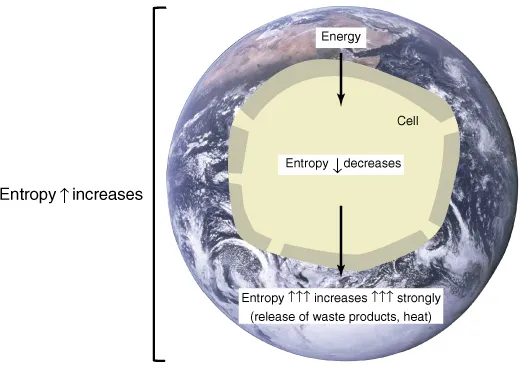
Figure 1.1What is Life? To built order inside, cells continuously use energy to decrease the intracellular entropy (or increase the intracellular negentropy = order) and overcompensate this by increasing the entropy in the environment by release of waste products and heat. Thus, in the total system composed of a cell and its environment, the entropy increases steadily during the chemical reactions in a cell, and the second law of thermodynamics is kept. Energy can be light energy or chemical energy (see Section 1.2). Intracellular order means macromolecules. (Earth photo: Courtesy of NASA.)
The second section of Chapter S1 introduces how a living cell functions in general. In the liquid phase of a solvent, most likely water, a cell represents a separated system that continuously uses energy from the outside to increase its negentropy inside by the synthesis of carbon-based macromolecules, thereby overcompensating the decrease in entropy inside by a higher increase in entropy outside. Further sections of this chapter show how this can be accomplished.
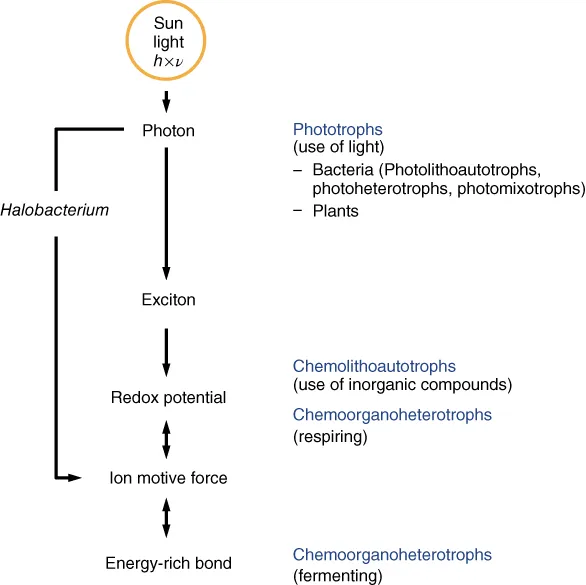
The chapter starts with the explanation of the lowest systems level of interest for biologists, the atoms, electrons, and photons and continues with the basic modes of energy conservation. Atoms, orbitals, and the consequences of the structure of the electron shells for the chemical features of the elements, redox energy, and electronegativity are explained in depth. Atoms form molecules at the next systems level and new features emerge by this process, which can nevertheless be deduced from the electron structure of the involved atoms. This is also true for the most important functional groups of the building blocks of the macromolecules. Which energy sources can be used by cells and how the energy from photons can be harvested and ultimately converted to an ion gradient across a biological membrane, leading to the phototrophic life style are explained (Figure 1.2).
Figure 1.2The universal roadmap of energy conservation. Phototrophs use light energy (photons) to create an exciton that is subsequently used to change the redox potential of a redox carrier to a lower potential (= higher energy). Electron transport from the resulting low redox potential to a more positive one drives ion transport to form an ion motive force, mostly in form of a proton motive force pmf. Finally, the ion motive force is used to generate compounds containing an energy-rich bond such as ATP. In a short cut, some archaea such as Halobacterium use a protein named bacteriorhodopsin to create an ion motive force directly from an exciton. Chemolithoautotrophic (cla) bacteria use the difference in redox potential of inorganic compounds to conserve energy, respiring chemoorganoheterotrophic (coh) bacteria transfer electrons from organic compounds to external electron acceptors that are mostly also inorganic compounds. Fermenting organism are also chemoorganoheterotrophs that use biochemical reactions for a direct formation of energy-rich bonds. Some phototrophs can grow photolithoautotrophically (pla), other photoheterotrophically (ph) or photomixotrophically (pm). Please note that energy-rich bonds can also be used to build an ion motive force, for example, for transport processes, and an ion motive force to drive electrons toward a low redox potential (reverse electron transport.)
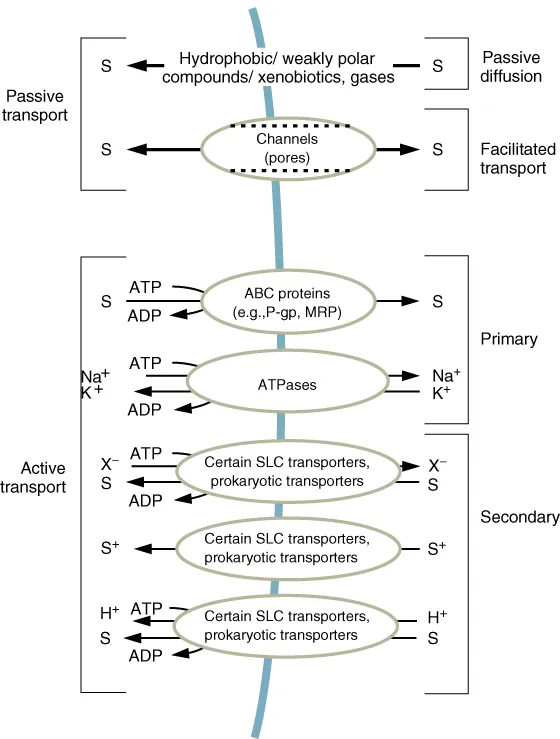
Transport processes change chemical gradients across biological membranes and these processes are categorized in a strict hierarchical manner (Figure 1.3), which leads also to the introduction of ion motive forces such as the proton motive force, and to the chemolithoautrophic and respiring chemoorganoheterotrophic life styles (Figure 1.2).
Figure 1.3Hierarchy of transport processes and examples.
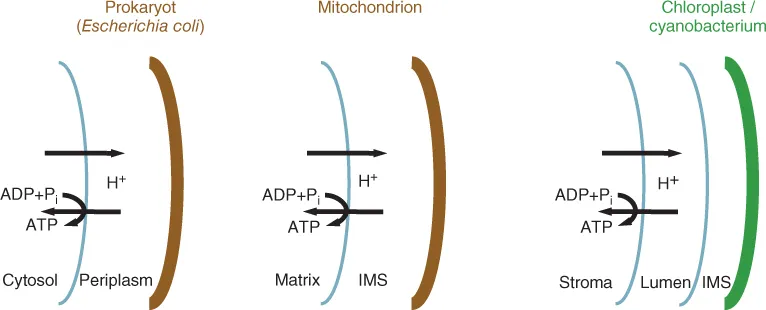
The important F1F0-ATPase is needed to connect the short-termed energy pool of the proton motive force to the medium-termed energy pool of ATP and related compounds, and consequently the structure and function of this ATPase is outlined (Figure 1.4). The fourth and last life style explained here is chemoorganoheterotrophic fermentation. In total, the basic modes of energy transformation in living beings are outlined and transport processes across biological membranes are explained in a thorough hierarchical scheme.
Figure 1.4Topology of ATP synthesis in bacteria and plant cell organelles (IMS – Intermembrane space; Lumen – Thylakoid lumen). (Graphics: D.Dobritzsch, G.-J. Krauss.)
Important terms explained: acid anhydride group, acidocalcisomes, active transport, alcohol group, aldose, amide group, amine group, amino acid, amino sugar, antiport, Archaea, atom, atomic number, autotroph, bacteriorhodopsin, carbohydrate, carbonyl group, carboxyl group, charge transfer complex, chemotrophs, Chlorobiaceae, Chloroflexaceae, chlorophyll, chloroplast, Chromatiaceae, color, conjugated double bonds, cyanobacteria, diffusion (facilitated, simple), DNA, electron, pair, electron acceptor, electron donor, electronegativity, electrons (delocalized, valence), energy (concentration, conformational, light, redox), energy pool (short-termed, long-termed, medium-termed), entropy, ester group, exciton, fatty acid, fermentation, frontier orbital gap, γ-rays, glutathione, glycerol, halobacteria, he...
Table of contents
Cover
Related Titles
Title Page
Copyright
Dedication
List of Contributors
Foreword
Preface
Companion Website
Part I: Basics of Life
Part II: Ecological Signatures of Life
Part III: Biochemical Response to Physiochemical Stress (Abiotic Stress)
Part IV: Organismal Interactions (Biotic Stress)
Part V: The Methodological Platform
Glossary
Index
End User License Agreement
Trusted by 375,005 students
Access to over 1.5 million titles for a fair monthly price.
Study more efficiently using our study tools.
Frequently asked questions
Yes, you can cancel anytime from the Subscription tab in your account settings on the Perlego website. Your subscription will stay active until the end of your current billing period. Learn how to cancel your subscription
No, books cannot be downloaded as external files, such as PDFs, for use outside of Perlego. However, you can download books within the Perlego app for offline reading on mobile or tablet. Learn how to download books offline
We are an online textbook subscription service, where you can get access to an entire online library for less than the price of a single book per month. With over 1.5 million books across 990+ topics, we’ve got you covered! Learn about our mission
Look out for the read-aloud symbol on your next book to see if you can listen to it. The read-aloud tool reads text aloud for you, highlighting the text as it is being read. You can pause it, speed it up and slow it down. Learn more about Read Aloud
Yes! You can use the Perlego app on both iOS and Android devices to read anytime, anywhere — even offline. Perfect for commutes or when you’re on the go. Please note we cannot support devices running on iOS 13 and Android 7 or earlier. Learn more about using the app
Yes, you can access Ecological Biochemistry by Gerd-Joachim Krauss,Dietrich H. Nies in PDF and/or ePUB format, as well as other popular books in Scienze biologiche & Biotecnologia. We have over 1.5 million books available in our catalogue for you to explore.