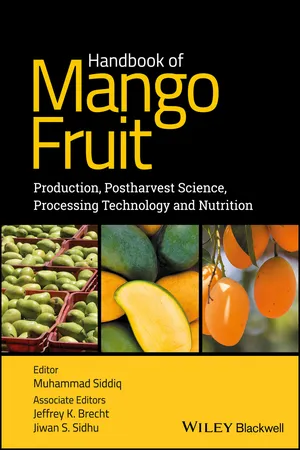
Handbook of Mango Fruit
eBook - ePub

Handbook of Mango Fruit

Production, Postharvest Science, Processing Technology and Nutrition

  1. English
  2. ePUB (mobile friendly)
  3. Available on iOS & Android
eBook - ePub

Handbook of Mango Fruit

Production, Postharvest Science, Processing Technology and Nutrition

About this book

Written by noted experts in the field, Handbook of Mango Fruit: Production, Postharvest Science, Processing Technology and Nutrition offers a comprehensive resource regarding the production, trade, and consumption of this popular tropical fruit. The authors review the geographic areas where the fruit is grown and harvested, including information on the ever-expanding global marketplace that highlights United States production, imports and exports, and consumption, as well as data on the outlook for the European market. 

Handbook of Mango Fruit outlines the postharvest handling and packaging techniques and reviews the fruit's processed products and byproducts that are gleaned from the processing of waste. The authors include information on the nutritional profile of the mango and review the food safety considerations for processing and transport of mangoes. This comprehensive resource: 

  • Reviews global mango production trends and countries that are the major exporters and importers of mangoes
  • Explores the burgeoning marketplace for mangoes with special emphasis on the US and European marketplace
  • Assesses latest trends in packaging of and shipping of mangoes
  • Provides in depth coverage on value-added processing and by-products utilization
  • Offers vital information on the innovative processing technologies and nutritional profile of popular tropical fruit

Written for anyone involved in the production, marketing, postharvest handling, processing and by-products of mangoes, Handbook of Mango Fruit is a vital resource offering the most current information and guidelines on the burgeoning marketplace as well as the safe handling, production, and distribution of mangoes.
Frequently asked questions

Yes, you can cancel anytime from the Subscription tab in your account settings on the Perlego website. Your subscription will stay active until the end of your current billing period. Learn how to cancel your subscription.
No, books cannot be downloaded as external files, such as PDFs, for use outside of Perlego. However, you can download books within the Perlego app for offline reading on mobile or tablet. Learn more here.
Perlego offers two plans: Essential and Complete
  • Essential is ideal for learners and professionals who enjoy exploring a wide range of subjects. Access the Essential Library with 800,000+ trusted titles and best-sellers across business, personal growth, and the humanities. Includes unlimited reading time and Standard Read Aloud voice.
  • Complete: Perfect for advanced learners and researchers needing full, unrestricted access. Unlock 1.4M+ books across hundreds of subjects, including academic and specialized titles. The Complete Plan also includes advanced features like Premium Read Aloud and Research Assistant.
Both plans are available with monthly, semester, or annual billing cycles.
We are an online textbook subscription service, where you can get access to an entire online library for less than the price of a single book per month. With over 1 million books across 1000+ topics, we’ve got you covered! Learn more here.
Look out for the read-aloud symbol on your next book to see if you can listen to it. The read-aloud tool reads text aloud for you, highlighting the text as it is being read. You can pause it, speed it up and slow it down. Learn more here.
Yes! You can use the Perlego app on both iOS or Android devices to read anytime, anywhere — even offline. Perfect for commutes or when you’re on the go.
Please note we cannot support devices running on iOS 13 and Android 7 or earlier. Learn more about using the app.
Yes, you can access Handbook of Mango Fruit by Muhammad Siddiq in PDF and/or ePUB format, as well as other popular books in Technology & Engineering & Food Science. We have over one million books available in our catalogue for you to explore.

Chapter 1
Mango Production, Global Trade, Consumption Trends, and Postharvest Processing and Nutrition

Edward A. Evans1, Fredy H. Ballen1 and Muhammad Siddiq2
1Center for Tropical Agriculture, University of Florida, IFAS, Homestead, Florida, USA
2Department of Food Science and Human Nutrition, Michigan State University, East Lansing, Michigan,, USA

1.1 Introduction

In terms of production, mangoes, pineapples, papayas, and avocados are considered the major tropical fruits, while lychees, durian, rambutan, guavas, and passion fruits are among the minor ones. Out of global production of the major tropical fruits, mangoes accounted for more than half of the total production in 2012, followed at a distance by pineapples, papayas, and avocados, with shares of 28.36, 15.08, and 5.33%, respectively (FAO 2015). It is to be noted that the FAO reports mango, mangosteen, and guava production and trade as one aggregated category. There are over a thousand different varieties of mangoes, giving rise to various shapes, sizes, colors, texture, and nutritional properties. The fruit is considered to be one of the most consumed fresh fruits in the world, with production taking place in more than 100 countries. However, despite its nutritional value, popularity in developed countries, and tremendous potential for export revenues in many developing countries, only a relatively small portion of the produce enters into international trade; the bulk of production is consumed in the producing country. In 2013, for example, less than 4% of global mango production reached international markets. The USA and Europe are the leading importers of mangoes and have shown steady increases in the volume of fruit absorbed over the past few years.
In recent years, since the mango fruit has made its way into mainstream market outlets in most of the developed countries and is available all year round, it is no longer classified as exotic. The year-round availability of the fruit is attributed to several factors. These include the fact that the fruit is grown under diverse climatic conditions, which allows harvesting throughout the year, and improvements in transportation, market access, preharvest production practices, and postharvest treatment allow the crop to be shipped over long distances, while remaining relatively free of pests and diseases. Demand for the fruit is also on the rise, as more health conscious consumers incorporate the fruit in their diet based on its nutritional value.
Although mangoes no longer command the high prices associated with exotic fruits and with its past scarcity on the international market, prices have not declined substantially. A likely explanation for the relative buoyancy of prices is due to promotional and consumer educational activities, which have had the effect of increasing the overall demand for the fruit despite increases in supply. Notwithstanding, prices of the fruit vary considerably depending on variety, source of origin, and time of the year.
This chapter gives an overview of mango fruit world production, exports, and imports, consumption trends, postharvest storage, processing, nutritional quality, and food safety aspects.

1.2 Mango Production, Trade, and Consumption

1.2.1 Area Harvested and World Production

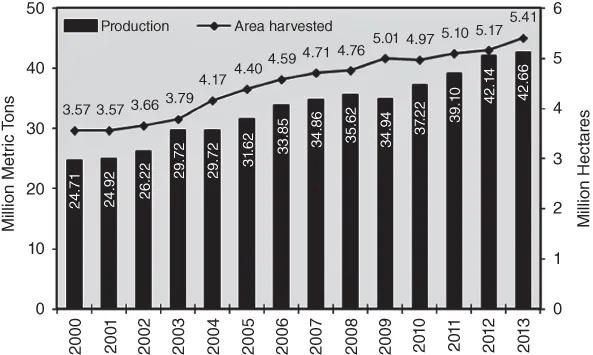
The global area of mangoes harvested in 2013 was 5.41 million hectares, an increase of about 52% as compared to that in 2000 (Figure 1.1). Given the expansion in the harvested area, global production of mangoes have also increased, growing from 24.71 million metric tons (MMT) in 2000 to 42.66 MMT in 2013, which represented an increase of about 73%. Since 2010, the area harvested and production have shown an increase of 8.95% and 14.62%, respectively. It is noted that the majority of the increase in production since 2010 has been due to corresponding increase in area harvested (52%) versus improvements in yield per unit area (14%).
Bar graph for World mango production and area harvested (2000-2013).
Figure 1.1 World mango production and area harvested (2000–2013).
Source: FAO (2015).
Mangoes are grown under very diverse climatic conditions, in tropical and subtropical regions. Asia is the dominant producing region, with over 77.17%, based...

Table of contents

  1. Cover
  2. Title Page
  3. Copyright
  4. Table of Contents
  5. Preface
  6. List of Contributors
  7. Chapter 1: Mango Production, Global Trade, Consumption Trends, and Postharvest Processing and Nutrition
  8. Chapter 2: Mango Production
  9. Chapter 3: Biology, Postharvest Physiology, and Biochemistry of Mango
  10. Chapter 4: Pests of Mango
  11. Chapter 5: Mango Pathology and Diseases
  12. Chapter 6: Harvesting and Postharvest Technology of Mango
  13. Chapter 7: Packaging of Fresh Mangoes and Processed Mango Products
  14. Chapter 8: Processing and Quality of Fresh-cut Mangoes
  15. Chapter 9: Innovative Processing Technologies for Mango Products
  16. Chapter 10: Mango Processing and Processed Products
  17. Chapter 11: Composition and Nutritional Properties of Mangoes
  18. Chapter 12: Phytochemical Compounds in Functional Properties of Mangoes
  19. Chapter 13: Microbiology of Fresh Mangoes and Processed Products
  20. Chapter 14: Value-added Processing and Utilization of Mango By-products
  21. Index
  22. End User License Agreement