Covering the core concepts, activities and approaches involved in medical education, Medical Education at a Glance provides a concise, accessible introduction to this rapidly expanding area of study and practice.
This brand new title from the best-selling at a Glance series covers the range of essential medical education topics which students, trainees, new lecturers and clinical teachers need to know. Written by an experienced author team, Medical Education at a Glance is structured under the major themes of the discipline including teaching skills, learning theory,and assessment, making it an easy-to-digest guide to the practical skills and theory of medical education, teaching and learning.
Medical Education at a Glance:
Presents core information in a highly visual way, with key concepts and terminology explained.
Is a useful companion to the Association for the Study of Medical Education's (ASME) book Understanding Medical Education.
Covers a wide range of topics and themes.
Is a perfect guide for teaching and learning in both the classroom and clinical setting.
Medical education draws from a range of disciplines to design and deliver programmes, and engage in research with a common goal of ensuring doctors are caring, competent and safe to practice
It is jointly delivered by universities and healthcare providers
Medical educators need to be aware of global trends and issues and challenges arising from both the education and healthcare sectors
Table 1.1 Issues in international higher education and health care
Issues in higher education
Issues in health care
‘Massification' (huge growth) of university-based education
Demand for healthcare practitioners outstripping supply
Impact of learning technologies (e.g. simulation, mobile learning)
Impact of technologies (e.g. remote monitoring of conditions, telemedicine)
Student/learner expectations
Patient expectations
Cost of delivery
Workforce maldistribution
Preparing for employability in a changing, global environment
Increase in non-communicable disease, pandemics, antimicrobial resistance
Internationalisation – threats from the global market
Community/primary care emphasis
Equality and diversity of staff and students, including unequal access and outcomes
Inequalities of health access and outcome within and between countries
Regulation and quality control of education
Environmental threats
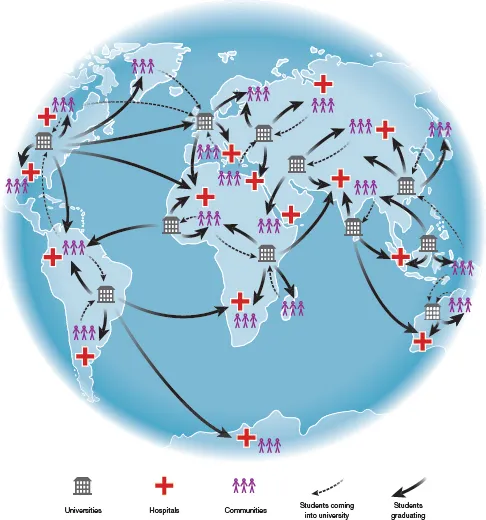
Figure 1.1 Medical education: a global movement
Medical education is ‘the process of teaching, learning and training of students with an ongoing integration of knowledge, experience, skills, qualities, responsibility and values which qualify an individual to practice medicine. It is divided into undergraduate, postgraduate and continuing medical education, but increasingly there is a focus on the “lifelong” nature of medical education.' (IIME, 2016).
Medical education has evolved over the last century to become a discrete educational field of study, which has shaped not only the way doctors are educated and trained but has also influenced wider education. Prior to the Flexner Report (Flexner, 1910), medical education was undertaken on an apprenticeship model, and it was usually the most privileged and wealthy who had access to such training. The Flexner Report recommended that the American and Canadian medical school system be transformed to one which provided university education in the basic medical sciences and also trained students in the workplace to be practising clinicians. Since then, around the world, basic (undergraduate or prequalifying) medical education has moved into universities, and medical education at all stages has become ever more tightly controlled and regulated.
Professionals who are involved in the education of students, doctors in training and qualified practitioners are termed medical educators. Medical educators come from a range of backgrounds: education, other health professions and the social and behavioural sciences, as well as from the biomedical sciences and medical specialties (i.e. practising clinicians). Doctors' world views and paradigms have traditionally reflected positivism, the scientific method and the pragmatism of the real world. This is both a strength and a weakness: a strength in that it can bring scientific rigour to research, and engagement in everyday clinical practice brings authenticity to teaching, learning and practice-based research; a weakness in that ‘medical education is about people and the way we think, act and interact in the world. Medical education research is not a poor relation of medical research; it belongs to a different family altogether' (Monrouxe and Rees, 2009, p. 198).
Currently, a range of approaches in medical education practice and research exists – from social, behavioural and management sciences, and the humanities as well as from more traditional disciplines. This has led to a richness and diversity of activities and outcomes, which utilise different approaches from other subject disciplines (particularly school and adult education) to explore what works, why and how? in the real world. For example, situational, experiential and outcomes-based education are derived from general education; and patient safety and simulation education was extended and adapted from work done in the airline and nuclear industry. And the ‘taken for granted' role of reflection in developing medical professionals drew heavily on Schön's (a philosopher) work on learning organisations and the reflective practitioner (e.g. Schön, 1987). See later chapters.
Medical education also gives back to the wider education and health community through specific educational strategies and social accountability initiatives: the social good of Tan et al. (2011). For example, problem-based learning (PBL), developed at McMaster University, Canada in the 1960s, is now used in many educational sectors and the objective structured clinical examination or OSCE (Harden and Gleeson, 1979) is now widely used in veterinary and health professions' education.
...
Table of contents
Cover
QR code
Title page
Copyright
Preface
Acknowledgements
About the editors
Contributors
Part 1 Overview and broad concepts
Part 2 Medical education in practice
Part 3 Assessment and feedback
Further reading
References
Index
EULA
Trusted by 375,005 students
Access to over 1.5 million titles for a fair monthly price.
Study more efficiently using our study tools.
Frequently asked questions
Yes, you can cancel anytime from the Subscription tab in your account settings on the Perlego website. Your subscription will stay active until the end of your current billing period. Learn how to cancel your subscription
No, books cannot be downloaded as external files, such as PDFs, for use outside of Perlego. However, you can download books within the Perlego app for offline reading on mobile or tablet. Learn how to download books offline
Perlego offers two plans: Essential and Complete
Essential is ideal for learners and professionals who enjoy exploring a wide range of subjects. Access the Essential Library with 800,000+ trusted titles and best-sellers across business, personal growth, and the humanities. Includes unlimited reading time and Standard Read Aloud voice.
Complete: Perfect for advanced learners and researchers needing full, unrestricted access. Unlock 1.5M+ books across hundreds of subjects, including academic and specialized titles. The Complete Plan also includes advanced features like Premium Read Aloud and Research Assistant.
Both plans are available with monthly, semester, or annual billing cycles.
We are an online textbook subscription service, where you can get access to an entire online library for less than the price of a single book per month. With over 1.5 million books across 990+ topics, we’ve got you covered! Learn about our mission
Look out for the read-aloud symbol on your next book to see if you can listen to it. The read-aloud tool reads text aloud for you, highlighting the text as it is being read. You can pause it, speed it up and slow it down. Learn more about Read Aloud
Yes! You can use the Perlego app on both iOS and Android devices to read anytime, anywhere — even offline. Perfect for commutes or when you’re on the go. Please note we cannot support devices running on iOS 13 and Android 7 or earlier. Learn more about using the app
Yes, you can access Medical Education at a Glance by Judy McKimm, Kirsty Forrest, Jill Thistlethwaite, Judy McKimm,Kirsty Forrest,Jill Thistlethwaite in PDF and/or ePUB format, as well as other popular books in Medicine & Medical Education. We have over 1.5 million books available in our catalogue for you to explore.