Handbook of Road Ecology
eBook - ePub

Handbook of Road Ecology

  1. English
  2. ePUB (mobile friendly)
  3. Available on iOS & Android
eBook - ePub

About this book

Winner of the IENE Project Award 2016.

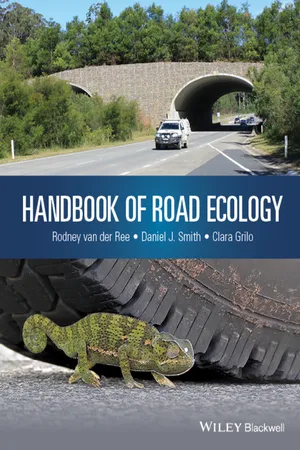
This authoritative volume brings together some of the world's leading researchers, academics, practitioners and transportation agency personnel to present the current status of the ecological sustainability of the linear infrastructure – primarily road, rail and utility easements – that dissect and fragment landscapes globally. It outlines the potential impacts, demonstrates how this infrastructure is being improved, and how broad ecological principles are applied to mitigate the impact of road networks on wildlife.

Research and monitoring is an important aspect of road ecology, encompassing all phases of a transportation project. This book covers research and monitoring to span the entire project continuum – starting with planning and design, through construction and into maintenance and management. It focuses on impacts and solutions for species groups and specific regions, with particular emphasis on the unique challenges facing Asia, South America and Africa.

Other key features:

  • Contributions from authors originating from over 25 countries, including from all continents
  • Each chapter summarizes important lessons, and includes lists of further reading and thoroughly up to date references
  • Highlights principles that address key points relevant to all phases in all road projects
  • Explains best-practices based on a number of successful international case studies
  • Chapters are "stand-alone", but they also build upon and complement each other; extensive cross-referencing directs the reader to relevant material elsewhere in the book

Handbook of Road Ecology offers a comprehensive summary of approximately 30 years of global efforts to quantify the impacts of roads and traffic and implement effective mitigation. As such, it is essential reading for those involved in the planning, design, assessment and construction of new roads; the management and maintenance of existing roads; and the modifying or retrofitting of existing roads and problem locations. This handbook is an accessible resource for both developed and developing countries, including government transportation agencies, Government environmental/conservation agencies, NGOs, and road funding and donor organisations.

Frequently asked questions

Yes, you can cancel anytime from the Subscription tab in your account settings on the Perlego website. Your subscription will stay active until the end of your current billing period. Learn how to cancel your subscription.
At the moment all of our mobile-responsive ePub books are available to download via the app. Most of our PDFs are also available to download and we're working on making the final remaining ones downloadable now. Learn more here.
Perlego offers two plans: Essential and Complete
  • Essential is ideal for learners and professionals who enjoy exploring a wide range of subjects. Access the Essential Library with 800,000+ trusted titles and best-sellers across business, personal growth, and the humanities. Includes unlimited reading time and Standard Read Aloud voice.
  • Complete: Perfect for advanced learners and researchers needing full, unrestricted access. Unlock 1.4M+ books across hundreds of subjects, including academic and specialized titles. The Complete Plan also includes advanced features like Premium Read Aloud and Research Assistant.
Both plans are available with monthly, semester, or annual billing cycles.
We are an online textbook subscription service, where you can get access to an entire online library for less than the price of a single book per month. With over 1 million books across 1000+ topics, we’ve got you covered! Learn more here.
Look out for the read-aloud symbol on your next book to see if you can listen to it. The read-aloud tool reads text aloud for you, highlighting the text as it is being read. You can pause it, speed it up and slow it down. Learn more here.
Yes! You can use the Perlego app on both iOS or Android devices to read anytime, anywhere — even offline. Perfect for commutes or when you’re on the go.
Please note we cannot support devices running on iOS 13 and Android 7 or earlier. Learn more about using the app.
Yes, you can access Handbook of Road Ecology by Rodney van der Ree,Daniel J. Smith,Clara Grilo in PDF and/or ePUB format, as well as other popular books in Biological Sciences & Ecology. We have over one million books available in our catalogue for you to explore.

Information

Table of contents

  1. COVER
  2. TITLE PAGE
  3. TABLE OF CONTENTS
  4. NOTES ON CONTRIBUTORS
  5. FOREWORD
  6. PREFACE
  7. ACKNOWLEDGEMENTS
  8. ABOUT THE COMPANION WEBSITE
  9. Chapter 1: THE ECOLOGICAL EFFECTS OF LINEAR INFRASTRUCTURE AND TRAFFIC: CHALLENGES AND OPPORTUNITIES OF RAPID GLOBAL GROWTH
  10. Chapter 2: BAD ROADS, GOOD ROADS
  11. Chapter 3: WHY KEEP AREAS ROAD-FREE? THE IMPORTANCE OF ROADLESS AREAS
  12. Chapter 4: INCORPORATING BIODIVERSITY ISSUES INTO ROAD DESIGN: THE ROAD AGENCY PERSPECTIVE
  13. Chapter 5: IMPROVING ENVIRONMENTAL IMPACT ASSESSMENT AND ROAD PLANNING AT THE LANDSCAPE SCALE
  14. Chapter 6: WHAT TRANSPORTATION AGENCIES NEED IN ENVIRONMENTAL IMPACT ASSESSMENTS AND OTHER REPORTS TO MINIMISE ECOLOGICAL IMPACTS
  15. Chapter 7: PRINCIPLES UNDERPINNING BIODIVERSITY OFFSETS AND GUIDANCE ON THEIR USE
  16. Chapter 8: CONSTRUCTION OF ROADS AND WILDLIFE MITIGATION MEASURES: PITFALLS AND OPPORTUNITIES
  17. Chapter 9: ENSURING THE COMPLETED ROAD PROJECT IS DESIGNED, BUILT AND OPERATED AS INTENDED
  18. Chapter 10: GOOD SCIENCE AND EXPERIMENTATION ARE NEEDED IN ROAD ECOLOGY
  19. Chapter 11: FIELD METHODS TO EVALUATE THE IMPACTS OF ROADS ON WILDLIFE
  20. Chapter 12: CASE STUDY: A ROBUST METHOD TO OBTAIN DEFENDABLE DATA ON WILDLIFE MORTALITY
  21. Chapter 13: ROAD–WILDLIFE MITIGATION PLANNING CAN BE IMPROVED BY IDENTIFYING THE PATTERNS AND PROCESSES ASSOCIATED WITH WILDLIFE-VEHICLE COLLISIONS
  22. Chapter 14: INCORPORATING LANDSCAPE GENETICS INTO ROAD ECOLOGY
  23. Chapter 15: GUIDELINES FOR EVALUATING USE OF WILDLIFE CROSSING STRUCTURES
  24. Chapter 16: GUIDELINES FOR EVALUATING THE EFFECTIVENESS OF ROAD MITIGATION MEASURES
  25. Chapter 17: HOW TO MAINTAIN SAFE AND EFFECTIVE MITIGATION MEASURES
  26. Chapter 18: UNDERSTANDING AND MITIGATING THE NEGATIVE EFFECTS OF ROAD LIGHTING ON ECOSYSTEMS
  27. Chapter 19: ECOLOGICAL IMPACTS OF ROAD NOISE AND OPTIONS FOR MITIGATION
  28. Chapter 20: FENCING: A VALUABLE TOOL FOR REDUCING WILDLIFE-VEHICLE COLLISIONS AND FUNNELLING FAUNA TO CROSSING STRUCTURES
  29. Chapter 21: WILDLIFE CROSSING STRUCTURES: AN EFFECTIVE STRATEGY TO RESTORE OR MAINTAIN WILDLIFE CONNECTIVITY ACROSS ROADS
  30. Chapter 22: RECREATIONAL CO-USE OF WILDLIFE CROSSING STRUCTURES
  31. Chapter 23: PREDATOR-PREY INTERACTIONS AT WILDLIFE CROSSING STRUCTURES: BETWEEN MYTH AND REALITY
  32. Chapter 24: WILDLIFE WARNING SIGNS AND ANIMAL DETECTION SYSTEMS AIMED AT REDUCING WILDLIFE-VEHICLE COLLISIONS
  33. Chapter 25: USE OF REFLECTORS AND AUDITORY DETERRENTS TO PREVENT WILDLIFE–VEHICLE COLLISIONS
  34. Chapter 26: ECOLOGICAL EFFECTS OF RAILWAYS ON WILDLIFE
  35. Chapter 27: IMPACTS OF UTILITY AND OTHER INDUSTRIAL LINEAR CORRIDORS ON WILDLIFE
  36. Chapter 28: THE IMPACTS OF ROADS AND TRAFFIC ON TERRESTRIAL ANIMAL POPULATIONS
  37. Chapter 29: INSECTS, SNAILS AND SPIDERS: THE ROLE OF INVERTEBRATES IN ROAD ECOLOGY
  38. Chapter 30: CASE STUDY: PROTECTING CHRISTMAS ISLAND’S ICONIC RED CRABS FROM VEHICLES
  39. Chapter 31: MAKING A SAFE LEAP FORWARD: MITIGATING ROAD IMPACTS ON AMPHIBIANS
  40. Chapter 32: REPTILES: OVERLOOKED BUT OFTEN AT RISK FROM ROADS
  41. Chapter 33: FLIGHT DOESN’T SOLVE EVERYTHING: MITIGATION OF ROAD IMPACTS ON BIRDS
  42. Chapter 34: BATS AND ROADS
  43. Chapter 35: CARNIVORES: STRUGGLING FOR SURVIVAL IN ROADED LANDSCAPES
  44. Chapter 36: CASE STUDY: ROADS AND JAGUARS IN THE MAYAN FORESTS
  45. Chapter 37: CASE STUDY: FINDING THE MIDDLE ROAD – GROUNDED APPROACHES TO MITIGATE HIGHWAY IMPACTS IN TIGER RESERVES
  46. Chapter 38: CASE STUDY: AFRICAN WILD DOGS AND THE FRAGMENTATION MENACE
  47. Chapter 39: ROADS, TRAFFIC AND VERGES: BIG PROBLEMS AND BIG OPPORTUNITIES FOR SMALL MAMMALS
  48. Chapter 40: REDUCING ROAD IMPACTS ON TREE-DWELLING ANIMALS
  49. Chapter 41: CASE STUDY: CANOPY BRIDGES FOR PRIMATE CONSERVATION
  50. Chapter 42: TRANSPORTATION AND LARGE HERBIVORES
  51. Chapter 43: CASE STUDYTHE MOUNT KENYA ELEPHANT CORRIDOR AND UNDERPASS
  52. Chapter 44: FORM AND FUNCTION: A MORE NATURAL APPROACH TO INFRASTRUCTURE, FISH AND STREAM HABITATS
  53. Chapter 45: SOLUTIONS TO THE IMPACTS OF ROADS AND OTHER BARRIERS ON FISH AND FISH HABITAT
  54. Chapter 46: THE FUNCTION AND MANAGEMENT OF ROADSIDE VEGETATION
  55. Chapter 47: ROADS IN THE ARID LANDS: ISSUES, CHALLENGES AND POTENTIAL SOLUTIONS
  56. Chapter 48: ROAD ECOLOGY IN AN URBANISING WORLD
  57. Chapter 49: TROPICAL ECOSYSTEM VULNERABILITY AND CLIMATIC CONDITIONS: PARTICULAR CHALLENGES FOR ROAD PLANNING, CONSTRUCTION AND MAINTENANCE
  58. Chapter 50: THE INFLUENCE OF ECONOMICS, POLITICS AND ENVIRONMENT ON ROAD ECOLOGY IN SOUTH AMERICA
  59. Chapter 51: HIGHWAY CONSTRUCTION AS A FORCE IN THE DESTRUCTION OF THE AMAZON FOREST
  60. Chapter 52: ROAD ECOLOGY IN SOUTH INDIA: ISSUES AND MITIGATION OPPORTUNITIES
  61. Chapter 53: PLANNING ROADS THROUGH SENSITIVE ASIAN LANDSCAPES: REGULATORY ISSUES, ECOLOGICAL IMPLICATIONS AND CHALLENGES FOR DECISION-MAKING
  62. Chapter 54: SETJHABA SA, SOUTH AFRIKA: A SOUTH AFRICAN PERSPECTIVE OF AN EMERGING TRANSPORT INFRASTRUCTURE
  63. Chapter 55: UNFENCED RESERVES, UNPARALLELED BIODIVERSITY AND A RAPIDLY CHANGING LANDSCAPE: ROADWAYS AND WILDLIFE IN EAST AFRICA
  64. Chapter 56: EXPECTED EFFECTS OF A ROAD ACROSS THE SERENGETI
  65. Chapter 57: CHINA: BUILDING AND MANAGING A MASSIVE ROAD AND RAIL NETWORK AND PROTECTING OUR RICH BIODIVERSITY
  66. Chapter 58: RAILWAYS, ROADS AND FENCES ACROSS KAZAKHSTAN AND MONGOLIA THREATEN THE SURVIVAL OF WIDE-RANGING WILDLIFE
  67. Chapter 59: BEST-PRACTICE GUIDELINES AND MANUALS
  68. Chapter 60: CASE STUDY: THE ROLE OF NON-GOVERNMENTAL ORGANISATIONS (NGOs) AND ADVOCATES IN REDUCING THE IMPACTS OF ROADS ON WILDLIFE
  69. Chapter 61: CASE STUDY: Building A COMMUNITY OF PRACTICE FOR ROAD ECOLOGY
  70. Chapter 62: WILDLIFE/ROADKILL OBSERVATION AND REPORTING SYSTEMS
  71. GLOSSARY
  72. SPECIES
  73. INDEX
  74. END USER LICENSE AGREEMENT