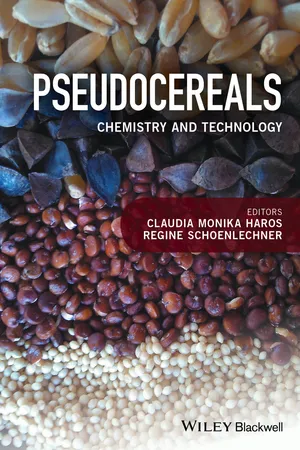
The aim of this book is to update knowledge and summarise recent research on pseudocereals, particularly regarding their botanical characteristics, composition, structure, use, production, technology and impact on human health. In the last few years, pseudocereals – in particular amaranth and quinoa – have acquired increased importance (which is also due to the increased demand for gluten]free food). Worldwide, the demand for amaranth and quinoa has risen immensely, as seen in rising prices for amaranth and quinoa. At the same time, research in all relevant fields has intensified.
At present there is some confusion surrounding the term 'pseudocereals' and what it does and does not include, for example kiwicha which is Amaranthus caudatus or kaniwa which is Chenopodium pallidicaule. Sometimes other grains are included in the pseudocereal group like chia (Salvia hispanica L), an oleaginous seed. One of the aims of the book is to clear up some of the confusion over what is included in the group of pseudocereals.
The book will include: the origin, production and utilization of pseudocereals; structure and composition of kernels; carbohydrates/fibre/bioactive compounds of kernels; proteins and amino acids of kernels; lipids of kernels; pseudocereal dry and wet milling: processes, products and applications; food uses of whole pseudocereals; pseudocereals in gluten free products; and the nutritional and health implications of pseudocereal intake.
eBook - ePub
Pseudocereals
Chemistry and Technology
- English
- ePUB (mobile friendly)
- Available on iOS & Android
eBook - ePub
Pseudocereals
Chemistry and Technology
About this book
Information
Chapter 1
Origin, Production and Utilization of Pseudocereals
Amanda Di Fabio1 and Gloria Parraga2
1School of Pharmacy and Biochemistry, Universidad Maza,, Guaymallén, Mendoza, , Argentina
2Agricultural Matters Division, Agricultural Department,, Salta, Capital City, Argentina
1.1 Quinoa – Chenopodium quinoa Willd (Amaranthaceae)
1.1.1 Introduction
The Andean region, an area inhabited originally by the Inca and Tiwanaku civilizations, is considered the centre of origin of Chenopodium quinoa Willd. Native to South America, it is an annual crop with several varieties and it was an important ingredient in the diet of many pre-Hispanic people. Traditional production areas are located in Peru – in Cajamarca, Callejón de Huaylas, Mantaro Valley, Andahuaylas, Cusco and Puno (high plateau); Bolivia – in the high plateau of La Paz, Oruro and Potosi and in the inter-Andean valleys of Cochabamba, Chuquisaca, Potosi and Tarija; and Argentina – in Jujuy, Salta and in the Calchaquí Valleys in Tucumán. It is also produced in Colombia, Ecuador and in the Chilean High Plateau (Barriga et al., 1994).
Given its agronomic versatility, quinoa could be produced in regions where the population has no access to other protein sources. The plant adapts well to different agro-ecological soils and climate zones and is a water-efficient crop; it survives under low soil-moisture conditions. The nutritional properties of this crop, the plant's possible uses and the fact that it provides an alternative solution to nutrition problems render quinoa production promising. Nowadays, quinoa is grown not only in the traditional production areas mentioned above but in the United States, Canada, Italy, France, England, Sweden, Denmark, the Netherlands and in Africa.
1.1.2 Origin and History
Archaeological findings show that quinoa was a species commonly used by the ancient Andean cultures. Fruiting branches and loose grain have been found in different regions of Peru and in the Arica coastal area (Chile). Seeds have been found in native burial sites in Chile – in Tarapacá, Calama and in the Calchaquí-Diaguite region. In the New Continent, the Spanish found colcas (warehouses) where the natives stored their food and large amounts of quinoa. Quinoa, as well as kañiwa (Chenopodium pallidicaule Aellen) and other edible plants such as kiwicha Amaranthus caudatus Linn, were largely consumed by the Andean inhabitants.
Heisser and Nelson (1974) pointed out that the archaeological findings in Peru and Argentina date back to the beginning of the Christian era. Accordingly, quinoa is one of the oldest crops in the Andean region, having been grown for approximately 7000 years (Jacobsen, 2013). The Tiahuanaku and Inca cultures played a major role in its domestication and preservation.
In 1586, Ulloa Mogollón mentioned the use of quinoa by the Collaguas in Bolivia. Quinoa was widely grown in the valleys in the north of Chile. In 1558, Cortés Hogea found quinoa crops in Chiloe Island. In 1583, Pedro Sotelo observed its existence in Argentina, in the Calchaquí Valley and in Córdoba (Tapia, 2013). Quinoa is a species with a wide-distribution multiple-diversification centre of origin. Its greater diversity and genetic variation took place on the shores of Lake Titicaca. According to Lescano (1994), today quinoa is distributed in the entire Andean region, from Colombia to the north of Argentina and Chile. A quinoa group was found in the region of Concepción, which is located at sea level. The geographical distribution of quinoa ranges from latitude 5° N in the South of Colombia to latitude 43° S in the IX Region of Chile, and from altitudes that go from sea level by the Chilean Sea up to 4000 m in the Peruvian and Bolivian High Plateau. The diversity of quinoa has been associated with five ecotypes: high plateau (Peru and Bolivia), inter-Andean valleys (Colombia, Ecuador and Peru), salt flats (Bolivia, Chile, and Argentina), warm valleys (Yungas, Bolivia) and coastal zone, lowlands (Chile). The plant's germplasm is associated with subcentres of diversity, considered as descendants of a central gene pool of the domesticated varieties around the Lake Titicaca basin. Toro (1971) studied quinoa from the Puno and Cuzco High Plateau and established a relation between crop age and its domestication and the usage of expressions of Quechuan (Kinua) and Aymara origin (jupha and jiura). Those terms are evidence of quinoa domestication by the Aymara and Quechuan people.
According to Wilson (1990), Chenopodium hircinun is included among the possible quinoa descendants, which evolved and domesticated the quinoa as we know it nowadays. There are four Chenopodium species related to quinoa, distributed in the south of the Andes, which are progenitors from which the modern quinoa varieties evolved: C. carnosolum, C. hircinum, C. incisum, C. petiolare (Mujica and Canahua, 1989). Originally, the Bolivian Southern High Plateau was identified as the quinoa genetic diversity centre (Gandarillas, 1979). Then, Christensen et al. (2007) worked with molecular approaches and simple sequence repeat (SSR) microsatellites, and suggested that the quinoa genetic diversity centre was the central Andean High Plateau from Peru to Bolivia. He indicated that the possible entry point of the Ecuadorian accession was the High Plateau from Peru to Bolivia. The molecular data showed the Ecuadorian and Argentine limited diversity of the Ecuadorian and Argentine quinoa germplasm. This may result from the small number of available samples and the limited germplasm conservation in situ in those areas. The information obtained confirmed that the possible entry point of the Ecuadorian accession was the plateau from Peru to Bolivia. Christensen et al. (2007) also stated that Argentine varieties had their origin in the northern Chilean plateau and in the southern coastal Chilean zones. This proves that Chilean quinoa is similar to its Bolivian counterpart, found in the southern high plateau. The genetic analysis led to the conclusion that quinoa has existed as two different gene pools:
- Quinoa from the Andean high plateau with the associated weeds complex (quinoa ajara or ashpa) Chenopodium quinoa variety Milleanum Aellen, known as Chenopodium quinoa variety melanospermum Hunziker.
- Coastal quinoa from the centre of Chile and south lowlands.
According to recent information, based on microsatellites and concerning quinoa diversity from the Argentine northeast (Costa Tártara et al., 2012), a greater quinoa diversity is found in the Andean foothills and the east subtropical lowlands that surround Gran Chaco and the Pampa. This emphasizes possible germplasm movement patterns of old and modern quinoa in the region of Bolivia-Argentina-Chile. Molecular evidence suggests that genetic erosion has been affected by four events (Jellen et al., 2011). The first might have been produced when two quinoa diploid descendants hybridized. The second one was when quinoa was domesticated from its tetraploid wild relatives through several cycles of seeds and crop exchange in new zones and climates. The third event might have occurred during the Spanish conquest, when quinoa was established as food for the indigenous communities (Cusack, 1984). The fourth event might have been caused by human migration from rural areas high in the Andes to urban centres. The countryside was therefore abandoned and the quinoa germplasm was lost (Fuentes et al., 2012).
1.1.3 Botanical Characteristics / Species / Varieties
1.1.3.1 Species / Varieties
The Chenopodium section contains four subsections: Cellulata, Leiosperma, Undata and Grossefoveata:
- The Cellulata, alveolate pericarp pattern, 2n = 4x = 36, which includes Chenopodium quino...
Table of contents
- Cover
- Title Page
- Copyright
- Table of Contents
- List of Contributors
- Preface
- Chapter 1: Origin, Production and Utilization of Pseudocereals
- Chapter 2: Structure and Composition of Kernels
- Chapter 3: Carbohydrates of Kernels
- Chapter 4: Dietary Fibre and Bioactive Compounds of Kernels
- Chapter 5: Proteins and Amino Acids of Kernels
- Chapter 6: Lipids of Kernels
- Chapter 7: Pseudocereal Dry and Wet Milling: Processes, Products and Applications
- Chapter 8: Food Uses of Whole Pseudocereals
- Chapter 9: Pseudocereals in Gluten-Free Products
- Chapter 10: Nutritional and Health Implications of Pseudocereal Intake
- Index
- End User License Agreement
Trusted by 375,005 students
Access to over 1.5 million titles for a fair monthly price.
Study more efficiently using our study tools.
Frequently asked questions
Yes, you can cancel anytime from the Subscription tab in your account settings on the Perlego website. Your subscription will stay active until the end of your current billing period. Learn how to cancel your subscription
No, books cannot be downloaded as external files, such as PDFs, for use outside of Perlego. However, you can download books within the Perlego app for offline reading on mobile or tablet. Learn how to download books offline
Perlego offers two plans: Essential and Complete
- Essential is ideal for learners and professionals who enjoy exploring a wide range of subjects. Access the Essential Library with 800,000+ trusted titles and best-sellers across business, personal growth, and the humanities. Includes unlimited reading time and Standard Read Aloud voice.
- Complete: Perfect for advanced learners and researchers needing full, unrestricted access. Unlock 1.5M+ books across hundreds of subjects, including academic and specialized titles. The Complete Plan also includes advanced features like Premium Read Aloud and Research Assistant.
We are an online textbook subscription service, where you can get access to an entire online library for less than the price of a single book per month. With over 1.5 million books across 990+ topics, we’ve got you covered! Learn about our mission
Look out for the read-aloud symbol on your next book to see if you can listen to it. The read-aloud tool reads text aloud for you, highlighting the text as it is being read. You can pause it, speed it up and slow it down. Learn more about Read Aloud
Yes! You can use the Perlego app on both iOS and Android devices to read anytime, anywhere — even offline. Perfect for commutes or when you’re on the go.
Please note we cannot support devices running on iOS 13 and Android 7 or earlier. Learn more about using the app
Please note we cannot support devices running on iOS 13 and Android 7 or earlier. Learn more about using the app
Yes, you can access Pseudocereals by Claudia Monika Haros, Regine Schoenlechner, Claudia Monika Haros,Regine Schoenlechner in PDF and/or ePUB format, as well as other popular books in Technologie et ingénierie & Sciences de l'alimentation. We have over 1.5 million books available in our catalogue for you to explore.