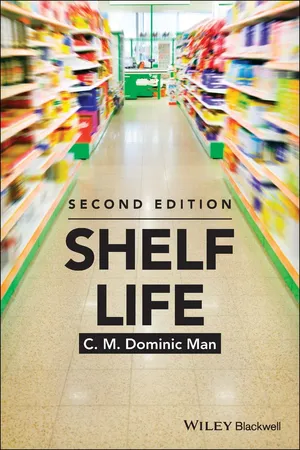
Shelf life, a term recognised in EU/UK food legislation, may be defined as the period of time for which a food product will remain safe and fit for use, provided that it is kept in defined storage conditions. During this period, the product should retain its desired sensory, chemical, physical, functional and microbiological characteristics, as well as accurately comply with any nutritional information printed on the label. ?Shelf life? therefore refers to a number of different aspects; each food product has a microbiological shelf life, a chemical shelf life, and a sensory (or organoleptic) shelf life. These categories reflect the different ways in which a food product will deteriorate over time. Ultimately the shelf life of a food product is intended to reflect the overall effect of these different aspects.
Shelf life has always been an important facet of industrial food preparation and production, as food and drink are often produced in one area and then distributed to other areas for retailing and consumption. Globalised distribution and supply chains make it imperative that food should survive the transit between producer and consumer – as a perishable commodity, food carries a high risk of spoilage. As such, a realistic, workable and reproducible shelf life has to be determined every time a new food product is developed and marketed; shelf life determination of food has become an integral part of food safety, quality assurance, product development, marketing, and consumer behaviour.
Dominic Man?s Shelf Life, now in a revised and updated second edition, encompasses the core considerations about shelf life. Section 1 introduces shelf life, describes its relationship to food safety, and provides answers to the frequently asked questions around shelf life determination and testing which are a manager?s chief concerns. Section 2 covers the science of the various ways in which food deteriorates and spoils, including the physical, chemical and microbiological changes. Section 3 looks at shelf life in practice, using case studies of different products to illustrate how shelf life may be determined in real life settings. This book will be invaluable to both practitioners and students in need of a succinct and comprehensive overview of shelf life concerns and topics.
eBook - ePub
Shelf Life
About this book
Information
Section 1
Introduction to shelf life of foods – frequently asked questions
1.1 What is shelf life?
Shelf life has been a frequently used term that can be understood and interpreted differently. A consumer is generally concerned with the length of time a food product can be kept in the home before it can no longer be used. A retailer is particularly interested in the length of time a product can stay on its shelf in order to maximise sales potential. Shelf life is now a legal term within the European Union (EU). Regulation (EC) No. 852/2004 of the European Parliament and of the Council on the hygiene of foodstuffs (EC, 2004a), enforced in England by the Food Safety and Hygiene (England) Regulations 2013 (TSO, 2013), requires food business operators to adopt as appropriate a number of specific hygiene measures (Article 4(3)) including ‘compliance with microbiological criteria’ as laid down in Commission Regulation (EC) No. 2073/2005 as amended on microbiological criteria for foodstuffs (EC, 2005). This latter regulation defines ‘shelf life’ (or ‘shelf-life’ (Article 2(f))) as ‘either the period corresponding to the period preceding the “use by” or the minimum durability date, as defined respectively in Articles 9 and 10 of Directive 2000/13/EC’, which itself has been repealed by Regulation (EU) No. 1169/2011 on the provision of food information to consumers (EC, 2011a), implemented in the United Kingdom as the Food Information Regulations 2014 (TSO, 2014). A much more helpful and informative definition of shelf life of food has been available for some time (IFST, 1993): It is the period of time under defined conditions of storage, after manufacture or packing, for which a food product will remain safe and be fit for use. In other words, during this period, it should retain its desired sensory, chemical, physical, functional or microbiological characteristics and, where appropriate, comply with any label declaration of nutrition information when stored according to the recommended conditions. It is obvious therefore that shelf life is a very important and multifaceted requirement of all manufactured and processed food products. Every food product has in principle, and should be recognised as having, a microbiological shelf life, a chemical shelf life, a functional shelf life and an organoleptic shelf life because all foods deteriorate, often in different ways and at different rates. Ultimately, the shelf life of a food product is intended to reflect the overall effect of these different aspects, ideally under a set of specified storage conditions. Because of this, the study of shelf life of food can often only rightfully be dealt with by the employment of multidisciplinary resources.
1.2 Why are food safety and shelf life related?
Within the EU, of which the United Kingdom is a member, the safety of food is both a fundamental and a legal requirement. Article 14 (Food safety requirements) of the European Regulation (EC) No. 178/2002 (EC, 2002), laying down the general principles and requirements of food law, clearly states the following:
- Food shall not be placed on the market if it is unsafe.
- Food shall be deemed to be unsafe if it is considered to be
- Injurious to health
- Unfit for human consumption
It follows that all food products offered for sale must be safe although they do not necessarily have to be of the highest quality. In the United Kingdom, the Food Safety Act 1990 (as amended) (FSA, 2009) prohibits the sale of food that
- Has been rendered injurious to health
- Is unfit
- Is so contaminated it would be unreasonable to expect it to be eaten
- Is not of the nature or substance or quality demanded
- Is falsely or misleadingly labelled
Table 1.1 gives examples of past food product withdrawals and recalls in the United Kingdom between 2010 and 2014 available on the UK Food Standards Agency (FSA) website. The list should give some insight into the kinds of hazards that can cause food to be unsafe and/or unacceptable to the public; recall and/or withdrawal of the affected food is a legal requirement within the EU (Article 19 of Regulation (EC) No. 178/2002). In effect, a food product, the safety of which has been called into question, be it of microbial, chemical or physical nature has no useful shelf life; its declared shelf life has become meaningless and irrelevant. Food safety and product shelf life are therefore inextricably linked; there can be no quality without food safety. Without exception, the question ‘Is this product safe to eat?’ must be a first question to be asked in every shelf life study for the simple fact that food safety is a legal requirement. Also, as every product or product concept has to be taste tested at some stage, it is only right and proper for ethical reasons to resolve this question about food safety at the earliest opportunity. Furthermore, the controlling factors for safety and spoilage, particularly those that are related to microbial growth, are often identical; the separate consideration of food safety and shelf life, although convenient in practice, is artificial. Today, the most effective way to ensure the safety of food is to use the internationally recognised hazard analysis critical control point (HACCP) system. Current EU food legislation mandates that, in order to ensure a high level of consumer protection with regard to food safety, food business operators are required to put in place, implement and maintain a permanent food safety management procedure or procedures based on the HACCP principles (EC, 2004a). In England, this legal requirement is contained in the Food Safety and Hygiene (England) Regulations 2013. An in-depth and up-to-date reference on the development, implementation and maintenance of an effective HACCP-based food safety management system as required by EU legislation is available (Mortimore & Wallace, 2013).
Table 1.1 Examples of food and drink product withdrawals and recalls in the United Kingdom between 2010 and 2014a
| Year | Product | Published reason for the recall |
| 2014 | Spring still natural mineral water | Contamination with small black particles |
| Supermarket own-brand pitted black olives | Contamination with small pieces of glass | |
| Fresh sandwiches, baguettes and wraps | Production not complying with food hygiene requirements | |
| Smoked salmon 70-g packs | High levels of Listeria monocytogenes | |
| Bread and butter pudding | Under-processing and food spoilage | |
| Vacuum-packed organic tofu | Potential risk of botulism | |
| Organic sultanas | Presence of Salmonella | |
| Unpasteurised cheese | High levels of Listeria monocytogenes | |
| 2013 | Supermarket own-brand curried chicken snack pack with a ‘use by’ date | Listeria monocytogenes was detected in the product |
| Coleslaw | Presence of Listeria monocytogenes | |
| Milk and cream products | Possible cross-conta... |
Table of contents
- Cover
- Title Page
- Table of Contents
- Preface to the Second Edition
- Preface to the First Edition
- Section 1: Introduction to shelf life of foods – frequently asked questions
- Section 2: The ways food deteriorates and spoils
- Section 3: Determining shelf life in practice
- Epilogue
- Appendix A: The Arrhenius model
- Appendix B: The CIMSCEE formulae for microbiological safety and stability
- References
- Index
- Advertisement Page
- End User License Agreement
Trusted by 375,005 students
Access to over 1.5 million titles for a fair monthly price.
Study more efficiently using our study tools.
Frequently asked questions
Yes, you can cancel anytime from the Subscription tab in your account settings on the Perlego website. Your subscription will stay active until the end of your current billing period. Learn how to cancel your subscription
No, books cannot be downloaded as external files, such as PDFs, for use outside of Perlego. However, you can download books within the Perlego app for offline reading on mobile or tablet. Learn how to download books offline
Perlego offers two plans: Essential and Complete
- Essential is ideal for learners and professionals who enjoy exploring a wide range of subjects. Access the Essential Library with 800,000+ trusted titles and best-sellers across business, personal growth, and the humanities. Includes unlimited reading time and Standard Read Aloud voice.
- Complete: Perfect for advanced learners and researchers needing full, unrestricted access. Unlock 1.5M+ books across hundreds of subjects, including academic and specialized titles. The Complete Plan also includes advanced features like Premium Read Aloud and Research Assistant.
We are an online textbook subscription service, where you can get access to an entire online library for less than the price of a single book per month. With over 1.5 million books across 990+ topics, we’ve got you covered! Learn about our mission
Look out for the read-aloud symbol on your next book to see if you can listen to it. The read-aloud tool reads text aloud for you, highlighting the text as it is being read. You can pause it, speed it up and slow it down. Learn more about Read Aloud
Yes! You can use the Perlego app on both iOS and Android devices to read anytime, anywhere — even offline. Perfect for commutes or when you’re on the go.
Please note we cannot support devices running on iOS 13 and Android 7 or earlier. Learn more about using the app
Please note we cannot support devices running on iOS 13 and Android 7 or earlier. Learn more about using the app
Yes, you can access Shelf Life by Dominic Man in PDF and/or ePUB format, as well as other popular books in Technology & Engineering & Food Science. We have over 1.5 million books available in our catalogue for you to explore.