This ready reference not only presents the hot and emerging topic of modern flow chemistry, it is also unique in illustrating the important connection to sustainable chemistry. Focusing on more sustainable methods and applications, the text extensively covers every important field from reaction time optimization to waste minimization, and from safety improvements to microwave applications. In addition, green metrics are presented as a key aspect of the book, helping readers to evaluate the efficiency of flow technologies and their impact on the overall efficiency of a chemical process. An invaluable handbook for every chemist working in the laboratory, whether in academia or industry.
Chapter 1 Flow Photochemistry – a Green Technology with a Bright Future
Michael Oelgemöller, Tyler Goodine and Padmakana Malakar
1.1 Introduction to Synthetic Organic Photochemistry
According to the International Union of Pure and Applied Chemistry (IUPAC), photochemistry is “the branch of chemistry concerned with the chemical effects of ultraviolet, visible, or infrared radiation” [1]. Owing to the multidisciplinary nature of light, photochemistry thus finds widespread applications in the fields of analytical, environmental, food, inorganic, material, medicinal, organic, pharmaceutical, polymer, and physical chemistry [2, 3]. In terms of organic synthesis, light energy is utilized to activate molecules within their chromophoric groups. For multichromophoric substrates, this activation can be selectively achieved [4]. The amount of energy required for activation corresponds to the wavelength of the light as expressed in the Planck relation (Equation (1.1)) [5]:
1.1
where E is the energy of light; h, the Planck constant; v, the frequency; c, the velocity of light; λ, the wavelength; and
, the wavenumber.
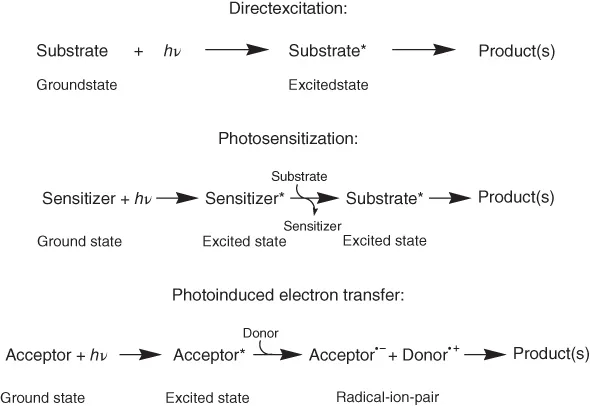
The excited state reached can undergo a multitude of energy- as well as electron-transfer processes, which are commonly shown in a Jablonski diagram [6]. Deactivation processes are common and include fluorescence, phosphorescence, or internal conversion. Alternatively, the excited state energy can be utilized for chemical changes. Owing to the different structural and physicochemical properties of excited states, photochemical reactions can differ significantly from thermal reactions. There are three main photochemical processes (Scheme 1.1) [1]: direct excitation, photosensitization, and photoinduced electron transfer reactions. In the first case, light is absorbed by the substrate and its subsequent excited state can undergo a chemical transformation either on its own or by reaction with another (ground-state) molecule. In the second case, light energy is used to activate a photosensitizer (or photocatalyst) into its excited state. This excess of energy is consequently transferred to another substrate by collision. The latter reagent enters its corresponding excited state and can undergo further chemical changes. In the third reaction mode, an electron is transferred between the excited state of one compound and the ground state of another substrate. The corresponding radical-ion pair can undergo further transformation. In reality, photochemical pathways are often much more complex.
Scheme 1.1 Simplified main photoreaction modes.
The extra energy provided via the excited state often enables chemical transformations that are thermally not feasible. Photochemistry is thus commonly applied to the synthesis of high-energy compounds such as strained rings [7, 8] or complex target molecules such as natural products [9–12]. More generally, photochemical transformations include additions, cleavages, isomerizations, rearrangements, and redox reactions. Many of these conversions proceed with high chemical yields and selectivities [13–16]. In contrast to these “productive chemical pathways,” physical deactivation processes do not yield any “chemical products”; however, they are used extensively in analytical, environmental, forensic, medical, sensory, or spectroscopic sciences.
An important performance parameter in photochemistry is the quantum yield (Φλ), which describes the efficiency of a photochemical pathway at a given wavelength (Equation (1.2)) [17]. This value is unity (Φλ = 1) when each photon absorbed by the substrate yields to the formation of a product molecule. Much smaller quantum yields (Φλ ≪ 1) are typically observed owing to competing deactivation or quenching processes. This low efficiency thus necessitates exhaustive irradiation times although the final chemical yield may still be large. When light is only required for the initiation step as in chain reactions, quantum yields can become very large instead (Φλ ≫ 1). The quantum yield is typically determined experimentally using actinometry [18].
1.2
Light absorption within a solution used in photochemical synthesis depends on the concentration of the chromophore and the thickness of the solution. This dependency is expressed in the Beer–Lambert–Bouguer law (Equation (1.3)) [19, 20]. Effective light penetration is thus limited to a narrow layer within the reaction mixture. To minimize this limitation, photochemical conversions are typically performed in high dilutions and in thin reaction vessels. In practice, this approach naturally results in large volumes of solvents.
1.3
where A is the absorbance of a solution at a given wavelength; T, the transmittance; I, the intensity of light exiting a medium; I0, the intensity of light entering a medium; ϵ, the molar absorption coefficient; l, the thickness of solution traversed by light (path length); and c, the molar concentration of absorbing species.
1.2 Conventional Batch Photochemistry
1.2.1 Batch Photochemical Technology
Two general types of reactor systems are commonly used for preparative photochemistry on laboratory scales (Figure 1.1): immersion-well and chamber reactors [21, 22]. The two systems typically utilize different light sources [23]. The former incorporates a single low-, medium-, or high-pressure mercury lamp within a double-walled immersion well at its center. The reaction medium surrounds the lamp in a separate reaction vessel. This inside-out irradiation arrangement allows for an effective utilization of light. The entire setup can be operated safely in an enclosing cabinet. Merry-go-round setups with rotating test tubes around an immersion well have also been developed and allow for space-efficient parallel photoreactions. In contrast, chamber reactors combine an external array of fluorescent tubes with internal reaction vessels such as test tubes or Schlenk flasks. This outside-in configuration allows for multiple reaction containers to be used. Cooling i...
Table of contents
Cover
Title Page
Copyright
Table of Contents
List of Contributors
Foreword
Chapter 1: Flow Photochemistry – a Green Technology with a Bright Future
Chapter 2: Continuous Flow Synthesis Using Recyclable Reaction Media
Chapter 3: Synthesis and Application of H2O2 in Flow Reactors
Chapter 4: Scale-Up of Flow Processes in the Pharmaceutical Industry
Chapter 5: Organic Synthesis in Flow: Toward Higher Levels of Sustainability
Chapter 6: Sustainable Flow Chemistry in Drug Discovery
Chapter 7: Flow Tools to Define Waste/Time/Energy-Minimized Protocols
Chapter 8: The Application of Flow Chemistry in the Use of Highly Reactive Intermediates and Reagents
Chapter 9: Nonconventional Techniques in Sustainable Flow Chemistry
Chapter 10: Life Cycle Assessment of Flow Chemistry Processes
Chapter 11: Solids in Continuous Flow Reactors for Specialty and Pharmaceutical Syntheses
Index
End User License Agreement
Trusted by 375,005 students
Access to over 1.5 million titles for a fair monthly price.
Study more efficiently using our study tools.
Frequently asked questions
Yes, you can cancel anytime from the Subscription tab in your account settings on the Perlego website. Your subscription will stay active until the end of your current billing period. Learn how to cancel your subscription
No, books cannot be downloaded as external files, such as PDFs, for use outside of Perlego. However, you can download books within the Perlego app for offline reading on mobile or tablet. Learn how to download books offline
Perlego offers two plans: Essential and Complete
Essential is ideal for learners and professionals who enjoy exploring a wide range of subjects. Access the Essential Library with 800,000+ trusted titles and best-sellers across business, personal growth, and the humanities. Includes unlimited reading time and Standard Read Aloud voice.
Complete: Perfect for advanced learners and researchers needing full, unrestricted access. Unlock 1.5M+ books across hundreds of subjects, including academic and specialized titles. The Complete Plan also includes advanced features like Premium Read Aloud and Research Assistant.
Both plans are available with monthly, semester, or annual billing cycles.
We are an online textbook subscription service, where you can get access to an entire online library for less than the price of a single book per month. With over 1.5 million books across 990+ topics, we’ve got you covered! Learn about our mission
Look out for the read-aloud symbol on your next book to see if you can listen to it. The read-aloud tool reads text aloud for you, highlighting the text as it is being read. You can pause it, speed it up and slow it down. Learn more about Read Aloud
Yes! You can use the Perlego app on both iOS and Android devices to read anytime, anywhere — even offline. Perfect for commutes or when you’re on the go. Please note we cannot support devices running on iOS 13 and Android 7 or earlier. Learn more about using the app
Yes, you can access Sustainable Flow Chemistry by Luigi Vaccaro in PDF and/or ePUB format, as well as other popular books in Physical Sciences & Chemistry. We have over 1.5 million books available in our catalogue for you to explore.