The eighth edition of California: A History covers the entire scope of the history of the Golden State, from before first contact with Europeans through the present; an accessible and compelling narrative that comprises the stories of the many diverse peoples who have called, and currently do call, California home.
Explores the latest developments relating to California's immigration, energy, environment, and transportation concerns
Features concise chapters and a narrative approach along with numerous maps, photographs, and new graphic features to facilitate student comprehension
Offers illuminating insights into the significant events and people that shaped the lengthy and complex history of a state that has become synonymous with the American dream
Includes discussion of recent – and uniquely Californian – social trends connecting Hollywood, social media, and Silicon Valley – and most recently "Silicon Beach"
The name California brings to mind extremes in both geography and climate. The state’s variety is overwhelming. Its mountains are the highest in the continental United States outside Alaska. Its redwood forests comprise the oldest and tallest trees alive. Its high surf and sandy beaches lie in sharp contrast to its bleak deserts. The state’s rains, floods, and wildfires can be catastrophic. Its droughts, too, are severe, its legendary earthquakes highly destructive.
In 1906, over 3,000 people were killed in a San Francisco earthquake. That catastrophe left a quarter of a million persons homeless. Since then, California has repeatedly experienced major quakes that resulted in the loss of life and property. In addition to its world-famous San Andreas Fault, it has a great many other underground faults, known and unknown.
California offers virtually every climatic, geologic, and botanical combination. These range from the wettest to the driest weather; sandy soil in its deserts and rich loam in the Central Valley. Mount Whitney (14,496 feet) is the second-highest peak in the United States. Bad Water in Death Valley (282 feet below sea level) is the lowest point in North America. In 2012, the World Meteorological Organization declared that Death Valley holds the highest recorded temperature in history, a stunning 134 degrees that was taken on Greenland Ranch, on July 10, 1913. In the summertime, the Central Valley’s temperature rises to well over a sweltering 100 degrees. Yet, in half an hour one can travel into the San Francisco Bay area, fogbound at less than 50 degrees. In midwinter, the orange groves of southern California lie in valleys framed by distant snowy peaks.
California’s literature expresses all this distinctive regionality. It underlies the “local color” of the short stories of Bret Harte, the wit of Mark Twain’s tall tales, the humanity of John Steinbeck’s novels, as well as the celebration of nature in the stark poetry of Robinson Jeffers. In architecture, the fusion of its Spanish heritage and tastes of the New Englanders who arrived next produced the Monterey-style house, with its balconies, adobe walls, red-tiled roof, and white-washed woodwork. Such variety lies at the heart of California’s past and present.
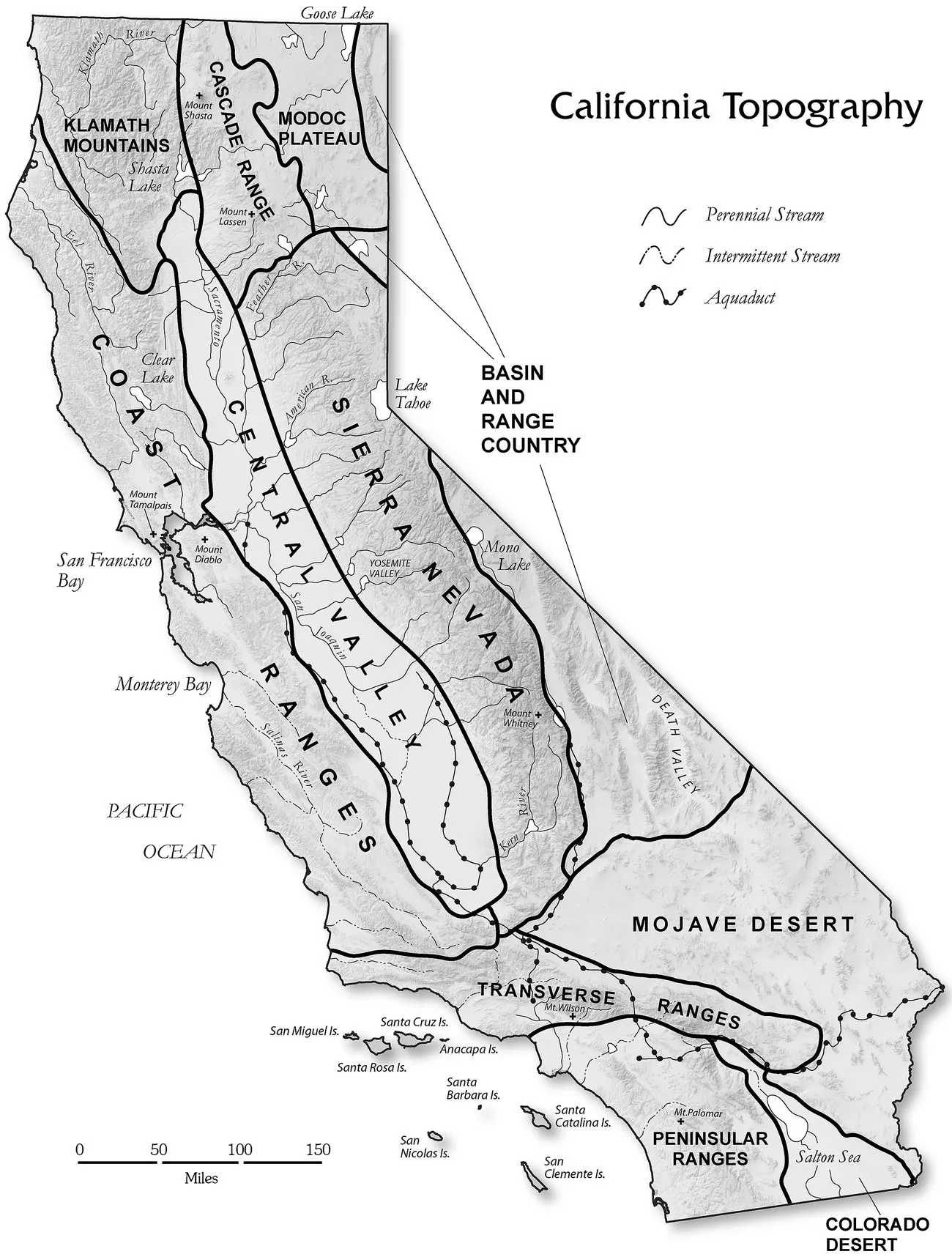
Map 1.1 California topography.
No other American state would, standing alone, comprise its own nation. California ranks third in size, but first in population. By 2013, the state surpassed 38 million inhabitants. The 14 counties that make up southern California are nearly as large as all six New England states combined, and are larger than Illinois, Iowa, or Alabama. More people live in Orange County than in Montana. There is a great disparity of population within the state’s 58 counties. The Los Angeles area, with some 10 million residents, stands in contrast to tiny Alpine County, with only 1,200 inhabitants.
The province’s natural wealth once lay unexploited. The melting snows of the Sierra rushed down unharnessed rivers into the sea. Underground reservoirs of petroleum lay untapped. Gold, shining on the bottoms of mountain streams, awaited the picks and shovels of Yankee miners. Magnificent timber stands stood untouched. But, rather quickly, the missions and ranchos gave way to vineyards and orange groves. Next came oil derricks, aircraft factories, steel mills, residential subdivisions, Hollywood film-making, and the technology in the Silicon Valley.
Urban development has overwhelmed a state whose shoreline spans the Pacific seaboard for 1,200 miles. The length of California is 824 miles while its width reaches 252 miles. The chief surface features are two mountain chains that traverse almost the entire length of the state. Its Central Valley lies between the mountains of the Coast Ranges and the Sierra Nevada. The combined San Joaquin and Sacramento Valleys, 400 miles long and 50 miles wide, constitute one of the great granaries of the world. Because farmers can raise crops during three growing seasons instead of the usual one, California remains the nation’s top agricultural state.
It is more accurate to speak of California’s “climates” than to refer to a single weather pattern. Scores of specialized microclimates frequently recur. What is usually thought of as “California climate” prevails mostly south of San Francisco to the Mexican border, and between the Coast Ranges and the Pacific Ocean. In these regions the seasons drift by mildly, almost unperceived. The heat of the day is fanned by prevailing westerly winds. Climatic comfort is usually maintained by foggy “veloe” clouds.
What Californians call “winter” evokes laughter in other parts of the country. The state’s coastline is cooled by a meteorological process known as “upwelling,” wherein warm winds swirl inward from a northwesterly direction even as prevailing currents bring cold ocean water from the depths up to the surface. When the warm air meets the cold surface water, condensation forms. Then fog and low clouds sit over the ocean, creeping inland at night and retreating seaward toward dawn. During the course of the day, heat radiating off the California landmass helps to dissipate this fog.
Although more than half the state’s residents live in southern California, most of the raw materials and 90 percent of the fresh water lie in northern California. Annual rainfall in the northwest corner of the state, above Eureka, reaches 110 inches, making the area a virtual rain forest. Precipitation in the Central Valley is heavier at Sacramento and Stockton than at other cities farther south, including Fresno and Bakersfield. At San Francisco, the average annual rainfall is nearly 23 inches; at San Luis Obispo it falls to 19 inches, and to less than 15 inches at Los Angeles. In San Diego, near the Mexican border, rainfall generally amounts to only 10 inches per year. Precipitation, the heaviest from November to April, averages only 6 inches at Bakersfield and as little as 1 or 2 inches in desert areas.
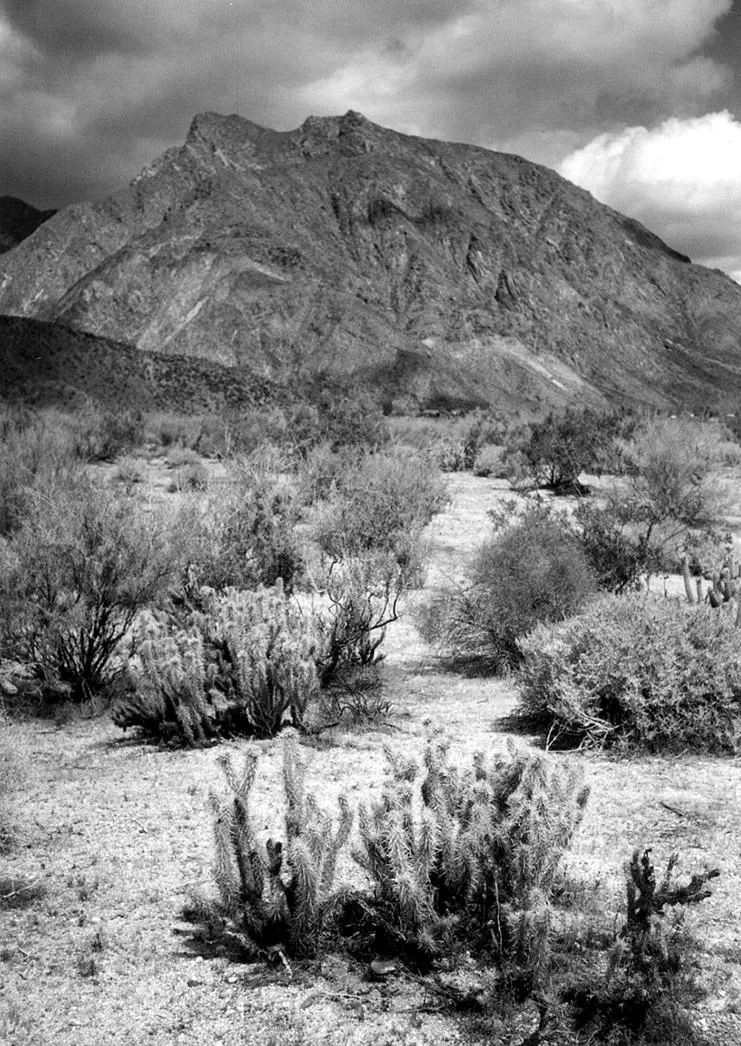
Figure 1.1 Anza-Borrego Desert State Park, east of San Diego. In the foreground are chollo cactus.
Courtesy of Lynne Blanton.
The Coast Ranges partly control California’s weather. In the winter, North Pacific storms crash down on those mountains. Rain clouds push through their canyon gaps into the Central Valley. Most fast-moving storms, however, break up along the Sierra crest. Below the eastern Sierra, the scorching temperature sometimes rises to 130 degrees in Death Valley, where there is hardly any vegetation. In the bleak volcanic area of northeastern California, a rocky topography also limits agriculture and ranching.
In northern California, annual floods can be especially severe. Since the Gold Rush era, Sacramento, Stockton, Oroville, and Marysville have repeatedly endured winter inundations. Paradoxically, one of the most serious flood threats exists in semi-arid southern California, where burned-out chaparral provides poor cover for unstable mountain watersheds.
This wide range of climate makes possible a great variety of vegetable and floral products. Almost every plant, tree, or shrub that grows in temperate zones, and many indigenous to the tropics, can be grown somewhere in California. The state also is known for its unique forms of vegetation, especially its giant sequoias, which have their roots deep in the ancient past. Along with the bristle-cone pines of the White Mountains, these monarchs of the forest may well be the oldest living things on Earth. Sequoias now standing reached their prime at the time of Christ. Their age may be 5,000 or more years. Sequoias are virtually immune to diseases that afflict other trees, and their tannic bark is practically resistant to fire. Most “big trees” that have perished have been the victims of human ravages, lightning strikes, or fierce storms.
The gnarled Monterey cypress, a picturesque denizen of the seacoast, grows along a rugged section of the Monterey shoreline. These trees, clinging precariously to promontories like Cypress Point, are totally exposed to Pacific storms. Over the years heavy winds have twisted them into fantastic forms, and yet they survive. Similar in tenacity are the rugged Torrey pines hugging the coastline above San Diego.
California’s skies were once darkened by flocks of geese, ducks, and other migrating birds that wintered there. Although the indigenous wildlife has been seriously depleted, 400 species of mammals and 600 varieties of birds still make the state their home. From the horned toad and desert tortoise to the bobcat, weasel, and black-tailed deer, California’s fauna is as diversified as its other natural features. In the wilderness, coyotes, mountain lions, and wolverines still roam. Once common, Bighorn mountain sheep and Wapiti (commonly known as elk) are now rare, and the grizzly bear is extinct. The California condor and sea otter have barely escaped extinction.
Geologically, California is still young. The 400-mile-long Sierra scarp, formed by processes known as uplifting and faulting, and the Cascade and Klamath ranges in the north are all in youthful stages of development. The California coastline, pushed up out of the Pacific’s depths at Points Pinos and Lobos, as well as at Cape Mendocino, is a rocky one, with headlands jutting out to sea. This coastline, unlike the eastern shore of the United States, is geologically one of emergence, rather than submergence; in fact, the entire Pacific shoreline is sharply uplifted. This geologic pattern has produced few navigable rivers or harbors comparable to Boston, New York, Philadelphia, or Baltimore. With the exception of San Diego Bay in the south, San Francisco Bay in the middle, and Bodega and Humboldt Bays (both lesser estuaries) in the north, California has few natural harbors.
Figure 1.2 Joshua Tree National Monument.
Courtesy of Lynne Blanton.
In past geologic ages, stupendous changes shaped the contour of California. Its two principal mountain chains, the Sierra Nevada and the Coa...
Table of contents
Cover
Title page
Copyright page
List of Illustrations
Preface
1 California’s Distinctiveness
2 The Native Americans
3 Exploring Baja and Alta California
4 Colonizers of the Frontier
5 Missions, Presidios, and Pueblos
6 California and Its Spanish Governors
7 Exploration and Foreign Interference
8 Arcadia
9 Mexican California
10 Infiltration and Revolt
11 On the Eve of American Rule
12 Trappers, Traders, and Homeseekers
13 American Conquest
14 Gold
15 Approaches to Statehood
16 Social Ferment
17 A New Culture at the Golden Gate
18 Post-Gold Rush Commerce
19 The Messy Land Problem
20 California and the Union
21 Ships and Rails
22 Agricultural and Urban Growth
23 Discrimination and Accommodation
24 Crushing or Saving the Indians?
25 Labor, the Farmers, and the New Constitution
26 California Culture, 1870–1918
27 Progressive Politics
28 Material Urban Growth
29 Water, Conservation, and Agriculture
30 Labor in an Industrial Age
31 The Depression Years
32 Twentieth-Century Culture
33 Sports and Leisure
34 Wartime Setbacks and Gains
35 World War II and Its Aftermath
36 The Beleaguered Sixties
37 Environmental Realities
38 From Reagan Conservatism to “Governor Moonbeam”
39 A New Ethnicity
40 From the Great Recession to the Rise of Silicon Beach
41 Glowing Past Versus Troubled Future
Appendix: The Governors of California
Index of Authors in Selected Readings
Subject Index
End User License Agreement
Trusted by 375,005 students
Access to over 1.5 million titles for a fair monthly price.
Study more efficiently using our study tools.
Frequently asked questions
Yes, you can cancel anytime from the Subscription tab in your account settings on the Perlego website. Your subscription will stay active until the end of your current billing period. Learn how to cancel your subscription
No, books cannot be downloaded as external files, such as PDFs, for use outside of Perlego. However, you can download books within the Perlego app for offline reading on mobile or tablet. Learn how to download books offline
Perlego offers two plans: Essential and Complete
Essential is ideal for learners and professionals who enjoy exploring a wide range of subjects. Access the Essential Library with 800,000+ trusted titles and best-sellers across business, personal growth, and the humanities. Includes unlimited reading time and Standard Read Aloud voice.
Complete: Perfect for advanced learners and researchers needing full, unrestricted access. Unlock 1.5M+ books across hundreds of subjects, including academic and specialized titles. The Complete Plan also includes advanced features like Premium Read Aloud and Research Assistant.
Both plans are available with monthly, semester, or annual billing cycles.
We are an online textbook subscription service, where you can get access to an entire online library for less than the price of a single book per month. With over 1.5 million books across 990+ topics, we’ve got you covered! Learn about our mission
Look out for the read-aloud symbol on your next book to see if you can listen to it. The read-aloud tool reads text aloud for you, highlighting the text as it is being read. You can pause it, speed it up and slow it down. Learn more about Read Aloud
Yes! You can use the Perlego app on both iOS and Android devices to read anytime, anywhere — even offline. Perfect for commutes or when you’re on the go. Please note we cannot support devices running on iOS 13 and Android 7 or earlier. Learn more about using the app
Yes, you can access California by Andrew Rolle,Arthur C. Verge in PDF and/or ePUB format, as well as other popular books in History & North American History. We have over 1.5 million books available in our catalogue for you to explore.