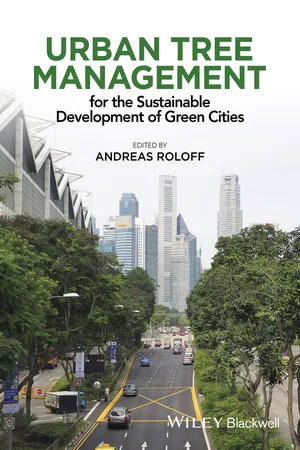
Urban Tree Management
eBook - ePub

Urban Tree Management

For the Sustainable Development of Green Cities

  1. English
  2. ePUB (mobile friendly)
  3. Available on iOS & Android
eBook - ePub

Urban Tree Management

For the Sustainable Development of Green Cities

About this book

Urban tree management is the key basis for greener cities of the future. It is a practical discipline which includes tree selection, planting, care and protection and the overall management of trees as a collective resource.

Urban Tree Management aims to raise awareness for the positive impacts and benefits of city trees and for their importance to city dwellers. It describes their advantages and details their effects on quality of urban life and well-being – aspects that are increasingly important in these times of progressing urbanisation.

With this book you will learn:

  • fundamentals, methods and tools of urban tree management
  • state of the art in the fields of urban forestry and tree biology
  • positive effects and uses of urban trees
  • features, requirements and selection criteria for urban trees
  • conditions and problems of urban trees
  • governance and management aspects
  • environmental education programs.

Edited by the leading expert Dr Andreas Roloff, Urban Tree Management is an excellent resource for plant scientists, horticulturists, dendrologists, arborists and arboriculturists, forestry scientists, city planners, parks department specialists and landscape architects. It will be an essential addition to all students and libraries where such subjects are taught.

Frequently asked questions

Yes, you can cancel anytime from the Subscription tab in your account settings on the Perlego website. Your subscription will stay active until the end of your current billing period. Learn how to cancel your subscription.
At the moment all of our mobile-responsive ePub books are available to download via the app. Most of our PDFs are also available to download and we're working on making the final remaining ones downloadable now. Learn more here.
Perlego offers two plans: Essential and Complete
  • Essential is ideal for learners and professionals who enjoy exploring a wide range of subjects. Access the Essential Library with 800,000+ trusted titles and best-sellers across business, personal growth, and the humanities. Includes unlimited reading time and Standard Read Aloud voice.
  • Complete: Perfect for advanced learners and researchers needing full, unrestricted access. Unlock 1.4M+ books across hundreds of subjects, including academic and specialized titles. The Complete Plan also includes advanced features like Premium Read Aloud and Research Assistant.
Both plans are available with monthly, semester, or annual billing cycles.
We are an online textbook subscription service, where you can get access to an entire online library for less than the price of a single book per month. With over 1 million books across 1000+ topics, we’ve got you covered! Learn more here.
Look out for the read-aloud symbol on your next book to see if you can listen to it. The read-aloud tool reads text aloud for you, highlighting the text as it is being read. You can pause it, speed it up and slow it down. Learn more here.
Yes! You can use the Perlego app on both iOS or Android devices to read anytime, anywhere — even offline. Perfect for commutes or when you’re on the go.
Please note we cannot support devices running on iOS 13 and Android 7 or earlier. Learn more about using the app.
Yes, you can access Urban Tree Management by Andreas Roloff in PDF and/or ePUB format, as well as other popular books in Technology & Engineering & Forestry. We have over one million books available in our catalogue for you to explore.

Information

CHAPTER 1
Intro: Urban trees – Importance, benefits, problems

Andreas Roloff
Technische Universität Dresden, Tharandt, Germany

1.1 Introduction

Trees often and quickly gain a bad reputation, caused by falling branches or entire trees, roots in sewage drains, neighbors fighting over fruit and leaves littering their gardens, health issues from pollen allergies, etc. The problems caused by city trees are usually more conspicuous and have greater ramifications. Their advantages can often be difficult to record and to assess. As a result, the negative impacts are much more widely discussed, whereas extensive papers about their positive aspects are rare.
This chapter, therefore, aims to raise awareness of the positive impacts and benefits of urban trees and their importance to city dwellers (Figures 1.1 and 1.2). It describes their advantages (with no claim to completeness) and details their effects on our quality of life and well-being – aspects that are increasingly important in these times of progressing urbanization.
If I knew the world would end tomorrow, I would still plant another tree today.
Martin Luther
Photo displaying an urban square without trees.
Figure 1.1 Treeless square – cold, hard, unwelcoming, and easily overheated in summer.
Photo displaying an urban square with trees (Fraxinus angustifolia).
Figure 1.2 Square with trees (Fraxinus angustifolia) – segmented, warm, inviting and shady.

1.2 Aesthetics, sensory impressions

To many people, the beauty of nature is manifest in trees (Tyrväinen et al., 2005). This is especially true for ancient, free-standing trees. Their variation in phenology (change of appearance across the seasons), including shooting, blooming, fruit, leaf coloring and falling leaves, is an important factor in how we experience the seasons, especially in cities. Many trees even change their smell over the course of the year. Areas without trees can be areas without seasons, especially in temperate climates.
Visual impressions such as coloring (e.g., of the leaves in spring and autumn), different structures (e.g., the shape of the leaves and the architecture of the treetops), design (e.g., Lombardy poplars, ancient oaks) and aesthetics (how a tree affects us) cause positive emotions and experiences (Bahamón, 2008; Miller, 2007; Trowbridge and Bassuk, 2004; Smardon, 1988; Velarde et al., 2007). As an example of the aesthetic impact of different tree species, just think of a light, young grove of birches, as opposed to a dark, dense forest of conifers in spring. An assessment based on aesthetics is, of course, subjective, but it may still be used, for example, to rank city trees by popularity.
Aside from visual impressions, the senses of smell (blossoms, autumn leaves), hearing (rustling of the treetops, rustling of the fallen leaves), taste (fruit, young leaves) and touch (fruit, young leaves) also play important roles.

1.3 Psychology, well-being, health

Trees accompany us through life. Relationships between trees and people are complex and have been poorly investigated. The potential of such relationships becomes clear if you consider the “house tree”. Even today, it is not uncommon for families to plant a tree next to their home – for example, to serve as a “patron”, in order to have shade in summer and shelter from wind, or in order to grow fruit, honey, and so on (Figure 1.3). Some house trees are even considered a member of the family, and the bond is particularly strong if the tree was planted by the owner of the home to mark a special occasion. Positive feelings towards house trees are usually associated with aesthetics: “looks nice”; “the blossoms”; “the color of the leaves”. Gardens often contain many of the “public” trees along the streets and in the parks of a city. In Dresden, for example, there are 600,000 private garden trees, but only 60,000 public street trees (Roloff, 2013).
Photo displaying a tree (Acer pseudoplatanus) in front of a house.
Figure 1.3 House tree (Acer pseudoplatanus) – often a member of the family.
Trees are also increasingly important for our health – for instance, visits to parks (municipal, spas and civic parks) and gardens, walks and hikes, resting on a bench under a tree, picnics in the shade of trees (a popular custom in many cultures). Parks may therefore also be called “therapeutic landscapes”, and a movement called “garden therapy” is currently on the rise. Gardens (including allotments) are increasingly seen as personal spas, as a place where people can feel comfortable and relax – gardening as private health care.
In addition, city trees also protect us from emissions, especially by reducing the levels of ozone, nitrogen oxides, sulfur and carbon dioxide (Harris et al., 2004; Konijnendijk et al., 2005; Tyrväinen et al., 2005; Yang et al., 2005; Donovan et al., 2011). Parks act as a city’s “green lungs”. In recent years there have been many discussions about particulate matter and how it can be reduced to protect our health, with a focus on the ability of trees to bind microparticles in their leaves. Benefits from this depend on factors such as the placement of the trees along the streets, and the width of the streets (see Chapter 13...

Table of contents

  1. Title Page
  2. Table of Contents
  3. List of contributors
  4. CHAPTER 1: Intro: Urban trees – Importance, benefits, problems
  5. CHAPTER 2: Urban trees: Features andrequirements
  6. CHAPTER 3: Fundamentals of tree biologyfor urban trees
  7. CHAPTER 4: Urban tree roots: problems and peculiarities
  8. CHAPTER 5: Drought stress: Adaptation strategies
  9. CHAPTER 6: Aspects of urban tree pathology
  10. CHAPTER 7: Vitality assessment, tree architecture
  11. CHAPTER 8: Body language of trees, tree diagnostics
  12. CHAPTER 9: Tree inventory, risk assessment and management
  13. CHAPTER 10: Tree preservation, maintenance and repair
  14. CHAPTER 11: Tree pruning: Methods and parameters
  15. CHAPTER 12: Transplanting large trees
  16. CHAPTER 13: Dust and noise reduction
  17. CHAPTER 14: Invasive species, indigenous vs. alien dendroflora
  18. CHAPTER 15: Criteria for species selection: Development of a database for urban trees
  19. CHAPTER 16: Genetic aspects
  20. CHAPTER 17: Governance in urban forestry
  21. CHAPTER 18: Allotment gardens and privately managed green space in urban environment
  22. CHAPTER 19: Urban woods for relaxation and inspiration
  23. CHAPTER 20: Acceptance for urban trees: Environmental education programs
  24. Index
  25. End User License Agreement