Green Biocatalysis
eBook - ePub

Green Biocatalysis

  1. English
  2. ePUB (mobile friendly)
  3. Available on iOS & Android
eBook - ePub

Green Biocatalysis

About this book

Green Biocatalysis presents an exciting green technology that uses mild and safe processes with high regioselectivity and enantioselectivity. Bioprocesses are carried out under ambient temperature and atmospheric pressure in aqueous conditions that do not require any protection and deprotection steps to shorten the synthetic process, offering waste prevention and using renewable resources.

Drawing on the knowledge of over 70 internationally renowned experts in the field of biotechnology, Green Biocatalysis discusses a variety of case studies with emphases on process R&D and scale-up of enzymatic processes to catalyze different types of reactions. Random and directed evolution under process conditions to generate novel highly stable and active enzymes is described at length. This book features:

  • A comprehensive review of green bioprocesses and application of enzymes in preparation of key compounds for pharmaceutical, fine chemical, agrochemical, cosmetic, flavor, and fragrance industries using diverse enzymatic reactions
  • Discussion of the development of efficient and stable novel biocatalysts under process conditions by random and directed evolution and their applications for the development of environmentally friendly, efficient, economical, and sustainable green processes to get desired products in high yields and enantiopurity
  • The most recent technological advances in enzymatic and microbial transformations and cuttingedge topics such as directed evolution by gene shuffling and enzyme engineering to improve biocatalysts

With over 3000 references and 800 figures, tables, equations, and drawings, Green Biocatalysis is an excellent resource for biochemists, organic chemists, medicinal chemists, chemical engineers, microbiologists, pharmaceutical chemists, and undergraduate and graduate students in the aforementioned disciplines.
Frequently asked questions

Yes, you can cancel anytime from the Subscription tab in your account settings on the Perlego website. Your subscription will stay active until the end of your current billing period. Learn how to cancel your subscription.
At the moment all of our mobile-responsive ePub books are available to download via the app. Most of our PDFs are also available to download and we're working on making the final remaining ones downloadable now. Learn more here.
Perlego offers two plans: Essential and Complete
  • Essential is ideal for learners and professionals who enjoy exploring a wide range of subjects. Access the Essential Library with 800,000+ trusted titles and best-sellers across business, personal growth, and the humanities. Includes unlimited reading time and Standard Read Aloud voice.
  • Complete: Perfect for advanced learners and researchers needing full, unrestricted access. Unlock 1.4M+ books across hundreds of subjects, including academic and specialized titles. The Complete Plan also includes advanced features like Premium Read Aloud and Research Assistant.
Both plans are available with monthly, semester, or annual billing cycles.
We are an online textbook subscription service, where you can get access to an entire online library for less than the price of a single book per month. With over 1 million books across 1000+ topics, we’ve got you covered! Learn more here.
Look out for the read-aloud symbol on your next book to see if you can listen to it. The read-aloud tool reads text aloud for you, highlighting the text as it is being read. You can pause it, speed it up and slow it down. Learn more here.
Yes! You can use the Perlego app on both iOS or Android devices to read anytime, anywhere — even offline. Perfect for commutes or when you’re on the go.
Please note we cannot support devices running on iOS 13 and Android 7 or earlier. Learn more about using the app.
Yes, you can access Green Biocatalysis by Ramesh N. Patel in PDF and/or ePUB format, as well as other popular books in Technology & Engineering & Biotechnology. We have over one million books available in our catalogue for you to explore.

Information

CHAPTER 1
Biocatalysis and Green Chemistry

Roger A. Sheldon
Department of Biotechnology, Delft University of Technology, Delft, the Netherlands
Molecular Sciences Institute, School of Chemistry, University of the Witwatersrand, Johannesburg, South Africa

1.1 INTRODUCTION TO SUSTAINABLE DEVELOPMENT AND GREEN CHEMISTRY

The publication in 1987 of the report Our Common Future by the World Commission on Environment and Development, otherwise known as the Brundtland Report [1], marked the advent of the concept of sustainable development. The report recognized the necessity for industrial and societal development to provide a growing global population with a satisfactory quality of life, but that such development must also be sustainable over time. Sustainable development was defined as development that meets the needs of the present generation without compromising the needs of future generations to meet their own needs. In order to be sustainable, it must fulfill two conditions: (i) natural resources should be used at rates that do not unacceptably deplete supplies over the long term, and (ii) residues should be generated at rates no higher than can be assimilated readily by the natural environment [2]. It is abundantly clear, for example, that a society based on nonrenewable fossil resources—oil, coal, and natural gas—is not sustainable in the long term. Sustainability consists of three components: societal, ecological, and economic, otherwise referred to as the three P’s—people, planet, and profit.
At the same time, in the mid-1980s, there was a growing concern regarding the copious amounts of waste being generated by the chemical industry. Clearly, a paradigm shift was needed from traditional concepts of reaction efficiency and selectivity, which focus largely on chemical yield, to one that assigns value to maximization of raw materials utilization, elimination of waste, and avoiding the use of toxic and/or hazardous substances [3]. By the same token, there was a pressing need for alternative, cleaner chemistry in order to minimize these waste streams. It led to the emergence of the concepts of waste minimization, zero waste plants, and green chemistry [4]. The latter can be succinctly defined as [5]:
Green chemistry efficiently utilizes (preferably renewable) raw materials, eliminates waste and avoids the use of toxic and/or hazardous reagents and solvents in the manufacture and application of chemical products.
Originally it was referred to as “clean chemistry” [6]. The now widely accepted term “green chemistry” was introduced in the mid-1990s by Anastas and colleagues [7] of the US Environmental Protection Agency (EPA). The guiding principle is benign by design [8] as embodied in the 12 principles of green chemistry of Anastas and Warner:
The 12 principles of green chemistry are as follows:
  1. Waste prevention instead of remediation
  2. Atom efficiency
  3. Less hazardous materials
  4. Safer products by design
  5. Innocuous solvents and auxiliaries
  6. Energy efficient by design
  7. Preferably renewable raw materials
  8. Shorter synthesis (avoid derivatization)
  9. Catalytic rather than stoichiometric reagents
  10. Design products for degradation
  11. Analytical methodologies for pollution prevention
  12. Inherently safer processes
Green chemistry eliminates waste at source; that is, it is primary pollution prevention rather than end-of-pipe waste remediation, as is inherent in the first principle of green chemistry: prevention is better than cure. Since the mid-1990s, the concept of green chemistry has been widely embraced in both industrial and academic circles [9]. One could say that sustainable development is our ultimate common goal and green chemistry is a means to achieving it.

1.2 GREEN CHEMISTRY METRICS

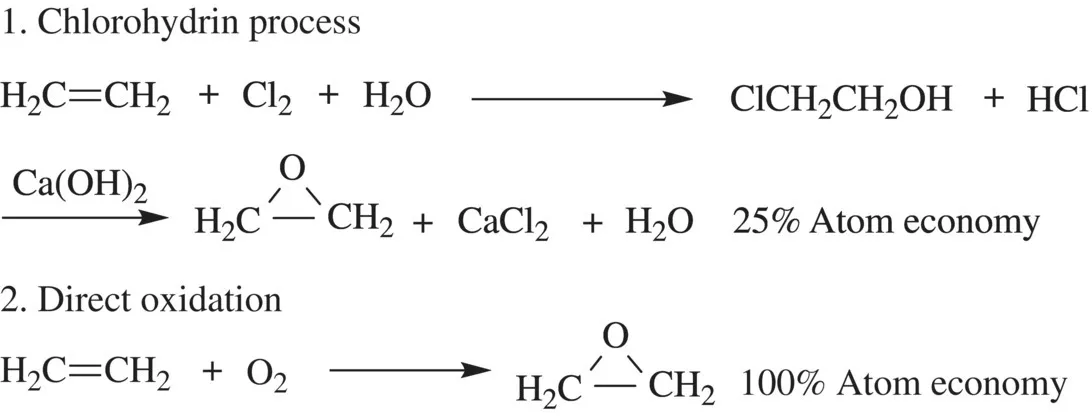
In order to know whether one process or product is greener than another one, we need meaningful metrics to measure greenness. The most widely accepted metrics of the environmental impact of chemical processes are, probably not coincidentally, the two most simple ones: the E factor [3–6, 10, 11], defined as the mass ratio of waste to desired product, and the atom economy (AE), defined as the molecular weight of the desired product divided by the sum of the molecular weights of all substances produced in the stoichiometric equation, expressed as a percentage [12, 13]. Knowledge of the stoichiometric equation enables one to predict, without performing any experiments, the theoretical amount of waste that will be formed. In Figure 1.1, for example, the AE of the classical chlorohydrin route to ethylene oxide is compared with that of catalytic oxidation with dioxygen. It is interesting to note that the former process produces, on a weight basis, more calcium chloride than ethylene oxide.
Schematic illustrating chemical formulas of the chlorohydrins process depicting 25% atom economy (top) and direct oxidation process depicting 100% atom economy (bottom).
FIGURE 1.1 Atom efficiencies of two processes for ethylene oxide.
The AE is a theoretical number that is based on the assumption that a chemical yield of 100% of the theoretical yield is obtained and that reactants are used in exactly stoichiometric amounts. Furthermore, it disregards substances, such as solvents and acids or bases used in work-up, which do not appear in the stoichiometric equation. The E factor, in contrast, is the actual amount of waste produced in the process, defined as everything but the desired product. It takes the chemical yield into account and includes all reagents, solvent losses, all process aids, and, in principle, even the energy consumed. Originally [3] water was excluded from the calculation of the E factor as it was thought that its inclu...

Table of contents

  1. Cover
  2. Title Page
  3. Table of Contents
  4. Preface
  5. About the Editor
  6. Contributors
  7. CHAPTER 1: Biocatalysis and Green Chemistry
  8. CHAPTER 2: Enzymatic Synthesis of Chiral Amines using ω-Transaminases, Amine Oxidases, and the Berberine Bridge Enzyme
  9. CHAPTER 3: Decarboxylation and Racemization of Unnatural Compounds using Artificial Enzymes Derived from Arylmalonate Decarboxylase
  10. CHAPTER 4: Green Processes for the Synthesis of Chiral Intermediates for the Development of Drugs
  11. CHAPTER 5: Dynamic Kinetic Resolution of Alcohols, Amines, and Amino Acids
  12. CHAPTER 6: Recent Developments in Flavin-Based Catalysis
  13. CHAPTER 7: Development of Chemoenzymatic Processes
  14. CHAPTER 8: Epoxide Hydrolases and their Application in Organic Synthesis
  15. CHAPTER 9: Enantioselective Acylation of Alcohol and Amine Reactions in Organic Synthesis
  16. CHAPTER 10: Recent Advances in Enzyme-Catalyzed Aldol Addition Reactions
  17. CHAPTER 11: Enzymatic Asymmetric Reduction of Carbonyl Compounds
  18. CHAPTER 12: Nitrile-Converting Enzymes and their Synthetic Applications
  19. CHAPTER 13: Biocatalytic Epoxidation for Green Synthesis
  20. CHAPTER 14: Dynamic Kinetic Resolution via Hydrolase–Metal Combo Catalysis
  21. CHAPTER 15: Discovery and Engineering of Enzymes for Peptide Synthesis and Activation
  22. CHAPTER 16: Biocatalysis for Drug Discovery and Development
  23. CHAPTER 17: Application of Aromatic Hydrocarbon Dioxygenases
  24. CHAPTER 18: Ene-reductases and their Applications
  25. CHAPTER 19: Recent Developments in Aminopeptidases, Racemases, and Oxidases
  26. CHAPTER 20: Biocatalytic Cascades for API Synthesis
  27. CHAPTER 21: Yeast-Mediated Stereoselective Synthesis
  28. CHAPTER 22: Biocatalytic Introduction of Chiral Hydroxy Groups using Oxygenases and Hydratases
  29. CHAPTER 23: Asymmetric Synthesis with Recombinant Whole-Cell Catalysts
  30. CHAPTER 24: Lipases and Esterases as User-Friendly Biocatalysts in Natural Product Synthesis
  31. CHAPTER 25: Hydroxynitrile Lyases for Biocatalytic Synthesis of Chiral Cyanohydrins
  32. CHAPTER 26: Biocatalysis
  33. CHAPTER 27: Biotechnology for the Production of Chemicals, Intermediates, and Pharmaceutical Ingredients
  34. CHAPTER 28: Microbial Transformations of Pentacyclic Triterpenes
  35. CHAPTER 29: Transaminases and their Applications
  36. Index
  37. End User License Agreement