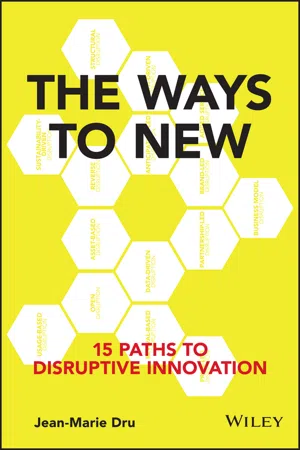
The Ways to New
eBook - ePub

The Ways to New

15 Paths to Disruptive Innovation

  1. English
  2. ePUB (mobile friendly)
  3. Available on iOS & Android
eBook - ePub

The Ways to New

15 Paths to Disruptive Innovation

About this book

Break free and lead the market with the roadmap to Disruption

The Ways to New gives you a blueprint for innovation, helping you dig your organization out of the quicksand and get on the fast track to growth. Author Jean-Marie Dru is the originator the Disruption methodology, which he shares here; he is also an international authority on breaking the mold and leading the market, and this book is his guide to making it happen. Too many companies are too slow with innovation. They lag behind, creating at a snail's pace, and thus miss out on any kind of organic growth. They approach new ideas too conservatively, and focus innovation on products only—when there is a whole world out there waiting to be disrupted. This book shows you how to steer your organization toward continued innovation, creation, growth, and success, with 15 proven paths to disruption. Each is illustrated with case studies from companies like L'oreal, Procter & Gamble, and Salesforce.com, to show you the glaring differences between disruption and stagnation.

We like to think that we live in a world where innovation happens at a staggering pace. The reality is that we don't, but that leaves an opening that your organization can fill if you're willing to break from the herd. This book shows you how start turning in a new direction, toward sustained, forward-thinking growth.

  • Foster organic growth within your organization
  • Become more proactive about innovation
  • Understand the famous "Disruption" methodology
  • Learn the specific, proven paths to disruption

Everyone loves to cite Apple, Google, and Amazon as proof of high-speed innovation. But companies like this represent only 20% of companies worldwide—the other 80% are still floundering and failing to move forward. The Ways to New gives you a roadmap to innovation, and the tools to make it work.

Trusted by 375,005 students

Access to over 1.5 million titles for a fair monthly price.

Study more efficiently using our study tools.

Information

Publisher
Wiley
Year
2015
Print ISBN
9781119167976
Edition
1
eBook ISBN
9781119211822
Subtopic
Marketing

Part One
Disruption and Innovation

Chapter 1
Disruption and the Innovation Deficit

The Innovation Deficit

Newspapers and business books have long focused on the digital revolution: on the start-up phenomenon, on the rise of nanotechnology and biotechnology, on scientific breakthroughs such as in health care. Innovation, it seems, is everywhere. But the few truly innovative corporations that have come into existence hide the facts. People lump them together with the rest of the industry, over which they may cast a rosy halo. The truth is that many companies, especially those born before the digital revolution, are proving unable to innovate fast enough.
The problem is in the implementation. Research and development guidelines often seem too conventional. They limit rather than open up possibilities. Many companies are hostages to management systems, schemes, and procedures set in stone. You only need to look at the insufficiency of their organic growth.
A.G. Lafley, Procter & Gamble's former chief executive officer, has made a list of all the innovations launched by his company in the last decades, carefully distinguishing between incremental and disruptive innovation.1 The latter are a minority but they generate more profit than incremental innovations do. Incremental innovations remain essential because they feed a continuous flow of new revenue streams, but they are insufficient, very insufficient. They do not ensure that a company will remain successful over the long term. Only disruptive innovation allows companies to stand the test of time.
Even Procter & Gamble, which ranks among the world's most innovative corporations historically, has only launched two truly disruptive innovations in recent years: Swiffer and Febreze. What about other companies? A 2011 report from Booz & Company2 underlines that the two sectors most heavily invested in research, automobiles and health care, can boast almost no disruptive innovations at all (other than the electric car). The pharmaceutical industry is struggling to innovate. Fast-moving consumer goods companies are suffering from a lack of breakthrough products. As to high-tech industries, the story is obviously different. Their latest inventions constantly make the headlines. They are transforming the business world forever. Yet, they only account for 20 percent of industrial and commercial activity. They alone cannot compensate for the insufficient pace of innovation of business as a whole.
Every year, thousands of scientific articles report on some of the millions of patents registered around the world. But the proportion of these inventions that actually come to market is very low, no more than 5 percent according to official sources. And we seem incapable of increasing the rate of success. So a solution would be not to try and improve the percentage, but to increase the size of the sample: the cent in percent. In other words, we need a much wider base of ideas.
To do this, we will have to find new sources of inspiration. New doors need to be boldly opened. Different experiments and experiences need cross-fertilizing. A diversity of talents must be brought together. Intuition must be encouraged to speak. Bountiful encounters must lead to unexpected ways of thinking. This is the very essence of Disruption.
As Frans Johansson puts it in The Medici Effect, “Quantity of ideas leads to quality of ideas.”3

Disruption Methodology

The term disruption has become hackneyed. Twenty years ago, it was the term we found to define a methodology. Then the business world appropriated it and gradually changed its meaning. Today, people use the word disruption to describe start-ups offering lower product prices through new technology. And it is true that digital newcomers can often radically upset the market, constituting a serious threat to existing players.
However, I cannot agree with this definition of Disruption. It is too restrictive. I prefer our original sense. Disruption is not just a way of defining how start-ups clear the decks in any given sector. Disruption concerns all types of businesses, in the broader definition that we shall use in this book, at any rate. To us, DisruptionÂź is a specific, three-step method: Convention, Vision, and Disruption.
Invariably, we start out by challenging existing conventions, ways of thinking and doing, based on preconceived ideas and deep-rooted habits. From there, we try to come up with a vision, a new way for a brand or company to define its future. And only then do we have Disruption, “the idea that will accelerate our journey from challenging convention on the one hand to renewed vision on the other.”
From the earliest days, it became apparent that Disruption, in this sense, would prove relevant to advertising, marketing, business models, and even new product development. Think of it as a series of concentric circles: at the center sits the product; then comes the business model; and at the outer edges stand marketing and advertising. Electric cars are a disruptive innovation. iTunes is a disruptive business model, as are Amazon, Ikea, and Airbnb. I consider Southwest Airlines and The Body Shop to be marketing disruptions. And Old Spice and Red Bull are advertising disruptions. In other words, it is possible to be a “disrupter” at any level. The closer Disruption comes to the center of the circle, which is to say the business model or even the product, the stronger it will prove.

Notes

1. Lafley, A.G., and Charan, Ram (2008). The Game-Changer: How You can Drive Revenue and Profit Growth with Innovation. New York: Crown Business Publishing. 2. “The Global Innovation 1000 Study.” Booz & Company Annual Report (2011). 3. Johansson, Frans (2006). The Medici Effect. What Elephants and Epidemics Can Teach Us About Innovation. Boston, Massachusetts: Harvard Business School Press, p.96.

Chapter 2
Disrupt the Way You Innovate

We need to fight against the widely held view that Disruption is destruction.
Some think that our only choice lies between incremental, evolutionary strategies at one end and revolutionary but destructive strategies at the other. In truth, a whole range of strategies is available to us, so that corporations can improve market share by adopting a disruptive approach, without going so far as destroying their marketplace. Not everyone has to be Uber or Airbnb.
Having said that, many of today's marketing departments appear to satisfy themselves with only incremental innovation. They do what they can to make marginal improvements. But disruptive innovation, though more demanding of imagination and commitment, also always turns out to be more fruitful. Not only does disruptive innovation create top-line growth, it also has a powerful impact on the bottom line.

Innovate against, Innovate for, Innovate with

So how does the Disruption methodology help? The answer is easy. It makes you think in many different ways.
Generally, most people innovate against or they innovate for. People innovate either where they think change is needed or because they believe they have something new to offer. In 1984, Apple innovated by challenging IBM. That was innovating “against.” Sixteen years later, in 2000, Apple was no longer an outsider. It had become a global leader: it was bringing the fruits of its amazing inventiveness to the world. It was innovating “for.”
Companies that sell fast-moving consumer goods tend to stick to “against” culture. High-tech firms tend to belong to “for” culture.
One interesting point is that the distinction between “against” and “for” matches the distinction between “Convention” and “Vision.” This observation has given rise to two different innovation sessions in Disruption meetings, whether with clients or among ourselves. At the first session, “Innovating Against,” we proceed according to the Disruption Method. In other words we identify market conventions. The aim is to dig up as many conventions as possible. Every one of them, however insignificant seeming, could turn out to be a launch pad for innovation.
The second session, called “Innovating For,” focuses on choosing one out of a range of approaches to brand vision. These can be summed up, depending on the brand story, as “An Ambition,” “A Belief,” “A Mission,” “A Viewpoint,” “A Reason for Being” or “A Role.” Every time someone comes up with a new way of looking at a brand, an avenue opens up for innovation. We also look at economic, cultural, technological, and social trends as well as dozens of related sub-trends. Then we take each one of these in turn and try to use them as a source of new ideas.
You can innovate “Against” or “For,” but also “With.” This is the subject of a third session, in which our goal is to think up partnerships, and more specifically unlikely partnerships between our clients and others. For instance, General Electric with Amazon or L'OrĂ©al with Instagram. We devise imaginary and unnatural joint ventures—with competitors, customers, and suppliers, with traditional and digital retailers, with Internet players like Facebook or Twitter, with companies in the health care, energy, and education fields—three sectors in dire need of innovation.
I call such partnerships unlikely or unnatural, in that we feel free to include in our game companies whose activities are very different from our clients's. We force things in order to maximize creative tension.

Innovate in All Shapes and Forms

Our fourth and last session is of another order. It is based on the fact that where innovation is concerned, most companies fail to venture beyond caution. Their methods tend to be repetitive, and not very inventive. We suggest that they look at how others go about things and study the way innovation happens elsewhere. And maybe get inspired by what they see.
This may seem simple, but it is important to choose examples after careful consideration. How many times have I heard our people tell c...

Table of contents

  1. Cover
  2. Title Page
  3. Copyright
  4. Dedication
  5. Foreword
  6. Introduction: Why Marketing Should Drive Innovation
  7. Part One: Disruption and Innovation
  8. Part Two: Disruptive Paths to Innovation
  9. Part Three: Disruptive Brand Building
  10. Conclusion
  11. Disruption What Ifs
  12. Exhibits
  13. Acknowledgments
  14. Bibliography
  15. Index
  16. End User License Agreement

Frequently asked questions

Yes, you can cancel anytime from the Subscription tab in your account settings on the Perlego website. Your subscription will stay active until the end of your current billing period. Learn how to cancel your subscription
No, books cannot be downloaded as external files, such as PDFs, for use outside of Perlego. However, you can download books within the Perlego app for offline reading on mobile or tablet. Learn how to download books offline
Perlego offers two plans: Essential and Complete
  • Essential is ideal for learners and professionals who enjoy exploring a wide range of subjects. Access the Essential Library with 800,000+ trusted titles and best-sellers across business, personal growth, and the humanities. Includes unlimited reading time and Standard Read Aloud voice.
  • Complete: Perfect for advanced learners and researchers needing full, unrestricted access. Unlock 1.5M+ books across hundreds of subjects, including academic and specialized titles. The Complete Plan also includes advanced features like Premium Read Aloud and Research Assistant.
Both plans are available with monthly, semester, or annual billing cycles.
We are an online textbook subscription service, where you can get access to an entire online library for less than the price of a single book per month. With over 1.5 million books across 990+ topics, we’ve got you covered! Learn about our mission
Look out for the read-aloud symbol on your next book to see if you can listen to it. The read-aloud tool reads text aloud for you, highlighting the text as it is being read. You can pause it, speed it up and slow it down. Learn more about Read Aloud
Yes! You can use the Perlego app on both iOS and Android devices to read anytime, anywhere — even offline. Perfect for commutes or when you’re on the go.
Please note we cannot support devices running on iOS 13 and Android 7 or earlier. Learn more about using the app
Yes, you can access The Ways to New by Jean-Marie Dru in PDF and/or ePUB format, as well as other popular books in Business & Marketing. We have over 1.5 million books available in our catalogue for you to explore.