Early intervention (EI) is the single most important advance in mental health care in recent decades, representing a key shift in both theoretical standpoint and service delivery.
Early Intervention in Psychiatry clearly describes best practice for extending this approach to all psychiatric disorders. Beginning with the rationale for EI, it informs interventions in people from all age groups across the lifespan, from perinatal to old age. It addresses EI in specific settings, such as primary health care, community health, the general hospital, non-government agencies, and in social movements, and for specific disorders including depression and anxiety, alcohol and substance use, childhood disorders, psychoses, bipolar disorders, eating disorders and borderline personality disorders.
Early Intervention in Psychiatry is an essential guide for all psychiatrists, general practitioners, family physicians and public health doctors. It is also a valuable resource for mental health professionals and primary care colleagues, including nurses, social workers, psychologists, occupational therapists, vocational rehabilitation specialists, peer and support workers and for mental health commissioners and policy-makers.
eBook - ePub
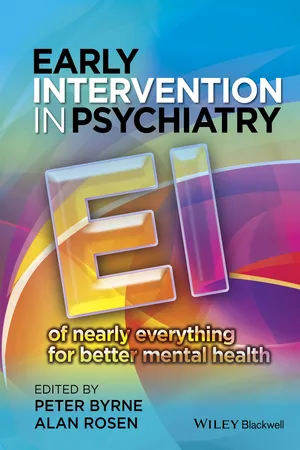
Early Intervention in Psychiatry
EI of Nearly Everything for Better Mental Health
- English
- ePUB (mobile friendly)
- Available on iOS & Android
eBook - ePub
Early Intervention in Psychiatry
EI of Nearly Everything for Better Mental Health
About this book
Information
I
The Rationale for Early Intervention in Nearly Everything
CHAPTER 1
Introduction
Peter Byrne1,2 and Alan Rosen3,4,5
1 Homerton University Hospital, London
2 Royal College of Psychiatrists, UK
3 School of Public Health, University of Wollongong
4 Brain and Mind Research Institute, University of Sydney
5 Mental Health Commission of New South Wales, Australia
Early intervention (EI) is arguably the single most important advance in mental health care of the past decade. In terms of all-time advances in mental health care delivery, EI is up there with the consumer, family, recovery, and human rights for psychiatric disability movements, person-centred and holistic integrated services, effective psychotropic medications and psychotherapeutic interventions, evidence-based psychosocial interventions and mobile assertive community-centred service delivery systems. EI represents a key shift in both theoretical standpoint and service delivery, and marks an end to the first era of community psychiatry – where we set up ‘accessible’ clinical structures by locality, and patients were expected to adapt to these. With EI, practitioners reconfigure how they work to engage, negotiate and agree interventions support and care with their service users. From a general practitioner (GP) perspective, some modern community mental health teams (CMHTs) have ‘raised the bar’ to focus only on those with severe mental illness (SMI), now implicitly or formally defined as established psychotic disorders. Many CMHTs decline people in crisis or in the early stages of illness: by the time their referral is accepted later on, engagement is harder and many interventions have a reduced efficacy. Like all useful ideas, EI is a simple one and has instant appeal to people in early stages of illness (crucially often before insight is lost) and to their families. Key clinicians, notably GPs and mental health professionals also have a strong self-interest in designing and supporting efficient EI services. It is both self-evident to them, and increasingly evident from emerging studies, that such timely approaches could save much harder and longer clinical endeavour further down the track. We list the key pioneers later (Chapter 27), many of whom have contributed to this book. Their work, along with impressive citations at the end of each chapter, should persuade readers new to EI that this will be a key component of the twenty-first century mental health care. This book's main aim is to affirm for every clinician, every purchaser of services and other interested parties the high value of EI in most care settings from cradle to grave.
Prevention
Caplan's three levels of prevention are well described [1, 2]. Primary prevention prevents the disorder from occurring in the first place, secondary restores health from an existing disorder, while tertiary attempts to claw back better function from persistent or long-term disorders. In mental health service delivery, most effort and money are devoted to tertiary prevention/maintenance treatment, where the quality of rehabilitation may be so variable that the term ‘rehabilitation’ may sometimes be a euphemism for habitual low-grade custodial care. Secondary prevention is the early recognition and treatment of psychiatric disorders: to date, the best evidence and best practice has been implemented in EI for psychosis in young people (see Chapters 7, 9, 15 and 21). This book will inform interventions in people from all age groups, building on the core components of excellent services: engaging, low (negative) impact practices that are culture- and age-sensitive with robust crisis interventions, assertive case management, flexible home visiting, family consultations and in and out of hours, active response services. EI teams should have a low threshold to identify individuals warranting assessment, monitoring and sometimes treatment, reduce stigma in patients and their local community, engage individuals with emerging symptoms and their family carers in low-key pre-emptive services even if formal treatment is not indicated, not wanted or not available, locally or anywhere. Their primary aim is to treat vigorously the first signs of the disorder in the first 3 years (‘the critical period’). In managing a complex mix of possible noncases and cases, medication is only one option and part of phase-specific organic and psychosocial interventions: comprehensive therapeutic assessment, crisis intervention, education, family work, cognitive behavioural therapy, assertive community treatment, substance misuse and vocational interventions, to name but eight.
Overview: structure of this book
EI principles also support service users and carers in their individual recovery models, and dare to aim for full remission or generate hope that their symptoms do not develop into lifelong disability. A large part of primary care, child psychiatry and consultation–liaison (general hospital) psychiatry works as secondary prevention, but within large caseloads across secondary services including CMHTs, there are many opportunities for EI. This book's approach will be:
- Across the age spans, identifying the best EI practices in specific groups.
- Comprehensive: most common psychiatric disorders will be addressed – that is the ‘nearly everything’ of our subtitle. Because most psychiatric subspecialities have developed in isolation, they may be unaware of hard-won lessons from other colleagues in engaging and managing people from different demographic groups and cultures. Whether your patient is 8 or 80, there is much to be gained from an EI ethos.
- Evidence based, with an emphasis on outcomes (e.g. improvements in symptoms, social functioning, concordance, quality of life, service satisfaction) and outputs (e.g. interventions, contacts with services, clear care pathways that encourage referrals). Where these are available and reliable, screening instruments will be discussed.
- International, with authors and promising studies and experiences recounted from Asia, Australasia, Europe and North America.
- Practical: though it is challenging to cross different cultures and diverse health care provision, authors will try to answer readers' questions about how excellent EI service configurations might look (Section III), and which clinicians are best placed to intervene.
- Interdisciplinary and collaborative: this book was written for all interdisciplinary team members, our mental health and primary care colleagues (nurses, social workers, psychologists, occupational therapists, vocational rehabilitation and supported housing specialists, peer workers etc.), doctors (psychiatrists, GPs, public health doctors, paediatricians, adolescent specialists, physicians, geriatricians and more), managers, purchasers/commissioners and other health care providers. The book will also be useful to trainees in these disciplines, postgraduate students and commentators and to service user and family groups.
- Flexible and holistic: one of the key lessons from EI Psychosis Teams internationally has been NOT to send young people elsewhere (to another service) to address their substance misuse problems, or to separate organisations to deal with educational/training, housing, relationship problems. Although we did not brief authors about physical health care, this was raised frequently by the individual authors, and new approaches are set out later.
- Pragmatic: for clinicians with scarce resources, prioritising early identification (precursor symptoms and prodromes) to reduce current long durations of untreated illness and to set out core interventions that reduce psychological morbidity.
- Future proof: where evidence appears relatively sparse (e.g. eating disorders, learning disability, bipolar disorder) or where research continues apace (e.g. psychosis, dementia, delirium), expert clinicians will summarise the advances and predict where best practice will lie in the future. Though it may be attractive to researchers, the book is aimed primarily at clinicians, service planners and providers.
We begin with contributions from two key groups, whose interests mostly overlap – service users (consumers) and carers (families) – before hearing the economic arguments in the fourth chapter. The next six chapters have artificially divided the life span into five stages. Our needs change as we attach, individuate, enter adolescence then adulthood, before biology and our environment act upon us in middle age through to later life. We also include a key chapter on transition – from children's services to general adult psychiatry as Chapter 8. As health care providers this is an inevitable transition that should herald an orderly handover of care. Certainly in Europe, and we believe elsewhere, clinicians have not managed this well, and there are lessons to learn. Although artificial, we have laid out settings and levels of prevention in the next five chapters. We accept the same patients are attending GPs (Chapter 13) as are admitted to general hospitals (Chapter 14), and every one of them benefits from primary prevention (Chapter 11) and voluntary sector activities (Chapter 12). Though this might seem theoretical, we think the principles that drive the evidence might be similar but the different settings require different strategies to deliver EI. Not least, each setting has a different story to tell about the institutional and other obstacles to EI.
Inevitably, we expect busy clinicians and students to go straight to the third section and Chapter 16 (the common mental disorders of depression and anxiety) and thence to the following eight chapters that are disorder specific. EI sceptics, and there are many, might need to explore the challenges from their comfort zone...
Table of contents
- Cover
- Fmimage
- Title Page
- Copyright
- Dedication
- List of Contributors
- Foreword
- Part I: The Rationale for Early Intervention in Nearly Everything
- Part II: Early Intervention Across the Lifespan
- Part III: Early Intervention in Specific Settings
- Part IV: Early Intervention in Specific Disorders
- Part V: Conclusions
- Afterword for Early Intervention of Nearly Everything for Better Mental Health Services
- Index
- End User License Agreement
Trusted by 375,005 students
Access to over 1.5 million titles for a fair monthly price.
Study more efficiently using our study tools.
Frequently asked questions
Yes, you can cancel anytime from the Subscription tab in your account settings on the Perlego website. Your subscription will stay active until the end of your current billing period. Learn how to cancel your subscription
No, books cannot be downloaded as external files, such as PDFs, for use outside of Perlego. However, you can download books within the Perlego app for offline reading on mobile or tablet. Learn how to download books offline
We are an online textbook subscription service, where you can get access to an entire online library for less than the price of a single book per month. With over 1.5 million books across 990+ topics, we’ve got you covered! Learn about our mission
Look out for the read-aloud symbol on your next book to see if you can listen to it. The read-aloud tool reads text aloud for you, highlighting the text as it is being read. You can pause it, speed it up and slow it down. Learn more about Read Aloud
Yes! You can use the Perlego app on both iOS and Android devices to read anytime, anywhere — even offline. Perfect for commutes or when you’re on the go.
Please note we cannot support devices running on iOS 13 and Android 7 or earlier. Learn more about using the app
Please note we cannot support devices running on iOS 13 and Android 7 or earlier. Learn more about using the app
Yes, you can access Early Intervention in Psychiatry by Peter Byrne, Alan Rosen, Peter Byrne,Alan Rosen in PDF and/or ePUB format, as well as other popular books in Medicina & Psichiatria e salute mentale. We have over 1.5 million books available in our catalogue for you to explore.