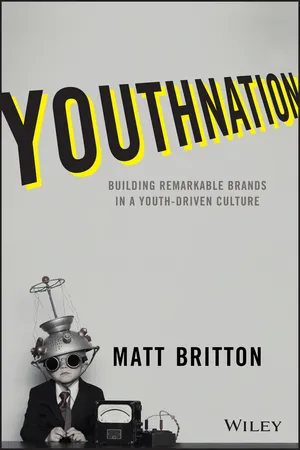
YouthNation is an indispensable brand roadmap to the youth-driven economy. Exploring the idea that youth is no longer an age—it's a commodity that's available to everyone—this book shows what it takes to stay connected, agile, authentic, and relevant in today's marketplace. Readers will learn the ins and outs of the new consumer, and the tools, methods, and techniques that ensure brand survival in the age of perpetual youth. Coverage includes marketing in a post-demographic world, crafting the story of the brand, building engaged communities, creating experiences that inspire loyalty and evangelism, and the cutting-edge tricks that help businesses large and small harness the enormous power of youth.
The old marketing models are over, and the status quo is dead. Businesses today have to embody the ideals of youth culture in order to succeed, by tapping the new and rapidly evolving resources n business and in life. When everything is changing at the pace of a teenager's attention span, how do businesses future-fit for long-term success? This book provides a plan, and the thoughts, strategies, and brass tacks advice for putting it into action.
Use New-Gen psychographics to target markets
Build stronger evangelism with a compelling brand narrative
Create loyal communities with immersive and engaging experiences
Navigate the radically-changed landscape of the future marketplace
In today's hyper-socialized, Facebook fanatic, selfie-obsessed world, youth is the primary driver of business and culture. Smart companies are looking to tap into the fountain of youth, and the others are sinking fast. YouthNation is a roadmap to brand relevancy in the new economy, giving businesses turn-by-turn direction to their market destination.
The notion of the status symbol goes back as far as human history. In ancient China, once a man reached 20, he was permitted to wear a cap. This was celebrated with a ceremony called Guanli, or Ceremony of the Cap. As each new dynasty took hold, the caste system of the cap evolved, developing ever more specific rules and privileges associated with each style. What your cap looked like, and what shape or color it was, said very important things about you. For example, in the Han Dynasty a “lowly person” had to be content wearing only a headband, whereas the elite could get really decadent and wear a headband with a matching hat.
Since its early beginnings with the highly nuanced Chinese cap trend, the notion of the status symbol really took off, taking hold all over the globe in an ever widening array of objects and styles, all designed to tell a story about the importance of the owner. In America today, Maybach vehicles, Christian Louboutin shoes, Hublot watches, and real estate in glamorous places like the Hamptons or Malibu are the de rigeur status symbols of opulence and power among the super wealthy.
America's youth has had a love/hate relationship with status symbols. For one, the glittering objects of the affluent elite have been by and large out of reach for them. In earlier generations, young people were motivated to work hard and long to reach the point where status symbols such as a beautiful home or a nice car were attainable. As the gap between aspirational youth and the affluent mainstream widened, however, the nation's youth rejected the status quo and turned to anti–status symbols to express a different kind of importance within their own cultural sphere.
Along with this shift away from traditional status symbols, came a new set of values to support this new anti-status iconography. In the sixties, for example, ripped jeans, flag t-shirts, and long hair became counterculture status symbols. Along with these symbols came a lifestyle and world vision centered on experiences that were not about luxury but about the pure enjoyment of life in its simplest and purest form. Be-ins, happenings, and protests, became the status alternatives for a youth culture in revolt against a system that had shut them out entirely, and that stood for materialism over existentialism. For young America in those days, poverty became chic, and wealth became tacky. And so a schism grew up between the mainstream and the counterculture with regard to visions of what status really meant, what was truly important and valuable in life, and how that was expressed.
Mainstream Status Symbols in the Sixties
Counterculture Status Symbols in the Sixties
Lincoln Continental
Travel aboard a Pan Am jet clipper
Color TV
A royal title
A suburban bungalow
The peace sign
The Afro
Levi's
Psychedelic drugs
Tie-dyed t-shirts
Communes
The Hip-Hop Invasion and the Reimagined Status Symbol
Young America's feelings about mainstream status symbols changed dramatically in the nineties. Suddenly, traditional status symbols of luxury and affluence became more accessible to youth culture. The accessibility of luxury opened up enormous windows of opportunities for brands and entertainers alike. The emergence of hip-hop culture combined with a booming economy toward the end of the twentieth century brought status symbols to young people in a whole new way. An infinite and innovative variety of status symbols, which were accessible and available everywhere from suburban malls to urban street corners across the U.S., led a hip-hop renaissance, along with a world vision that supported this new emphasis on accessible affluence for youth.
Hip-Hop Status Symbol Highlights
Through pervasive lyrics, from the likes of Notorious B.I.G., Jay-Z, Kanye West, Mase, Nas, and others, the new importance of status symbols to young America came through loud and clear. This new youth narrative, which stressed affordable opulence, helped usher in a wave of accessible luxury goods creating status symbols in every section of the economy. Here are some of the more notable examples:
One of the first status symbols that emerged from hip-hop's early influence was from Run DMC in 1986 by way of their hit song “My Adidas.” These early rap pioneers received a multimillion dollar endorsement deal as Adidas' three-striped sneakers tread the streets from Queens to Long Beach, California, in heavy rotation.
In 1994 Snoop Dogg donned some Tommy Hilfiger gear on Saturday Night Live, and sales reportedly jumped by over $90 million that year. Prior to the SNL endorsement, Tommy Hilfiger was largely an elitist fashion brand relatively unknown in inner cities and hip-hop culture.
Leading into 2001 at least 10 Rap and R&B songs by artists including Jennifer Lopez had mentioned Cadillac's Escalade brand in their song lyrics. During the MTV video awards that year, Ludacris drove an Escalade right onto the stage. His hit song that year “Southern Hospitality” included the lyrics: “Cadillac grills, Cadillac mills, Cadillac fills.” Suddenly Cadillac, which had an average consumer age of 62, had its Escalade SUV on back order in the dealerships of major cities where a whole new generation was lining up to be a reimagined Cadillac owner.
In 2003 after Justin Timberlake wore a Von Dutch trucker hat to the Grammy after parties, stars like Britney Spears and Ashton Kutcher quickly followed suit. The Von Dutch had been in fringe existence for five years before this fortuitous set of events. After its celebrity patronage, it became a status symbol at suburban malls in white upper-middle class enclaves across America, selling out of stores at prices exceeding $100.
Through hats, cars, and sneakers, America's hip-hop and pop culture icons of the new millennium became core drivers of discretionary spending among America's youth. Logos meant more than ever before and played an increasingly important role in showcasing social status, wealth, and style, the very same way that wearing hats did in ancient China.
Logos from companies like GAP, Abercrombie & Fitch, and FUBU were brazenly branded across outerwear and considered high fashion simply because of their label. By the mid-00s, hip-hop would go on to reach arguably its cultural peak as whimsical lyrics about Gulfstream private jets, Cristal champagne, and Jacob the Jeweler bling were commonplace in songs on Casey Kasem's top 40 lists.
Status Symbols Disrupted
While much has been written about the effect of the 2008 financial collapse on American culture, its impact on pop culture and music has largely been understated. In fact a strong argument can be made that the experience of parental stress and deflated 401(k) accounts made YouthNation rethink the importance of the material status symbols that had become so important in defining their identity in the nineties.
The logos once proudly emblazoned across their chests, YouthNation realized, were nothing more than manufactured corporate symbols of a crumbling and sometimes corrupt empire. Somehow, having mom or dad splurge on a $200 pair of Air Yeezys when they were trying to piece together the monthly mortgage payment just didn't seem as cool anymore.
The foundational belief that home prices and stock values would always rise, and every generation would do better than the one before it, came crashing down with every word out of Maria Bartiromo's mouth on those scary fall 2008 mornings on CNBC. Despite the continued popularity of a select group of hip-hop artists who became bona fide crossover stars into mainstream pop (Jay-Z, Kanye West, Lil' Wayne), 2008 created a palpable shift within popular music as the once dominant genre of hip-hop gradually lost its hold on YouthNation's imagination.
A new measure of importance and a new definition of status emerged out of the social media trend that was beginning to entrance our culture. Shiny new stuff started to lose its glimmer, and in its place came a new form of status, based not on material items, but on experiences.
YouthNation's Guide to Creating a Status Symbol
Though status symbols may differ widely in form, shape, and design, there are a few key elements that all status symbols have in common. Here are the critical components that go into the creation of any breakout status symbol to guide you in the creation of your own luxury offerings:
Cost: In modern society, few things play a bigger role in establishing something as a status symbol than the amount of money it takes to acquire it. The ownership of certain things that come at great cost—a mansion, a luxury vehicle, a yacht, or vacation home—signifies economic class and, in some cases, power. In fact, the purchase of some items, such as a private jet, can propel you into an even higher social class, in this case the “jet set” which travels the world from the privacy of their own aircraft. Note: If you want to see YouthNation's take on the “jet set” follow “RichKidsOfInstagram” on Instagram (but don't procrastinate on that for too long).
Some high-cost status symbols even seem to defy the basic principles of economics and are known as Veblen goods. The price of Veblen goods will always remain high, regardless of low demand, and in fact, lowering their cost would make them less desirable to those few with the money to burn.
Exclusivity: The more difficult something is to obtain, the more desirable it becomes as a status symbol. This is true for both goods such as the Veblen goods that defy economic principles, as well as certain services and memberships. The American Express Centurion Card, for example, is an invitation-only card made available exclusively to those who meet a set of eligibility criteria. The same ap...
Table of contents
Cover
Title Page
Copyright
Table of Contents
Dedication
Foreword
Acknowledgments
Disclosures
How to Connect with Me and Learn more about YouthNation
Introduction: Forever Young
Chapter 1: From Status Symbol to Status Update
Chapter 2: From Things to Thrills
Chapter 3: The Rise of Electronic Dance Music
Chapter 4: Access Over Ownership
Chapter 5: The Communal Table
Chapter 6: The Peer-to-Peer Economy
Chapter 7: The Power of the Crowd
Chapter 8: Free Agency
Chapter 9: Lifehacking
Chapter 10: The Field Guide to Lifehackers
Let's Pivot to Brand Building
Chapter 11: TV, the NFL, and the End of Demographics
Chapter 12: Going Viral: Decoded
Chapter 13: Big Data 101
Chapter 14: People Are Brands
Chapter 15: Brands Are People
Chapter 16: A Story Worth Sharing
Epilogue
Index
End User License Agreement
Trusted by 375,005 students
Access to over 1.5 million titles for a fair monthly price.
Study more efficiently using our study tools.
Frequently asked questions
Yes, you can cancel anytime from the Subscription tab in your account settings on the Perlego website. Your subscription will stay active until the end of your current billing period. Learn how to cancel your subscription
No, books cannot be downloaded as external files, such as PDFs, for use outside of Perlego. However, you can download books within the Perlego app for offline reading on mobile or tablet. Learn how to download books offline
Perlego offers two plans: Essential and Complete
Essential is ideal for learners and professionals who enjoy exploring a wide range of subjects. Access the Essential Library with 800,000+ trusted titles and best-sellers across business, personal growth, and the humanities. Includes unlimited reading time and Standard Read Aloud voice.
Complete: Perfect for advanced learners and researchers needing full, unrestricted access. Unlock 1.5M+ books across hundreds of subjects, including academic and specialized titles. The Complete Plan also includes advanced features like Premium Read Aloud and Research Assistant.
Both plans are available with monthly, semester, or annual billing cycles.
We are an online textbook subscription service, where you can get access to an entire online library for less than the price of a single book per month. With over 1.5 million books across 990+ topics, we’ve got you covered! Learn about our mission
Look out for the read-aloud symbol on your next book to see if you can listen to it. The read-aloud tool reads text aloud for you, highlighting the text as it is being read. You can pause it, speed it up and slow it down. Learn more about Read Aloud
Yes! You can use the Perlego app on both iOS and Android devices to read anytime, anywhere — even offline. Perfect for commutes or when you’re on the go. Please note we cannot support devices running on iOS 13 and Android 7 or earlier. Learn more about using the app
Yes, you can access YouthNation by Matt Britton in PDF and/or ePUB format, as well as other popular books in Business & Advertising. We have over 1.5 million books available in our catalogue for you to explore.