![]()
1
Kennel Management and Nutrition of the Bitch and Her Offspring
Jill Cline
There is no denying that kennel management, husbandry, and nutrition play equal roles in determining the success of a mating to bear live, viable puppies. Simple management of each of these factors will significantly improve the likelihood of a healthy breeding stock and puppies.
Kennel Management
The facilities which house breeding dogs are a contributing factor to the success of the breeding program. In many cases, the “facilities” may be as simple as a whelping box tucked into the corner of the laundry room, but the facilities could be as complex as a multibuilding campus requiring elaborate husbandry, record-keeping, and sanitation programs. Building styles and materials and outdoor kennel areas affect sanitation and husbandry practices. Whelping and raising puppies requires certain changes in sanitation and husbandry procedures when compared with caring for adult, nonbreeding dogs.
Building Management
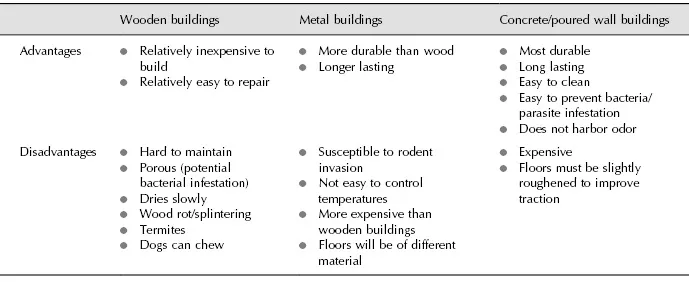
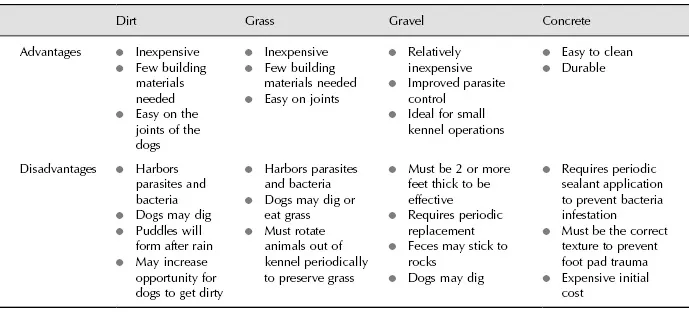
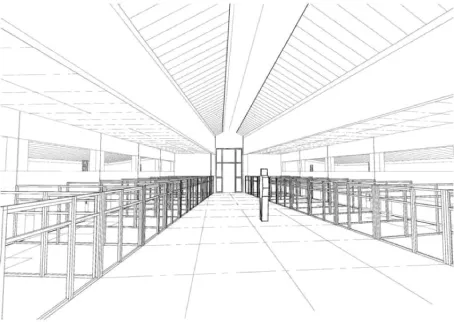
Most hobby breeders prefer to keep their dogs in their homes, but some breeders may choose to provide a separate building for breeding and kennel activities. There are three main types of kennel construction materials: wood, metal, or concrete or poured walls. Many buildings are combinations of the available materials. Table 1.1 outlines the advantages and disadvantages of each construction material as it pertains to kennel management and Table 1.2 details the advantages and disadvantages of different outdoor kennel types. Over the past few years, kennel design has moved away from traditional linear kennels and toward building shapes which improve quality of life and decrease stress in dogs. Figure 1.1 shows a V-shaped kennel design which allows all dogs’ line of sight to exits as well as the central feeding and grooming areas. Round buildings provide the same effect and have been shown to decrease stress hormones and barking by 40% when compared to linear kennels. Providing safe, clean, and enriched environments for breeding dogs and puppies decreases stress and improves overall health and well-being (Lawler, 1995).
Table 1.1 Advantages and disadvantages of different kennel building types.
Adapted from Lawler (1995).
Table 1.2 Advantages and disadvantages of different outdoor kennel or run surfaces.
Sanitation and Husbandry
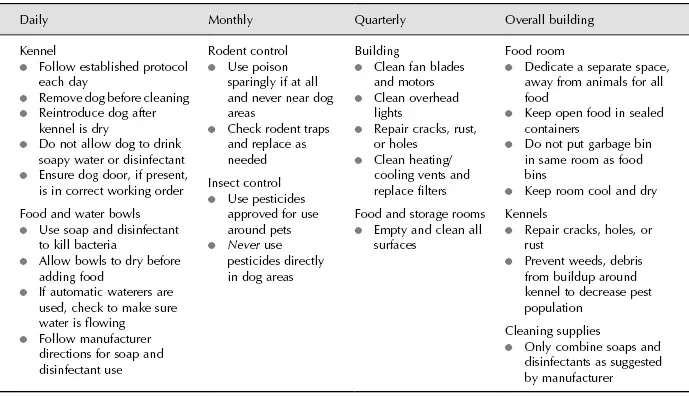
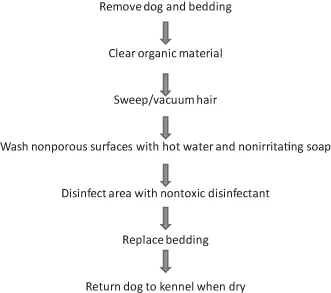
Sanitation programs are ideally established before a breeding program is developed; however, it is important to intermittently review the sanitation practices with the health and safety of the breeding bitch and the puppies, both in utero and on the ground, in mind. Sanitation programs can be divided into four main areas: the overall building, monthly sanitation, periodic cleaning, and daily cleaning. Most sanitation practices are commonsense and need only to be refreshed in the mind of the primary caregiver. Table 1.3 provides a list of activities for areas of the sanitation program. Figure 1.2 illustrates the order in which kennels should be cleaned.
Table 1.3 Sanitation practices for kennel and outdoor areas.
Puppies are inoculated with their initial microflora milieu from their dam and their environment; therefore, it is essential to manage both in such a way to provide a healthy start to life. Transmission of potentially infectious agents and expression of infection depend on the type of contact and susceptibility of the host animal. Transmission can be direct and immediate between the current reservoir host and the potential new host, or through surfaces or other vectors (Lemarie & Hosgood, 1995). Factors which influence the likelihood of infection of the host include age, nutritional status, immune health, and environmental factors like season, overcrowding, ventilation, and sanitation. For example, increases in seasonal humidity can affect the incidence of mastitis, metritis, and neonatal mortality (Case et al., 2000).
In preparation for whelping, the bitch should be introduced to the whelping area, if different, at least 5 days prior to whelping. This allows her to acclimatize and “nest” to make the area her own prior to the onset of labor. The whelping area should be draft free and preferably temperature controlled, regardless of season. Optimal room temperature is 70°F if the dam is present to provide additional warmth (Case, 1999). If central heating/cooling is not possible, provisions should be made for providing a thermal neutral or comfortable temperature for the bitch and puppies. If it is too cool, there is an increased risk of respiratory complications and if it is too warm, an increased risk of infections. Puppies do not have the shiver response until they are over 5 days old, so one cannot rely on the puppies’ reaction to their environment as an indicator of appropriate temperature (Case et al., 2000).
Heat lamps are a viable alternative only if placed so that they warm only one-half to two-thirds of the whelping box rather than the entire box so that both the bitch and the puppies can move away from the direct heat if they become too warm. Heating pads should be used with caution, especially when the pups are very young. Prolonged exposure to a too-warm heating pad can cause tissue degeneration and breakdown of organs. Never warm chilled puppies quickly on a heating pad; instead, use body heat to slowly warm chilled puppies over 1–2 hours.
The opposite problem, attempting to cool the bitch and puppies, also requires careful consideration. Fans circulate air, but can also blow potential infectious agents onto the puppies. Fans may also cause drafts which could lead to chilling. Cold, wet towels can be used to cool the bitch but should not be used with young puppies.
The whelping box should be 1.5 to 2 times the length of the bitch from nose to base of tail. There are many different whelping box options. Examples of simple boxes would include a child’s hard plastic wading pool or a plastic box open at the top so the dam can come and go, or an open fronted plastic box with a piece of plastic blocking the bottom half of the open side to keep the puppies contained. More elaborate commercial boxes can be purchased which contain safeguards like a rail along the inside (pig rail) which prevents the bitch from accidentally smothering a puppy between her body and the side of the whelping box. Whelping nests are available to build into the center of the whelping box. The heat to the nest itself is controlled by a rheostat, while the surrounding edges of the box are cooler for the bitch. Once the puppies are older they will start to leave the nest and explore the cooler areas of the box. The temperature rheostat is adjusted as the puppies age.
All whelping boxes should be nonporous and easy to clean. In the first few weeks, the bedding will have to be changed multiple times per day. Appropriate bedding would include old towels, mattress pads, cloth diapers, or indoor/outdoor carpeting. Newspapers are often used for the first few days but should be discontinued when the puppies begin to move around and use their mouths to explore. As puppies grow and begin to explore their environment, surrounding the whelping box with a wire or epoxy-coated wire exercise pen is advisable. This allows the puppies to move away from the whelping box and observe the surrounding environment through the open wire of the pen but still keep them safely contained.
Puppies are very fragile for the first few weeks of life. A multiyear analysis of breeding kennel records indicated the highest risks for neonatal mortality were either being stillborn (29%) or death between 0 and 3 days of age (49.6%) (Lawler, 2008). After the first week, mortality dropped considerably. There appears to be a strong correlation between postwhelping weight and survival. It is not uncommon for puppies to lose a small amount of their initial birth weight, similar to human babies. However, a postwhelping loss of 10% or greater was linked with lower survival rates. Table 1.4 contains general causes of mortality in pups. Further discussion will be found in the neonatal disease chapter (Chapter 8). Weighing puppies daily for the first 2 weeks and then every third or fourth day until 4 weeks of age makes it easy to determine if the pups are continuing to grow appropriately and allows the caregiver a quick daily physical exam of each puppy. A general rule of thumb is a puppy should gain 1–2 g/day for each pound of anticipated adult body weight. As an example, a puppy that is predicted to weigh 40 lb as an adult should gain 40–80 g or 1.6–3.3 oz/day for the first 4 weeks.
Table 1.4 General causes of mortality in pups.
Adapted from Lawler (1995).
| Stress | Birth weight |
| Sanitation | Hypoxia |
| Noise | Acid–base balance |
| Humidity (and barometric pressure) | Temperature |
| Temperature | Infection |
| Feeding (malnourishment/unable to feed) | |
| Trauma | |
| Cannibalism | |
Nutrition of the Bitch and Offspring
Planning the Plane of Nutrition
It can take several weeks for a dog to entirely adjust to a new food. The endogenous gut bacteria require approximately 3 weeks to adjust to a new food (Czarnecki-Maulden & Patil, 2002). During this time there are increases and decreases in certain bacterial populations based on the ingredient and nutrient matrix of the food. In addition, enzymes for digestion of nutrients have to be adjusted for the new nutrient matrix. Therefore, abrupt changes in diet can cause gastrointestinal upset in some dogs and result in flatulence, soft stool, or diarrhea.
Dog skin cells turn over every 21 days, which means visible changes due to diet are often not seen for the first few weeks after diet change. The muscle cells take even longer to turn over, approximately 45 days for striated muscle and the subsequent changes in metabolic enzyme concentrations are dependent on consistent delivery of nutrients.
Therefore, it is often recommended to switch to the chosen food for gestation and lactation at least by the day of breeding, but in reality it is preferred to switch to the food well in advance (at least 21 days) of breeding to allow the dog to adjust to the new diet before the stress of egg production and to maximize breeding potential.
Good kennel or breeding program management requires considering not only the ancestry, physical, and behavioral attributes of the breeding stock but also an element of preplanning, especially with regard to plane of nutrition of the dogs at time of breeding. Many things can affect conception rates, the incidence of pseudopregnancy, and the number of viable offspring; for example, appropriate detection of estrus, the number of oocytes released, and the parity or number of prior litters. Two other factors that can influence co...