Making Sense of Data I
A Practical Guide to Exploratory Data Analysis and Data Mining
- English
- ePUB (mobile friendly)
- Available on iOS & Android
Making Sense of Data I
A Practical Guide to Exploratory Data Analysis and Data Mining
About this book
Praise for the First Edition
"...a well-written book on data analysis and data mining that provides an excellent foundation..."
—CHOICE
"This is a must-read book for learning practical statistics and data analysis..."
—Computing Reviews.com
A proven go-to guide for data analysis, Making Sense of Data I: A Practical Guide to Exploratory Data Analysis and Data Mining, Second Edition focuses on basic data analysis approaches that are necessary to make timely and accurate decisions in a diverse range of projects. Based on the authors' practical experience in implementing data analysis and data mining, the new edition provides clear explanations that guide readers from almost every field of study.
- Updated exercises for both manual and computer-aided implementation with accompanying worked examples
- New appendices with coverage on the freely available Traceis™ software, including tutorials using data from a variety of disciplines such as the social sciences, engineering, and finance
- New topical coverage on multiple linear regression and logistic regression to provide a range of widely used and transparent approaches
- Additional real-world examples of data preparation to establish a practical background for making decisions from data
Making Sense of Data I: A Practical Guide to Exploratory Data Analysis and Data Mining, Second Edition is an excellent reference for researchers and professionals who need to achieve effective decision making from data. The Second Edition is also an ideal textbook for undergraduate and graduate-level courses in data analysis and data mining and is appropriate for cross-disciplinary courses found within computer science and engineering departments.

Trusted by 375,005 students
Access to over 1 million titles for a fair monthly price.
Study more efficiently using our study tools.
Information
CHAPTER 1
INTRODUCTION
1.1 OVERVIEW
1.2 SOURCES OF DATA
1.3 PROCESS FOR MAKING SENSE OF DATA
1.3.1 Overview
- Problem definition and planning: The problem to be solved and the projected deliverables should be clearly defined and planned, and an appropriate team should be assembled to perform the analysis.
- Data preparation: Prior to starting a data analysis or data mining project, the data should be collected, characterized, cleaned, transformed, and partitioned into an appropriate form for further processing.
- Analysis: Based on the information from steps 1 and 2, appropriate data analysis and data mining techniques should be selected. These methods often need to be optimized to obtain the best results.
- Deployment: The results from step 3 should be communicated and/or deployed to obtain the projected benefits identified at the start of the project.

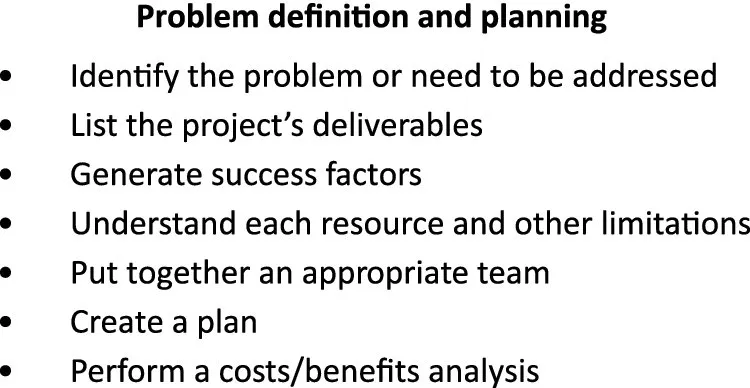
1.3.2 Problem Definition and Planning

Table of contents
- Cover
- Titlepage
- Copyright
- PREFACE
- 1 INTRODUCTION
- 2 DESCRIBING DATA
- 3 PREPARING DATA TABLES
- 4 UNDERSTANDING RELATIONSHIPS
- 5 IDENTIFYING AND UNDERSTANDING GROUPS
- 6 BUILDING MODELS FROM DATA
- APPENDIX A ANSWERS TO EXERCISES
- APPENDIX B HANDS-ON TUTORIALS
- BIBLIOGRAPHY
- INDEX
- END USER LICENSE AGREEMENT
Frequently asked questions
- Essential is ideal for learners and professionals who enjoy exploring a wide range of subjects. Access the Essential Library with 800,000+ trusted titles and best-sellers across business, personal growth, and the humanities. Includes unlimited reading time and Standard Read Aloud voice.
- Complete: Perfect for advanced learners and researchers needing full, unrestricted access. Unlock 1.4M+ books across hundreds of subjects, including academic and specialized titles. The Complete Plan also includes advanced features like Premium Read Aloud and Research Assistant.
Please note we cannot support devices running on iOS 13 and Android 7 or earlier. Learn more about using the app