Biological Sciences

Artificial Selection
Artificial selection is the process by which humans intentionally breed plants or animals for specific desirable traits. This selective breeding can lead to the development of new varieties or breeds with characteristics that are more beneficial to humans. Through artificial selection, humans have been able to significantly alter the genetic makeup of various species to suit their needs and preferences.
Written by Perlego with AI-assistance
Related key terms
1 of 5
7 Key excerpts on "Artificial Selection"
 eBook - PDF
Experimental Evolution
Concepts, Methods, and Applications of Selection Experiments
- Theodore Garland, Michael R. Rose, Theodore Garland, Michael R. Rose(Authors)
- 2009(Publication Date)
- University of California Press(Publisher)
The effectiveness of selection can be further increased by controlling the mating by pairing specific individuals among the selected cohort (Falconer and Mackay 1996). Artificial Selection also allows a direct measurement of selection differential or intensity, as well as realized heritability (Falconer and Mackay 1996). Artificial Selection is the approach used in most evolutionary studies of behavior, including virtually all experiments on vertebrates (see also Garland 2003; Eisen 2005; Swallow and Garland 2005; Swallow et al. this volume), where the population size and the number of generations are limited by other considerations (e.g. , cost, low reproduc-tive rate, long generation time). Breeding for desired behavioral characteristics has also been practiced for millennia in the process of domestication of animals, long before being applied to scientifically motivated study of the evolution of a behavior. One inter-esting observation from domestication is that unintentional changes (i.e., correlated responses) in morphological characters are remarkably similar across domestication events and across species of vertebrates (Belyaev 1979). For example, selection for tame-ness in the Russian fox, Vulpes vulpes , found patterned changes in pigment in the skin and fur in the shape of a star on the face (common in dogs, Canis lupus familiaris ), floppy ears (common to dogs, goats, and sheep), and rolled tails (common in dogs and pigs) (Belyaev 1979; Belyaev et al. 1981; Trut 1999). Many other changes were noted in behav-ioral and physiological traits, such as the onset of hormonally driven fear and aggression responses during early postnatal development, and changes in serotonin metabolism in the brain (Hare et al. 2005). Although a great deal has been learned from these domes-tication events, they are not scientific experiments (e.g., variables are not always con-trolled, lines are not replicated).
- Günter Wricke, Eberhard Weber(Authors)
- 2010(Publication Date)
- De Gruyter(Publisher)
5. Basic concepts of selection Selection is one of the main processes in any breeding program. Generally two different types of selection can be distinguished: natural selection and Artificial Selection (see also page 4). In both cases the number of offspring - or the size of the clone in case of vegetatively propagated crops -depends on the genotype. In natural selection the selective advantage of a specific genotype is measured by thefitness value. The ratio of fitness values of two genotypes measures the ratio of their numbers of offspring. The fitness value depends on several factors in-cluding viability, fecundity, or longevity. In most cases fitness itself can be regar-ded as a quantitative character. In Artificial Selection the breeder determines the number of offspring to be saved. Formally the number of offspring raised by the breeder is a measure of fitness in Artificial Selection. In the easiest case only two groups of genotypes exist. One group is discarded and from the other group progenies of nearly equal size are raised. In context with the fitness concept the discarded genotypes can be considered as having a fitness value of zero. Often more complicated schemes are used; for example, mass selection after flowering in cross-pollinating crops. In this case all genotypes are used as male parents, but only the selected plants contribute to the next generation as female parents. In this case there is no genotype with a fitness value of zero. Natural selection is superimposed on Artificial Selection during the breeding program in almost all situations. Practically, the only exception is when prog-enies are grown in very favourable conditions and special care is given to avoid loss of plants by any nonrandom factor. Even then natural selection may act upon gametes or zygotes. When natural selection acts in opposite direction of Artificial Selection, it can be a deterrent to improvement of a population. No longer available |Learn more
- (Author)
- 2014(Publication Date)
- University Publications(Publisher)
In other words, natural selection is an important process (though not the only process) by which evolution takes place within a population of organisms. As opposed to Artificial Selection, in which humans favor specific traits, in natural selection the environment acts as a sieve through which only certain variations can pass. Natural selection is one of the cornerstones of modern biology. The term was introduced by Darwin in his influential 1859 book On the Origin of Species , in which natural selection was described as analogous to Artificial Selection, a process by which animals and plants with traits considered desirable by human breeders are systematically favored for reproduction. The concept of natural selection was originally developed in the absence of a valid theory of heredity; at the time of Darwin's writing, nothing was known of modern genetics. The union of traditional Darwinian evolution with subsequent discoveries in classical and molecular genetics is termed the modern evolutionary synthesis . Natural selection remains the primary explanation for adaptive evolution. ________________________ WORLD TECHNOLOGIES ________________________ General principles Darwin's illustrations of beak variation in the finches of the Galápagos Islands, which hold 13 closely related species that differ most markedly in the shape of their beaks. The beak of each species is suited to its preferred food, suggesting that beak shapes evolved by natural selection. Natural variation occurs among the individuals of any population of organisms. Many of these differences do not affect survival (such as differences in eye color in humans), but some differences may improve the chances of survival of a particular individual. A rabbit that runs faster than others may be more likely to escape from predators, and algae that are more efficient at extracting energy from sunlight will grow faster.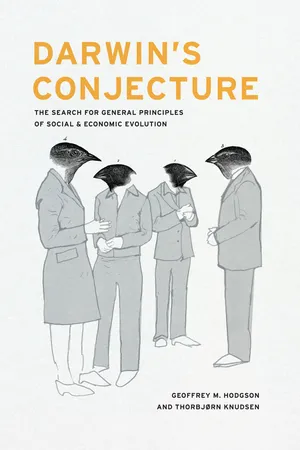 eBook - PDF
Darwin's Conjecture
The Search for General Principles of Social and Economic Evolution
- Geoffrey M. Hodgson, Thorbjørn Knudsen(Authors)
- 2010(Publication Date)
- University of Chicago Press(Publisher)
Sometimes it can lead to the gradual honing of performance, but it can be diverted in different directions and fail to eliminate inefficiencies or 9 2 c h a p t e r f i v e anomalies. Suboptimal evolutionary processes — producing traits that yield replication rates or chances of survival that are below the maximum in the circumstances — are commonplace in both nature and human society. Both Darwin and his colleague Alfred Russel Wallace worried that use of the word selection might be taken to imply the existence of an agent doing the selecting and that some could take this agent to be God. Today, social scientists have a different worry: the use of the term selection in the context of social evolution might undermine the role of human agency and deny the existence of human intentionality. But, in the social domain, insofar as selection involves human interaction or deliberation, it always involves choice and preference in some way: selection excludes neither intentional-ity nor agency. In common usage, selection is synonymous with choice , connoting the act of selecting, as in the selection of an item from a restaurant menu or a new manager to fill an open position. In contrast, the scientific usage of selection has a very precise meaning, referring to a change in the composition of a population leading to a change in its properties (traits), such as the colors of a population of moths or the size distribution of firms in an industry. But this scientific meaning does not necessarily exclude choice. Toward the end of this chapter, we introduce the concept of diffusion and ask whether it should be treated as a type of selection. Diffusion is important in the social domain. Although the definition of selection adopted here is very broad, diffusion is established as a separate phenomenon and a type of inheritance rather than selection. eBook - PDF
- Tomar, Arun Kumar(Authors)
- 2021(Publication Date)
- Daya Publishing House(Publisher)
9 : Response to Selection The diferent evolutionary processes together with artifcial selection have resulted into many breeds of domestic animals that exist today. After domestication man has tried to change the genetic structure of animal population through judicious selection for bringing genetic improvement in performance potential. However, the aim has not been achieved so far and more genetic improvement is needed for milk, meat, egg, wool and other characters like race in horses, beter show jumping and more intelligent guide dogs. 9.1 SELECTION OBJECTIVE AND SELECTION UNIT The selection , in animal breeding, is an outcome of the process of diferential reproduction and survival of animals which may be natural or artifcial or both. Artifcial selection is man’s activity and depends on the choice of the breeder which is objective specifc viz. to bring genetic improvement (to produce animals of high genetic merit) in certain traits of interest like production of milk, meat, wool, egg, pashmina fber, pelt production or for any other purpose like, draft, race, load carrying capacity, etc. The objective of selection is to bring genetic improvement in a character of interest and hence the character under selection is known as selection objective . The genetic selection is based on the breeding value of the individual(s) under selection. The individuals under selection may belong to the diferent families and selectd on the basis of certain criteria viz. individuals own performance or relatives performance. Secondly, the the individuals under selection may belong to the same family wherein all individuals of the family are selected based on the family mean as a deviation from population mean. Thus, whole family is considered as unit and is selected or rejected based on merit. The families may be half sib or full sib families whose breeding values are estimated based on family mean. eBook - PDF
- Judith M. Hughes(Author)
- 2008(Publication Date)
- Yale University Press(Publisher)
Chapter 4 Artificial Selection: Robert J. Stoller and Nancy Chodorow After his return to England in 1837, Charles Darwin began col-lecting all facts which bore in any way on the variation of animals and plants under domestication—in hopes, as he commented in his Autobiography, that some light would be thrown on the subject of species modification. Thanks to the writings of animal breeders, he soon came to recognize the power of judiciously selecting males and females to propagate. Artificial Selection, he noted, was the keystone of mans success in making useful races of animals and plants. Thus, he continued, happening to read for amusement Malthus on Population, he was well prepared to appreciate the struggle for existence which went on everywhere. 1 The role of Artificial Selection in Darwin's theory building has been ques-tioned; 2 its role in the modification of domesticated species has long been established. Artificial Selection, unlike sexual selection, remained ready at hand and could be reckoned as background knowledge shared by Robert J. Stoller and Nancy Chodorow—and by their readers as well. Yet neither explicitly referred to it. What justifies using artifi-87 88 Artificial Selection cial selection as a title for their stories is that they featured the issue the concept highlights: the role of intelligent manipulation (in this instance not always fully conscious). As for those being domesticated—that is, chil-dren—in the tales Stoller and Chodorow told, they figured as passive creatures. Their narratives took off from a common Freudian starting point. In a series of papers published between 1925 and 1933, Freud revised his initial symmetrical view of girls' and boys' oedipal desires—that girls' wishes were directed toward father and boys' toward mother. 3 For girls as well as for boys, he now argued, mother figured as the original love object. eBook - ePub
The History of Creation, Vol. 1 (of 2)
Or the Development of the Earth and its Inhabitants by the Action of Natural Causes
- Ernst Haeckel, Lankester, E. Ray (Edwin Ray), Sir, (Authors)
- 2012(Publication Date)
- Perlego(Publisher)
This agency will perhaps appear at first sight small and insignificant, and the reader will not be inclined to concede to the action of such relations the weight which it in reality possesses. I must therefore find space in a subsequent chapter to put forward further examples of the immense and far-reaching power of transformation exhibited in natural selection. For the present I will confine myself to simply placing side by side the two processes of artificial and natural selection, and clearly explaining the agreement and the differences of the two.Both natural and Artificial Selection are quite simple natural, mechanical relations of life, which depend upon the interaction of two physiological functions, namely, on Adaptation and Inheritance, functions which, as such, must again be traced to physical and chemical properties of organic matter. The difference between the two forms of selection consists in this: in Artificial Selection the will of man makes the selection according to a plan, whereas in natural selection, the struggle for life (that universal inter-relation of organisms) acts without a plan, but otherwise produces quite the same result, namely, a selection of a particular kind of individuals for propagation. The alterations produced by Artificial Selection are turned to the advantage of those who make the selection; in natural selection, on the other hand, to the advantage of the selected organism.These are the most essential differences and agreements of the two modes of selection; it must, however, be further observed that there is another difference, viz., in the duration of time required for the two processes of selection. Man in his Artificial Selection can produce very important changes in a very short time, while in natural selection similar results are obtained only after a much longer time. This arises from the fact that man can make his selection with much greater care. Man is able with the greatest nicety to pick out individuals from a large number, drop the others, and to employ only the privileged beings for propagation, which is not the case in natural selection. In natural conditions, besides the privileged individuals which first succeed in propagating themselves, some few or many of the less distinguished individuals will propagate themselves by the side of the former. Moreover, man can prevent the crossing of the original and the new form, which in natural selection is often unavoidable. If such a crossing, that is, a sexual connection, of the new variety with the original forms takes place, the offspring thereby produced generally returns to the original character. In natural selection, such a crossing can be avoided only when the new variety by migration separates from the original and isolates itself.
Index pages curate the most relevant extracts from our library of academic textbooks. They’ve been created using an in-house natural language model (NLM), each adding context and meaning to key research topics.

