Biological Sciences

Bacterial Growth
Bacterial growth refers to the increase in the number of bacterial cells in a population. It involves a series of stages including lag phase, exponential phase, stationary phase, and death phase. Factors such as nutrients, temperature, pH, and oxygen availability influence the rate and extent of bacterial growth. Understanding bacterial growth is crucial in various fields including microbiology, medicine, and biotechnology.
Written by Perlego with AI-assistance
Related key terms
1 of 5
12 Key excerpts on "Bacterial Growth"

- Frank R. Spellman(Author)
- 1999(Publication Date)
- CRC Press(Publisher)
1 1 8 FUNDAMENTAL CONCEPTS presence and destruction and/or maintenance of a mass or bio-mass concentration. Since most information is available about bacteria and control of its growth, most of the discussion in this chapter concerns bacteria. Bacterial Growth In microbiology, growth may be defined as an increase in the number of cells or in cellular constituents. If the microorgan-ism is a multinucleate (coenocytic) organism in which nuclear division is not accompanied by actual cell division (as with bac-teria), growth results only in an increase in cell size and not in cell number. In bacteria, as a general rule, growth leads to a rise in cell number because reproduction is by binary fission where two cells enlarge and divide into two progeny of about equal size. Other bacterial species increase their cell numbers asexu- ally by budding, for example, as with the mycoplasma (Wistreich & Lechtman, 1980). Population Growth It is not usually convenient or practical for the water or wastewater specialist to investigate the growth of individual microorganisms because of their small size. Therefore, plant operators normally follow changes in the total population num-ber when studying growth. As was mentioned earlier, growth is defined as an increase in the number of microbial cells in a population, which is mea-sured as an increase in microbial mass. The change in cell num-ber or mass per unit time is the growth rate. When bacterial cells are introduced into a suitable medium, held at the optimum growth temperature, and a small volume of medium is withdrawn and cultured (bacteria growing in or on a medium), a count can be made of the cells it contains (counting methods will be discussed later). In this way the de-velopment of a population (i.e., the increase in cell numbers with time) can be observed and followed. By plotting the num-ber of cells against time, a growth curve can be obtained. The ac-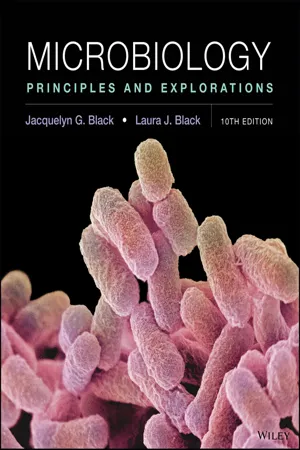 eBook - PDF
Microbiology
Principles and Explorations
- Jacquelyn G. Black, Laura J. Black(Authors)
- 2018(Publication Date)
- Wiley(Publisher)
Knowing how these factors influence growth is useful in culturing organisms in the laboratory and in preventing their growth in undesirable places. Further- more, growing the microbes in pure cultures is essential in performing diagnostic tests that are used to identify a number of disease-causing organisms. 143 GROWTH AND CELL DIVISION 143 Microbial Growth Defined 143 • Cell Division 143 Phases of Growth 144 • Measuring Bacterial Growth 146 FACTORS AFFECTING Bacterial Growth 152 Physical Factors 152 • Nutritional Factors 157 • Bacterial Interactions Affecting Growth 159 CHAPTER MAP SPORULATION 161 Other Sporelike Bacterial Structures 162 CULTURING BACTERIA 163 Methods of Obtaining Pure Cultures 163 • Culture Media 163 • Methods of Performing Multiple Diagnostic Tests 168 LIVING, BUT NONCULTURABLE, ORGANISMS 170 GROWTH AND CELL DIVISION Microbial Growth Defined In everyday language, growth refers to an increase in size. We are accustomed to seeing children, other animals, and plants grow. Unicellular organisms also grow, but as soon as a cell, called the mother (or parent) cell, has approximately doubled in size and duplicated its con- tents, it divides into two daughter cells. Then the daughter cells grow, and subsequently they also divide. Because individual cells grow larger only to divide into two new individuals, microbial growth is defined not in terms of cell size but as the increase in the number of cells, which occurs by cell division. Follow the Chapter Map to help you pinpoint the core concepts in the chapter. Cell Division Cell division in bacteria, unlike cell division in eukary- otes, usually occurs by binary fission or sometimes by budding. In binary fission, a cell duplicates its compo- nents and divides into two cells (Figure 7.1a). The daugh- ter cells become independent when a septum (partition) grows between them and they separate (Figure 7.1c).
- David M. Carlberg(Author)
- 2004(Publication Date)
- CRC Press(Publisher)
39 2 GROWTH OF MICROORGANISMS I. INTRODUCTION The word “growth” means different things to different people. To most, growth implies increase in size, as in the growth of a tree or a child. To a microbiologist, growth may also mean the increase in the size of a microbial cell, but more often it refers to an increase in the numbers of cells in a microbial population. In this chapter and for the remainder of this book, growth will usually refer to the latter meaning: an increase in the numbers of organisms in a microbial population. Most of our knowledge of microorganisms has been gained by observ-ing their activities while growing them in the laboratory, which microbi-ologists learned to do only a little over 120 years ago. Growing micro-organisms in the laboratory is a necessary and important activity for the cleanroom microbiologist. Raw materials, process water, finished products, and the air and surfaces of the manufacturing facility must be sampled for the possible presence of excessive numbers of microorganisms. The presence of microorganisms in materials and environmental samples is almost always detected by observing their growth through certain labo-ratory procedures. In this chapter we will describe the most common techniques used by microbiologists for growing microorganisms as well as some of the methods for monitoring their growth. Then, in Chapter 5 we will describe how these techniques are used to determine levels of microbial contamination in the cleanroom. 40 Cleanroom Microbiology for the Non-Microbiologist A. Scientific Notation Because of their rapid growth rate, microbial populations frequently reach enormous levels. It is not unusual, for example, to have 1 billion bacterial cells in a milliliter of growth fluid. Dealing with such large numbers can be difficult without a useful tool known as scientific notation, which uses exponents to denote zeros or decimal places. eBook - PDF
- C. H. Werkman, P. W. Wilson, C. H. Werkman, P. W. Wilson(Authors)
- 2013(Publication Date)
- Academic Press(Publisher)
CHAPTER IV GROWTH OF BACTERIA BY I. C. GUNSALUS CONTENTS Page I. Introduction 101 II. Quantitative Studies of Bacterial Growth 103 III. Growth and Population Cycle of a Bacterial Culture 106 A. The Growth Curve 106 B. Mathematical Description of Growth 109 C. The Lag Phase 113 D. Logarithmic Growth Phase 119 1. The Organism 119 2. The Medium 120 3. Temperature, Growth, and Metabolic Rates 122 E. The Endpoint of Growth 123 IV. Conclusion 125 I. Introduction Growth, the ability of a system to reproduce itself, is one of the prime characteristics of living matter. An understanding of the phenomena associated with growth and the conditions necessary for its occurrence is one of the problems common to all biological studies. To work with living systems, one must find the conditions essential to their preserva- tion and to their replication, i.e., growth. As with many systems that are subjects of common knowledge, much of the information on growth is at the impression stage and lacks the precision necessary as a basis for further work. The terms must be defined, the objectives stated, and the systems subjected to quantitative measurement. For our purposes, growth may be defined as an increase in protoplasm. The fruitfulness of studies of Bacterial Growth will be dependent upon the ease and adequacy of the methods selected for its measurement. Particularly with microorganisms one must clearly differentiate between the growth of the individual, that is, the cell, and the growth of the culture—an increase in population. The early studies of Bacterial Growth 101 102 I. C. GUNSALUS were based upon the plate count which measured the number of viable cells. This criterion involved two assumptions: (a) that all offspring are viable, and (b) that the cells are of uniform size. As we shall see later, neither of these is entirely accurate though generally the first is sufficiently true not to introduce serious error. eBook - PDF
- H W Doelle(Author)
- 1994(Publication Date)
- WSPC(Publisher)
CHAPTER 7 Growth, and Cultivation 1. Introduction In any biological system, growth can be defined as the orderly increase of a l l chemical components. Increase of mass might not really reflect growth because the cells could be simply increasing their content of storage products such as glycogen or poly-beta-hydroxy-butyric acid. In an ad-equate medium to which they become fully adapted, however, bacteria are in a state of balanced growth. During a period of balanced growth, an increase of biomass is accompanied by a comparable increase of a l l other measurable properties of the population, e.g. protein, RNA, DNA, and intracellular water. In other words, cultures undergoing balanced growth maintain a constant chemical composition. The phenomenon of balanced growth simplifies the task of measuring the rate of growth of a bacterial culture. 2. Microbial Nutrition All substances in the environment, which can be used by the cell for catabolism and biosynthesis are called nutrients. A culture medium must therefore contain, in quantities appropri-ate to the specific requirements of the microorganisms for which i t is designed, a l l necessary nutrients. However, micro-organisms are extraordinarily diverse in their specific physio-logical properties, and correspondingly in their specific nutrient requirements. Literally thousands of different media have been proposed for their cultivation, and in the descrip-tion of these media the reasons for the presence of the various components are often not clearly stated. Nevertheless, the design of a culture medium can and should be based on scienti-fic principles, the principles of nutrition. The chemical composition of the cell, broadly constant throughout the living world indicates the major material requirements for growth. Water accounts for some 80-90% of the total weight of cells and is always therefore the major essential nutrient in quantitative terms.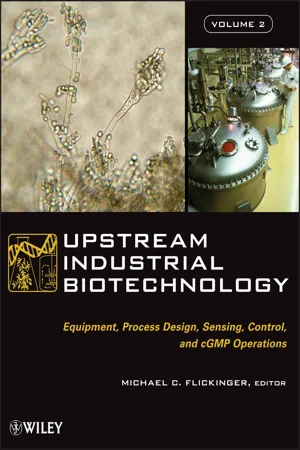 eBook - ePub
- Michael C. Flickinger(Author)
- 2013(Publication Date)
- Wiley(Publisher)
To measure biomass and Bacterial Growth rate, precise definitions are needed. Although biomass is fundamental to carrying out technology, we have to first consider the growth process that makes the biomass and examine its several definitions. The most basic definition of growth is based on the ability of individual cells to multiply, that is, to repetitively initiate and complete cell and organismal division. This definition implies monitoring the increase in total number of discrete bacterial particles. There are three basic ways to do this: by microscopic enumeration of the particles, by electronic enumeration of the particles passing through an orifice (Coulter counter), and by modern flow cytometry. Assessment of particle number would falsely include dead cells and detritus, which would tend to lower estimations of growth rate. The rate would be artificially raised by the progressive dissolution of aggregates of bacteria and the fragmentation of nongrowing filamentous organisms. An increase in cell number is not exactly correlated with an increase in biomass or useful product. Commonly, at the end of an exponential growth phase, cell division overshoots biomass production and the cells become smaller.A second definition of growth involves determining the increase in colony-forming units (CFU). Because some cells may be dead or dying, this definition of growth may be different from the one based on the detection of discrete particles as a function of time. Although in the long run, the increase in the number of organisms capable of indefinite growth is the only important consideration for the physiologist, this is not so for the biotechnologist, for several reasons. First, for strain purity, each new production run starts afresh from starter cultures; these cultures would have been specially treated much differently than the cells in the actual production run. This care is to avoid contamination and the buildup of unwanted mutants. Second, dead, dying cells and stationary cells may be the productive members of the culture in terms of product formation. This second definition is the reason that colony counting and most probable number (MPN) methods of measurement are so important. It must be noted that viable counting methods, which seem so natural to a bacteriologist, are really quite special in that cultures are diluted so highly that individual organisms cannot interact. For example, these methods cannot, in principle, be applied to obligate sexually reproducing organisms requiring male–female interaction or to colonial organisms such as myxobacteria that in certain conditions need to be part of a large mass of organisms that produces sufficient exoenzymes to grow. Even when applied to the prokaryote, there are special restrictions and limitations; for example, CO2must be available in sufficient concentration, although this need not be supplied if many organisms are present generating CO2
- Agnes Ullmann(Author)
- 2012(Publication Date)
- Academic Press(Publisher)
THE GROWTH OF BACTERIAL CULTURES B Y J A C Q U E S M O N O D Pasteur Institute, Paris, France I N T R O D U C T I O N The study of the growth of bacterial cultures does not consti-tute a specialized subject or branch of research: it is the basic method of Microbiology. It would be a foolish enterprise, and doomed to failure, to a t t e m p t reviewing briefly a subject which covers actually our whole discipline. Unless, of course, we considered the formal laws of growth for their own sake, an ap-proach which has repeatedly proved sterile. In the present review we shall consider Bacterial Growth as a method for the study of bacterial physiology and biochemistry. More precisely, we shall concern ourselves with the quantitative aspects of the method, with the interpretation of quantitative data referring to Bacterial Growth. Furthermore, we shall consider exclusively the positive phases of growth, since the study of bacterial d e a t h , i.e., of the negative phases of growth, involves distinct problems and meth-ods. T h e discussion will be limited to populations considered genetically homogeneous. The problems of mutation and selection in growing cultures have been excellently dealt with in recent review articles by Delbrück (1) and Luria (2). No a t t e m p t is made at reviewing the literature on a subject which, as we have just seen, is not really a subject at all. T h e papers and results quoted have been selected as illustrations of the points discussed. D E F I N I T I O N O F G R O W T H P H A S E S A N D G R O W T H C O N S T A N T S D I V I S I O N R A T E AND G R O W T H R A T E In all that follows, we shall define cell concentration as the number of individual cells per unit volume of a culture and bacterial density as the dry weight of cells per unit volume of a culture. Consider a unit volume of a growing culture containing a t time h a certain number x of cells. eBook - PDF
- Rodney P. Anderson, Linda Young, Kim R. Finer(Authors)
- 2020(Publication Date)
- Wiley(Publisher)
How- ever, typically, as the bacterial cells multiply, conditions become increasingly less favorable, and the growth rate slows. When microbiologists refer to microbial growth, they are normally referring to an increase in the number of individuals in a population, not to an increase in the size of the individual microbes. Microbial growth requires raw materials, energy, and genetic blueprints to produce new microbes and increase pop- ulation size. This chapter analyzes the requirements for micro- bial growth, how we use that knowledge to grow microbes in the lab for identification, and the physical and chemical meth- ods we use to control it. 257 258 CHAPTER 11 Microbial Growth and Control TABLE 11.1 Classification of Living Microorganisms by Energy and Carbon Source Energy Source Carbon Source Classification Example Light Organic molecules Photoheterotroph Rhodobacter Inorganic molecules Photoautotroph Anabaena Chemicals Organic molecules Chemoheterotroph Staphylococcus Inorganic molecules Chemoautotroph Acidithiobacillus ferrooxicans 11.1 Requirements for Microbial Growth LEARNING OBJECTIVES 1. Describe the energy sources used by microbes. 2. Explain the physical requirements for microbial growth, including pH, temperature, and osmolarity. 3. Describe the chemical requirements for microbial growth. Microbes require a constant supply of energy to make ade- nosine triphosphate (ATP), which, in turn, is the source of energy for the metabolic processes necessary to produce new cells (see Remember This!). A microbe must also have a habitat for reproduction that is within the range of the physical and chemical parameters that allow for metabolic function. In a laboratory, this habitat is provided through a culture. Physical requirements include appropriate acidity (pH), temperature, and osmolarity, whereas chemical requirements involve levels of oxygen and other essential elements. eBook - PDF
An Introduction to Microbiology
Pharmaceutical Monographs
- W. B. Hugo, J. B. Stenlake(Authors)
- 2014(Publication Date)
- Butterworth-Heinemann(Publisher)
There are four main methods of measuring Bacterial Growth: 1. Total counts by direct counting of the bacteria when viewed under the microscope. 2. Viable counts, a technique which seeks to measure the living population of a bacterial culture by adding samples to culture media and counting the colonies assumed to be produced by the growth of each original cell in the sample. 3. Indirect counts which, using a suitable optical instrument, measure the turbidity or light-scattering properties of a suspension. 4. Biochemical methods which measure the increase of, for example, protein in the suspension, again assuming that this is increasing with increasing bacterial numbers. It should be clearly realised that methods 1, 3 and 4 measure either directly or indirectly the total bacterial population, whether living or dead. The Pattern of Bacterial Multiplication Assuming optimum or near optimum conditions, the pattern of the multiplication of bacteria from an inoculum into a liquid medium, is as follows (Fig. 12). 38 Bacterial Growth 1. An initial stationary or lag phase. In typical instances this may be as little as 20 minutes, during which there is very little, if any, increase in the numbers of the viable population. The cells, how-ever, are metabolically active in that they consume nutrients and increase in size, and are more susceptible to adverse conditions 9 Ί z LU a. CÛ < > LL O LU CÛ Z 3 Z O FIG. TIME (hours) 12. Bacterial Growth curve. Escherichia coli in nutrient broth at 37° C. (A. D. Russell, Ph.D. thesis, University of Nottingham) such as extremes of temperature or the action of toxic substances than when actively growing. 2. A log phase. Following the initial stage, in which bacterial numbers are not increasing, there occurs a phase of cell division in which one cell gives rise to two, these two to two more, or put in general terms the bacterial numbers increase by geometrical pro-gression. eBook - PDF
- John Troller(Author)
- 2012(Publication Date)
- Academic Press(Publisher)
This can be determined by selecting two time points during the growth period and counting the numbers of bacteria that are present initially and after this arbitrary period of growth. The difference between these periods is then divided by the time multiplied by 0.301, the logarithm of two (re- member we are dealing here with binary fission). If the reciprocal of this number is taken, the generation time, discussed above, is obtained. 124 6. Microbial Growth in Foods FACTORS AFFECTING Bacterial Growth In our earlier discussions on methods of counting bacteria, we men- tioned microbiological media. The nutritional content of these media, and the conditions for microbial growth, must be optimized if an accu- rate estimate of the bacterial population is to be obtained. We stated that there is, in fact, no ideal or optimal medium for the growth of all micro- organisms, and we now extend this statement to nearly all conditions that affect growth. Conditions in the microenvironment that favor one organism might not cause others to respond similarly. For this reason, the microbiologist must choose the conditions for growth carefully and utilize knowledge and experience to choose environments that are most likely to achieve the ends that he or she has in mind, such as identifica- tion or enumeration. Nutrition Most microbiological media arrive at the laboratory in the dehydrated state, with ingredients (except water) already mixed in their proper pro- portions. Water is added, and the mixture is heated to nearly 100°C to melt the agar that is present if a so-called solid medium is called for. Liquid media do not require this step if the ingredients are readily soluble. The rehydrated medium is then dispensed and sterilized. The list of medium ingredients may be very long in the case of com- plex media, or it may include only two, three, or four components in simple systems. Often, a carbohydrate is needed to provide energy for growth. eBook - PDF
- Nina Parker, Mark Schneegurt, Anh-Hue Thi Tu, Brian M. Forster, Philip Lister(Authors)
- 2016(Publication Date)
- Openstax(Publisher)
An example of a batch culture in nature is a pond in which a small number of cells grow in a closed environment. The culture density is defined as the number of cells per unit volume. In a closed environment, the culture density is also a measure of the number of cells in the population. Infections of the body do not always follow the growth curve, but correlations can exist depending upon the site and type of infection. When the number of live cells is plotted against time, distinct phases can be observed in the curve (Figure 9.5). Chapter 9 | Microbial Growth 363 Figure 9.5 The growth curve of a bacterial culture is represented by the logarithm of the number of live cells plotted as a function of time. The graph can be divided into four phases according to the slope, each of which matches events in the cell. The four phases are lag, log, stationary, and death. The Lag Phase The beginning of the growth curve represents a small number of cells, referred to as an inoculum, that are added to a fresh culture medium, a nutritional broth that supports growth. The initial phase of the growth curve is called the lag phase, during which cells are gearing up for the next phase of growth. The number of cells does not change during the lag phase; however, cells grow larger and are metabolically active, synthesizing proteins needed to grow within the medium. If any cells were damaged or shocked during the transfer to the new medium, repair takes place during the lag phase. The duration of the lag phase is determined by many factors, including the species and genetic make-up of the cells, the composition of the medium, and the size of the original inoculum. The Log Phase In the logarithmic (log) growth phase, sometimes called exponential growth phase, the cells are actively dividing by binary fission and their number increases exponentially. eBook - PDF
- Stuart Hogg(Author)
- 2013(Publication Date)
- Wiley-Blackwell(Publisher)
Blood agar can act as a differential medium, in allowing the user to distinguish between haemolytic and non- haemolytic bacteria (see Chapter 7). If we are to culture microorganisms successfully in the laboratory, we must provide appropriate physical conditions as well as providing an appropriate nutrient medium. In the next chapter, we shall examine how physical factors such as pH and temperature influence the growth of microorganisms, and describe how these conditions are provided in the laboratory. 4.3.3 Preservation of microbial cultures Microbial cultures are preserved by storage at low temperatures, in order to suspend growth processes. For short periods, most organisms can be kept at refrigerator temperature (around 4 ◦ C), but for longer-term storage, more specialised treatment is necessary. Using deep-freezing or freeze-drying, 4.3 LABORATORY CULTIVATION OF MICROORGANISMS 95 cultures can be kept for many years, and then resurrected and recultured. Deep-freezing requires rapid freezing to between −70 ◦ C and −95 ◦ C, while freeze-drying (lyophilisation) involves freezing at slightly less extreme tem- peratures and removing the water content under vacuum. Long-term stor- age may be desirable to avoid the development of mutations or loss of cell viability. 5 Microbial Growth When we consider growth as applied to a multicellular organism such as a tree, a fish or a human being, we think in terms of an ordered increase in the size of the individual. Growth in unicellular microorganisms such as bacteria, yeasts and protozoans, however, is more properly defined in terms Biomass is the total amount of cellular mate- rial in a system. of an increase in the size of a given population. This may be expressed as an increase in either the number of individuals or the total amount of biomass. Methods employed in the measure- ment of growth of unicellular microorganisms may be based on either of these.
Index pages curate the most relevant extracts from our library of academic textbooks. They’ve been created using an in-house natural language model (NLM), each adding context and meaning to key research topics.

