Biological Sciences

Bacterial Colonization
Bacterial colonization refers to the process by which bacteria establish and multiply in a particular environment, such as the human body or a surface. This process involves the initial attachment of bacteria to a substrate, followed by growth and formation of a stable community. Bacterial colonization can have both beneficial and harmful effects, depending on the specific bacteria involved and the host environment.
Written by Perlego with AI-assistance
5 Key excerpts on "Bacterial Colonization"
 eBook - ePub
Marine Biofouling
Colonization Processes and Defenses
- Alexander I. Railkin(Author)
- 2003(Publication Date)
- CRC Press(Publisher)
2 Biofouling as a Process
2.1 COLONIZATION
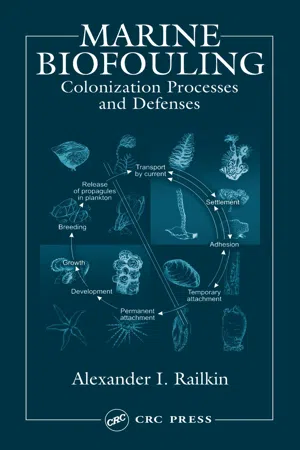
In its extended sense, the word colonization means the process of spreading over some new territory. As regards hard surfaces in a water medium, the terms “colonization,” “biofouling,” and sometimes “fouling” may be synonymous (Wahl, 1989). Biofouling as a process means biological fouling, as distinct from other forms of fouling, i.e., the accumulation of deposits of different kinds and origin on the surface, such as the products of corrosion, crystallization, chemical reactions, suspended particles, detritus, ice, etc. (Characklis et al., 1984; Bott, 1988). Thus, biological fouling is a special case of colonization of hard surfaces by living organisms in the water medium.Unfortunately, there are only a few studies in the literature in which a comprehensive and detailed analysis of problems associated with colonization processes has been performed. According to a study by W.G. Characklis (1984), entitled “Development of Biofilm: Analysis of the Process,” Bacterial Colonization includes:- Transport of organic molecules and bacteria towards a submerged surface
- Adsorption of organic molecules, as a result of which the surface becomes conditioned, i.e., more favorable for attachment of bacteria
- Attachment of bacteria to the conditioned surface
- Metabolism of attached microorganisms, as a result of which they adhere to the surface faster
- Growth of bacteria
- Detachment of part of the bacterial film
In Characklis’ classification (1984), emphasis is laid on the mechanisms of these processes. For the purposes of our analysis it should be accepted that neither the second (adsorption of molecules) nor the fourth (bacterial metabolism) stages are processes of hard surface colonization proper, although they facilitate the settlement of bacteria. Detachment of bacteria occurs as a result of the overdevelopment of the biofilm and loss of mechanical strength, and under the action of the current. This specific feature of microfouling films is not inherent in macrofouling. eBook - PDF
Microbial Biofilms
Importance and Applications
- Dharumadurai Dhanasekaran, Nooruddin Thajuddin, Dharumadurai Dhanasekaran, Nooruddin Thajuddin(Authors)
- 2016(Publication Date)
- IntechOpen(Publisher)
Colonies, macro- and micro-colonies A mass of bacteria having some sort of physical cohesion and having developed by growth on a solid dry surface; micro-colonies are those associated with the biofilm development process on submerged solid surfaces, or small aggregations of bacteria not noticed as colonies unless observed with magnification on leaf surfaces, detritus, or agar plates. Communities and consortia A complex mixture of multiple bacterial species (or genotypes) and possibly other microorganisms in which biotic interactions define structure and function. Crusts, dust particulates and aerosols Microbial communities developing on the surface of soils and dessert sand; also the dried remnants of colonies etc. Deposits and sediments Mass or body of bacteria that accumulate on dry or submerged surfaces due to wind or water movement. Desert varnish A dark stain or coating covering rock surfaces and colonised by bacteria. Filamentous structures and streamers Long strands of material stretching out from the main mass of a biofilm subject to liquid flow. Films, layers, planes, plates, volumes and zones A thin layer or volume containing bacteria which may or may not be physically connected to one another, solid surfaces, or other interfaces, and occurring in liquids, porous or permeable solids. Flocs and snow Masses of bacteria formed by growth, self-association, hydrophobic interactions, or by attachment to suspended inert particles; flocs in sea water are referred to as snow. Floaters Biofilms at the air-liquid interface having no appreciable attachment to a solid surface; these may be localised at the liquid surface by buoyancy, penetration of the interface, or by hydrophobic surfaces. Foams Air-water emulsions containing high concentrations of bacteria and compounds such as polymers and surfactants, which may help stabilise the structure. Granules A mass of bacteria growing on small solid particles. Microbial Biofilms - Importance and Applications 10 eBook - ePub
Bacterial Pathogenesis
A Molecular Approach
- Brenda A. Wilson, Malcolm Winkler, Brian T. Ho, Brenda A. Wilson, Malcolm Winkler(Authors)
- 2019(Publication Date)
- ASM Press(Publisher)
We will begin this chapter by covering some general features of bacterial pathogens that enable them to survive in the external environment and then colonize and infect the human body in the presence of a myriad of host defenses (Table 11-1). We have placed one group of important bacterial virulence factors—toxins and other factors produced by the bacteria and released into the medium that bind and enter the host cell, or that are directly delivered into the host cells, that then damage eukaryotic cells and tissues—in a chapter of their own (see chapter 12). Many bacteria have also developed or acquired resistance to antibiotics or disinfectants. These virulence properties are discussed in chapters 15 and 16. Table 11-1. Mechanisms used by bacteria to facilitate colonization and survival in a host In order to invade and survive in a host and establish an infection, a pathogenic microbe must be able to do the following: 1. Attach to host cells for colonization 2. Evade the host’s innate and adaptive immune defenses and persist in the host 3. Obtain iron and other nutrients needed to multiply, especially those that are essential for growth but may be limiting within the host 4. Disseminate or spread within a host and to other hosts (this is critical for the survival of the bacterial species) 5. Produce symptoms of disease in the host in order to be considered pathogenic (although production of symptoms is not necessarily a requirement in and of itself, disease is often a result of the presence of the microbe and/or its products or the host’s response to the presence of the microbe and/or its products) A useful paradigm for thinking about the three stages of bacterial infection (colonization, persistence, and spread) is a comparison to an in vitro growth curve (Figure 11-1) eBook - PDF
Salmonella
A Diversified Superbug
- Yashwant Kumar(Author)
- 2012(Publication Date)
- IntechOpen(Publisher)
Part 1 Environmental Interactions 1 Invasion and Survival of Salmonella in the Environment: The Role of Biofilms Cynthia L. Sheffield and Tawni L. Crippen United States Department of Agriculture, Agriculture Research Service Southern Plains Agricultural Research Center USA 1. Introduction Bacteria compose the majority of living biomass on Earth and play a vital role in the recycling of elements critical to sustaining life. We are discovering that they often exist as interlinked, multispecies colonies termed biofilms. They are all around us, on us, and in us. In fact, over 99% of microorganisms on Earth live as biofilms. They play a critical role in the ecology of the earth and the sustainability of life. For many years, studies of bacterial physiology focused primarily on the planktonic state neglecting the bacteria within the biofilm. The biofilm state is now recognized as the predominant form in which bacteria endure the stresses of the environment (An and Parsek, 2007; Hall-Stoodley et al., 2004; Hoffman et al., 2005; Karatan and Watnick, 2009; Stoodley et al., 2001) Bacterial biofilms have long been recognized as participants in tooth decay, slippery rock surfaces, and contaminated water. Now these colonies are being investigated as perpetrators of persistent low-level food contamination which threaten animal and human health. Bacteria existing as biofilms are capable of surviving for extended periods in various environments, such as water, animal manure, and a range of agricultural soil types. For example, human pathogens can attach to and colonize the surfaces of plants and form biofilms on plant tissues (Annous et al., 2006). These biofilms are problematic because they are extremely hearty and difficult to remove by simple washing techniques. Causing, foodborne illnesses associated with human consumption of contaminated fresh fruits and vegetables (Fett and Cooke, 2003; Sivapalasingam et al., 2004).
- Steven Lane Percival, James Taggari Walker, Paul R. Hunter(Authors)
- 2000(Publication Date)
- CRC Press(Publisher)
Systems used to study biofilms are discussed in Chapter 9. 6.4 STAGES IN THE FORMATION OF BIOFILMS Bacteria generally range in size from 0.05 (nanobacteria) to 4 μm in length or diameter, with slow-growing and starved cells dominating at the smaller end of the range and fast-growing cells, especially in nutrient rich environments, at the larger end. Bacteria commonly bear a negative charge 18 with the initial interactions between bacteria and surfaces being considered in terms of the colloidal behaviour. 19 How-ever, the fact that bacteria are living entities and capable of changing themselves and their environment through active metabolism and biosynthesis must not be overlooked. 18 The process of biofilm formation is now considered to be a complex process, but generally, it can be recognised as consisting of five stages. These include (Figure 6.1) 1. Development of a surface-conditioning film. 2. Those events which bring the organisms into the close proximity with the surface. 64 Microbiological Aspects of Biofilms and Drinking Water 3. Adhesion (reversible and irreversible adhesion of microbes to the condi-tioned surface). 4. Growth and division of the organisms with the colonisation of the surface, microcolony formation and biofilm formation. 5. Detachment. Each of these processes will be considered in turn. 6.4.1 D EVELOPMENT OF THE C ONDITIONING F ILM Marshall 20 described a surface evident in a flowing system as a “relatively nutrient-rich haven in an otherwise low nutrient environment.” This quote suggests that clean unexposed surfaces when evident in either natural or in vitro solutions become conditioned with nutrients. Whether these molecules which condition the surface function as microbial nutrients is largely unknown. It does, however, seem to be generally accepted that a clean surface which first makes contact with a bathing fluid must have organic substances and microbial cells transported to the surface before biofilm development can begin.
Index pages curate the most relevant extracts from our library of academic textbooks. They’ve been created using an in-house natural language model (NLM), each adding context and meaning to key research topics.

