Biological Sciences

Disease Triangle
The Disease Triangle is a concept that illustrates the interaction between three key factors in the development of plant diseases: the host plant, the pathogen, and the environment. It emphasizes that disease occurs when these three elements intersect, highlighting the complex relationship between the host, pathogen, and environmental conditions in the spread and development of diseases in plants.
Written by Perlego with AI-assistance
Related key terms
1 of 5

8 Key excerpts on "Disease Triangle"
 eBook - PDF
- Amal K. Mitra(Author)
- 2023(Publication Date)
- For Dummies(Publisher)
2 Understanding Disease Causation IN THIS PART . . . Be familiar with the epidemiologic triangle — the acute disease model of disease causation. Examine how biological agents, the human host and intermediary hosts, and environmental factors interplay with each other in creating an imbalance for causing a disease. Find how the association of person factors such as age, sex, and occupation, and place of living affect overall health and act as potential risk factors of diseases. Define epidemiologic transition and explore reasons for the changing pattern of diseases from acute and infectious diseases to chronic and noncommunicable diseases in the United States and many other developed countries. Understand demographic transition and the four stages of demographic transition due to the changes in birth rates, death rates, and migration. Compare population growth patterns in selected countries and identify the top ten countries with the largest proportions of senior citizens. Figure out how to estimate the future population of a country. Know how to calculate important rates for a population. CHAPTER 6 Tackling the Epidemiologic Triangle 105 Chapter 6 Tackling the Epidemiologic Triangle I n order to understand a disease, you need to answer the following fundamental questions to identify what’s needed for a disease to occur: » What causes the disease? » What makes some people more susceptible to a disease and some people spared of contracting the disease? » What factors in the environment favor the disease-causing agent survival and transmit the disease to humans? An American pathologist, Theobald Smith, in his book, Parasitism and Disease, clearly articulated how an interaction happens among three factors — the agent, the host, and the environment — and that these three factors interplay with each other in causing a disease or an event (such as accident or suicide) in humans. Collectively, they’re called the epidemiologic triangle or the epidemiologic triad. eBook - ePub
- Amal K. Mitra(Author)
- 2023(Publication Date)
- For Dummies(Publisher)
epidemiologic triad .This chapter looks more closely at these three factors of the epidemiologic triangle for an acute disease model and a chronic disease model. I explain how climate changes affect health, and I examine four vector-borne diseases that are mostly affected by climate changes.Scrutinizing an Acute Disease Model
The epidemiologic triangle, first introduced as a traditional model for infectious diseases, is the simplest model (Figure 6-1a ) of all models that look at what causes an acute and infectious disease.Here are the parts of the triangle:© John Wiley & Sons, Inc.FIGURE 6-1: The agent-host-environment model.- Agent: The cause of the disease
- Susceptible host: Either humans or animals who are victims of the disease
-
Environment: Where both the agent and the host live and interplayA suitable environment also helps the agent to grow and multiply, and in a favorable situation, the agent enters the host to cause a disease. In other words, the environment keep the balance. The environment factor works like a fulcrum of the balance between the agent on one side and the host on the other side, as shown in Figure 6-1b .
If the balance between the agent and the host goes down on one side, the other side gets an upper hand. For example, if the host (the human body) gets weaker due to the loss of host immunity or host resistance, the agent gets easy access to the human body. On the other hand, if the human body grows resistance like getting a vaccine and by practicing a healthy lifestyle, then the agent fails to attack the person.The following sections take a closer look at the three parts of the triangle.Examining agent factors
In an infectious disease model, an agent is a bacteria, virus, parasite, or fungus. Agents are infectious because they can spread from one person to another. However, some don’t infect people directly; they’re transmitted from one infected person to another through a vehicle, such as drinking contaminated water or through the bites of an insect, such as a mosquito. eBook - ePub
Global Warming and the Political Ecology of Health
Emerging Crises and Systemic Solutions
- Hans Baer, Merrill Singer(Authors)
- 2016(Publication Date)
- Routledge(Publisher)
133 6Ecosyndemics
The Interaction of Changing Environment and DiseaseAndrew Dobson and Robin Carper, parasitologistsParasites and disease will do well on a warming earth. They are, by definition, organisms that colonize and exploit. Those species of parasite that are already common will be able to spread and perhaps colonize new susceptible hosts that may have no prior genetic resistance to them.What is Disease?
A lthough various diseases were examined in the previous three chapters, the concept of disease was not specifically defined. In that a goal of this chapter is the presentation of a broadened understanding of disease in light of the effects of global warming, the starting point is a consideration of the conventional way disease is conceived. Within biomedicine, disease is thought of as any deviation from or disruption of the normal structure or function of a body part or system, including the mind, that is characterized by a configuration of signs (detectable by physicians) and symptoms (experienced and reported by sufferers). While some diseases are recognized that have no distinct symptoms (e.g., hypertensive disease), physicians are hesitant to validate a disease known experientially to victims but undetectable to medical specialists (e.g., various folk illnesses). Critical to this model is the understanding that diseases, as distinct, bounded entities in nature, are part of an immutable physical reality and therefore have an existence independent from the social and cultural contexts in which they are found. It is for this reason that they are subject to objective description by a trained diagnostician.Cancer, for example, is a meta label that refers to a large number of specific diseases or kinds of cancer, all of which are characterized by the development of (observable) abnormal cells (caused by a genetic mutation) that divide uncontrollably and have the capacity to both infiltrate and destroy normal body tissue. From the perspective of biomedicine, cancer is neither a cultural construction nor is it peculiar to any individual sufferer or specific group. Rather, cancer is accepted as a bona fide component of material reality, even though it is recognized that it often is not easy to diagnose (especially in its earliest stages)—although 134 eBook - PDF
- John H. Vandermeer(Author)
- 2002(Publication Date)
- CRC Press(Publisher)
This triad simplifies diverse interactions among many variables that typically produce indirect and nonlinear effects over differing temporal scales, often involving time lags and various feedbacks (Wilson, 2001). For this reason, risk of disease is complex, and the presence of a pathogenic microbe in a region is necessary but not sufficient for disease occurrence. Many other factors influence which and how many people become infected, and whether or not they become ill (Anderson and May, 1991). Because only some infections produce dis-ease, it is important to understand how agroecology influences these factors, and others such as previous exposure, nutrition, age, and immune status. Some of these variables have links to environmental change. The environment affects different kinds of transmission differently. Human dis-eases can be divided into those for which the pathogen has a life cycle involving only humans as a vertebrate reservoir host (anthroponotic diseases) and others for which nonhuman animals are the main vertebrate reservoirs, with occasional transfer to people (zoonotic diseases). Transmission may be direct (involving close physical contact) or indirect (via physical objects such as air, food, water, etc. or animal vectors such as blood-feeding arthropods). Depending on the natural mode of trans-mission of each microbe, the importance of particular characteristics of the environ-ment will vary. Generally, directly transmitted anthroponoses are less affected by the biophysical environment, while directly transmitted zoonoses and indirectly transmitted anthroponoses are more often influenced. The most important role of the environment involves transmission of vector-borne zoonoses, but the direction of effect is sometimes difficult to predict. Exposure is largely a function of the abundance and time–space distribution of each infectious organism and its transfer characteristics. eBook - PDF
Ecological Health
Society, Ecology and Health
- Maya K. Gislason(Author)
- 2013(Publication Date)
- Emerald Group Publishing Limited(Publisher)
New and improved insights into the interconnections between various spheres – as they interplay across multiple scales and levels – and how these affect infectious disease emergence PARNALI DHAR CHOWDHURY AND C. EMDAD HAQUE 218 will enable medical and public health initiatives to more successfully prevent, control and respond to infectious disease epidemics. Rooted in this view, the objective of our study is twofold: (i) to offer a critique of conventional disciplinary and multi-disciplinary epistemological lenses which have been used to study disease causation, and (ii) to justify the claim that an integrated social-ecological systems (ISES) lens is required in order to explain the interplay between causes and determinants of disease occurrence at various levels. Such an integrated social-ecological approach is warranted, we argue, because complex patterns, processes and relationships among interconnected biological, ecological and social variables cannot be fully captured through any one disciplinary lens. In isolation, disciplinary lenses, whether conduc-ting analyses of single or multiple dimensions (such as a ‘web of disease causation’), are not able to adequately study the complexities of disease causation. We assert, therefore, that analyses of the roles of biological, ecological and social spheres must be augmented by a study of their interactions and simultaneous functions made possible by adopting a systems approach to analysis which develops more robust and nuanced explanations of disease causation. Understanding the complexities of human disease risk has been a historic mission of modern medicine, beginning with the production of aetiologic explanations based on cause-and-effect studies of disease emergence at the individual level and moving into the formulation of epidemiologic theories of disease causality at the scale of populations.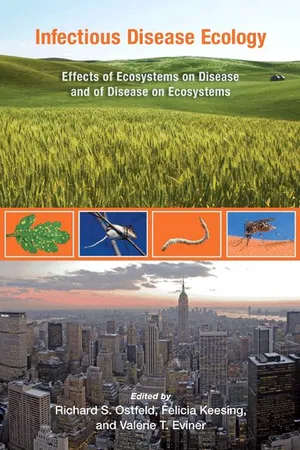 eBook - PDF
Infectious Disease Ecology
Effects of Ecosystems on Disease and of Disease on Ecosystems
- Richard S. Ostfeld, Felicia Keesing, Valerie T. Eviner, Richard S. Ostfeld, Felicia Keesing, Valerie T. Eviner, Richard Ostfeld, Felicia Keesing, Valerie Eviner(Authors)
- 2010(Publication Date)
- Princeton University Press(Publisher)
This work suggests, therefore, that when disease preva- lence is very high and is associated with significant mortality, as remains the case in many developing nations, it may be impossible to fully un- derstand epidemic patterns by studying pathogens in isolation. Although the patterns revealed in these historical data are consistent with model prediction of disease interference, there remains a need for systematic study of the different possible routes of interaction between different infectious diseases (or strains of the same disease) and their dynamical consequences. In this chapter, we aim to further develop theory on the interaction between infectious diseases. We present a novel general model for examining systems with multiple pathogens. For illustration purposes, our model analyses are focused on measles and whooping cough, but the proposed framework is flexible and may be applied to strain polymorphic as well as to other unrelated diseases. The key ingredient of the formalism we develop is the simultaneous inclusion of immunologically determined components (immunosup- pression and cross-immunity) and ecological factors (isolation and in- fection-induced mortality). The Two-Disease Model Much of the influential epidemiological theory has been based on the SEIR (susceptible, exposed, infected, recovered) paradigm (Anderson and May 1991; Dietz 1976; Keeling and Rohani 2007). In this frame- 52 R O H A N I , W E A R I N G , VA S C O , A N D H U A N G U N D E R S T A N D I N G H O S T- M U LT I PA T H O G E N S Y S T E M S 53 work, individuals are categorized according to infection status: the infection-naïve are thought of as susceptible, upon infection they be- come exposed, and once latency is over they are infected and proceed to transmit the pathogen. After successfully overcoming the infection, in- dividuals are considered recovered and immune for life. eBook - PDF
- Bruce Colbert, Kurtis Pierce(Authors)
- 2018(Publication Date)
- Cengage Learning EMEA(Publisher)
See Figure 1-1. FIGURE 1-1 Many factors play a role in the mortality rate of a disease. © PlusONE/Shutterstock.com. Copyright 2019 Cengage Learning. All Rights Reserved. May not be copied, scanned, or duplicated, in whole or in part. Due to electronic rights, some third party content may be suppressed from the eBook and/or eChapter(s). Editorial review has deemed that any suppressed content does not materially affect the overall learning experience. Cengage Learning reserves the right to remove additional content at any time if subsequent rights restrictions require it. Module 1 Core Concepts of Disease 5 1.2 1-3 TRANSMISSION OF DISEASE This section will further explain the different methods by which disease can be transferred. Many terms are used to describe the characteristics of disease. Before understanding how diseases are transmitted, let’s discuss the meaning of the terms communicable, contagious, and infectious diseases. Describe how disease is transferred. LEARNING OBJECTIVE KEY TERMS Airborne transmission Pathogenic transmis-sion by way of coughing, sneezing, talking, and laughing. Biological vector Animal or insect that spreads pathogen to other hosts by a bite or injection. Centers for Disease Control and Prevention (CDC) Agency responsible for recording and tracking diseases not only domestically but also abroad. Common vehicle Any medium such as food or blood that acts as a vehicle to transport pathogens. Communicable Contagious and spread from one source to another whether it is person–person, animal–person or even an object–person via bacterial or viral microorganisms. Contagious Potential to cause infection and spread rapidly. Direct contact Making physical contact with another person or body fluids that spreads infection. Endemic Disease found in a certain region or spe-cific population. Epidemic Sudden spread of illness to large amount of people. Epidemiology Study of disease transmission, occurrence, distribution, and control for a population.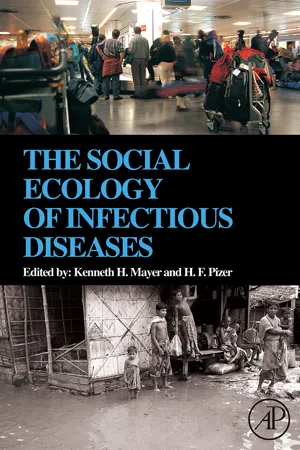 eBook - PDF
- Kenneth H. Mayer, H.F. Pizer(Authors)
- 2011(Publication Date)
- Academic Press(Publisher)
But although these are important results of ecological thinking, ecology itself is much more. In its original sense, it is the science of connections. It seeks to describe the vast web of interrelationships that tie living things to their environments, its fundamental premise being that a change in any part of one of the Introduction: What constitutes the social ecology of infectious diseases? Kenneth H. Mayer and H.F. Pizer 2 “tangled banks” of life we call ecosystems can have broad and often unexpected implications for any living thing seeking to survive within them. Gabriel Rotello, 1997, in Sexual Ecology AIDS and the Destiny of Gay Men This book was conceived to expand upon previous efforts to explore the social ecology of infectious diseases, which we define as the scientific study of the ways by which human activities enable microbes to disseminate and evolve, creating favorable conditions for the diverse manifestations of communicable diseases. Despite advances in living standards, public health, and medical technologies (including antimicrobial drugs and vaccines), infectious and parasitic diseases cause about a third of deaths worldwide and are the second leading cause of mortality and disability (Fauci, 2001). The rapidity by which changes in human behavior can result in severe epidemics is well illustrated by HIV, the cause of AIDS, which is spread primarily by sexual activity and injecting drugs using un-sterile equipment. But AIDS is only one of multiple microbial threats, and other human activities can cause devastating infectious epidemics. The goal of this text is to analyze the wide range of activities and behaviors that influence the evolu-tion and dissemination of infectious disease epidemics.
Index pages curate the most relevant extracts from our library of academic textbooks. They’ve been created using an in-house natural language model (NLM), each adding context and meaning to key research topics.

