Biological Sciences

Fertility Treatment
Fertility treatment refers to medical interventions aimed at assisting individuals or couples in achieving pregnancy. These treatments may include medications to stimulate ovulation, intrauterine insemination, or assisted reproductive technologies such as in vitro fertilization. Fertility treatments are often sought by individuals experiencing infertility or reproductive challenges.
Written by Perlego with AI-assistance
Related key terms
1 of 5

6 Key excerpts on "Fertility Treatment"
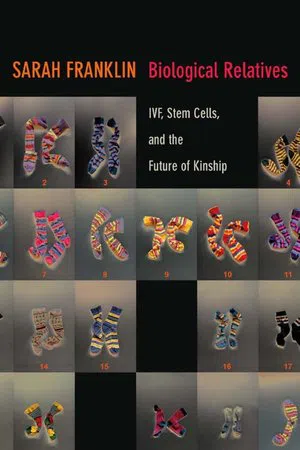
- Sarah Franklin(Author)
- 2013(Publication Date)
- Duke University Press(Publisher)
In vitro fertilization is the means by which this new form of technological control has been transferred into the human, thus confrming not only a new means of establishing a pregnancy but a new role for technology in making life. One of the most helpful models for addressing the contemporary “engi- neering ideal” of biology (Pauly 1987), or the process of “culturing life” (Lan- rElativEly biological 15 decker 2007), is that described in Adele Clarke’s (1998) account of “disci- plining reproduction.” As Clarke notes, “the reproductive sciences have themselves been marginalized, and their centrality to the overall project of controlling life has thereby been comparatively ignored,” despite the fact, as she was among the frst to point out, that it is “the reproductive sciences that have to date facilitated not only control over reproduction but control over heredity, and hence over life itself” (1998: 276).5 The control of reproduc- tive substance through technologies of selective breeding is, after all, as old as agriculture while also more central than ever today to the production, for example, of new cell factories. During the nineteenth century, modern agri- cultural methods of selective breeding began to be introduced by fgures such as Robert Bakewell, who carefully “disciplined” the reproductive substance of his livestock in order to increase their economic value, using methods such as in-and-in breeding among close biological relatives to “fx” desirable traits—a process that relied, as Harriet Ritvo (1987) has shown, on new forms of stan- dardizing animals, as well as new means of calculating their ftness, docu- menting their reproductive performance, and devising new fnancial instru- ments to market their “genetic capital.” Lineages of breed records, as well as still-existing Bakewell breeds (such as the Dishley Leicester sheep) continue this instrumental legacy (and have themselves now become valuable com- modities). eBook - PDF
Biotechnology Policy across National Boundaries
The Science-Industrial Complex
- D. West(Author)
- 2007(Publication Date)
- Palgrave Macmillan(Publisher)
The larger percentage of infertility in African countries is due to poverty, poor levels of medical treatment, and a high incidence of sexually transmitted diseases. 5 In postindustrial societies, fertility problems arise when couples delay childbearing until later years. Infertility rises with age so the decision to defer children increases the difficulty of getting preg- nant. Studies estimate that the odds of being infertile increase from 8 percent of all women between 19 and 26 years old, to 13–14 percent of those between 27 and 34 years, and to 18 percent for those between 35 and 39 years old. 6 Treatments vary by individual need, but the most common approaches include injecting sperm into an egg, transferring a 32 BIOTECHNOLOGY POLICY ACROSS NATIONAL BOUNDARIES donor egg, embryo freezing, assisted hatching, sperm storage, artificial insemination, or drug therapies to stimulate egg produc- tion. Generally, in vitro techniques involve taking eggs and/or sperm cells out of the body, combining them through artificial means, and reinserting the impregnated egg in the woman. According to gov- ernment figures, around 25 percent of these interventions produce babies. 7 The vast majority (85 percent) of women with fertility issues do not seek treatment. In vitro fertilization is expensive and time con- suming, and most insurance companies do not cover the procedure (although 15 American state governments have passed legislation requiring insurers to cover Fertility Treatments for women under a certain age, anywhere from 40 to 46 years old). 8 With costs in Western countries ranging from $5,000 to $12,000 per procedure and many women requiring four treatments (or a total of up to $20,000–$48,000 per baby), many of those affected do not utilize this elective therapy. 9 If the treatment is not beyond their financial means, couples are often discouraged by the physical and emotional stresses that accompany assisted reproductive therapies.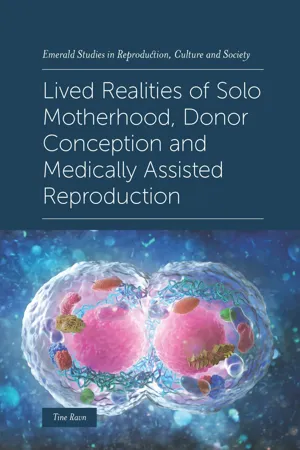
- Tine Ravn(Author)
- 2021(Publication Date)
- Emerald Publishing Limited(Publisher)
I also turn to both the physical and emotional experiences of undergoing treatment and discuss both material and discursive processes in terms of Fertility Treatment. I ask for instance, whether the women in this study change their perception of reproductive technology during their process of treatment and how they cope with undergoing treatment without a partner. Furthermore, I ask in what way the above-mentioned processes of naturalization and normalization intertwine with ‘ technology as culture ’ (Becker, 2000, p. 237) as depending on the meanings assigned to reproductive technologies. 5.1 Treatment Procedures, Risks and Success Rates Today, the fi eld of medically assisted reproduction (MAR), and the technolog-ization of human reproduction is a phenomenon which is both ‘ ordinary and Lived Realities of Solo Motherhood, Donor Conception and Medically Assisted Reproduction, 105 – 125 Copyright © 2021 Tine Ravn Published under exclusive licence by Emerald Publishing Limited doi: 10.1108/978-1-83909-115-520211007 curious ’ (Franklin, 2013a). Curious because it remains paradoxical, and ordinary, because having a child via the aid of assisted reproduction has become increas-ingly normalized (as previously noted, in Denmark, 10.5% of babies born yearly (2019 estimate) come into the world as a result of assisted reproduction (Danish Fertility Society, 2020a). As described in the introduction to this book, MAR includes all ART procedures as well as intra-uterine insemination with partner or donor sperm (IUI-H, IUI-D). ART procedures cover ‘ all interventions that include the in-vitro handling of both human oocytes and sperm or embryos for the purpose of reproduction ’ . These may include IVF, embryo transfer ET, intra-cytoplasmic sperm injection ICSI and gamete and embryo cryopreservation (Zegers-Hochschild et al., 2017, p. 1790). eBook - PDF
Regulating Reproduction
Law, Technology and Autonomy
- Emily Jackson(Author)
- 2001(Publication Date)
- Hart Publishing(Publisher)
5 Reproductive Technologies 1. INTRODUCTION I T IS AT least arguable that assisted conception techniques represent one of the most important and spectacular scientific developments of the last 25 years. In addition to transforming some people’s reproductive lives, 1 inFertility Treatment has also wrought a profound change in the relationship between law and repro-duction. Until recently parenthood was only regulated after children had been born. With the exception of the instances of sterilisation abuse discussed in chap-ter two, the decision to procreate was not susceptible to legal control. Assisted conception, on the other hand, is intensely regulated, and the announcement of any new technique is invariably followed by demands for further regulation. There are very few people who would advocate the completely unregulated pro-vision of reproductive technologies: a system in which there were no prior licens-ing requirements for the setting-up of an infertility clinic would obviously be open to abuse. The disagreement that exists is rather between those who believe that regulation should be broadly facilitative, and those who would restrict or even remove access to assisted conception techniques. My first task in this chapter is to explain what inFertility Treatment involves, and define some of the different techniques. We then consider the various argu-ments commonly put forward by critics of assisted conception. Having explained why I believe that regulation should facilitate, rather than restrict access to inFertility Treatment, this chapter then covers six key areas of regula-tion, drawing particular attention to the social, ethical and legal implications of some of the more controversial technologies and practices. First, we con-sider the role of the Human Fertilisation and Embryology Authority (HFEA) in controlling the provision of assisted conception services. Second, the restric-tions upon access to treatment are examined.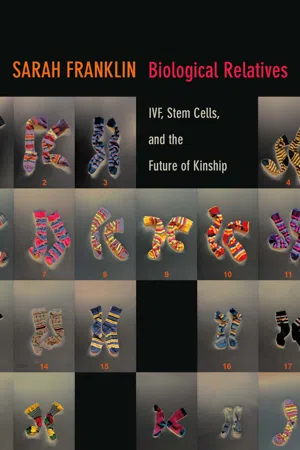 eBook - PDF
Biological Relatives
IVF, Stem Cells, and the Future of Kinship
- Sarah Franklin(Author)
- 2013(Publication Date)
- Duke University Press Books(Publisher)
In vitro fertilization is the means by which this new form of technological control has been transferred into the human, thus confirming not only a new means of establishing a pregnancy but a new role for technology in making life. One of the most helpful models for addressing the contemporary “engi-neering ideal” of biology (Pauly 1987), or the process of “culturing life” (Lan- rElativEly biological 15 decker 2007), is that described in Adele Clarke’s (1998) account of “disci-plining reproduction.” As Clarke notes, “the reproductive sciences have themselves been marginalized, and their centrality to the overall project of controlling life has thereby been comparatively ignored,” despite the fact, as she was among the first to point out, that it is “the reproductive sciences that have to date facilitated not only control over reproduction but control over heredity, and hence over life itself” (1998: 276).5 The control of reproduc-tive substance through technologies of selective breeding is, after all, as old as agriculture while also more central than ever today to the production, for example, of new cell factories. During the nineteenth century, modern agri-cultural methods of selective breeding began to be introduced by figures such as Robert Bakewell, who carefully “disciplined” the reproductive substance of his livestock in order to increase their economic value, using methods such as in-and-in breeding among close biological relatives to “fix” desirable traits—a process that relied, as Harriet Ritvo (1987) has shown, on new forms of stan-dardizing animals, as well as new means of calculating their fitness, docu-menting their reproductive performance, and devising new financial instru-ments to market their “genetic capital.” Lineages of breed records, as well as still-existing Bakewell breeds (such as the Dishley Leicester sheep) continue this instrumental legacy (and have themselves now become valuable com-modities). eBook - PDF
- David Jagiello(Author)
- 2012(Publication Date)
- Academic Press(Publisher)
PART V IN VITRO FERTILIZATION This page intentionally left blank In Vitro Fertilization in the Treatment of Human Infertility ALEXANDER LOPATA, IAN W. JOHNSTON, IAN J. H O U L T , A N D A N D R E W L. SPEIRS Department of Obstetrics and Gynaecology, University of Melbourne and Reproductive Biology Unit, Royal Women s Hospital, Carlton, Victoria, Australia INTRODUCTION In vitro fertilization of human eggs and culture of the resulting em- bryos have become highly successful procedures. In contrast, the transfer of cultured embryos into the uterus has resulted in a disap- pointingly low number of term pregnancies. At present one live birth can be expected for approximately every 20 embryos placed in the uterus (1). It is envisaged, nevertheless, that the systematic evaluation and control of the factors responsible for this low efficiency of embryo transfer, will in time, make the procedure a generally accepted treat- ment for several types of human reproductive failure. Infertility caused by irreparably damaged, or missing fallopian tubes, had been the only definitive indication for in vitro fertilization (IVF) and embryo transfer (ET). A fairly complete discussion of some current concepts in the management of patients who have these disor- ders, and consideration of the advantages and disadvantages of surgi- cal removal of damaged tubes before IVF and ET, has been presented in a previous report (2). However, couples whose inability to conceive is unexplained, or is due to sperm antibodies in the female or the 4 1 1 BIOREGULATORS OF REPRODUCTION Copyright © 1981 by Academic Press, Inc. All rights of reproduction in any form reserved. ISBN 0-12-379980-5 412 ALEXANDER LOPATA et al. male, cervical hostility, oligospermia, failed insemination by donor, and endometriosis are now included in the IVF program.
Index pages curate the most relevant extracts from our library of academic textbooks. They’ve been created using an in-house natural language model (NLM), each adding context and meaning to key research topics.

