Biological Sciences

Gene Therapy
Gene therapy is a technique that involves introducing genetic material into a patient's cells to treat or prevent disease. This can be achieved by replacing a faulty gene with a healthy one, inactivating a malfunctioning gene, or introducing a new gene to help the body fight a disease. Gene therapy holds promise for treating a wide range of genetic disorders and other diseases.
Written by Perlego with AI-assistance
Related key terms
1 of 5
9 Key excerpts on "Gene Therapy"
 No longer available |Learn more
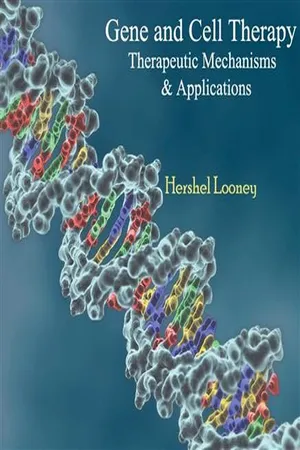
Gene and Cell Therapy
Therapeutic Mechanisms & Applications
- (Author)
- 2014(Publication Date)
- The English Press(Publisher)
____________________ WORLD TECHNOLOGIES ____________________ Chapter- 1 Gene Therapy and Cell Therapy Gene Therapy Gene Therapy Gene Therapy is the insertion, alteration, or removal of genes within an individual's cells and biological tissues to treat disease. The most common form of Gene Therapy involves the insertion of functional genes into an unspecified genomic location in order to replace a mutated gene, but other forms involve directly correcting the mutation or modifying normal gene that enables a viral infection. Although the technology is still in its infancy, it has been used with some success. ____________________ WORLD TECHNOLOGIES ____________________ Gene Therapy using an Adenovirus vector. A new gene is inserted into an adenovirus vector, which is used to introduce the modified DNA into a human cell. If the treatment is successful, the new gene will make a functional protein. Approach Scientists have taken the logical step of trying to introduce genes directly into human cells, focusing on diseases caused by single-gene defects, such as cystic fibrosis, haemophilia, muscular dystrophy and sickle cell anemia. However, this has proven more difficult than modifying bacteria, primarily because of the problems involved in carrying large sections of DNA and delivering them to the correct site on the gene. Today, most Gene Therapy studies are aimed at cancer and hereditary diseases linked to a genetic defect. Antisense therapy is not strictly a form of Gene Therapy, but is a related, genetically-mediated therapy. The most common form of genetic engineering involves the insertion of a functional gene at an unspecified location in the host genome. This is accomplished by isolating and copying the gene of interest, generating a construct containing all the genetic elements for correct expression, and then inserting this construct into a random location in the host organism.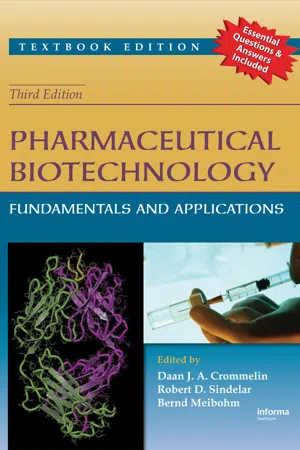 eBook - PDF
Pharmaceutical Biotechnology
Fundamentals and Applications, Third Edition
- Daan J. A. Crommelin, Robert D. Sindelar, Bernd Meibohm, Daan J. A. Crommelin, Robert D. Sindelar, Bernd Meibohm(Authors)
- 2016(Publication Date)
- CRC Press(Publisher)
8 Gene Therapy Maria A. Croyle College of Pharmacy, The University of Texas at Austin, Austin, Texas, U.S.A. INTRODUCTION The pioneering report of James Watson and Francis Crick describing the helical structure of DNA spurned an upsurge of biomedical research focusing on the composition of DNA, RNA and proteins and their role in health and disease that continues today. This “molecular revolution” has markedly influenced understanding of the pathophysiology of a diverse collection of disease states ranging from cystic fibrosis (CF), inborn errors of metabolism and immunodeficiencies to cancer, cardiovascular disease and diabetes. Rapid development of recombinant DNA technology prompted sequencing of the human genome and identifying genotype–phenotype rela-tionships in human disease. Although these efforts have produced highly sophisticated, extremely sen-sitive diagnostic tests, the development of successful molecular therapies based upon this expanded knowledge of disease pathogenesis is still in progress. Gene Therapy is the use of nucleic acids as therapeutic medicinal compounds. The most straight-forward Gene Therapy strategy is to compensate for abnormal gene expression. Gene medicines can also be engineered to reconstitute a diseased organ, either by directing regeneration of specific tissues through expression of embryonic genes to induce cell growth and development or, in the case of cell-based therapies, by using natural or genetically corrected stem cells to produce healthy tissues. The field of Gene Therapy is still in its infancy with the first testing of this concept in the clinic occurring in 1990. This landmark trial, for adenosine deaminase (ADA) deficiency, involved the use of peripheral blood lymphocytes treated with a retrovirus expressing ADA in ADA-deficient patients (Anonymous, 1990). eBook - PDF
- Danilo D. Lasic(Author)
- 2019(Publication Date)
- CRC Press(Publisher)
Gene Therapy Medicine has passed in its history through several breakthroughs, from Galen and Pasteur to the introduction of anesthesia, surgery, vaccines, antibiotics, novel imaging techniques, lasers, and remote operating devices. Direct treatment on the molecular level of diseases themselves and not their symptoms may be the next important development in human therapy. Gene Therapy is emerging as a new modality as well as a technology in medical practice. It offers the potential to cure disease on its most basic level and has therefore captured the imagination of scientific and popular media. The therapy requires the insertion of a functional gene or other molecule with an information sequence into a cell to achieve a therapeutic effect, and the gene therefore serves as a drug (Anderson, 1992; Miller, 1992; Mulligan, 1993; Goldspiel et al., 1993). All the organisms of a particular species have an identical number and type of genes. Obviously, because we are not absolutely identical, small variations among genes exist within the species. While most of these polymorphisms have no effect on the protein function and some of them bring only innocuous variations in physical appearance, such as the color of eyes or hair, some of them produce serious inherited disorders. These disorders can be apparent immediately after birth or can develop only later in the life span; they can also make some individuals more susceptible to environmental factors. It is anticipated that Gene Therapy can handle or eliminate such problems. ■ ■ STRATEGIES IN GENE DELIVERY Several thousand diseases can be traced to defective or missing functional genes, and it is hoped that by delivering the appropriate gene into the appropriate cells, the mutated or missing proteins can be synthesized and the signs of the disease alleviated. In the majority of cases the mutation is in the coding region of the gene.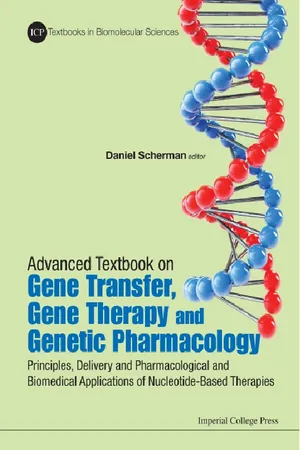 eBook - PDF
Advanced Textbook On Gene Transfer, Gene Therapy And Genetic Pharmacology: Principles, Delivery And Pharmacological And Biomedical Applications Of Nucleotide-based Therapies
Principles, Delivery and Pharmacological and Biomedical Applications of Nucleotide-Based Therapies
- Daniel Scherman(Author)
- 2013(Publication Date)
- ICP(Publisher)
Gene Therapy consists of administering a gene-expressing cassette (promoter — gene — polyadenylation signal) to the cells. Basic Definitions and General Principles 9 2.2 Critical Advantageous Properties of Gene Therapy Several fundamental properties render Gene Therapy essential for the treatment of a large body of diseases, whether genetic or not, and also suggest that it could represent an attractive alternative to protein-substitution therapy. First, since proteins are generally unable to cross cell membranes, only Gene Therapy is able to provide for the treatment of any disease which is caused by the lack of expression of an intracellular protein, or which can be cured through the intracellular expression of a therapeutic or antigenic protein. This is the case, for instance, for neuromuscular disorders such as Duchenne muscular dystrophy, for which the missing dystrophin protein has to be expressed in the muscle cytosol. This is also the case for vaccination strategies based on class 1 antigen presentation. TABLE 2.1 Examples of Genetic Diseases Already Treated or in Clinical Trials Using Gene-Replacement Therapy, and Their Related Clinical Protocols — A Non-Exhaustive List. eBook - PDF
- John P. Fisher, Antonios G. Mikos, Joseph D. Bronzino(Authors)
- 2007(Publication Date)
- CRC Press(Publisher)
14 Gene Therapy J.M. Munson W.T. Godbey Tulane University 14.1 Introduction .............................................. 14 -1 14.2 Nucleotides for Delivery ................................. 14 -2 DNA (deoxyribonucleic acid) • RNA 14.3 Gene Delivery ............................................ 14 -2 Biological Delivery Methods • Chemical Delivery Methods • Physical Delivery Methods 14.4 Intracellular Pathways ................................... 14 -6 14.5 Cell and Tissue Targeting ................................ 14 -7 14.6 Applications .............................................. 14 -8 In Vitro • Ex Vivo • In Vivo 14.7 Clinical Applications .................................... 14 -9 14.8 Summary ................................................. 14 -10 References ....................................................... 14 -10 14.1 Introduction Gene Therapy is the delivery of genetic material into cells for the purpose of altering cellular function. This seemingly straightforward definition encompasses a variety of situations that can at times seem unrelated. The delivered genetic material can be composed of deoxyribonucleic acid (DNA) or RNA, or even involve proteins in some cases. The alteration in cellular function can be an increase or decrease in the amount of a native protein that is produced, or the production of a protein that is foreign. The delivery of the genetic material can occur directly, as is the case with microinjection, or involve carriers that interact with cell membranes or membrane-bound proteins as a part of cellular entry. Polynucleotides can be single or double stranded, and can code for a message, or not (as is the case for antisense gene delivery). Even the location of cells at the time of gene delivery is not restricted. Cells can be part of a living organism, can exist as a culture on a plate, or can be removed from an organism, transfected, and replaced into the same or a different organism at a later time. eBook - PDF
- Evelyn B. Kelly(Author)
- 2007(Publication Date)
- Greenwood(Publisher)
The researchers had ignored warnings that could have prevented the death of Gelsinger and the illnesses of other participants in the trial. The FDA and the NIH initiated new stringent guidelines and safety regulations. See Chapter 10, Regulation of Gene Therapy. T HE F IRST GERM-L INE TRANSFER People are more frightened of germ-line therapy. Gene Therapy affecting these cells raised several concerns in addition to those of somatic cell therapy. Such therapy could be directed in several ways: • Directly at the sperm or ova before the two unite at fertilization • At the cells that produce the sperm or ova—precursor cells • At the early stages of embryonic development, only hours after fertilization Many religious traditions especially oppose germ-line experimentation. See Chapter 12, Social and Religious Issues. The major objections surrounding germ- line therapy concern the propagation of unpredictable effects into future genera- tions and the long-term effects of changing genetic characteristics in human pop- ulations. SUCCESSES AND SETBACKS IN THE 1990S 41 Genetic Treatment versus Eugenics In a series of articles in The New Yorker, Daniel J. Kevles (1984) quoted Francis Galton as having defining eugenics as “the science [of] improving human stock by giving the more suitable races or strains of blood a better chance of prevailing over the less suitable.” Gene Therapy is defined as the medical intervention of replacing a defective gene that is not working with a healthy gene that is working. Researchers are generally discreet about germ-line therapy, and getting approval for such protocols is extremely difficult. However, one type of germ-line therapy has been successful and has not caused controversy. As of 2001, 30 chil- dren were born as a result of transfer of the egg cytoplasm (ooplasm) performed on women who cannot conceive because of defects in their ooplasm. To correct the conditions, healthy ooplasm from donor eggs is injected into the defective eggs. eBook - PDF
Gene Therapy
Developments and Future Perspectives
- Chunsheng Kang(Author)
- 2011(Publication Date)
- IntechOpen(Publisher)
Almost half a century later, the initial enthusiasm and euphoria have been greatly tempered by the sober recognition that while Gene Therapy is simple in concept, it is highly complex and challenging in execution. The early promises of human Gene Therapy raised unrealistically high expectations that gene medicine was round the corner. Compounded by well publicised serious iatrogenic complications from a small number of clinical trials, a pall quickly descended on the field from the late 1990s that led many investigators to flee from a field of research that came to be perceived as both unfeasible and unfundable. Gene Therapy has now emerged from a much needed phase of reflection and correction. There is clear evidence that appropriately selected monogenic and acquired diseases can benefit from gene-based therapy. Notwithstanding that there remains a risk to certain viral vectors, the decision to reinitiate Gene Therapy trials for SCID-X1 (NCT01129544) is acknowledgement of what Gene Therapy may offer to diseases that are currently difficult to treat effectively or at reasonable cost. Failures of Gene Therapy should not discredit the field but ought to be opportunities to deepen scientific understanding of the complex processes demanded for therapeutic success. Safety is a key consideration, particularly with respect to genotoxicity. The confluence of autologous cell therapy with conventional Gene Therapy appears to be a promising approach. Cells that are first modified ex vivo lend themselves readily to comprehensive biosafety assessments that are not feasible with conventional in vivo Gene Therapy. The ability to thoroughly characterize cells for the desired phenotype, and for genotoxicity and other risks before in vivo implantation or administration should go some way to making such novel treatments safe. (The authors were unable to cite all relevant publications owing to page limitations.) Gene Therapy - Developments and Future Perspectives 176 6. eBook - PDF
- Xu-bo Yuan(Author)
- 2011(Publication Date)
- IntechOpen(Publisher)
Gene Therapy of Some Genetic Diseases by Transferring Normal Human Genomic DNA into Somatic Cells and Stem Cells from Patients 127 C., Faix, D., Blair, P., Yu, C., Keene, K., Dotson, P. Jr., Boxrud, D., Sambol, A., Abid, S., St George, K., Bannerman, T., Moore, A., Stringer, D., Blevins, P., Demmler-Harrison, G., Ginsberg, M., Kriner, P., Waterman, S., Smole, S., Guevara, H., Belongia, E., Clark, P., Beatrice, S., Donis, R., Katz, J., Finelli, L., Bridges, C., Shaw, M., Jernigan, D., Uyeki, T., Smith, D., Klimov, A. & Cox, N. (2009). Antigenic and Genetic Characteristics of Swine-origin 2009 A (H1N1) Influenza Viruses Circulating in Humans. Science , Vol.325, No.5937, (July 2009), pp. 197-201, ISSN 0036-8075 Gaspar, H., Parsley, K., Howe, S., King, D., Gilmour, K., Sinclair, J., Brouns, G., Schmidt, M., Von Kalle, C., Barington, T., Jakobsen, M., Christensen, H., Al Ghonaium, A., White, H., Smith, J., Levinsky, R., Ali, R., Kinnon, C. & Thrasher, A. (2004). Gene Therapy of X-linked Severe Combined Immunodeficiency by Use of a Pseudotyped Gammaretroviral Vector. The Lancet , Vol.364, No.9452, (December 2004), pp. 2181-2187, ISSN 0140-6736 Gaspar, H., Aiuti, A., Porta, F., Candotti, F., Hershfield, M. & Notarangelo, L. (2009). How I Treat ADA Deficiency. Blood, Journal of the American Society of Hematology , Vol.114, No.17, (October 2009), pp. 3524-3532, ISSN 0006-4971 Giampietro, P., Verlander, P., Davis, J. & Auerbach, A. (1997). Diagnosis of Fanconi Anemia in Patients without Congenital Malformations: An International Fanconi Anemia Registry Study. The American Journal of Human Genetics , Vol.68, No.1, (January 1997), pp. eBook - PDF
Gene and Cell Therapy
Therapeutic Mechanisms and Strategies, Fourth Edition
- Nancy Smyth Templeton(Author)
- 2015(Publication Date)
- CRC Press(Publisher)
1045 44 44.1 STRATEGIES OF GENE TRANSFER FOR THE TREATMENT OF CANCER During the last few decades, a multidisciplinary approach combining surgery, chemotherapy, radiation, and, at times, hematopoietic stem cell (HSC) transplantation has led to a significant improvement in survival for patients affected by malignant disorders. Nonetheless, many cancers are still resistant to standard therapies, which often also have high acute and chronic organ toxicity and an increased risk for sec-ondary malignancies. Therefore, new strategies are needed to improve overall survival and decrease treatment-associated morbidity. Despite recent successes of targeted drug thera-pies, Gene Therapy provides opportunities, impossible other-wise, to precisely repair or interfere with pathways critical to cancer survival. In this chapter, we will review the different ways in which gene transfer can be used in new approaches against cancer, which are summarized in Table 44.1. Even though not a therapeutic intervention per se, gene marking has helped investigators to understand the behavior and out-come of transduced cells once returned to the patient. 44.2 MODIFICATION OF TUMOR CELLS Oncogenesis has been associated with a multitude of molec-ular aberrations that alter key regulatory, survival, and dif-ferentiation processes in the cell. Other abnormalities lead to the production of abnormal fusion products, with subse-quent gain or loss of critical functions in cell life and death. Correction of these aberrancies offers a potential means of controlling tumor growth. 44.2.1 R EPAIR OF A BNORMAL P ATHWAYS The most widely strategy currently used to repair an abnor-mal, oncogenic pathway is the delivery of a gene that encodes a functional protein that compensates for loss of function mutations. For example, TP53 (p53) gene mutations Gene Therapy for the Treatment of Cancer From Laboratory to Bedside Carlos A.
Index pages curate the most relevant extracts from our library of academic textbooks. They’ve been created using an in-house natural language model (NLM), each adding context and meaning to key research topics.

