Biological Sciences

Mycology
Mycology is the branch of biology that focuses on the study of fungi, including their genetic, biochemical, and ecological characteristics. It encompasses the identification, classification, and understanding of the roles fungi play in various ecosystems, as well as their interactions with other organisms. Mycologists study the diversity of fungi and their impact on human health, agriculture, and the environment.
Written by Perlego with AI-assistance
Related key terms
1 of 5
9 Key excerpts on "Mycology"
 eBook - PDF
- Davis, Z(Authors)
- 2021(Publication Date)
- Agri Horti Press(Publisher)
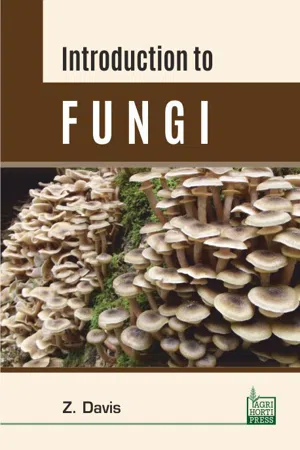
Mycology is a relatively new science that became systematic after the development of the microscope in the 16th century. Although fungal spores were first observed by Giambattista della Porta in 1588, the seminal work in the development of Mycology is considered to be the publication of Pier Antonio Micheli’s 1729 work Nova plantarum genera . Micheli not only observed spores, but showed that under the proper conditions, they could be induced into growing into the same species of fungi from which they originated. Extending the use of the binomial system of nomenclature introduced by Carl Linnaeus in his Species plantarum , the Dutch Christian Hendrik Persoon established the first classification of mushrooms with such skill so as to be considered a founder of modern Mycology. Later, Elias Magnus Fries further elabourated the classification of fungi, using spore colour and various microscopic characteristics, methods still used by taxonomists today. Other notable early contributors to Mycology in the 17th–19th and early 20th centuries include Miles Joseph Berkeley, August Carl Joseph Corda, Anton de Bary, the brothers Louis René and Charles Tulasne, Arthur H. R. Buller, Curtis G. Lloyd, and Pier Andrea Saccardo. The 20th century has seen a modernization of Mycology that has come from advances in biochemistry, genetics, molecular biology, and biotechnology. The use of DNA sequencing technologies and phylogenetic analysis has provided new insights into fungal relationships and biodiversity, and has challenged traditional morphology-based groupings in fungal taxonomy. This ebook is exclusively for this university only. Cannot be resold/distributed. Fungal Ecology 193 Fungal Endophytes The plant is an extraordinarily common source of organic energy. It is thus likely that a huge array of fungi interact with plants. Of these, a range can be isolated from apparently healthy tissue, and many have never been documented to be associated with disease.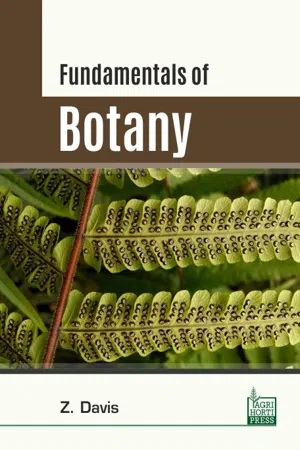 eBook - PDF
- Davis, Z(Authors)
- 2018(Publication Date)
- Agri Horti Press(Publisher)
The Fungi are ranked as a kingdom within the Domain Eukaryota. That is, they have eukaryotic cells with distinct nuclei, although in some species divisions between nucleated “cells” are sparse. However, they all lack chlorophyll, and the species are either saprophytic or parasitic. Included within the Fungi are the well known mushrooms, but the group also includes many microscopic forms, and fungi inhabit every environment on earth, perhaps second only to the bacteria in distribution. Mycology Mycology (from the Greek ìýêçò, meaning “fungus”) is the study of fungi, their genetic and biochemical properties, their taxonomy, and their use to humans as a source for tinder, medicinals (e.g., penicillin), food (e.g., beer, wine, cheese, edible mushrooms) and entheogens, as well as their dangers, such as poisoning or infection. From Mycology arose the field of phytopathology, the study of plant diseases, and the two disciplines remain closely related. A biologist who studies Mycology is called a mycologist. This ebook is exclusively for this university only. Cannot be resold/distributed. 212 Fundamentals of Botany BACKGROUND Historically, Mycology was a branch of botany (though fungi are evolutionarily more closely related to animals than plants this was not recognized until recently). Pioneer mycologists included Elias Magnus Fries, Christian Hendrik Persoon, Anton de Bary and Lewis David von Schweinitz. The British Mycological Society was founded in 1896. Today, the most comprehensively studied and understood fungi are the yeasts and eukaryotic model organisms Saccharomyces cerevisiae and Schizosaccharomyces pombe . Many fungi produce toxins, antibiotics, and other secondary metabolites. For example, the cosmopolitan (worldwide) genus Fusarium and their toxins associated with fatal outbreaks of alimentary toxic aleukia in humans were extensively studied by Abraham Joffe. Fungi are fundamental for life on earth in their roles as symbionts, e.g. eBook - PDF
- J.W. Bennett(Author)
- 2012(Publication Date)
- Academic Press(Publisher)
In this sytem, categories such as genetics, ecology, phys-iology, morphology, and molecular biology are used. Molecular Mycology, then, combines the two systems and is the application of a certain set of experi-mental approaches to the study of fungi. Mycology has never been a glamor field, and most people who work with fungi do not even call themselves mycologists. They are plant pathologists, food technologists, natural products chemists, industrial microbiologists, geneticists, and so on. Often they are less interested in the biology of their system than in some practical application. Yet it is this same group of nonmycologists working with fungi who offer the greatest hope for bringing molecular biology to the study of fungi. This is because research is stimulated by the profit motive (and its academic variant, the availability of funding) as well as by intellectual curiosity. Sometimes both stimuli reinforce one another. Economics will be the driving force behind much of the new mycological research, and many of the recombi-nant DNA techniques tailored for use on fungi will come out of industrial and agricultural laboratories. What will the new techniques do for Mycology? Recombinant DNA tech-nology makes many new experiments possible. Rarely before has the introduc-tion of a new methodology had such an immediate impact. There are those who believe we now have the magic elixir that will resolve all biological engimas. This stance has been labeled molecular biology macho (Lewin, 1984). Here 21. Prospects for a Molecular Mycology 525 is an example. Sydney Brenner, in reflecting on the publication of the complete developmental lineages of C. elegans, was quoted during the summer of 1984: Peter Medawar has written that science is the art of the soluble. My reply is that molecular biology is the art of the inevitable. If you do it, it's inevitable you will find out how it works—in the end. eBook - PDF
- (Author)
- 2001(Publication Date)
- Elsevier Science(Publisher)
We survive in the diversity of insects, fungi and plants, in our interlocked community of organisms. The world population is expected to increase by 2 billion in the next quarter century. In context, life will be a fine balance in terms of food, space, and species interactions. The importance of the kingdom of fungi, relates to its interactions on an equal basis with members of plants, animals and prokaryotic microorganisms. Fungal diversity, whether in structure, survival in the extremes of environment, modes of growth and proliferation, production and secretion of extracellular enzymes, peptides and secondary metabolites is consequential to agriculture and food. While the molecular biologists of the day work with a few well studied fungi such as Saccharomyces cerevisiae, Aspergillus nidulans and Neurospora crassa there are 72,000 species waiting in line to be studied (1). Through advances in Mycology we understand fungal organismic structure, physiology, genetic endowment, and primary and secondary metabolism and their purposes (see; chapters by Weber and Pitt; Peberdy, Wallis and Archer; and Marzluff, in this volume). Advances in genetics and molecular biology and collective strength of the associated tools of analytical chemistry, biology and information technology allows us to probe into the mystery of the fungal world. As we have a growing base of some 10,000 fungal species in various collections and the public domain literature we have some of the relevant knowledge to cross connect to biotechnology for exploitation of fungi for manufacturing of products and deployment of processes of benefit agriculture and food. The knowledge base in Mycology is in a good position to lead the new biotechnology of agriculture and food. But this knowledge is trailing so far as its use in the prevention of mycotic infections of animals, humans, foods and plant products are concerned. eBook - PDF
- Emea, A(Authors)
- 2018(Publication Date)
- Agri Horti Press(Publisher)
R. Buller, Curtis G. Lloyd, and Pier Andrea Saccardo. The twentieth century has seen a modernization of Mycology that has come from advances in biochemistry, genetics, molecular biology, and biotechnology. The use of DNA sequencing technologies and phylogenetic analysis has provided new insights into fungal relationships and biodiversity, and has challenged traditional morphology-based groupings in fungal taxonomy. FUNGI AS HUMAN PATHOGENS The diseases of warm-blooded animals caused by fungi are known as mycoses (sing.=mycosis). Although such diseases are relatively few, the fungi that cause them have a wide host as well as geographical range. Most of these diseases are not fatal, but once contracted, they may forever be a source of constant irritation and can lead to permanent scaring, which is why they are not such a pretty sight to view. The successful treatment of fungal diseases is more difficult than those caused by bacteria. Because bacteria are prokaryotes, the makeup of their cells are very different than our own eukaryotic cells and pharmaceutical products, such as antibiotics, can successfully destroy bacteria without harming our cells, tissues and organs. However, because fungi are eukaryotes, finding a treatment that will kill the fungus and not harm our own cells is more difficult. Early man viewed disease as a work of demons, and in many tribal societies, This ebook is exclusively for this university only. Cannot be resold/distributed. Cell Biology, Physiology and Mycology 198 the exorcism of demons was the job of the shaman, witch doctor, sorcerer, etc. With the development of civilization, more elaborate stories came about. For example, the Greeks tell of the myth about Pandora opening a box given to her by Zeus and releasing a host of plagues on mankind. However, they also created Aesculapius, the god of healing and medicine who had two daughters, Hygeia and Panacea, who were goddesses of health.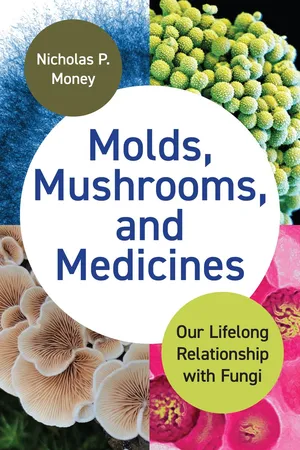 No longer available |Learn more
Molds, Mushrooms, and Medicines
Our Lifelong Relationship with Fungi
- Nicholas P. Money, Nicholas Money(Authors)
- 2024(Publication Date)
- Princeton University Press(Publisher)
It widens to our conscious interactions with these mi- crobes through their roles in our diet and as a source of powerful medi- cines. Science has been advancing in all of these areas of mycological inquiry, from studies that reveal the diversity of yeasts that grow on the skin to research on the use of psychedelic mushrooms in the treatment 4 c h a p t e r 1 of depression. Once we expand our view of the give-and-take between humans and fungi to these deliberate uses of fungi, we discover a broader relationship, a human-fungus symbiosis that is a defining feature of our biology and culture. The term “symbiosis” is used in its original and most liberal sense in this book to describe helpful and harmful re- lationships between species. This is a perfect reflection of the incredible range of interactions between humans and fungi. WHAT IS A FUNGUS? Not plant, not animal, more animal than plant, and treated as the most mysterious kingdom of life in popular culture, fungi come in many shapes and sizes.1 The fungi we see most often seem too big to be cat- egorized as microbes. These are mushrooms, which include the fairy- tale fly agaric, with its red cap spotted with white scales; shelf fungi, as big as dinner plates, that grow on decomposing logs; and slices of white button mushrooms on pizzas. The reason we call these species micro- organisms is that the fungus that forms the mushroom is microscopic. For almost all of their lives, these organisms exist as spidery colonies of tiny threads called hyphae. Each thread, or hypha, is ten times thinner than a human hair. These filaments elongate and branch as they feed in soil and go about the process of rotting wood. The colony of branching hyphae is a mycelium. When this mycelium has grown over a large area and absorbed enough food, it reverses direction and flows to the sur- face, where the threads merge to form mushrooms. Mushrooms with gills are the fruit bodies or sex organs of fungi that mist the air with spores. eBook - PDF
- Mary Ann Clark, Jung Choi, Matthew Douglas(Authors)
- 2018(Publication Date)
- Openstax(Publisher)
Most familiar mushrooms belong to this division. Fungi that have no known sexual cycle were originally classified in the “form phylum” Deuteromycota, but many have been classified by comparative molecular analysis with the Ascomycota and Basidiomycota. Glomeromycota form tight associations (called mycorrhizae) with the roots of plants. Chapter 24 | Fungi 697 24.3 Ecology of Fungi Fungi have colonized nearly all environments on Earth, but are frequently found in cool, dark, moist places with a supply of decaying material. Fungi are saprobes that decompose organic matter. Many successful mutualistic relationships involve a fungus and another organism. Many fungi establish complex mycorrhizal associations with the roots of plants. Some ants farm fungi as a supply of food. Lichens are a symbiotic relationship between a fungus and a photosynthetic organism, usually an alga or cyanobacterium. The photosynthetic organism provides energy from stored carbohydrates, while the fungus supplies minerals and protection. Some animals that consume fungi help disseminate spores over long distances. 24.4 Fungal Parasites and Pathogens Fungi establish parasitic relationships with plants and animals. Fungal diseases can decimate crops and spoil food during storage. Compounds produced by fungi can be toxic to humans and other animals. Mycoses are infections caused by fungi. Superficial mycoses affect the skin, whereas systemic mycoses spread through the body. Fungal infections are difficult to cure, since fungi, like their hosts, are eukaryotic, and cladistically related closely to Kingdom Animalia. 24.5 Importance of Fungi in Human Life Fungi are important to everyday human life. Fungi are important decomposers in most ecosystems. Mycorrhizal fungi are essential for the growth of most plants. eBook - PDF
- F. H. Kayser, K. A. Bienz, J. Eckert(Authors)
- 2011(Publication Date)
- Thieme(Publisher)
III Mycology Absidia corymbifera 5 General Mycology F. H. Kayser General Characteristics of Fungi & Fungi are eukaryotic microorganisms (domain eucarya) that occur ubiqui-tously in nature. Only about 200 of the thousands of species have been identified as human pathogens, and among these known pathogenic species fewer than a dozen are responsible for more than 90% of all human fungal infections. The basic morphological element of filamentous fungi is the hypha and a web of intertwined hyphae is called a mycelium. The basic form of a unicel-lular fungus is the yeast cell. Dimorphic fungi usually assume the form of yeasts in the parasitic stage and the form of mycelia in the saprophytic stage. The cell walls of fungi consist of nearly 90 % carbohydrate (chitin, glucans, mannans) and fungal membranes are rich in sterol types not found in other biological membranes (e.g., ergosterol). Filamentous fungi reproduce either asexually (mitosis), by hyphal growth and tip extension, or with the help of asexual spores. Yeasts reproduce by a process of budding. Sexual reproduc-tion (meiosis) on the other hand, produces sexual spores. Fungi imperfecti or deuteromycetes are the designation for a type of fungi in which the fruc-tification forms are either unknown or missing entirely. & Definition and Taxonomy Fungi are microorganisms in the domain eucarya (see. p. 5). They show less differentiation than plants, but a higher degree of organization than the pro-karyotes bacteria (Table 5. 1 ). The kingdom of the fungi ( Mycota ) comprises over 50 000 different species, only about 200 of which have been identified as human pathogens. Only about a dozen of these “pathogenic” species cause 90 % of all human mycoses. Many mycotic infections are relatively harmless, for instance the dermatomycoses. In recent years, however, the increasing numbers of patients with various kinds of immune defects have resulted in more life-threatening mycoses. 348 5 eBook - PDF
Soil Fungi and Soil Fertility
An Introduction to Soil Mycology
- S. D. Garrett(Author)
- 2016(Publication Date)
- Pergamon(Publisher)
CHAPTER 6 STUDYING THE SOIL FUNGUS FLORA The first isolation of soil fungi in culture was made by I. Adametz (1886) in Germany and he was followed by Oudemans and Koning (1902) in the Netherlands and then by others in the early years of the present century. The real importance of fungi in the soil economy was not fully established until some 50 years ago and another 20 years were to elapse before the ecology of soil fungi became as popular a study as it is today. The early years of any branch of plant ecology must be occupied chiefly by a study of the whole flora comprising the community occupying any habitat under investigation; this is called a synecological study. It is later followed by a more intensive autecological study of particular species that may be of special scientific interest or of great economic importance for applied biologists. So soil mycologists first had to collect information about the genera (and species) of at least the commoner fungi in the soils that they were studying. So the compilation and comparison of fungal floristic lists was a first task for soil mycologists all over the world. As time went on, these synecological studies were increasingly supplemented by autecologi-cal studies of economically important soil fungi. As noted in Chapter 1, such fungi are chiefly the mycorrhizal fungi, making a positive contribution to crop growth and yield, and the pathogenic root-infecting fungi, making a negative one. Work with these fungi will provide most of the examples to be discussed in following chapters. The present chapter will now describe the more general studies. S T U D I E S O F F U N G A L C O M M U N I T I E S B Y D I R E C T M I C R O S C O P I C A L O B S E R V A T I O N The first and most fundamental problem of soil Mycology was posed by the assertion of some bacteriologists (e.g. Conn, 1917) that fungi do not live 76
Index pages curate the most relevant extracts from our library of academic textbooks. They’ve been created using an in-house natural language model (NLM), each adding context and meaning to key research topics.

