Biological Sciences

Mycelium
Mycelium is the vegetative part of a fungus, consisting of a network of fine, white filaments called hyphae. It plays a crucial role in the decomposition of organic matter and nutrient cycling in ecosystems. Mycelium also serves as the main mode of nutrient absorption for the fungus, allowing it to extract nutrients from its surroundings.
Written by Perlego with AI-assistance
Related key terms
1 of 5
11 Key excerpts on "Mycelium"
 eBook - PDF
- Lynne Boddy, Juliet Frankland, Pieter van West(Authors)
- 2007(Publication Date)
- Academic Press(Publisher)
Network architecture is a significant factor in the acquisition and distribution of nutrients, and in survival when parts of the network are destroyed. The costs and benefits of different architectures to large mycelial networks are considered. British Mycological Society Symposia Series r 2008 The British Mycological Society Published by Elsevier Ltd. All rights reserved. 3 1. INTRODUCTION For most Basidiomycota in terrestrial ecosystems the predominant body form is the Mycelium, comprising an interconnecting series of apically extending tubes — hyphae. Hyphae provide a large surface:volume, ideal for secreting enzymes for extracellular digestion of resources (Chapter 2), and for subsequent uptake of small molecules. Mineral nutrients, carbon and energy sources are presumed to be taken up largely at hyphal tips, be they embedded within an organic resource or foraging externally for new resources, and translocated from these sources to sites of demand (sinks; Chapter 3). Nutrient acquisition and other aspects of physiology are affected by the local environment (Chapter 2), and mycelia exhibit remarkable physiological and morphological plasti-city. Moreover, since mycelial activity in one region can be supported by sup-ply of water and nutritional resources from elsewhere, growth can sometimes occur in inhospitable places and adverse conditions. The interconnectedness of mycelia is of crucial significance to the organization and ecological roles of fungi (Rayner et al ., 1995). In terrestrial ecosystems, the organic resources on which saprotrophic Basidiomycota depend are usually discrete, varying in size from small to large plant fragments, e.g. bud scales, leaves and large woody components. These resources are distributed heterogeneously in both space and time. eBook - PDF
The Rhizosphere
Biochemistry and Organic Substances at the Soil-Plant Interface, Second Edition
- Roberto Pinton, Zeno Varanini, Paolo Nannipieri, Roberto Pinton, Zeno Varanini, Paolo Nannipieri(Authors)
- 2007(Publication Date)
- CRC Press(Publisher)
Depending on the specificity of the plant–fungus interactions, such hyphal connections, named by Simard et al. [165] the “wood-wide web,” may involve plants of the same or different species. Although mycorrhizal networks can be formed by both ECM and endomycorrhizal fungi, the functional and ecological roles of the hyphal networks have been investigated mostly for fungi involved in ectomycorrhiza. In particular, an exciting discovery was that, among nutrients, organic carbon is transferred from one plant to another along the hyphae of the mycorrhizal fungal web, following the general rule of a source-to-sink movement [165]. FIGURE 8.16 Mycelium of Glomus mosseae stained with Toluidine blue O for the histochemical detection of polyphosphate (S: spore, arrowheads: polyphosphate granules). S 224 The Rhizosphere: Biochemistry and Organic Substances at the Soil–Plant Interface The wood-wide web represents a highway of horizontal nutrient movement and a pool of organic carbon in the ECM plant communities; it is therefore not surprising that some organisms have learned to exploit it. In the recent years, it has become clear that many achlorophyllous plants, which are heterotrophic because of the lack of photosynthesis, obtain organic carbon by connecting to the wood-wide web through their mycorrhizal endophytes [7]. The mycorrhizal symbionts of achlorophyllous plants are usually recalcitrant to isolation and growth in axenic culture, and their identification has been greatly aided by molecular methods (for example, see Reference 33). A common feature of the achlorophyllous plants so far investigated is that they all associate with fungi capable of forming mycorrhiza on surrounding autotrophic species. Another feature common to achlorophyllous plants is the unusually high degree of specificity toward their mycorrhizal symbionts. eBook - PDF
- Y. Pachepsky, J.W. Crawford, W.J. Rawls(Authors)
- 2000(Publication Date)
- Elsevier Science(Publisher)
In between these, mycelia exhibit various degrees of hyphal aggregation, though all have diffuse growing fronts, and become consolidated into mycelial cords from behind (Thompson, 1984; Rayner et al., 1985; Boddy, 1993). Those fungi whose mycelia are predominantly diffuse, utilize resources which are relatively common and relatively homogeneously supplied in space. For example, the fairy ring forming fungi of grasslands, e.g., Marasmius oreades, and the woodland floor, e.g., members of genera such as Collybia, Clitocybe and Mycena (Rayner and Boddy, 1988; Dowson et al., 1989a). In contrast, those fungi which utilize bulky, relatively uncommon and heterogeneously distributed resources, such as large branches, trunks and tree stumps, predominantly produce extensive and long-lived systems of mycelial linear organs, e.g., P. velutina (mycelial cords) and Armillaria gallica (rhizomorphs) (e.g., Rayner and Boddy, 1988; Boddy, 1993). Nonetheless, as indeterminate systems, mycelia have the capacity to alter their organizational state according to changing circumstances and functional requirements. Thus at different times, or at the same time in different parts of the system, mycelia may exhibit different branching patterns, degrees of aggregation and hyphal densities (unit length per unit volume). The extra-resource foraging mycelia of cord-, rhizomorph- and fairy ring-for- ming fungi mentioned so far all tend to form large systems (easily visible to the naked eye at a macroscopic scale), most commonly at the soil/litter interface. The latter means that they can be considered as approximately 2-D, and that trays containing a thin layer of compact soil provide suitable model systems for studying them. However, this is only an approximation and it may not be entirely appropriate to confine all of these fungi in this way and certainly not those which form small mycelia radiating only a few centimeters into soil from spores or organic resources. eBook - PDF
Handbook of Soil Sciences
Properties and Processes, Second Edition
- Pan Ming Huang, Yuncong Li, Malcolm E. Sumner, Pan Ming Huang, Yuncong Li, Malcolm E. Sumner(Authors)
- 2011(Publication Date)
- CRC Press(Publisher)
These data suggest that mixotro-phic plants that live in forests derive photosynthates by sharing symbiotic fungi (Selosse and Roy, 2009). 24.4.3 Diversity in Mycorrhizal Features: Mycorrhizal Fungi Develop Structures Outside and Inside the Roots According to their ability to colonize the root cells, mycorrhizal fungi are divided into two main categories: endo- and ectomy-corrhizae. Since a detailed structural description of mycorrhizae is not the main aim of this chapter, we here only briefly review the main structural features that characterize mycorrhizal mor-phologies. More detailed information can be found in Peterson et al. (2004). Endomycorrhizal hyphae adopt a variety of colo-nization patterns during their penetration of host root cells. AM fungi depend on their hosts on a great extent and cannot survive for long without them. Once the fungus has overcome the epidermal layer, it develops an appressoria and grows inter- and intracellularly all along the root in order to spread fungal structures. During the symbiotic phase, some Glomeromycota (i.e., Glomus species) develop structures, called vesicles, that fill the cellular spaces, and probably act as storage pools. Only when the fungus has reached the cortical layers, does a peculiar branching process start, which leads to highly branched arbus-cules (Bonfante et al., 2009; Bonfante and Genre, 2010). These are the key structures that are produced during the symbioses, and are considered the site of nutrient exchange (Figure 24.8a). During endosymbiosis, regardless of the involved partners, a new apoplastic space, based on membrane proliferation, is built around all the intracellular hyphae (Bonfante, 2001). In AM, this new compartment is known as the interfacial compartment, and it consists of the invaginated membrane, the cell wall-like material, and the fungal wall, and plasma membrane (Balestrini and Bonfante, 2005). eBook - PDF
- Dilip K. Arora(Author)
- 2003(Publication Date)
- CRC Press(Publisher)
1 Cell Biology of Hyphae Oded Yarden The Hebrew University of Jerusalem, Rehovot, Israel 1 INTRODUCTION Members of the fungal kingdom are present in almost every conceivable niche. Even though fungi are remarkably diverse, many fungi share common cellular characteristics that are instrumental to the success of fungal growth, development, proliferation, and survival. The purpose of this introductory chapter is to provide the reader with an overview of some of the fundamental aspects of one of the predominant forms of fungal structures—hyphae. The introductory chapter discusses the attributes that are common to many fungi as well as other organisms while also emphasizing some of the features that are unique to fungal species, as compared to other eukaryotes (some of the details will be discussed in depth in the following chapters of this book). Perhaps the primary recognizable difference between the hyphal “cell” and cells of other organisms is the predominantly coenocytic nature of the former. Characteristically, the hyphal cell harbors multiple nuclei that are evenly or unevenly distributed over relatively long distances of cytoplasmic continuity. Nonetheless, in this chapter, the term “cell” is used while discussing some of the fundamental as well as more unique attributes of hyphae. Identifying and understanding the nature of these attributes, and in particular, the regulatory mechanisms involved in orchestrating the growth of the fungal filament is an important step in the process of our intervention in fungal biology, be it curbing detriments or enhancing benefits these organisms are capable of exhibiting. 2 THE CELL WALL The cell wall is a characteristic structure present in many organisms whose life style to grow in an environment with continuously changing water potential can be described as an absorptive one.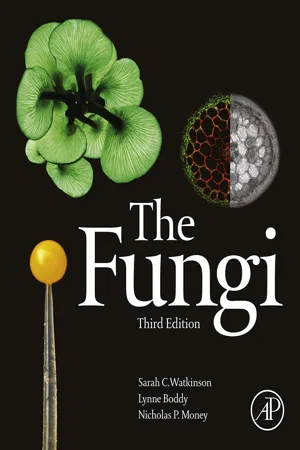 eBook - ePub
- Sarah C. Watkinson, Lynne Boddy, Nicholas Money(Authors)
- 2015(Publication Date)
- Academic Press(Publisher)
Chapter 2Fungal Cell Biology and Development
Nicholas P. Money Miami University, Oxford, OH, USAAbstract
Fungi share most fundamental features of cell structure and function with other eukaryotes. Cell biological distinctions include the unique chemical composition of the fungal cell wall and plasma membrane, and the peculiar mechanisms of hyphal growth in filamentous fungi and budding in yeasts. Filamentous fungi generate multicellular colonies, or mycelia, through the extension and repeated branching of cells called hyphae. Mycelia can be restricted to a patch on a decomposing leaf, or span an enormous territory in a forest ecosystem. Fungi also produce multicellular organs that function in the exploration of the environment and survival under conditions of environmental stress. Fruit bodies, including the familiar mushrooms of basidiomycetes, are multicellular reproductive organs. Mushroom formation involves the coordinated growth of millions of hyphae. The molecular control of hyphal growth and fruit body formation are areas of active research, but many questions about the developmental biology of the fungi are unanswered.Keywords Basidiomata Chitin Dolipore septum Ergosterol Hyphal tip growth Turgor pressure Rhizomorphs Septation Woronin bodies Yeast cell cycleOrganelles, Cells, Organs
Fungi are eukaryotes and much of their cell biology is shared with animals, plants, and protists. Fungal cells are built from the same kinds of organelles as other eukaryotes. They have a plasma membrane, nuclei, and complicated endomembrane system. Most species have mitochondria. A few organelles are not found in other kingdoms. These include a dense assembly of secretory vesicles called the Spitzenkörper that is located in hyphal tips, and the Woronin body of Ascomycota that serves as an intracellular plugging device that stops cytoplasmic leakage. The chitinous cell wall is another distinctive feature of fungal cells. This chapter will provide an overview of the structure of fungal cells, discuss how they grow and multiply to form yeast colonies or branching mycelia, and describe the developmental processes that result in the formation of complex, multicellular organs including cords, sclerotia, and mushrooms (Figure 2.1 eBook - PDF
- Gupta, Rajan Kumar(Authors)
- 2021(Publication Date)
- Daya Publishing House(Publisher)
Chapter 20 Microbial Megacell in Advanced Biological Processes Rajesh K. Srivastava * Department of Biotechnology, GITAM Institute of Technology, GITAM University, Gandhi Nagar Campus, Rushikonda, Visakhapatnam – 530 045, A.P . Introduction Filamentous growth is a fungal differentiation behaviour and fungal scavenging response, occurred to extra-cellular stimuli such as nutrient limitation (Bharucha, et al ., 2008). Megacell or filaments is found in range of size from 0.8 to 5 µm in width and from 5 to > 500 µm in length. Growth morphology of filamentous fungi and some filamentous nature of bacteria is an important parameter for productivity of several industrial processes (Villena and Gutierrez-Correa, 2007; Srivastava et al ., 2009). Exposure ( i.e .15–30 min) of cells harboring synthetic genetic circuit to small molecule signals ( i.e . anhydrotetracycline or IPTG), triggered long-term and uniform cell elongation, with cell length being directly proportional to the time elapsed following a brief chemical exposure (Gardner et al ., 2000). Many different species including plant and animal pathogens (such as some bacteria and fungi), and yeasts like the baker’s (or budding) yeast Saccharomyces cerevisiae undergo filamentous growth (Paul and George, 2012). Controlling of mycelial morphology is important factor or key parameter for attaining the optimum metabolic stage for maximum production of metabolites in industrial application. Engineering studies of filamentous organism is used to design and operation for industrial fermentation processes. Filamentous fungi are grown by the polar extension of hyphae. Polar growth requires the specication of sites of germ tube or branch emergence which is then followed This ebook is exclusively for this university only. Cannot be resold/distributed. by the recruitment of the morphogenetic machinery to those sites for localized cell wall deposition. eBook - PDF
- (Author)
- 2002(Publication Date)
- Elsevier Science(Publisher)
The most important types are represented by ectomycorrhizas, ectoendomycorrhizas and endomycorrhizas [1]. In ectomycorrhizas the fungal symbiont forms a thick mantle of interwoven hyphae around feeder roots and grows intercellularly in the cortex, forming a network termed Hartig net, but it never penetrates root cells. Ectomycorrhizas are widespread in temperate and boreal forest trees such as Castanea, Quercus, Pinus, Tsuga, Pseudotsuga, Corylus, Eucalyptus, Betula, Tilia, Ulmus, Larix. Fungal symbionts are represented by more than 5000 different species mainly belonging to Basidiomycota, which produce mushrooms and toadstools, such as Amanita, Boletus, Cortinarius, Hebeloma, Laccaria, Russula, Suillus, Tricholoma, and to Ascomycota, such as the hypogeous genus Tuber [2]. Ectoendomycorrhizas are structurally different from ectomycorrhizas, since the fungus is able to grow intracellularly in the first layer of root cells. Depending on the fungal/plant association the fungal mantle may be more or less developed. These mycorrhizas occur in some plant genera belonging to Ericales, /. e. Arbutus and Arctostaphylos, and are known as arbutoid mycorrhizas. The fungi able to form arbutoid mycorrhizas generally give rise to ectomycorrhizal symbioses when colonising other host plants [3, 4]. Similarly, a limited number of fungi infecting dominant ectomycorrhizal trees in natural forest ecosystems are able to colonise a small group of achlorophyllous epiparasitic plants, monotropes, (Monotropoideae, Ericaceae), forming ectoendomycorrhizas of the monotropoid type. The achlorophyllous species depend on fungal symbionts for their carbon nutrition, since the extraradical Mycelium acts as a link between the different plants, transferring photosyntates from the autotrophic to the heterotrophic hosts [5, 6]. eBook - PDF
- Emea, A(Authors)
- 2018(Publication Date)
- Agri Horti Press(Publisher)
Cell Biology, Physiology and Mycology 244 separate and different nuclei in a single hyphal segment) in the life cycle usually has been interpreted as support for a close relationship between Basidiomycota and Ascomycota. Numerous phylogenetic studies such as SSU rDNA, RNA polymerase genes, and mitochondrial genome sequencing provide strong support for this relationship. A subkingdom termed Dikarya is proposed, creating a division between a highly speciose subkingdom (Dikarya) and the remaining early diverging lineages whose relationships are not precisely known. Fungal classification is far from static, and even which organisms are actually members of Fungi is changing. For example, the group trichomycetes describes gut inhabitants of arthropods that share similarities with zygomycetes. Molecular phylogenetic studies have demonstrated that two of the four orders of trichomycetes are actually members of the Mesomycetozoea protist group. Other organisms that were previously considered to be Fungi because of their heterotrophic, mold-like growth forms are now classified as stramenopiles (Oomycota, Hyphochytriomycota, and Labyrinthulomycota) or slime molds (Myxomycota, Plasmodiomycota, Dictyosteliomycota, Acrasiomycota). More interesting for mycologists are the findings that some species previously considered protozoa are actually Fungi. For example, the species Hyaloraphidium curvatum was assumed to be a green alga that had adopted a heterotrophic lifecycle concomitantly with losing its chloroplast. It is now known to be a chytrid fungus related to Monoblephariomycetes but lacking a flagellated stage. Other examples include the parasitic organisms presumed to be protozoa, such as the cockroach parasite Nepridiophaga and the Daphnia parasite Polycarum recently demonstrated to be members of the fungal kingdom based on SSU rDNA phylogenies. eBook - PDF
- Panda, Himadri(Authors)
- 2021(Publication Date)
- Genetech(Publisher)
Far from being deleterious, the presence of this fungal net actually prolongs the life of the cortical cells and of the root as a whole. The fungal mantle, which develops concomitantly around the outside of the root, varies from a relatively loose weft of hyphae to a thick, dense, pseudoparenchymatous layer which may account for nearly half the biomass of the mycorrhiza. Mycelial strands or hyphae often extend from the mantle into the surrounding soil, while the formation of roothairs by the plant is suppressed. It has been shown that sugars are translocated from the root via the Hartig net to the fungal mantle, where they tend to accumulate. As sugars pass from plant to fungus, they are converted into trehalose (a disaccharide), mannitol (a polyhydric alcohol) and glycogen, all three being typical fungal carbohydrates. The glycogen is insoluble, and therefore unavailable for possible reabsorption by the plant. More surprisingly, although the mannitol and trehalose remain in solution in the fungus, the plant is incapable of reabsorbing them. Thus, the fungal mantle acts as a sink where reserves of carbohydrates derived from the phytobiont are stored. This fact is emphasized when, as autumn approaches, many of the fungi mobilize the stored carbohydrates and produce flushes of their large, fleshy basidiomata near the tree. If we add up the various parts of the fungus, the conspicuous fruit bodies, the extensive but usually inconspicuous Mycelium ramifying through the soil, and the rootlet mantles, we can calculate that the tree often invests at least 10 per cent of its total production of photosynthates in its mycorrhizal fungus. This investment is clearly more than compensated for by the increased efficiency of mineral absorption provided by the EM fungus.
- Chandra, Ram(Authors)
- 2021(Publication Date)
- Daya Publishing House(Publisher)
Frank in 1885, and originates from the Greek mycos , This ebook is exclusively for this university only. Cannot be resold/distributed. meaning ‘fungus’ and rhiza , meaning ‘root’. Mycorrhiza is a symbiotic mutualistic relationship between special soil fungi and fine plant roots; it is neither the fungus nor the root, but rather the structure formed from these two partners. Since the association is mutualistic, both organisms benefit from the association. The fungus receives carbohydrates (sugars) and growth factors from the the plant, which in turn receives many benefits, including increased nutrient absorption. In this association, the fungus takes over the role of the plant’s root hairs and acts as an extension of the root system. Among important plants that associate with mycorrhizal fungi are corn, carrots, leek, potatoes, beans, soybeans, other legumes, tomatoes, peppers, onions, garlic, sunflower, strawberries, citrus, apples, peaches, grapes, cotton, coffee, tea, cocoa, sugarcane, forest species, wild plants, and even weeds. Cruciferae in general, and some aquatic plants are usually non-mycorrhizal. Mycorrhizal Types On the basis of tropic level two main types of mycorrhizae may be found, depending on whether the fungus penetrates into the root cells or not: ectomycorrhizae and endomycorrhizae . Ectotrophic types, or e ctomycorrhizae , are found in roots of trees such as pines, birches, willows, and oaks. This type causes a drastic change in the root shape. The ectomycorrhizal fungus penetrates between the cell walls of the cortex and forms a covering sheath, or mantle, of fungal hyphae around the entire root. Ectomycorrhizae are short and forked and sometimes appear as tight clusters. Most ectomycorrhizal fungi produce mushrooms and can be cultivated in culture media in the laboratory. Endotrophic types, endomycorrhizae or Arbuscular Mycorrhizae (AM) do not form a mantle over the root, and the fungus actually enters the cortex cells.
Index pages curate the most relevant extracts from our library of academic textbooks. They’ve been created using an in-house natural language model (NLM), each adding context and meaning to key research topics.

