Biological Sciences

Wood Fungus
Wood fungus refers to a type of fungus that primarily grows on wood and plays a crucial role in the decomposition of dead wood in forest ecosystems. These fungi break down the complex organic compounds present in wood, aiding in the recycling of nutrients back into the environment. Additionally, some wood fungi are also known for their ability to cause wood decay in structures and buildings.
Written by Perlego with AI-assistance
Related key terms
1 of 5
12 Key excerpts on "Wood Fungus"
 eBook - PDF
- Monica Ek, Göran Gellerstedt, Gunnar Henriksson, Monica Ek, Göran Gellerstedt, Gunnar Henriksson(Authors)
- 2009(Publication Date)
- De Gruyter(Publisher)
Fungi are heterotrophic organisms that depend on organic carbon; they derive their energy from a saprophytic or parasitic life. Figure 10.1. Hyphae of the white-rot fungus Phlebiopsis radiata growing in pine tracheids. Note erosion of the tracheid walls along the hyphae. SEM. Figure 10.2. Mycelium of a white rot. fungus growing over discoloured birch wood chips. Note the bleaching effect. 221 Figure 10.3. Mycelium of a Pycnoporus embedding wheat straw. The main wood-inhabiting organisms of the Kingdom of Fungi are found in the classes Zy-gomycota , Ascomycota and Basidiomycota and the wood-degrading bacteria belong to the Eu-bacteria. Figure 10.5 illustrates their phylogenetic relations. The classification is based on the form the sexual phase of the fungal life cycle. Some fungi, the Deuteromycetes or Fungi Imper-fect i, only produce asexual spores. Other characteristics suggest that most Deuteromycetes in fact belong to the Ascomycota . Members of Zygomycota are not able to degrade wood, but some species within genera like Mucor and Rhizopus occur as moulds on timber. Degradation of wood is caused by fungi from the classes of Basidiomycota , Ascomycota and the Deuteromycet-es . Basidiomycetes are usually referred to as higher fungi and the wood-degrading species are sometimes called “ true wood-decay fungi ”. They often form macroscopic fruit bodies such as brackets and mushrooms. Ascomycetes and Deuteromycetes are usually referred to as “micro-fungi” due to their generally microscopic appearance. Some are capable of degrading wood, by causing soft rot, other species may cause sapstain or grow as moulds on wooden surfaces. Most wood-degrading organisms are also able to degrade other types of lignocelluloses, such as straw, bagasse and various plant components such as bark, needles, cones etc. The dominant de-graders of such substrates in nature are, however, organisms that are specifically adapted to a particular substrate. eBook - PDF
Timber Pests and Diseases
Pergamon Series of Monographs on Furniture and Timber
- W. P. K. Findlay, Jack Kape(Authors)
- 2013(Publication Date)
- Pergamon(Publisher)
FUNGAL DECAY decomposition. It was his son, Robert Hartig, who proved that fungi are the cause and not the result of rot in trees and timber. His brilliant work dominated thought on this subject till the end of last century, and his excellent illustrations were copied again and again. Since fungi play such an important role in bringing about timber decay, it is necessary to understand what kind of organ-isms they are, how they are reproduced, and the conditions under which they can grow and flourish. The study of fungi is called mycology and those who undertake it are called mycologists. NATURE OF FUNGI Fungi are generally regarded as a highly specialized class of plants, though there are some mycologists who would consider them as belonging to a phylum (kingdom) of their own, com-parable to that of plants and animals. The relationship of fungi to other plants is in a way similar to that of insects to other animals. Both groups exhibit a great diversity of form, are exceedingly numerous both in numbers and species, and have the means for incredibly rapid multiplication; and both are responsible for many of the diseases suffered by other plants and animals. Fungi differ fundamentally from all the green plants which live by the process known as photosynthesis. No fungi possess chlorophyll (the green colouring matter which is in leaves) and they are therefore unable to build up sugar and starch from the carbon dioxide in the atmosphere. Fungi, like animals, must find ready-make organic food materials on which to live. The variety of materials on which they will grow is surprising. Practically any material obtained from plants or animals can provide sustenance for some species of fungus. Even such resistant materials as cork and hair can be attacked, and many 33 TIMBER PESTS AND DISEASES man-made products, such as nitrocellulose, can be decomposed by fungi. eBook - ePub
Wood Microbiology
Decay and Its Prevention
- Robert A. Zabel, Jeffrey J. Morrell(Authors)
- 2020(Publication Date)
- Academic Press(Publisher)
Many fungi can decay wood, however, only a few types have been studied thoroughly. New, novel methods by which fungi digest ligno-cellulose alone or in concert with other organisms may await discovery. There are thousands of decay fungi, yet our knowledge of the chemistry of decay rests on the study of only a few dozen species.Many, if not most, laboratory studies of fungi are conducted in pure cultures. In nature, many microorganisms are involved sequentially in the colonization and alteration of wood during the decay process. Studying the microecological aspects of the decay process may reveal cohorts of organisms that more efficiently decay wood or sequences of organisms and interactions which suggest potent new biological control agents or ways to accelerate decay.Studies of the types and sequences of fungi involved during wood colonization and decay also may reveal effective ways to modify wood to impart attractive colors or patterns or improve properties such as penetrability. Emerging high throughput sequencing techniques can provide enormous detail on the organisms present in a substrate and community ecology techniques can allow us to establish fungal relationships. These techniques permit detection of previously unculturable organisms and researchers are struggling to understand the roles of so many organisms in the decay process. This discovery process offers exciting new possibilities for developing a better understanding of the microbial ecology of decaying wood.Wood as substrate for mushroom production
The ability of fungi to colonize wood and produce reproductive structures has been exploited for centuries in Asia for the production of mushrooms like Shiitake (Lentinulus edodes ) and the Oyster mushroom (Pluerotus ostreatus ) (Leatham, 1982 ; Zadrazil, 1974 ). These white rot fungi are inoculated into freshly-cut hardwood logs, that are incubated in cool, moist environments for up to two years (Leatham, 1982 ; San Antonio, 1981 ). Once they begin fruiting, the fungus produces mushrooms for one to two years before it exhausts the nutrients in the log. At that point there is little value left in the log, although there have been some suggestions to use this material as animal feed, since the fungi have solubilized the wood polymers to make them more digestible (Kirk, 1983 eBook - PDF
- J. K. Misra, Jalpa P. Tewari, Sunil Kumar Deshmukh, Csaba Vágvölgyi, J. K. Misra, Jalpa P. Tewari, Sunil Kumar Deshmukh, Csaba Vágvölgyi(Authors)
- 2014(Publication Date)
- CRC Press(Publisher)
66 Fungi from Different Substrates conifers and being able to spread over throughout boreal, temperate as well as most tropical regions of the world are represented by fungi well adapted to environmental fluctuations. This group of fungi evolved by developing various survival strategies and is able to cause serious damage to forest and urban ecosystems (e.g., some of the most feared wood destroying fungi able to kill living trees, decompose their wood structure and remain in soil living on root fragments for several decades until new seedlings are planted: Armillaria mellea , A. tabescens , Heterobasidion annosum , Ganoderma spp., etc.), some other wood fungi spread over wood surfaces poor in moisture content [dry-rot fungi: e.g., Serpula lacrymans , S. himantioides (Fr.) P. Karst., Coniophora puteana , Fibroporia vaillantii , etc.] causing serious damage to material used in construction or wood made historical artifacts. In terms of disease control the most reliable strategy remains prevention by implementing detailed analyses and careful choice when planting new tree species or adopting “healthy” pruning habits, though when infection is observed correct fungus identification by observing both mycelia of fruitbody characters and tree disease symptoms are necessary followed by disease spreading control strategies. Making people aware of the ecological and economical impact correlated to such dangerous wood fungi species probably would ensure a higher degree of prevention, tree disease control and focus on adopting stronger regulations for dispersal of alien aggressive pathogenic species throughout borders. Another aspect refers to directing research towards finding practical solutions including eco-friendly biological control and not only by adopting the “chemical” approach as already experimented. Regarding timber fungi, close attention is needed when selecting wood type for construction purposes.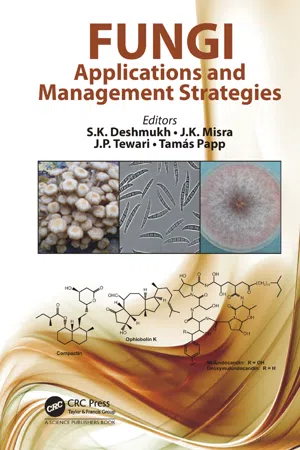 eBook - ePub
Fungi
Applications and Management Strategies
- Sunil K. Deshmukh, J. K. Misra, Jalpa P. Tewari, Tamas Papp, Sunil K. Deshmukh, J. K. Misra, Jalpa P. Tewari, Tamas Papp(Authors)
- 2018(Publication Date)
- CRC Press(Publisher)
In terms of evolution, various wood-inhabiting fungi species belong to different groupings. Some are restricted to colonizing one type of substrate and follow the distribution range of the substrate that they prefer [e.g., Inonotus tamaricis (Pat.) Maire], while other fungi evolved differently. For example, species able to colonize wood at a faster rate occur on a wide range of substrata including both living and dead hardwoods and conifers and are able to spread over boreal, temperate as well as most tropical regions of the world and are represented by fungi well adapted to environmental fluctuations. This group of fungi have evolved by developing various survival strategies and are able to cause serious damages to forest and urban ecosystems (e.g., some of the most feared wood destroying fungi are able to kill living trees and decompose their wood structure and remain in soil on root fragments for several decades until new seedlings are planted: Armillaria mellea, A. tabescens, Heterobasidion annosum, Ganoderma spp., etc.). Some other fungi spread over wood surfaces poor in moisture content [dry-rot fungi, e.g., Serpula lacrymans, S. himantioides (Fr.) P. Karst., Coniophora puteana, Fibroporia vaillantii, etc.] causing serious damage to material used in construction or wood-made historical artifacts. In terms of disease control the most reliable strategy is the prevention by carefully selecting the type of plant when planting new tree species and adopting ‘healthy’ pruning habits. For infected plants correct fungus identification by observing both mycelia and fruitbody characters, disease symptoms are necessary before implementing any control strategies. Making people aware of the economical impact of some serious destructive fungi will also ensure a higher degree of prevention. Tree disease control and focus on adopting stronger regulations to check the dispersal of alien aggressive pathogenic species throughout borders would also be useful eBook - PDF
- J. W. Deacon(Author)
- 2009(Publication Date)
- Wiley-Blackwell(Publisher)
Chapter 11 Fungal ecology: saprotrophs This chapter is divided into the following major sections: • a theoretical model: the concept of life-history strategies • the biochemical and molecular toolbox for fungal ecology • a “universal” decomposition sequence • the fungal community of composts • fungal decomposers in the root zone • fungal communities in decaying wood The importance of fungi in ecosystem processes is unde- niable. Fungi are the main agents of decomposition in many terrestrial and aquatic environments. They are particularly important in the breakdown and recycl- ing of cellulose and hemicelluloses, which together account for nearly 70% of all the plant wall material that is recycled annually. In addition, fungi have a unique role in degrading woody substrates, which contain cellulose intimately complexed with lignin (lignocellulose). And, fungi degrade many other natural and manmade materials, causing serious economic losses. In previous chapters we dealt with the physiology, growth, genetics, and dispersal of fungi – the basis for understanding fungal ecology. But when we turn to fungi in natural environments we face a major problem, because natural communities are extremely complex: they contain many types of substrate, interacting species, and microhabitats. Therefore, at a practical level we need to find well-defined com- munities that can be dissected to provide key insights into fungal behavior. We will do this by focusing on a few natural “model” systems that have been well researched – the leaf zone, leaf litter, the root zone, self-heating composts, and wood decay. The principles derived from these natural model systems apply more generally across the fungal kingdom. We will also explore the biochemical and molecular toolbox that enables us to track and identify fungi in complex natural materials. eBook - ePub
- J. W. Deacon(Author)
- 2013(Publication Date)
- Wiley-Blackwell(Publisher)
Chapter 11
Fungal ecology: saprotrophs
This chapter is divided into the following major sections:- a theoretical model: the concept of life-history strategies
- the biochemical and molecular toolbox for fungal ecology
- a “universal” decomposition sequence
- the fungal community of composts
- fungal decomposers in the root zone
- fungal communities in decaying wood
The importance of fungi in ecosystem processes is undeniable. Fungi are the main agents of decomposition in many terrestrial and aquatic environments. They are particularly important in the breakdown and recycling of cellulose and hemicelluloses, which together account for nearly 70% of all the plant wall material that is recycled annually. In addition, fungi have a unique role in degrading woody substrates, which contain cellulose intimately complexed with lignin (lignocellulose). And, fungi degrade many other natural and manmade materials, causing serious economic losses.In previous chapters we dealt with the physiology, growth, genetics, and dispersal of fungi – the basis for understanding fungal ecology. But when we turn to fungi in natural environments we face a major problem, because natural communities are extremely complex: they contain many types of substrate, interacting species, and microhabitats. Therefore, at a practical level we need to find well-defined communities that can be dissected to provide key insights into fungal behavior. We will do this by focusing on a few natural “model” systems that have been well researched – the leaf zone, leaf litter, the root zone, self-heating composts, and wood decay. The principles derived from these natural model systems apply more generally across the fungal kingdom. We will also explore the biochemical and molecular toolbox that enables us to track and identify fungi in complex natural materials.A theoretical model: the concept of life-history strategies
Ecology lends itself to theoretical models as a basis for synthesizing complex information. The references at the end of this chapter cite some key publications in this field. Here we will briefly discuss one of these models, first developed by animal ecologists, then applied to plants and later to fungi – the concept of life-history strategies (Fig. 11.1 eBook - ePub
- Ladislav Reinprecht(Author)
- 2016(Publication Date)
- Wiley-Blackwell(Publisher)
Wood – Decay, Pests and Protection. Chapman & Hall, London, UK, 546 pBacteria acting in wood damaged by other pests are living in symbiosis with fungi or insects. For example, during degradation of mine timbers or cooling tower slats, the wood polymers are decomposed first by enzymes of fungi to low molecule weight organic substances with a high content of carbon (glucose, xylose, etc.), and these subsequently become the food for bacteria. Fungi record this sensitively and adapt their metabolism to the current situation, that is, they will increase the production of 1,4-β-glucanases needed for depolymerization of cellulose.Antagonistic bacteria, such as B. subtilis, Bacillus asterosporus and other species, produce antibiotics and toxic or repellent substances to suppress the growth of fungi and other pests in wood (see Section 6.4).3.2 Wood damaged by fungi
Fungi are carbon-heterotrophic organisms without pigments for photosynthesis and without the ability to transform carbon dioxide (CO2 ) from air to organic substances. They for life must obtain carbon from other organic substrates; for example, wood-damaging fungi from wood.Wood-damaging fungi attack live or non-live wood (Gáper & Pišút 2003):- parasitic fungi act on live trees from which they draw nutrients and energy, and sometimes they even cause various disease in them;
- saprophytic fungi damage dead wood (e.g. wooden products);
- parasitic-saprophytic fungi primarily attack live trees, and saprophytic-parasitic fungi primarily attack non-live wood from which can be transformed on live trees.
Wood-damaging fungi cause failures in wood in various ways:- Wood-decaying fungi disrupt the structural components of wood (cellulose, hemicelluloses, lignin) and thus they also worsen its physical and mechanical properties. They cause extensive rot damages on live trees, logs, sawn timber and various products made of wood.
 eBook - PDF
- Guenther Stotzky(Author)
- 2000(Publication Date)
- CRC Press(Publisher)
9 Recent Advances in the Use of Fungi in Environmental Remediation and Biotechnology Andrzej Paszczynski and Ronald L. Crawford University of Idaho, Moscow, Idaho I. INTRODUCTION Soil is a complex ecosystem with very diverse habitats. It harbors all major groups of fungi, including the motile fungi of the classes Zygomycetes and Basidiomy-cetes. Fungal populations have been estimated by determining the number of colony-forming units, which range from 104 to 106/g of soil. Hyphal lengths range from 100 to 1000 meters/g, and biomass ranges from 37 to 184 g of dry weight/m2 [1]. A total of 144 samples of sandy soil from Ipanema Beach, Rio de Janeiro, Brazil produced 4285 colonies of yeast and almost 7000 colonies of fungi. Filamentous fungi were identified in 1334 colonies, and represented 34 genera and 170 species. The most common genera were Aspergillus (30.4%), Penicillium (16.2%), Fusarium (12.6%), Trichoderma (6.4%), Paecilomyces (3.7%), Cladosporium (3.1%), and Acremonium (1 %) [2]. These impressive num bers point to the dominance of fungi in many soil habitats. Mycologists estimate that there are over 1 million species of filamentous fungi populating virtually every ecosystem on earth [3]. Soil contains not only fungal cells, but also their secretions. Oxidative enzymes of fungal origin have been detected in grassland and forest soil samples [4]. Saprophytic microorganisms have a fundamental role in the earth’s carbon Reprinted from Publication No. 98501 of the Idaho Agricultural Experiment Station. 379 380 Paszczynski and Crawford cycle. They release C02 bound in plant material back to the atmosphere, pre venting the accumulation of carbon in organic matter of biological origin. The most studied and best understood saprophytic fungi are those that cause wood decay and deterioration. Ultrastructural microscopic studies of decaying wood reveal several major types of decay: white-rot, brown-rot, soft-rot, and bacterial erosion. eBook - PDF
Fungi
Experimental Methods In Biology, Second Edition
- Ramesh Maheshwari(Author)
- 2016(Publication Date)
- CRC Press(Publisher)
71 CHAPTER 4 Fungi as Scavengers Lignin is the second most abundant constituent of the cell wall of vascular plants, where it protects cellulose towards hydrolytic attack by saprophytic and pathogenic microbes. Its removal represents a key step for carbon recycling in land ecosystems, as well as a central issue for industrial utilization of plant biomass. —Francisco J. Ruiz-Dueñas and Ángel T. Martínez (2009) Vast quantities of litter comprised mostly of dead plant cell walls are continuously decom-posed. The functioning of the ecosystem depends on this crucial process in which communities of microorganisms, with fungi being the principal player, break litter down into smaller mol-ecules. During this process the mineral ions required by living organisms are dissociated from the organic substances with which they were complexed and released into the soil. With their hyphal tips shaped as spears, the fungi penetrate through the pit apertures into the cell lumen, secreting enzymes that break pectin in the middle lamella and effecting separation of cells in dead plant material. Eventually, the cell wall is broken down into myriad small molecular substances for further decomposition into carbon dioxide and water. The fungi eke out a living by absorbing the released nutrients as a source of carbon and energy. Cellulose and hemicelluloses are the chief polysaccharide constituents of litter and wood. However, these polymeric substances are encrusted with lignin, a highly refractory insoluble compound resistant to microbial attack. Hence the key process in the recycling of carbon in nature is lignin biodegradation. The most striking lignin-degrading fungi are those that form fruiting bodies that project out from the woody trunk of trees (Figure 4.1). The isolation and identification of fungi from decomposing litter, their growth in pure cultures, and the characterization of the enzymes and of compounds have provided some insights into this process. eBook - PDF
Nonhuman DNA Typing
Theory and Casework Applications
- Heather Miller Coyle(Author)
- 2007(Publication Date)
- CRC Press(Publisher)
Mold exposure could result in health problems that would likely reduce their effectiveness in their duties. In a study on Finnish peace-keepers in Kosovo that evaluated different risk factors encountered in their daily duties, water-damaged buildings and mold risk represented 30% of most perceived risks according to the collected soldier’s interviews. 47 9.8 Decomposition and Taphonomy Fungi are one of the major factors aiding decomposition on earth. Fungi have been reported on decomposed plants, humans, and other animal bodies and remains, either in the early stages of decomposition or later, as in the Basics of Forensic Fungi 143 case of humans. 48 A few researchers have suggested using some fungi species as clandestine grave markers and in the estimation of postburial interval (e.g., Hebeloma syrjense in North America). 49 There are some disputes when con-sidering some species of fungi as standard species of postputrefaction 50 where geographic location and environmental conditions must be taken into account; more study is needed in this area of fungal classification. It is clear from research studies that when insects and other biological decomposition agents are not permitted to reach the organically rich dead bodies/cadavers, the only organisms that can lead to decomposition are fungi and bacteria when the conditions are suitable for them to grow. Fungal hyphae growth on biological specimens can make changes to the body due to the enzymatic secretion and absorption from the fungi cells. For example, Figure 1 shows how a flesh fly head has been deformed by fungi growth, after keeping the fly inverted in a tube in a refrigerator at 4 ° C for a few months. Fungal growth on a cadaver found outdoors can provide useful evidence to estimate the postmortem interval (PMI). Using this technique, a group of researchers from Japan noticed a white spotted fungal growth on the external face of a cadaver removed from a water well. eBook - PDF
Wood Microbiology
Decay and Its Prevention
- Robert A. Zabel, Jeffrey J. Morrell(Authors)
- 2012(Publication Date)
- Academic Press(Publisher)
124 / 5. Fungal Metabolism and Wood Decay because of their central role in wood decay. This topic is considered in more detail in a later chapter on wood decay. Cellulose This polymer is decomposed by a multienzyme complex known generally as cellulase, which consists of at least three enzymes that may vary with fungi (decay type) and type of substrate. Endo-l,4-ß -D -glucanases act randomly on exposed molecule surfaces, randomly cleaving the cellulose polymer. The ex-posed ends are attacked by exo-l,4-ß-glucanases (cellobiohydrolase) forming glucose or cellobiose. A 1,4-ß-glucosidase then converts the cellobiose into glucose, which can be absorbed by the microorganism. In some fungi, oxida-tive enzymes may also be involved. Hemicelluloses These polymers are also decomposed by a multienzyme complex. Hemi-celluloses are complex heteropolymers containing xylose, galactose, glucose, and mannose with acetyl, methyl, and short oligosaccharide units as side chains. Many of the hemicellulase enzymes are poorly understood. Those that attack the polymer backbones are presumed to be ß -D -galactanases, ß -D-mannanases, and ß -D -xylanases. Since the hemicelluloses are noncrystalline and more exposed in the transient capillary zone, only 1,4-ß -D endoenzymes are involved and attack the polymers randomly. Separate enzymes may be necessary to remove the side chains, but the coordination between polymer decomposition and side-chain attack is uncertain. Exoglycosidases then at-tack the oligosaccharide residues, and the xylose, mannose, glucose, and galactose units can be absorbed and utilized. Lignin Lignin biodégradation is the unique capability that distinguishes wood-decay fungi from most other microorganisms. At present, the process is only partially understood for several white-rot fungi and is still under intensive study.
Index pages curate the most relevant extracts from our library of academic textbooks. They’ve been created using an in-house natural language model (NLM), each adding context and meaning to key research topics.

