Biological Sciences

Mycorrhizae
Mycorrhizae are symbiotic associations between fungi and plant roots. They facilitate the exchange of nutrients between the fungus and the plant, enhancing the plant's ability to absorb water and minerals from the soil. This mutualistic relationship is crucial for the health and growth of many plant species, and mycorrhizae play a significant role in ecosystem functioning.
Written by Perlego with AI-assistance
Related key terms
1 of 5
11 Key excerpts on "Mycorrhizae"
 eBook - PDF
- B.L. McMichael, H. Persson(Authors)
- 2012(Publication Date)
- Elsevier Science(Publisher)
290 © 1991 Elsevier Science Publishers B. V. Plant roots and their environment B.L. McMichael and H. Persson, eds THE IMPORTANCE OF MYCORRHIZA FOR ROOTS K.G. MUKERJI, RANO JAGPAL, MAMTA BALI and REKHA RANI Mycology Laboratory, Department of Botany, University of Delhi, Del hi-1 10007 (India) ABSTRACT K.G. MUKERJI, R. JAGPAL, M. BALI and REKHA RANI, 1988. The importance of mycorrhiza for roots Roots of mycorrhizal plants are highly branched and comparatively thicker than normal roots. Thus they have increased surface area, and the hyphal strands coming out from it further extend the soil volume penetrated so that more of the soils pool of immobile elements like phosphorus is utilised. Mycorrhizal plants show improved growth, and development, mostly because of increased mine-ral nutrient uptake. The mycorrhizal roots are more efficient than the normal root in terms of uptake. They also live longer and are less susceptible to diseases than non-mycorrhizal roots. INTRODUCTION During the process of co-evolution., certain dissimilar organisms have become adapted to living together and are mutually beneficial. Such consortia, known as the mutualistic symbiosis, are extremely common in nature. One such associ-ation exists in mycorrhiza. The importance of Mycorrhizae in plants cannot be over-emphasized. The term mycorrhiza coined by Frank (1885), literally means fungus-root and it is used to describe symbiotic associations between fungi (GK= mikes) and the roots (GK=rhiza) of higher plants. Rootlets of most healthy vas-cular plants are inhabited by these beneficial fungi which play a very important role in plant nutrition. There are only few plants which develop normally without Mycorrhizae. In addition to their wide distribution in plant kingdom, these non-pathogenic rela-tionships are geographically ubiquitous. Thus the mycorrhizal condition is the rule, as both host plant and fungus specificity is minimal and usually not obse-rved (Miller et al., 1986). eBook - PDF
Metals in the Environment
Analysis by Biodiversity
- M.N.V. Prasad(Author)
- 2001(Publication Date)
- CRC Press(Publisher)
2 Mycorrhizal Fungi Jan V. Colpaert Limburgs Universitair Centrum, Diepenbeek, Belgium P. Vandenkoornhuyse Universite de Lille, Paris, France 1 INTRODUCTION Mycorrhizal symbiosis is the most widespread symbiosis between plants and mi croorganisms. Between 80% and 90% of all seed plant species have fungi in their roots, forming structures known as mycorrhizas (1). Mycorrhizas are a functional part of the plant roots where the fungus provides an interface between the roots and the soil. Mycorrhizas are very effective in assimilating nutrients, including essential metals and their analogues, many of which are present in toxic concen trations on contaminated soils. Mycorrhizas range widely in form and in type of fungus involved, demonstrating that they represent not a single class of symbiosis but rather a type of plant-fungus association that has evolved repeatedly, in re sponse to distinct selection pressures (2). Mycorrhizas have been classified in various ways, such as into ectomycorrhizas, typically formed between some long- lived woody plant species and long-lived fungi (generally Basidiomycota and Ascomycota) (Fig. 1), and endomycorrhizas. The latter contain the most ubiqui tous mycorrhizal association, the arbuscular mycorrhizas (Fig. 1), involving a 37 38 Colpaert and Vandenkoornhuyse F ig . 1 Longitudinal section of an ectomycorrhiza and an arbuscular mycor-rhiza. (Ref. 105.) very wide range of plants and a small group of fungi in the Glomales (Zygomy- cota) (3). A much smaller group of plants form the ericoid endomycorrhizas. In the following paragraphs, we describe the three types of mycorrhizas that are commonly found in metal-polluted habitats. Arbuscular mycorrhizal (AM) fungi are strict biotrophs. In exchange for carbon compounds, these symbiotic fungi improve the uptake of phosphorus in plants (1,4,5), a highly immobile element in soil.
- Chandra, Ram(Authors)
- 2021(Publication Date)
- Daya Publishing House(Publisher)
Chapter 2 Arbuscular Mycorrhiza: A Versatile Component in Agro-Ecological Matrix Sumita Pal 1 * , Amitava Rakshit 2 and H.B. Singh 2 1 Department of Mycology and Plant Pathology 2 Department of Soil Science and Agricultural Chemistry, Institute of Agricultural Sciences, BHU, Varanasi – 221 005, India ABSTRACT Soil microbial populations are immersed in a framework of interactions known to affect plant fitness and soil quality. Beneficial microbial interactions involving arbuscular mycorrhiza, the omnipresent fungus-plant beneficial symbiosis is our main focus. They are involved in fundamental activities that ensure the stability and productivity of both agricultural systems and natural ecosystems. Both form of research has demonstrated that certain co-operative microbial activities can be exploited, as a low-input biotechnology, to help sustainable, environmentally-friendly, agro-technological practices. An analysis of the co-operative arbuscular mycorrhizal activities known to affect plant development is the general aim of this review . Keywords : Arbuscular mycorrhiza, Rhizosphere, Sustainability . Introduction “Plants don’t have roots, they have mycorrhizas (J.L. Harley)”. This strong statement was made to make it very clear that Mycorrhizae are the rule in nature, not the exception and the fact that under natural conditions more than 90 per cent of all known species are associated with soil fungi in a mutualistic symbiosis, termed mycorrhizas. Mycorrhizal fungi are symbionts in roots of majority of higher plants. The word Mycorrhizae was first used by German researcher A.B. Frank in 1885, and originates from the Greek mycos , This ebook is exclusively for this university only. Cannot be resold/distributed. meaning ‘fungus’ and rhiza , meaning ‘root’. Mycorrhiza is a symbiotic mutualistic relationship between special soil fungi and fine plant roots; it is neither the fungus nor the root, but rather the structure formed from these two partners.
- R C Ray, O.P. Ward(Authors)
- 2008(Publication Date)
- CRC Press(Publisher)
Mycorrhizal Symbiosis— An Indispensable Component of the Plant Culture Milan Gryndler INTRODUCTION C ultivated plants, a source of nutrition for humans, are dependent on suipply of water and minerals obtained from soil, $ flgtural growth medium for the great majority of pterit species. Soil is extremely rich in many forms of living organisms, These organisms constitute really very rich cenosis, the complexity of whkh by far exceeds the complexity of the richest aboveground plant cpyey,. §gi Ibipt^ involve microorganisms of different life strategies such as saprpfr^pfrp feeding on dead organic matter, autotrophs that do not need organe flMtri¡er$s, various parasitic organisms harmful for their host organisms, and symbiotic oirganisms that may collaborate with other components of soil biota, for example, plant roots, through mycorrhizal symbiosis. MycorrhJizal symbiosis -a functional coexistence of a fungus with roots of a host plant -is very common in nature (Trappe, 1987; Peterson and Farquahar, 1994). Mycorrhizal symbiosis is a widespread natural phenomenon and a common nutritional mechanism for the vast majority of cultivated plants, hence mycorrhizal fungi merit earnest attention of growers. Mycorrhizal fungi colonizing root tissues profoundly alter the physiological states of the plant and the fungus, resulting in formation of new complex organs called mycorrhiza. In Volume I of this series (Microbial Biotechnology in Horticulture), Bagyaraj et al. (2006) have 5 H E I MICROBIAL BIOTECHNOLOGY IN HORTICULTURE—VOL. 2 described the uses of mycorrhizal fungi in increasing productivity in horticulture. Some more information is provided in this chapter on functioning of mycorrhizal symbiosis in agriculture, forestry and horticulture. SYMBIOSIS OF HORTICUTURAL PLANTS WITH MYCORRHIZAL FUNGI Several dissimilar types of mycorrhizal symbiosis have been recognized (Peterson and Farquahar, 1994). eBook - PDF
Beneficial Plant-microbial Interactions
Ecology and Applications
- M. Belén Rodelas González, Jesús Gonzalez-López, M. Belén Rodelas González, Jesús Gonzalez-Lopez, Jesús Gonzalez-López, M. Belén Rodelas González, Jesús Gonzalez-Lopez(Authors)
- 2016(Publication Date)
- CRC Press(Publisher)
Diverse chemical, physical and biological factors are involved in the framework of plant-soil interactions responsible for a sustainable ecosystem functioning (Barea et al. 2005a). The biological components are based on diverse genetic and functional groups of soil microbial populations able to carry out critical ecosystem functions such as the biogeochemical cycling of mineral nutrients, organic matter decomposition and the formation and maintenance of soil structure, key issues in a sustainable production scenario (Barea et al. 2005b, Chaudhary et al. 2009, Richardson et al. 2009). Among the beneficial microbes, mycorrhizal fungi are recognized as one of the most influential group of soil biota in the context of ecosystem sustainability once they establish mutualistic plant-fungus symbioses, so-called mycorrhizas (Jeffries and Barea 2012). Mycorrhizal associations are formed by most vascular plant species on Earth and can be found in almost all terrestrial ecosystems worldwide (Smith and Read 2008, Brundrett 2009), being universally accepted that they are fundamental to improve plant performance and soil quality (Jeffries et al. 2003). Mycorrhizal functioning is based on the exchange of nutrients and energy between both the plant and fungal partners (Brundrett 2002). A variety of mycorrhizal types are formed, depending on the plant and fungal taxa involved. However, arbuscular mycorrhizal (AM) symbiosis is the most common and over 70 percent of plant species are capable of forming these associations (Smith and Read 2008, Brundrett 2009). This chapter will focus on AM symbiosis but the importance and ecological meaning of other mycorrhizal types are reviewed in this book (Chapter 17). AM fungi, included in the phylum Glomeromycota (Schüßler et al. 2001), are ubiquitous soil-borne fungi, whose origin and divergence have been dated back over 450 million years (Redecker et al. 2000, Honrubia 2009, Schübler and Walker 2011).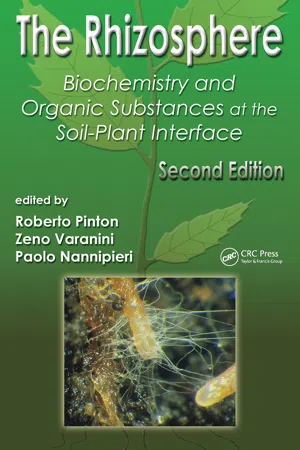 eBook - PDF
The Rhizosphere
Biochemistry and Organic Substances at the Soil-Plant Interface, Second Edition
- Roberto Pinton, Zeno Varanini, Paolo Nannipieri, Roberto Pinton, Zeno Varanini, Paolo Nannipieri(Authors)
- 2007(Publication Date)
- CRC Press(Publisher)
As significant compo-nents of the rhizosphere populations, mycorrhizal fungi interact with other microorganisms pro-ducing beneficial effects on plant nutrition and health, and on soil stability. Mycorrhizal research is currently part of mainstream biology, thanks to DNA technologies and genomics, which provide us with new tools to discover symbiont diversity and to reveal the contribution of symbiotic partners to ecosystem functioning. Another leading concept developed during this last decade and pertinent to the rhizosphere is the evolutionary and molecular similarities existing between the legumes/rhizobia symbiosis and the symbiosis of legumes with a specific group of mycorrhizal fungi, the arbuscular mycorrhizal (AM) fungi. As a consequence, the recent years have witnessed an extensive blooming of literature on the molecular, cellular, and physio-logical aspects of plant–fungus communication in mycorrhizal roots in general, [10–13] and, more specifically, in arbuscular mycorrhizas [14–18]. This chapter offers a synoptic overview of the literature on the interactions between mycorrhizal fungi and their rhizospheric environment. Here, we first discuss recent advances in molecular tools used to estimate the diversity of mycorrhizal species. We then describe the roles of mycorrhizal fungi in the establishment of a bridge between the soil and the root, their crucial role in the acquisition and assimilation of nutrients and water, metal detoxification, stabilization of the soil, and colonization of neighboring plant roots. Finally, the major insights derived from cellular, biochemical, and molecular studies of mycorrhiza development at the soil–root interface will be summarized and the gaps in our current knowledge will be highlighted. II. MYCORRHIZAL FUNGI ARE GENETICALLY DIVERSE Mycorrhizal fungi are major components of the microbial soil community, mediating soil-to-plant transfer of nutrients.
- Sudhir(Author)
- 2021(Publication Date)
- Biotech(Publisher)
Chapter 5 Mycorrhizae AS BIO-FERTILIZER Nearly a century ago A.B. Frank (1885) found that the roots of most plant are colonized by fungi and transofmred into fungus roots organ which he called “Mycorrhizal”. Mycorrhizae result from a mutualistic symbiosis between plant roots and certain fungi. Roots of most flowering plants live in mutual symbiosis with Mycorrhizae which bio-trophically colonise the root cortex and extra-metrical mycelia help the plants to obtain plant nutrients from soil (Barea, 1991). These fungi are ubiquitous in soil and are found in the roots of many Angiosperms, Gymnosperms, Pteridophytes and Thallophytes (Mosse et al , 1981). The mycorrhizal fungi perform the function of root hairs. The fungus takes carbohydrates from the plant and in turn supplies the plants with nutrients, hormones and protects it from root pathogens. The mycorrhizal plants have greater tolerance to toxic heavy metals, high soil temperature, soil salinity, unfavourable soil pH and to transplantation shocks. They play an important role in increasing plant growth and nutrients uptake (Bagyaraj, 1992, VasanthaKrishna and Bagyaraj 1993). These fungi can be used to promote biotechnologically developed plants in soil (Varma and Schuepp 1994). Classification of Mycorrhizae Frank (1885) distinguished two main types of Mycorrhizae viz., ectotrophic and endotrophic. According to recent information seven different types of Mycorrhizae are known (Harley and Smith 1983, Bhandari and Mukerji 1993). These types are as follows: 1. Ectomycorrhiza 2. Endomycorrhiza 3. Ectendomycorrhiza 4. Arbutoid mycorrhiza 5. Monotropoid mycorrhiza This ebook is exclusively for this university only. Cannot be resold/distributed. 6. Orchidaceous mycorrhiza 7. Ericoid mycorrhiza Ectomycorrhiza They form a sheath around roots but lack intracellular penetration of the cortical cells. They are commonly found on the roots of forest trees like pine, oak, beech and eucalyptus.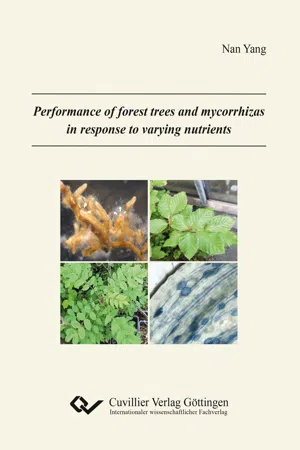
- (Author)
- 2016(Publication Date)
- Cuvillier Verlag(Publisher)
17 CHAPTER 1. General introduction Dieses Werk ist copyrightgeschützt und darf in keiner Form vervielfältigt werden noch an Dritte weitergegeben werden. Es g ilt nur für den persönlichen Gebrauch. CHAPTER 1. General introduction 18 1. General introduction 1.1. Description of mycorrhizal symbiosis In temperate forests, one of the most common mutualistic symbioses is formed by association of tree root tips with mycorrhizal fungi forming mycorrhiza. Mycorrhizas are important for plant nutrient uptake (Tuomi et al. , 2001). The mycorrhizal symbiosis is a trading system, in which the mycorrhizal fungi through their external hyphal network take up and deliver nutrients to the host plant, in return, they obtain from the plant the carbohydrates they need for essential organic compound synthesis (Smith & Read, 2008). Mycorrhizas increase the surface for nutrient uptake and overcome the nutrient-depletion area around roots for immobile nutrients (Agerer 2001). They connect nutrient fluxes between trees and soil and contribute significantly to plant phosphorous (P) and nitrogen (N) supply (van der Heijden et al. , 1988). Since forest trees have about 100% of the root tips colonized by mycorrhizal fungi (Lang et al. , 2011; Lang & Polle, 2011), almost all N and P present in plants has been taken up via mycorrhizas (van der Heijden et al. , 1988; Högberg et al. , 2006; Lambers et al. , 2009). Therefore, mycorrhizal symbiosis acts as a major active force of the forest ecosystem processes (Read et al. , 2004). Five types of mycorrhizal association have been described, and among them, two are of major economic and ecological importance: arbuscular mycorrhizas (AM) and ectomycorrhizas (EM) ( Smith & Read, 2008). 1.1.1. Arbuscular mycorrhizas Approximately 70-90% of terrestrial plants are colonized by arbuscular mycorrhizal (AM) fungi (Smith & Read, 2008). AM typically dominate in grasslands, shrublands, and tropical rainforests (Read, 1991). eBook - PDF
- Mahendra Rai(Author)
- 2006(Publication Date)
- CRC Press(Publisher)
264 HANDBOOK OF MICROBIAL BIOFERTILIZERS CONCLUSIONS Many papers have been published on Mycorrhizae, most of which relate to forest trees (Parke et al., 1983a,b; Mikola, 1988; Danielson and Visser, 1989; Baar and de Vries, 1995). Mycorrhizal associations of higher plants are among the most widely known microbial processes in nature. In natural conditions, the symbiosis forms spontaneously and contributes to plant growth. Many forest trees cannot grow without ectoMycorrhizae. This point has practical significance to afforestation programs with normally ecto-mycorrhizal trees in areas of the world where their symbiotic fungi do not occur naturally. Mycorrhizal associations function as dynamic biological linkages. Un-derstanding the extent, diversity, and function of these linkages is vital to predict future productivity. Although inoculation may be necessary in cer-tain reforestation or afforestation situations (e.g., severe, long-term degra-dation), maintaining the biological diversity of mycorrhizal fungi and other soil microbes through wise resource management may be the best way to apply mycorrhizal technology. Diversity in both plant and microbial com-munities stabilizes the plant-soil system during environmental fluctuations, particularly following adverse disturbance (Perry et al., 1987). Specificity phenomena in mycorrhizal associations act as primary sources of func-tional biodiversity in terrestial ecosystems. REFERENCES Abbott L.K. and Robson A.D. (1991). Factors influencing the occurrence of vesicu-lar arbuscular mycorrhizas. Agriculture, Ecosystems and Environment 35:121-150. Ahlström K., Persson H., and Börjesson I. (1988). Fertilization in a mature Scots pine ( Pinus sylvestris L.) stands-effects on fine roots. Plant Soil 106: 179-190. Allen M.F. and Mac Mahon J.A. (1985). Impact of disturbance on cold desert fungi: Comparative microscale dispersion patterns. eBook - PDF
- Panda, Himadri(Authors)
- 2021(Publication Date)
- Genetech(Publisher)
Man first became aware of this long tradition of plant-fungus interaction This ebook is exclusively for this university only. Cannot be resold/distributed. about a century ago, when several biologists noticed that some plant roots, while extensively invaded by fungi, did not become diseased. The name ‘mycorrhiza’, literally translated ‘fungus root’, was coined by Frank in 1885. Although the beneficial nature of the relationship was not established until much later, there is now an overwhelming body of evidence showing that in many situations (particularly in infertile soils) mycorrhizal plants grow better than non-mycorrhizal plants. It has been demonstrated that the hyphae of the fungal symbionts permeate the soil and obtain scarce and relatively immobile elements, especially phosphorus, but also nitrogen, potassium, copper and zinc, more effectively than the root hairs on a non-mycorrhizal plant. But long before the true nature of the mycorrhizal association was suspected, the constant association of particular fungi with certain trees had been noted. In the third century BC, Theophrastus commented on fungi which grew from the roots of oaks and other trees, and more recently, unsung naturalists coined such suggestive names as dubovik or ‘oak mushroom’ for Boletus luridus in Russia, and Larchenmilchling, or ‘larch milky cap’ for Lactarius porillsis in Germany. From the early 1800s the French had been encouraging the growth of truffles, which were (and still are) in great demand for haute cuisine, by planting oak trees in particular kinds of soil. Interest in this symbiosis has escalated dramatically in recent years, partly because of what we have learned about the benefits of Mycorrhizae, and partly because of economic and geopolitical events. On the geopolitical and economic fronts, several factors emerged which stimulated interest in Mycorrhizae. eBook - PDF
- Devarajan Thangadurai, Carlos Alberto Busso, Mohamed Hijri(Authors)
- 2010(Publication Date)
- CRC Press(Publisher)
1 Arbuscular Mycorrhiza and Soil Microbes Mohammad Miransari Department of Soil Science, College of Agricultural Sciences Shahed University, Tehran, Iran Introduction Soil rhizosphere is a very interesting and complicated environment surrounding plant roots. There are very many different types of microorganisms in the soil rhizosphere interacting with the other microbes and with plant roots. The properties of soil rhizosphere make it a unique and active area. The activity and interactions of rhizotrophic microorganisms can very much influence soil conditions and hence plant growth and microorganism activities [1]. Arbuscular mycorrhizas (AM) are among the most important and influencing soil microbes significantly affecting the growth of plants and other soil microorganisms. The soil part around the plant roots and AM hypha, where AM and bacteria are interactive is called ‘mycorrhizosphere’. There are also different types of soil bacteria in the soil, which are interactive with AM, particularly in the rhizosphere and in most cases the interactions are synergistic. Consideration of the rhizotrophic interactions and their consequent effects on the soil properties and hence plant growth can have very important implications in agriculture and ecology. There are different effects resulted by such interactions, which modified soil structural properties [2] and soil enhanced availability of nutrients [3] are among the most important ones. Thus, it is pertinent to evaluate such interactions precisely and suggest some new perspectives for the future research, which can make the advance of the field more rapidly and result in more efficient agricultural strategies. 2 M. Miransari Arbuscular Mycorrhiza Arbuscular mycorrhiza (AM) are zygomycetes belonging to the order Glomales. According to both fossil discoveries and DNA sequences, the appearance of both AM and plants is almost 400 million years old [4].
Index pages curate the most relevant extracts from our library of academic textbooks. They’ve been created using an in-house natural language model (NLM), each adding context and meaning to key research topics.

