Biological Sciences

Zygomycota
Zygomycota is a phylum of fungi characterized by their unique mode of sexual reproduction involving the formation of zygospores. They are typically found in soil, decaying organic matter, and as parasites on plants and animals. Zygomycota includes economically important species such as bread mold (Rhizopus stolonifer) and is known for their rapid growth and ability to spoil food.
Written by Perlego with AI-assistance
Related key terms
1 of 5
8 Key excerpts on "Zygomycota"
 eBook - PDF
- John Webster, Roland Weber(Authors)
- 2007(Publication Date)
- Cambridge University Press(Publisher)
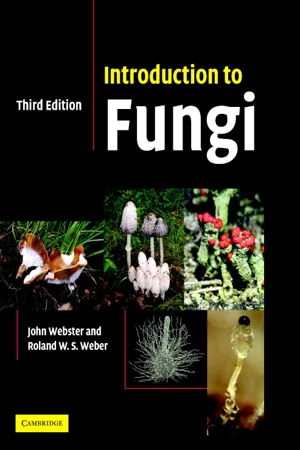
7 Zygomycota 7.1 Introduction The phylum Zygomycota comprises the first group of fungi considered in this book which lacks any motile stage. Asexual reproduction is by spores which are called aplanospores because they are non-motile, and sporangiospores because they are typically contained within sporangia. They are dispersed passively by wind, insects and rain splash, although violent libera-tion of entire sporangia (e.g. Pilobolus ) or individ-ual spores (e.g. Basidiobolus , Entomophthora ) can also occur. Sexual reproduction is by gametan-gial copulation which is typically isogamous and results in the formation of a zygospore . The mycelial organization is coenocytic, and the cell wall contains chitin and its deacetylated derivative, chitosan (Bartnicki-Garcia, 1968, 1987; see Fig. 1.5). As in the Chytridio-, Asco-and Basidiomycota, the mitochondria possess lamel-late cristae, and the Golgi system is reduced to single cisternae. Lysine is synthesized by the a -aminoadipic acid (AAA) route, as it appears to be in all Eumycota. General accounts of the Zygomycota have been given by Benjamin (1979), Benny (2001) and Benny et al. (2001). Molecular evidence indicates that the group may have diverged from the Chytridiomycota early in the history of terres-trial life. The Zygomycota, in turn, probably gave rise to the Asco-and Basidiomycota, i.e. the ‘higher fungi’ (Jensen et al ., 1998; Schu ¨ssler et al ., 2001). Two classes are included in the Zygomycota, namely Zygomycetes comprising 870 species in 10 orders, and Trichomycetes with 218 species in 3 orders (Kirk et al ., 2001). The most prominent orders of the Zygomycetes are the Mucorales, Entomophthorales and Glomales. Mucorales are ubiquitous in soil and dung mostly as saprotrophs, although a few are parasitic on plants and animals. Entomophthor-ales include a number of insect parasites, but some saprotrophic forms also exist. eBook - PDF
- Emea, A(Authors)
- 2018(Publication Date)
- Agri Horti Press(Publisher)
Cell Biology, Physiology and Mycology 244 separate and different nuclei in a single hyphal segment) in the life cycle usually has been interpreted as support for a close relationship between Basidiomycota and Ascomycota. Numerous phylogenetic studies such as SSU rDNA, RNA polymerase genes, and mitochondrial genome sequencing provide strong support for this relationship. A subkingdom termed Dikarya is proposed, creating a division between a highly speciose subkingdom (Dikarya) and the remaining early diverging lineages whose relationships are not precisely known. Fungal classification is far from static, and even which organisms are actually members of Fungi is changing. For example, the group trichomycetes describes gut inhabitants of arthropods that share similarities with zygomycetes. Molecular phylogenetic studies have demonstrated that two of the four orders of trichomycetes are actually members of the Mesomycetozoea protist group. Other organisms that were previously considered to be Fungi because of their heterotrophic, mold-like growth forms are now classified as stramenopiles (Oomycota, Hyphochytriomycota, and Labyrinthulomycota) or slime molds (Myxomycota, Plasmodiomycota, Dictyosteliomycota, Acrasiomycota). More interesting for mycologists are the findings that some species previously considered protozoa are actually Fungi. For example, the species Hyaloraphidium curvatum was assumed to be a green alga that had adopted a heterotrophic lifecycle concomitantly with losing its chloroplast. It is now known to be a chytrid fungus related to Monoblephariomycetes but lacking a flagellated stage. Other examples include the parasitic organisms presumed to be protozoa, such as the cockroach parasite Nepridiophaga and the Daphnia parasite Polycarum recently demonstrated to be members of the fungal kingdom based on SSU rDNA phylogenies. eBook - PDF
Handbook of Soil Sciences
Properties and Processes, Second Edition
- Pan Ming Huang, Yuncong Li, Malcolm E. Sumner, Pan Ming Huang, Yuncong Li, Malcolm E. Sumner(Authors)
- 2011(Publication Date)
- CRC Press(Publisher)
Still, the term “sugar fungi” accurately portrays the typical growth sub-strate of these fungi. They are not noted for their extracellular degradative enzymes and may frequently depend on the break-down products provided by lignocellulose-degrading ascomyce-tes or basidiomycetes (Cooke and Rayner, 1984). From here, it may have been a short step to direct, biotrophic parasitism of the decomposer fungi, a nutritional mode found among some Mucorales and related groups (O’Donnell, 1979; Benny et al., 2001). Of the 1065 described species of Zygomycota (including Entomophthorales, Kickxellales, Mucorales, and Zoopagales) accepted in the Dictionary of the Fungi (Kirk et al., 2008), the majority might be found in soil or close to soil in various organic substrates. 24.3.2.6 Kingdom Fungi, Phylum Glomeromycota The phylum Glomeromycota contains a single order, Glomerales (formerly misspelled Glomales and treated within the Zygomycota) (Morton, 1988; Morton and Benny, 1990; Schüßler et al., 2001; Redecker and Raab, 2006; http://www.lrz-muenchen. de/ ∼ schuessler/amphylo/). It appears that this lineage goes back at least to the early Cambrian, when they may have been symbi-otic with cyanobacteria and, later, with the ancestors of modern land plants (Pirozynski and Malloch, 1975). These are arguably among the most important of all of the fungi: Approximately 80% of the world’s land plants depend upon mycorrhizal sym-bioses with these fungi for survival in soils that are nutrient-limiting or prone to drought or other stresses (Malloch et al., 1980; van der Heijden et al., 1998; Selosse et al., 2004; de Boer et al., 2005; Smith and Read, 2008; Section 24.4). As in chytrids Microbiota 24 -21 and zygomycetes, their hyphae are coenocytic, and recent analyses have shown that many of the nuclei in a single spore may be genetically distinct (Jansa et al., 2002; Sanders, 2002). No longer available |Learn more
- (Author)
- 2014(Publication Date)
- Academic Studio(Publisher)
Elevation of the taxonomic rank of the Ascomycetes resulted in the names Ascomycetae, Ascomycotina, and finally Ascomycota. Together, the Ascomycota and the Basidiomycota form the subkingdom Dikarya. The more familiar term, Ascomycetes, is still loosely used, e.g. at fungal forays it is often said of a fungus, such as Peziza , It is an ascomycete, not a basidiomycete in reference to their sexual reproductive mode. The terms are further abbreviated to ascos and basidos which are not officially sanctioned technical names. Modern classification of Ascomycota There are three subphyla that are described and accepted: • The Pezizomycotina is the largest subphylum and contains all ascomycetes that produce ascocarps (fruiting bodies), except for one genus, Neolecta , in the Taphrinomycotina. It is roughly equivalent to the previous taxon, Euascomycetes . The Pezizomycotina includes most macroscopic ascos such as truffles, ergot, ascolichens, cup fungi (discomycetes), pyrenomycetes, lorchels, and caterpillar fungus. It also contains microscopic fungi such as powdery mildews, derma-tophytic fungi, and Laboulbeniales. • The Saccharomycotina comprises most of the true yeasts, such as baker's yeast and Candida which are single-celled (unicellular) fungi, which reproduce vegetatively by budding. Most of these species were previously classified in a taxon called Hemiascomycetes . • The Taphrinomycotina includes a disparate and basal group within the Ascom-ycota that was recognized following molecular (DNA) analyses. The taxon was originally named Archiascomycetes (or Archaeascomycetes ). It includes both hyphal fungi ( Neolecta , Taphrina ), fission yeasts ( Schizosaccharomyces ), and the mammalian lung parasite, Pneumocystis . Ribosomal RNA gene sequencing of soil suggests that there may be a fourth subphylum of Ascomycota (termed Soil Clone Group I or SCGI), that has not been described in cultures or based on fruiting bodies.
- Srinivasulu, B(Authors)
- 2018(Publication Date)
- Daya Publishing House(Publisher)
5 : Classifcation of Fungi Numerous schemes of classifcation have been proposed and some have been adopted. A generally accepted scheme for fungal classifcation has been published by the Commonwealth Mycological Institute (1983) and is reproduced here. The scheme is based on common ending for order, class, divisions, names etc. These are Division: -mycota; Sub-division: -mycotina; Class: -mycetes; Sub-class: -mycetidae; Order: -ales; and Family-ceae. Important Characters Division 1: Myxomycota Slime moulds Plasmodial forms Thallus is plasmodium True mycelium is absent. This ebook is exclusively for this university only. Cannot be resold/distributed. Class I: Plasmodiophoromycetes Endoparasitic slime moulds. Obligate parasites of vascular plants Thallus is plasmodium a) Sporangiogenous Plasmodium - Sporangial zoospores b) Cystogenous plasmodium - Cyst Zoospores ik Bifagellate Zoospores - Heterocont zoospores. Sexual reproduction - Isogamous planogametic copulation. ik Cause hypertrophy and hyperplasia of host tissue. Division 2: Eumycota True fungi. Non-plasmodial flamentous forms with cell wall. Well-developed flamentous thallus. Sub-Division a) Mastigomycotina Motile spores (Zoospores) are present. Flagellate zoospores Sexual spores - Oospore Sexual reproduction - gametangial contact (or) gametangial copulation b) Zygomycotina No motile spores. Produce non-motile spores - Aplanospores Well-developed coenocytic mycelium This ebook is exclusively for this university only. Cannot be resold/distributed. Sexual reproduction - gametangial copulation c) Ascomycotina They are called ‘sac fungi’. eBook - PDF
- Michael R. McGinnis(Author)
- 2012(Publication Date)
- Academic Press(Publisher)
Occasionally, Basidiomycetes will be 50 1 Basic Terminology and Classification Table 1.5. Keys to the Higher Groups of the Kingdom of Fungi* Key to the Divisions of the Fungi 1. Zoospores posteriorly uniflagellate (flagella whiplash type) Chytridiomycota Γ. Zoospores absent 2 2. Zygospores or sporangia present Zygomycota 2'. Zygospores or sporangia absent 3 3. Perfect state present 4 3'. Perfect state absent Fungi Imperfecti 4. Ascospores present Ascomycota 4'. Basidiospores present Basidiomycota I. Chytridiomycota Key to the Classes of Chytridiomycota 1. Thallus variously constructed, always penetrating substratum by means of rhizoids or hyphae, or entirely within it 2 Γ. Thallus uniaxial, eucarpic with proximal basal or subbasal disklike holdfast on surface only of substratum, that is, epiphytic or epizooic; distal part composed of upper sporogenous and lower nucleated vegetative region, which persists after speculation and is capable of sporulation Harpochytridiomycetes 2. Thallus holocarpic, eucarpic, monocentric, or polycentric, variously developed; zoospores often with a conspicuous globule, germination monopolar Chytridiomycetes 2'. Thallus nearly always differentiated into a well-developed hyphalike vegetative system bearing numerous reproductive bodies, occasionally monocentric; zoo-spores without a conspicuous globule, germination bipolar 3 3. Thallus usually bearing a thick-walled, usually punctate or ornamented, asexually formed resting spore at some stage of its life history; sexuality varied by iso- or anisoplanogametes; not oogamous Blastocladiomycetes 3'. Thallus without above type of resting spore; oogamous, with motile sperms and encysted oospores Monoblepharidiomycetes II. Zygomycota Key to the Classes of Zygomycota 1. Saprobic or, if parasitic or predacious having mycelium immersed in host tissue Zygomycetes Γ. Associated with arthropods and attached to the cuticle or digestive tract by a holdfast and not immersed in host tissue Trichomycetes eBook - PDF
- Lawrence A. Lacey(Author)
- 1997(Publication Date)
- Academic Press(Publisher)
CHAPTER V-4 Fungi: Oomycetes and Chytri di omyc ete s JAMES L. KERWIN & ERIN E. PETERSEN Botany Department, University of Washington, Seattle, Washington 98195 USA. 1 INTRODUCTION - PHYLOGENY AND LIFE CYCLES Aquatic fungi, formerly grouped together as Phycomycetes, are a diverse group of organisms characterized by a motile, flagellated zoospore at some stage of their life cycle (Sparrow, 1960). It is now recognized that there are phylogenetically distinct groups within this artificial assemblage. This chapter will deal primarily with two genera of entomopathogenic organisms, Lagenidium (Oomycetes: Lagenidiales) and Coelomomyces spp. (Chytridiomycetes: Blastocladiales). These are two very different groups of organisms, with one common feature: Lagenidium giganteum, the species discussed in detail here, and Coelomomyces spp. are primarily parasites of mosquito larvae. Because they are parasites of these medically important arthropods, there has been much interest for the last two decades in developing them for use in operational mosquito control. MANUALOF TECHNIQUESIN INSECTPATHOLOGY ISBN 0-12-432555-6 A Lagenidium giganteum The Oomycetes are a group of organisms whose phy- logenetic relationship to fungi and other taxonomic groups has been the subject of controversy for many years (Copeland, 1956; Barr, 1992). Although there are dissenting opinions, the prevailing view is that Oomycetes are related to heterokont algae, and are placed in the kingdom Chromista, which includes diatoms, the brown algae and all protists with chloro- plast endoplasmic reticulum or tubular ciliary mastigonemes. Monographs describing the relation- ship of the Lagenidiales to related taxa by Karling (1981) and a revision of earlier views (Dick, 1996) are available. Lagenidium giganteum is a robust, fast-growing facultative parasite which can be grown on a variety of undefined media (Domnas et al., 1982; Kerwin et al., 1986). eBook - PDF
- M. Breitenbach, R. Crameri, S. B. Lehrer, T. A. E. Platts-Mills(Authors)
- 2002(Publication Date)
- S. Karger(Publisher)
In addition, a yeast stage could be genotypically demonstrated in three species of the agaric Collybia (fig. 10) [150]. Meanwhile yeast stages are also known from symbiontic agarics (Agaricales) of leaf-cut-ting ants (e.g. different Cyphomyrmex species) [332]. A yeast/hypha dimor-phism is considered of major importance in the evolution of Zygomycota, Ascomycota and Basidiomycota. With respect to basidia, Prillinger et al. [216] introduced two different types of holobasidia. Whereas simple holobasidia are known in all three classes of the Basidiomycota, complex holobasidia are reported from the Hymeno-mycetes only [215, 216, 234]. Complex holobasidia can be traced back by partially septate basidia to tremelloid basidia (e.g. Syzygospora ) [216, 333]. Yeast cells were considered to be the most primitive basidia within the Prillinger/Lopandic/Schweigkofler/Deak/Aarts/Bauer/Sterflinger/Kraus/Maraz 250 b a Fig. 10. A yeast stage in the agarics Collybia cirrata and C. tuberosa . a C. tuberosa on decaying agaric; arrow indicates purple sclerotium. b C. cirrata : yeasts develop from basidiospores on an acidic (pH 4.5) malt extract medium. From Prillinger et al.: Expel Mycol 1993;17:26. With permission from Academic Press. Basidiomycota [215–217]. Similarly, the forcibly discharged basidiospore was already established in yeast cells of the ‘ Sporobolomyces ’ type. Ballistospores stimulate a faster spreading of yeast colonies on solid habitats and may help to escape or establish parasitic interactions. In Melanotaenium endogenum , all stages of transition from a mitotic ballistospore to the meiosporangium of smuts can be observed [334]. Similarly, in the Zygomycota the structures of the mitosporangium were used to disperse meiospores [63].
Index pages curate the most relevant extracts from our library of academic textbooks. They’ve been created using an in-house natural language model (NLM), each adding context and meaning to key research topics.

