Business

Demand Forecasting
Demand forecasting is the process of estimating future customer demand for a product or service. It involves analyzing historical data, market trends, and other relevant factors to predict future demand levels. Accurate demand forecasting is crucial for businesses to optimize inventory levels, production schedules, and resource allocation, ultimately leading to improved operational efficiency and customer satisfaction.
Written by Perlego with AI-assistance
Related key terms
1 of 5

10 Key excerpts on "Demand Forecasting"
 eBook - ePub
Supply Chain Planning and Analytics
The Right Product in the Right Place at the Right Time The Right Product in the Right Place at the Right Time
- Gerald Feigin(Author)
- 2011(Publication Date)
- Business Expert Press(Publisher)
Chapter 2 Demand PlanningThe only thing we know about the future is that it will be different. —Peter DruckerA question that is often asked in various guises in all kinds of businesses is, how much of this product are we going to sell? The answer is, it depends. It depends on who is asking the question, what product it is being asked about, what the state of the economy will be, what period of time you are looking at, how the product is priced relative to competition, whether there are substitutes available to customers, how the product has been or will be marketed, the product quality, where the product is available, and how quickly it can be provided to the customer.Demand planning, or just plain forecasting, is what companies do when they attempt to answer this question. Many decisions within a company depend on its outcome: how much product is produced, how much inventory is stored, how much supply is procured, how much capacity is needed, what staffing is required, and what working capital is needed. And yet it is remarkable how little attention companies in general give to forecasting and how little thought goes into designing a process that will yield the best possible result. Usually relegated to a back-office operations staff or to a back-office software system, forecasting as a business process is not often treated with the seriousness it deserves.Business forecasting has been around as long as businesses have. In the introduction to The Problem of Business Forecasting , written in 1924, William Foster wrote,When a man enters business, he enters a forecasting profession. He may forecast badly or well, but forecast he must. He may scorn business forecasters, but he cannot help being one. He may shun statistics, but he cannot help using them. Since business is essentially risk-taking with the expectation of profits, every enterpriser must run risks; and, as a risk-taker, he is necessarily a business forecaster.1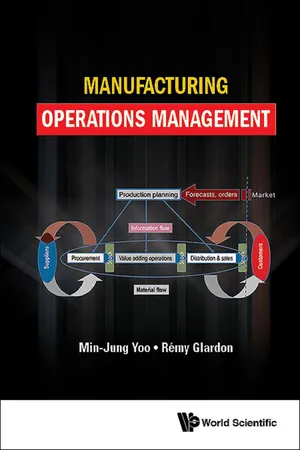 eBook - ePub
- Min-Jung Yoo, Rémy Glardon(Authors)
- 2018(Publication Date)
- WSPC (EUROPE)(Publisher)
For a large majority of companies, the delivery lead-time of finished products are greater than what the market is likely to accept, thus making it impossible to completely adopt an MTO production policy. Consequently, Demand Forecasting represents a key input for the survival and success of the company. In fact, demand forecasts condition the optimisation of the value-adding chain, regardless of the organisation type, level of flexibility, or reactivity. The knowledge of future demand is useful information which plays an important role in companies’ decision-making at various levels in the supply chain. For the purchasing department, two types of information are essential for defining the optimal procurement policy:•The estimated future needs (i.e. forecasted demands) in components and raw materials; •The reliability of the forecasts.This information is important in determining the minimal coverage of needs for a specific horizon and the level of safety stock. During the process of production planning, Demand Forecasting contributes to making key decisions such as make or buy, in creating the Master Production Schedule from which other production stems, or in determining the required resources.For distribution planning, forecasts provides input for dimensionning inventories and transportation capacities. Although these examples are not exhaustive, it is clear that forecasts are crucial in the global optimisation of value adding chains.3.3Basic concepts and definitions
This section introduces several concepts and definitions that are essential for forecasting.Direct statistical forecasting (see Section 3.1.4 ) consists of extrapolating past data that have a time reference; a month, a week, an hour, a second, and so on. The collection of data with a time reference is called a time series. In the following subsection, time series and basic statistics are discussed.3.3.1Time series and statistical analyses
A time series is a collection of sequential values observed at equally spaced time intervals. For example, the monthly sold quantities, the weekly number of air plane passengers, and the yearly profits are all time series. The study of time series models can be useful in the following circumstances. Firstly, it helps obtain an understanding of the underlying forces and structure that produced the observed data. Secondly, time series analysis is essential for forecasting, monitoring or feedback and feedforward control. eBook - PDF
Quantitative Techniques in Business, Management and Finance
A Case-Study Approach
- Umeshkumar Dubey, D P Kothari, G K Awari(Authors)
- 2016(Publication Date)
- Chapman and Hall/CRC(Publisher)
Decisions could be made and plans formulated on a once-and-for-all basis, without the need for subsequent revision. But uncertainty does exist, future outcomes are rarely assured, and therefore, an organised system of forecasting is necessary rather than the establishment of predictions based on hunches, intuition or guesses. Forecasting is essential for a number of planning decisions and often provides a valu-able input on which future operations of the business enterprise depend. Areas where forecasts of the future product demand would be useful are 1. Specification of production 2. Planning of equipment, manpower and procurement 262 Quantitative Techniques in Business, Management and Finance 3. Budget allocation depending on production and sales 4. Determination of inventory policy 5. Decision on expansion and changes in production process 6. Future trends of product development, diversification, scrapping and so on 7. Design of pricing policy 8. Planning of distribution and sales promotion 11.3 Future Uncertainty The future is uncertain, and any forecast at best is an educated guess with no guarantee of coming true. Forecasting generally refers to the scientific methodology that often uses past data along with some assumptions to come up with a forecast of future demand. A prediction is an estimate made by an individual using an intuitive ‘hunch’, which may, in fact, turn out to be true. The demand for a particular product (say, a raincoat) would depend on competitors’ prices, advertising, weather conditions, population, and a number of factors that might even be difficult to identify. In spite of these complexities, a forecast has to be made so that the manufacturers of raincoats (a product that exhibits a seasonal demand) can plan for the next season. 11.4 Forecasting for Planning Decisions The primary purpose of forecasting is to provide valuable information for planning the design and operation of the enterprise. eBook - ePub
Demand and Supply Integration
The Key to World-Class Demand Forecasting, Second Edition
- Mark A. Moon(Author)
- 2018(Publication Date)
- De Gruyter(Publisher)
But the bottom-line principle is that a forecast is not a goal. The final elaboration of our definition of Demand Forecasting centers on the term demand. The reader should note that the term contained in the title of this book, and the terminology that I will use throughout this book, is Demand Forecasting. A demand forecast is a best estimate of demand. Many other books and articles have been written on the subject of Sales Forecasting, and this is a generally accepted term. It is, however, in my mind, the wrong term. The purpose of the process that we are focusing on in this book is to create the best possible estimate of future demand. So, let us then formally define demand: Demand is what customers would buy from us if they could. An illustration will help to make the distinction between demand forecasts and sales forecasts. In spring 2000, Sony Corporation introduced its PlayStation 2 (PS2) gaming console in Japan, followed by a fall 2000 launch in the United States and Europe. At the time of its introduction, Sony was faced with manufacturing delays that led to significant and highly publicized shortages on retailer shelves. Enthusiastic consumers did everything they could to secure one of the scarce PS2 consoles. I distinctly remember one of my undergraduate students in fall 2000 who skipped class one day; at the next class period, he reported to me that he had waited all night in line to procure one of the scarce PS2s and proceeded to sell it on eBay the next day for more than double its list price. This is a well-publicized example of how demand and sales are often very different. There may be good reason for a company to produce a sales forecast— defined as the best estimate of how many units will be sold in some future time period. Good reasons include financial planning, especially reporting of revenue and profit projections to Wall Street, and short-term supply chain planning eBook - ePub
- Jayanta Kumar Bandyopadhyay(Author)
- 2015(Publication Date)
- CRC Press(Publisher)
Forecasting of demand involves an attempt to predict the future demand by examination of the pattern of the past performance of demand. Forecasting the demand of products or services is essential to the planning process of a modern business enterprise. Before making plans, a forecast must be made of demand that will exist over the future planning horizon. Many factors influence the demand for a firm’s products and services. While it is not possible to identify all of them, and their effect on demand, it is helpful to consider some of the major factors, such as general business and economic conditions, the passage of new government regulations, technological innovation, product obsolescence, competitive factors, market trends, and the company’s own plans for advertising, promotion, pricing, and product design changes.Forecasts must be made for the business plan, the production plan, and the master production schedule. The purpose, planning horizons, and level of detail vary for each case as follows:- The business plan is concerned with overall markets and the direction of the economy over the next 3–10 years or more. Its purpose is to provide time to plan for those things that take a long time to change. For a manufacturing business organization, the business plan should provide sufficient time for resource planning: plant expansion, capital equipment purchase, and those things that require a long lead time to purchase. The level of detail is not high, and usually forecasts are in sales units or sales dollars. The forecast and the plan will probably be reviewed yearly.
- The production plan is concerned with manufacturing activity for the next 1–3 years. For manufacturing, it means forecasting those items needed for production planning, budgeting, manpower planning, material requirement and procurement planning, and managing overall inventory levels. Forecasts are made for groups or families of products rather than specific end items. Forecasts and production plans are reviewed monthly.
- The master production schedule
 eBook - PDF
Supply Chain Management
A Global Perspective
- Nada R. Sanders(Author)
- 2020(Publication Date)
- Wiley(Publisher)
This is called demand◾man- agement and is the process of influencing demand. Notice that demand management cannot occur without first having a forecast or a prediction of what future demand is going to be. Once a forecast and a resulting plan have been made, the organization may decide to influence demand to better utilize its resources, and the plan recon- figured accordingly. This is shown in Figure 8.2. FORECASTING The process of predicting future events PLANNING The process of selecting actions in anticipation of the forecast DEMAND MANAGEMENT The process of influencing demand FIGURE 8.2 Fore- casting,◾planning,◾and◾ demand◾management. 166 FORECASTING AND DEMAND PLANNING Impact◾on the Organization Plans at all levels of the organization, from the strategic level, where long-range plans are made, to the tactical, where day-to-day scheduling is made, are based on forecasting. Also, forecasting drives the decisions of every organizational function. Marketing relies on forecasting to develop estimates of demand and future sales. Marketing also forecasts sizes of markets, new competi- tion, future trends and emerging markets, and changes in consumer preferences. Finance, in turn, uses forecasting to assess financial performance and capital investment needs, predict stock Managerial Insights Box ■ FORECASTING BEYOND WIDGETS Planning for any event requires a forecast of the future. Whether in business or in our own lives, we make forecasts of future events. Based on these forecasts we make plans and take action. As in the example of Nike, most of us think of forecasting in terms of estimating demand for tangible products and what it means for inventories and sourcing. However, it is important to expand our concept of fore- casting beyond that. Remember that all plans are based on a forecast. Let’s look at some forecasting examples that go beyond the traditional and see how they impact planning. eBook - ePub
Influencing Customer Demand
An Operations Management Approach
- Mahya Hemmati, Mohsen S. Sajadieh, Mahya Hemmati, Mohsen S. Sajadieh(Authors)
- 2021(Publication Date)
- CRC Press(Publisher)
14 Past and Future of Demand Forecasting ModelsT. AhmadiCenter for Marketing and Supply Chain Management, Nyenrode Business University, Breukelen, The Netherlands; Department of Industrial Engineering and Innovation Sciences, Eindhoven University of Technology, Eindhoven, The NetherlandsS. SolaimaniCenter for Marketing and Supply Chain Management, Nyenrode Business University, Breukelen, The NetherlandsCONTENTS14.1 Introduction: The Importance of Demand Information 14.2 Quantitative Demand Forecasting Models 14.2.1 Time-Series Demand Models 14.2.1.1 Time-Series Forecast with Level 14.2.1.2 Time-Series Forecast with Trend 14.2.1.3 Time-Series Forecast with Seasonality 14.2.1.4 Time-Series Forecast with Lumpy Data 14.2.2 Demand Causal Models 14.2.2.1 Regression Models 14.2.2.2 Simulation-Based Models 14.2.2.3 Artificial Intelligence Models 14.3 Forecast Accuracy Metrics 14.4 Data Accuracy 14.5 Conclusion and Future Research Directions References14.1 Introduction: The Importance of Demand Information
Economics- and marketing-oriented research recognize that demand management can be interpreted as a firm’s ability to identify customer demand and balance it with the firm’s capabilities (Croxton et al. 2002; Rexhausen, Pibernik, and Kaiser 2012). In today’s modern business workplace, demand management is not a disconnected back-office task. It is an indispensable element of a process that aims to link corporate strategic planning to daily operational plans by which the firm can balance demand with supply (Grimson and Pyke 2007). This process that integrates information across the supply chain (i.e., from the upstream to the downstream) is known as the sales and operations planning (S&OP) function.By simplifying the supply chain into supply and demand activities, the S&OP function acquires input data from both the supply side and the demand side, which enables streamlined and coordinated operations or production and sales planning. Grimson and Pyke (2007) suggest that the S&OP department needs a cross-functional team in which there are representatives from the supply side (e.g., sourcing, production, and logistics) and the demand side (e.g., sales, marketing, and customer relationship management). In today’s highly competitive global marketplace, firms need a well-aligned S&OP function to maintain their market value and increase their market share. The effectiveness of the S&OP function depends on whether firms can influence customer purchasing behavior. eBook - PDF
- Mohan Munasinghe(Author)
- 2019(Publication Date)
- Routledge(Publisher)
7 Demand Analysis and Forecasting The purpose of this chapter is to provide an introduction to water demand analysis and forecasting, and identify some of the main problems of practical implementation. Accurate demand projections are an important pre-requisite for sound water management, especially for determining future investments in supply capacity. Furthermore, together with the price at which water supplies are set, the level of demand determines the revenue generated by the sale of water to consumers. It is important to look at demand from two perspectives, the first being Demand Forecasting, and the second being demand management. Demand Forecasting is accomplished by a rational assessment of the range of possible demand schedules of consumers for a new, or improved water supply. These will depend on a wide range of factors including current and future population levels, current consumption levels, characteristics of current source and supply, quality and cost of planned service, levels of economic activity, household income, opportunities for water use, etc. Assessment is carried out through consumer survey, water use data collection, and a variety of Demand Forecasting models and analytical techniques, some of which are described in the following sections. Market research is important to establish willingness-to-pay and demand agendas for different consumer categories. Many of the assessment techniques are contingent valuations which rely on answers to hypothetical questions concerning consumer actions under a range of future supply conditions. Where forecasts are made on the basis of meter readings from existing consumers and projections of past trends, water utilities usually have a quantitative basis for forecasting consumption based on past and present patterns of use under a given price schedule. 232 Water Supply and Environmental Management There are several interrelated reasons underlying the importance of accurate demand projection. eBook - PDF
Essentials of Logistics and Management
The Global Supply Chain.
- Philippe Wieser(Author)
- 2012(Publication Date)
- EPFL PRESS(Publisher)
Forecasting is a major synchronization element for information and material flows, with a direct impact on a company’s level of service and its success. Linked to an extrapolation function and applied to chronological data series, the forecasting models retrace the life of a product or a group of products and evaluate the logistical, marketing, financial or techni- cal performances of a company (and by extension, of the supply chain, Figure 4.1). It is then possible to judge the impact of internal and external influences such as marketing actions, market evolutions, competition and regulations. The results of a forecast influence every function of the firm, directly and indirectly, and especially its entire logistics chain (supply chain, added value chain): from sourcing to delivery, from suppliers to customers, and – with today’s sustainable approach – from raw material to recycling. A forecasting error or a misinterpretation of results can lead the company into serious difficulty. Forecasting and demand analysis are today two of the most important chal- lenges for companies (worldwide and for all activities, [1]). The goal of this general approach is to illustrate how a forecasting approach is set up, and how to exploit the model’s results in terms of reliability (choice of a model, risk analysis), organ- ization, efficiency (probabilistic interpretation of the forecasted values), follow up and control. 4.2 Model application The forecasting models used in the industrial logistics field usually use observed values of a chronological series of data in order to model its behavior (endogenous approach, in opposi- tion to the econometrical models for which the effect of external factors is determinant). The goal of mathematical forecasting models is to eliminate, or at least diminish, the subjective interpretation of the evolution of a series of historical data.
- David K. Hayes, Joshua D. Hayes, Peggy A. Hayes(Authors)
- 2021(Publication Date)
- Wiley(Publisher)
CHAPTER 6 134 Forecasting Demand CHAPTER OUTLINE The Importance of Demand Forecasting Historical Data Current Data Occupancy and Availability Reports Group Rooms Pace Reporting Non-rooms Revenue Pace Reporting Future Data Factors Affecting Future Demand Forecasting Future Demand The Misuse of Forecasts Demand Forecasts and Strategic Pricing Impact of Demand on Price Impact of Price on Demand Impact of Demand Forecasts on RM Strategy THE IMPORTANCE OF Demand Forecasting As an astute reader, you will quickly become aware that in this and the chapters that follow, the focus of this book changes. In the first five chapters, you learned about important revenue management principles. In this and all future chapters you will learn RM practices and exactly how hospitality CHAPTER HIGHLIGHTS 1. Explanation of why collecting and analyzing data about customer demand for lodging products and services are essential when forecasting future sales. 2. Presentation of the tools that revenue managers use to track historical, current, and future demand for their rooms inventory. 3. Examination of how demand forecasts affect decisions on hotel rooms and services pricing. THE IMPORTANCE OF Demand Forecasting 135 professionals apply what they know to their daily job duties. The goal for you is to become a customer- centric revenue manager who is skilled at revenue optimization. Why is a focus on customers so important in revenue management? Because developing customer loyalty is more important than maximizing short-term revenue. Loyal customers come back again and again. And they tell others about their experiences. In fact, the only way to maxi- mize long-term revenue generation is to develop loyal customers who prefer to buy from you, even when lower-cost alternatives are available to them.
Index pages curate the most relevant extracts from our library of academic textbooks. They’ve been created using an in-house natural language model (NLM), each adding context and meaning to key research topics.

