Business

Marginal Returns
Marginal returns refer to the change in output resulting from increasing one unit of input while keeping other inputs constant. In business, it is used to analyze the impact of adding more resources, such as labor or capital, on the overall production. Understanding marginal returns helps businesses optimize resource allocation and production levels to maximize efficiency and profitability.
Written by Perlego with AI-assistance
Related key terms
1 of 5

10 Key excerpts on "Marginal Returns"
 No longer available |Learn more
- Rob Dransfield(Author)
- 2013(Publication Date)
- Taylor & Francis(Publisher)
In economics the marginal unit is the extra unit of something that you want to measure. In this case we can measure marginal output per head per hour. The first worker was able to produce 20 units per hour. An additional (marginal) worker was able to increase the output to 22 units per head per hour – a marginal increase of 2 units per head. You should be able to see that marginal output per head per hour increases up to the point at which five workers are employed. Beyond this point marginal output per head starts to fall (see Figure 4.3a). Logically therefore (assuming each operative receives the same wage) average labour costs (variable costs) per unit of production will decrease up to a point at which five operatives are employed and will then start to rise (see Figure 4.3b). Figure 4.3a Productivity of labour Figure 4.3b Average labour costs The law of increasing and diminishing returns to a factor of production Economists use the laws of increasing and diminishing returns to describe what we have just explained. Key Terms Increasing returns – as increasing quantities of a variable factor of production (in this case labour) are combined with a fixed quantity of another factor (in this case machinery) initially there will be increasing returns to the variable factor. Decreasing returns – at a certain point decreasing returns set in. Beyond the most efficient point of production adding increasing quantities of the variable factor will lead to falling efficiency and rising cost per unit. Case Study Returns to a small company Office Services is a company with five computers. With no staff the capital lies idle and is therefore inefficient. With one member of staff only four computers remain idle and output and efficiency start to increase. With a second member of staff the process continues (with increasing efficiency) eBook - ePub
- Neva Goodwin, Jonathan M. Harris, Julie A. Nelson, Pratistha Joshi Rajkarnikar, Brian Roach, Mariano Torras(Authors)
- 2018(Publication Date)
- Routledge(Publisher)
Chapter 8 , on consumption) was the diminishing pleasure received by eating successive units of the same food. Suggest two other areas in life that exhibit diminishing Marginal Returns. Can you also think of some examples in your own life where there are constant or increasing returns to scale (i.e., you get the same, or more, psychic or other “returns” from each additional increment of something)?Review Questions
- What is the “triple bottom line” and how does it differ from the traditional economic assumption about the goal of production?
- What is the difference between fixed costs and variable costs?
- What is the difference between accounting costs and economic costs?
- Name all the categories that comprise economic costs.
- What is the difference between private costs and external costs?
- What is a production function?
- What is a limiting factor in production?
- What distinguishes the short run from the long run?
- How can we express a production function graphically?
- What is marginal product?
- Describe the meaning of diminishing returns, constant returns, and increasing Marginal Returns, and explain how each might come about.
- Sketch a total product curve illustrating increasing returns, constant returns, and diminishing returns.
- Distinguish among fixed cost, variable cost, total cost, and marginal cost.
- Sketch a total cost curve illustrating fixed cost and decreasing, constant, and increasing marginal costs.
- What are average costs?
- What are economies of scale?
- Sketch a long-run average cost curve illustrating economies of scale, constant returns to scale, and diseconomies of scale.
- How do we define the efficient scale of production?
 eBook - PDF
Economics
Principles & Policy
- William Baumol, Alan Blinder, John Solow, , William Baumol, Alan Blinder, John Solow(Authors)
- 2019(Publication Date)
- Cengage Learning EMEA(Publisher)
The “law” of diminishing Marginal Returns crops up a lot in ordinary life— not just in the world of business. Consider Jason and his study habits: He has a tendency to procrastinate and then cram for exams the night before he takes them, pulling “all-nighters” regularly. How might an economist compare Jason’s marginal reward from an additional hour of study in the wee hours of the morning, relative to that of Colin, who studies for two hours every night? Closer to Home: The Diminishing Marginal Returns to Studying Bill Varie/Alamy Stock Photo Copyright 2020 Cengage Learning. All Rights Reserved. May not be copied, scanned, or duplicated, in whole or in part. Due to electronic rights, some third party content may be suppressed from the eBook and/or eChapter(s). Editorial review has deemed that any suppressed content does not materially affect the overall learning experience. Cengage Learning reserves the right to remove additional content at any time if subsequent rights restrictions require it. Chapter 7 Production, Inputs, and Cost: Building Blocks for Supply Analysis 133 7-3 MULTIPLE INPUT DECISIONS: THE CHOICE OF OPTIMAL INPUT COMBINATIONS 4 Up to this point we have simplified our analysis by assuming that the firm can change the quantity of only one of its inputs and that the price the product can command does not change, no matter how large a quantity the producer offers for sale (the fixed price is $15,000 for Al’s garages). Of course, neither of these assumptions is true in reality. In Chapter 8, we will explore the effect of product quantity decisions on prices by bringing in the demand curve. First, we must deal with the obvious fact that a firm must decide on the quantities of each of the many inputs it uses, not just one input at a time. That is, Al must decide not only how many carpenters to hire but also how much lumber and how many tools to buy. Both of the latter decisions clearly depend on the number of carpenters in his team. eBook - ePub
- John H Hoag(Author)
- 2012(Publication Date)
- WSPC(Publisher)
The primary concept we need from our earlier work is the marginal product. You will find the marginal product defined in definition 4.7. It is the slope of the total product curve (see definition 4.6). We obtain the total product from the production function and the marginal product from the total product. The production function represents the technology the firm has available, so the marginal product (MP) is also a representation of the technology. We generally expect that the MP will have a particular shape, eventually sloping downward. This is the Law of Diminishing Returns, which we state next (a repeat of definition 4.8).Definition 10.1: The Law of Diminishing Returns states that as we add more of a variable factor to fixed factors, eventually the marginal product of the variable factor will begin to decrease as the variable factor is increased.Note what the law says. It says that the MP will eventually fall. It does not say that the MP will eventually become zero, nor does it say that output will fall as the input increases. And the law is particularly vague about when this falling MP will start to happen. All the law says is that at some point, the MP will begin to fall. One might wonder why we think this law is likely to be true.The Law of Diminishing Returns is set in the short run where there is a fixed factor, and the fixed factor is the problem. When the firm wants to increase (or decrease) its output, it can do so by adjusting labor, but not the fixed factor, say the scale of plant. Consider this example. I have a basket-making business in my garage. I go out and collect reeds from the ditches by the road, bring them home, and dry them in the sun. I then take the reeds and weave them into a basket using no staples or other fastening devices. My labor is the variable input. My garage is the scale of plant. In my garage, I have a long bench where I weave the baskets. By myself, I make four baskets a day. Suppose that for some unknown reason, my baskets start to sell, and I hire someone else to help. This may be a really good thing. Now, there is someone to collect reeds most of the day, bring them back, and set them out to dry, while the other person weaves the reeds into baskets. So production rises by a lot; we more than double output. What happens when we hire a third person? If we had more space in the garage to assemble the baskets, the third person would be able to increase production by a large amount. But we do not have the space in the garage for both people to work. Hence, we gain some output, but the third worker does not add as much output as the second, and diminishing returns sets in. eBook - PDF
- Y. Ng(Author)
- 2009(Publication Date)
- Palgrave Macmillan(Publisher)
6 Division of Labour: Increasing Returns at the Economy Level 55 Increasing returns at the economy level through the division of labour is ana- lyzed, focusing on the Yang–Ng f ramework of inf ramarginal analysis. The central trade-off is between the economies of specialization and the required higher transaction costs. The resulting higher role of entrepreneurship and importance of organizational (in contrast to allocational) eff iciency of the network of division of labour are also discussed. Some welfare economic issues and some policy implications are outlined. 6.1 Introduction: Marginal versus inframarginal analysis Economic (and in fact many non-economic) decisions may be classified into the marginal decisions regarding how much of a (or a number of ) variable one should undertake (buy, sell, produce, invest, etc. ) and the inframarginal decisions as to whether to undertake it at all and which one to undertake, e.g. whether to set up a business and in the produc- tion of which good? Whether to produce a good or input yourself or to buy it from the market? Whether to get a job and in what occupation? While the marginal decisions on the appropriate value of a variable is also important, it is often the inframarginal decisions of ‘whether’ and ‘which’ that are even more decisive in affecting one’s success or failure and welfare. Think of your (or your parents’) classmates in high school or university, their fortunes now probably depend much more on which degrees they did at the universities, on which lines of business or occu- pation they took up than on how many hours of study or work they allocate to the various activities. While inframarginal decisions are very important, orthodox eco- nomic analysis after the neoclassical marginalism revolution con- centrates on the marginal analysis of resource allocation, largely 56 Increasing Returns and Economic Efficiency ignoring the problems of division of labour and specialization empha- sized by classical economists. eBook - ePub
- Erich Schneider(Author)
- 2013(Publication Date)
- Routledge(Publisher)
As is obvious—and will be shown in detail later on—the ratio of the price of the variable factor to its marginal product gives the marginal costs due to a partial factor variation. If the price of the factor remains constant, marginal costs will diminish, increase or remain constant according to whether partial marginal product diminishes, increases, or remains constant.2. From the total product curve one may infer directly the behaviour of the average product. Average product is given by the quotient or, geometrically, by the tan of angle α in Fig. 83 . To construct the average product curve we need merely ascertain how the angle α changes as v 1 grows. Figure 84 (85) shows the curves of total and average product for the case in which marginal product rises at first, (or, in Fig. 85 , is constant at first) and then declines.3. The fact observed in agriculture, that with partial factor variation the marginal product diminishes after a certain point has been termed the “law of diminishing returns ”. But it must be stressed that this refers to a purely empirical regularity the validity of which can of course only be empirically established.Similarly, the next section will make it apparent that if partial factor variation takes place in industrial production, the marginal product may diminish (and marginal costs increase, with given factor prices) from a particular point onwards. But in the field of industrial production one can equally well point to constant marginal product over the entire range of variation of a factor.The returns function in the case when factors vary partially can have different forms according to the type of the productive process, that is, according to the type of the production function . A precise study of the technical characteristics of a particular process of production is alone capable of yielding information about the behaviour of the returns function in any concrete instance. In this context —and this is often overlooked —one must carefully distinguish between returns functions for variation in the scale of process on the one hand, and returns functions for partial factor variations on the other hand .c. The Minimum Cost Combination eBook - PDF
Microeconomics
Theory and Applications
- Edgar K. Browning, Mark A. Zupan(Authors)
- 2019(Publication Date)
- Wiley(Publisher)
SUMMARY 180 Chapter Seven • Production • • Constant and decreasing returns to scale are defined analogously. In general, increasing returns to scale are common at low levels of output for a firm, possibly fol- lowed by constant returns over a certain range. • At high levels of output, decreasing returns to scale will exist. • Although it is not without its difficulties, regression analysis offers one means for estimating the relationship between inputs employed and output. • Among other things, production functions can take a linear or multiplicative form. The Cobb–Douglas pro- duction function is an example of a multiplicative form. REVIEW QUESTIONS AND PROBLEMS Questions and problems marked with an asterisk have solu- tions given in Answers to Selected Problems at the back of the book (pages 532–539). 7.1 Fill in the spaces in the accompanying table associated with the firm William Perry, Inc., that delivers refrigerators in the Chicago area, using the two inputs of labor and trucks. Number of Trucks Amount of Labor Total Output Average Product of Labor Marginal Product of Labor 2 0 0 — — 2 1 75 2 2 100 2 3 100 2 4 380 2 5 50 2 6 75 7.2 State the law of diminishing Marginal Returns. How is it illustrated by the data in the table of the preceding question? There is a proviso to this law that certain things be held constant: What are these things? Give examples of situations where the law of diminishing Marginal Returns is not applicable because these “other things” are likely to vary. *7.3 If the total product curve is a straight line through the origin, what do the average product and marginal product curves look like? What principle would lead you to expect that the total product curve would never have this shape? *7.4 Is it possible that diminishing Marginal Returns will set in after the very first unit of labor is employed? What do the total, average, and marginal product curves look like in this case? *7.5 Deloitte is thinking of hiring an additional employee. No longer available |Learn more
- Neva Goodwin, Jonathan M. Harris, Pratistha Joshi Rajkarnikar, Brian Roach, Tim B. Thornton(Authors)
- 2020(Publication Date)
- Routledge(Publisher)
- How would you describe this pattern of returns?
- Suppose that you have started a small business offering computer consulting. Match each concept in Column A with an example in Column B.
Column A Column B a. Fixed input 1. The more months that you work at consulting, the better you become at it b. Variable input 2. The way that you irritate your roommate by working late at night c. opportunity cost 3. The lost salary that you could have had as an employee elsewhere d. external cost 4. The more hours you work without a break, the less effectively you work e. Increasing returns 5. The time that you spend consulting f. Diminishing returns 6. The computer that you initially purchased when you started the business Ramona designs Web pages and needs the jolt that she gets from the caffeine in cola drinks to keep herself awake and alert. The total product curve for the relationship between her cola consumption per day and the number of pages that she can design in one day is given in the following figure.- Fill out Columns (2) and (3) of the table subsequently, referring to the previous graph.
Quantity of variable input (cans of cola) (2)Quantity of output (pages) (3)Marginal product (pages) Fixed cost ($) Variable cost ($) Total cost ($) 0 1 2 3 - Ramona’s employer pays her $50 per day regardless of whether she is productive and provides her with all the cola that she wants to drink. Cola costs her employer $2 per can. Add to your table information on the fixed, variable, and total costs of Ramona’s producing from 0 to 3 Web pages.
- Using graph paper or a spreadsheet or presentation program, graph the total cost curve. (What is measured on the horizontal axis? The vertical axis?)
- Using information on the marginal product from your previous table, calculate the marginal cost per page of output at each level of soda consumption.
 No longer available |Learn more
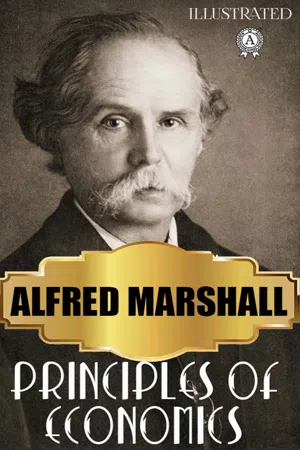
- Alfred Marshall(Author)
- 2021(Publication Date)
- Strelbytskyy Multimedia Publishing(Publisher)
For instance, in any given case, there is a certain proportion between the amounts which may with best advantage be spent on ploughing and harrowing, or manuring. There might be some differences of opinion on the matter, but only within narrow limits. An inexperienced person who ploughed many times over land, which was already in fairly good mechanical condition, while he gave it little or none of the manure which it was craving, would be generally condemned as having so over applied ploughing as to make it yield a rapidly diminishing return. But this result of the misapplication of resources has no very close connection with the tendency of agriculture in an old country to yield a diminishing return to a general increase of resources well applied in cultivation: and indeed exactly parallel cases can be found of a diminishing return to particular resources when applied in undue proportion, even in industries which yield an increasing return to increased applications of capital and labor when appropriately distributed*81.The part played by the net product at the margin of production in the modern doctrine of Distribution is apt to be misunderstood. In particular many able writers have supposed that it represents the marginal use of a thing as governing the value of the whole. It is not so; the doctrine says we must go to the margin to study the action of those forces which govern the value of the whole: and that is a very different affair. Of course the withdrawal of (say) iron from any of its necessary uses would have just the same influence on its value as its withdrawal from its marginal uses; in the same way as the pressure in a boiler for cooking under high pressure would be affected by the escape of any other steam just as it would by the escape of the steam in one of the safety valves: but in fact the steam does not escape except through the safety valves. In like manner iron, or any other agent of production, is not (under ordinary circumstances) thrown out of use except at points at which its use yields no clear surplus of profit; that is, it is thrown out from its marginal uses only. eBook - PDF
Microeconomics
Principles and Policy
- William Baumol, Alan Blinder(Authors)
- 2015(Publication Date)
- Cengage Learning EMEA(Publisher)
7-3a Substitutability: The Choice of Input Proportions Just as we found it useful to start the analysis with physical output or product in the one-variable-input case, we will start with physical production in the multiple-variable-input case. Firms can choose among alternative types of technology to produce any given prod-uct. Many people mistakenly believe that management really has very little choice when selecting its input proportions. Technological considerations alone, they believe, dictate such choices. For example, a particular type of furniture-cutting machine may require two operators working for an hour on a certain amount of wood to make five desks—no more and no less. But this way of looking at the possibilities is an overly narrow view of the matter. In reality, the furniture manufacturer can choose among several alternative production processes for making desks. For example, simpler and cheaper machines might be able to change the same pile of wood into five desks, but only by using more than two hours of labor. Or, the firm might choose to create the desks with simple hand tools, which would 5 Instructors may want to teach this part of the chapter (through “The Optimal Quantity of an Input and Diminishing Returns“ section) now, or they may prefer to wait until they come to Chapters 18 and 19 on the determination of wages, interest rates, profit, and rent. The “law” of diminishing Marginal Returns crops up a lot in ordinary life—not just in the world of business. Consider Jason and his study habits: He has a tendency to procrastinate and then cram for exams the night before he takes them, pulling “all-nighters” regularly. How might an economist describe Jason’s payoff from an additional hour of study in the wee hours of the morning, relative to that of Colin, who studies for two hours every night? Closer to Home: The Diminishing Marginal Returns to Studying Bill Varie/Alamy Copyright 2016 Cengage Learning.
Index pages curate the most relevant extracts from our library of academic textbooks. They’ve been created using an in-house natural language model (NLM), each adding context and meaning to key research topics.

