Business

Taylor Motivation Theory
The Taylor Motivation Theory, developed by Frederick Taylor, emphasizes the role of monetary incentives in motivating employees to increase productivity. It suggests that workers are primarily motivated by financial rewards and that their performance can be improved through a system of rewards and punishments. The theory focuses on the concept of "scientific management" to optimize efficiency and productivity in the workplace.
Written by Perlego with AI-assistance
Related key terms
1 of 5

9 Key excerpts on "Taylor Motivation Theory"
 eBook - ePub
Management Organization and Employment Strategy (RLE: Organizations)
New Directions in Theory and Practice
- Tony Watson(Author)
- 2013(Publication Date)
- Routledge(Publisher)
Babbage is probably best known as the deviser of the original computer and his work here is relevant to our claim that the philosophy underlying these ideas is one which sees people as machines. Part of the inspiration for Babbage's ‘calculating engine’ derived from his admiration of the way his fellow mathematicians in France had so speedily produced a series of mathematical tables. This had been done by identifying parts of the work that could be done by the less mathematically able staff and allocating it accordingly. The organisation of these tasks, thought Babbage, showed the way for the machines which would eventually replace people in this kind of work.The motivational theory behind all this is implicit and is crude. The economic context in which this kind of work is offered is a free market one. The individual is not dependent on any kind of feudal lord or on the state. To survive he or she has to sell their capacity to work for the best price they can get. In the laissez-faire world implied by these principles of job design, one works to avoid hunger. And the extent to which one's hunger is assuaged depends on what quality of labour capacity one has to sell.Taylorism
Taylorism or Scientific Management represents a further syste-matisation of emerging ideas of rationalised work effort. The basic principles laid down by Taylor and his fellow systematisers were examined earlier (pp. 49–51) but there are several points which need to be added in the present context. The earlier advocates of work specialisation did not have a great deal to say about how the work was to be ‘managed’ or about ‘leadership’ and ‘rewards’. As Craig Littler (1982) puts it, earlier theorists like Babbage had ‘no clear idea of the problems of, and the means of, re-integration of the fragmented job roles’. To manage the fragmented work, therefore, the managers would ensure that all the planning and allocation work was done by themselves, that all work would be monitored and allocated times and that a payment-by-results system would be introduced to motivate the workers to apply themselves to maximum effect in terms of output.Leadership under Taylorism is a matter of applying science, and motivation is a matter of offering a financial return commensurate with the steady application of effort to the tasks designed by the managers. Workers are like machines, both in the manner they are required to work and in the way they are ‘fed’ with cash in proportion to their output – just as a motor is fed with petrol in proportion to the mileage it covers. eBook - PDF
Organization Theory and Technocratic Consciousness
Rationality, Ideology and Quality of Work
- Mats Alvesson(Author)
- 2018(Publication Date)
- De Gruyter(Publisher)
The basic thought behind scientific management can be summarized as follows: The overall assumption behind the scientific management theory was that by simplifying work the job could be carried out more efficiently, less qualified workers could be employed, the company management's control of production could be increased and, finally, the profits of the organization could rise. (Hackman and Lawler, 1971: 215) Hackman and Lawler express themselves still more concisely when they write that the aim of scientific management was to find means by which work could be simplified, specialized, standardized and subjected to routi-nes. According to Braverman (1974) it is just these particular job conditions which are characteristic of modern working life. In Braverman's view Taylorism has by no means lost its influence, but on the contrary is of the greatest importance to the forming of the modern work organization: It is impossible to overestimate the importance of the scientific management movement in the shaping of the modern corporation and indeed all institutions of capitalist society which carry on labor processes. The popular notion that Taylorism has been 'superseded' by later schools of industrial psychology or 'human relations', that it 'failed' - because of Taylor's amateurish and naive views of human motiva-tion or because it brought about a storm of labor opposition or because Taylor and various successors antagonized workers and sometimes management as well - or that it is outmoded because certain Taylorian specifics like functional foreman- Scientific Management 111 ship or his incentive-pay schemes have been discarded for more sophisticated methods: all these represent a woeful misreading of the actual dynamics of the development of management. (p. 86-7) A survey of the literature concerned with the importance of Taylorism to contemporary working life reveals that most writers are of an opinion similar to that of Braverman on this point (see Chapter 2). eBook - PDF
Valuing People To Create Value: An Innovative Approach To Leveraging Motivation At Work
An Innovative Approach to Leveraging Motivation at Work
- Herve Mathe, Xavier Pavie, Marwyn O'keeffe(Authors)
- 2011(Publication Date)
- World Scientific(Publisher)
Yet, it does not suffice to consider only the goals of the organisation for individual motivation to be unrelenting and sustainable. The shortcoming of Taylorism, or ‘scientific management’, is attributed to the very fact that motivating people to increase productivity was calculated with a myopic disregard for individual needs. People, it transpired, are not happy to be treated like cogs in a machine. Consequentially, many of the theoretical meanderings over the past century are somewhat of an antidote to the coercive approach of Taylorism. 17 All of the theorists, in one way or another, 17 Won-joo, Yun and F Mulhern (2009). Leadership and the performance of people in organizations: Enriching employees and connecting people, Forum for People Perfor-mance Management and Measurement Publication , November. 187 188 Valuing People to Create Value have crusaded for the consideration of the human perspective when seeking to inspire motivation at work. Maslow developed a hierarchy of the needs that lie at the root of human behaviour and drive motivation. Vroom put forward the idea that the personal value an individual associates with the outcome of a task at work is instrumental in his choice to complete that task. Herzberg asserted that by making work meaningful, and giving people opportunities to realise their aspirations, people will take a vested interest in their work, an essential parameter for sustainable motivation. Thus it can be concluded from the theoretical foundations that an understanding of what the individual values at work, and aligning these goals with those of the organisation, is essential for motivated behaviour at work to have a mutual benefit for the organisation and the individual. eBook - ePub
Performance Management Systems
A Global Perspective
- Arup Varma, Pawan S. Budhwar, Angelo DeNisi, Arup Varma, Pawan S. Budhwar, Angelo DeNisi(Authors)
- 2023(Publication Date)
- Routledge(Publisher)
First, one will be more motivated to put forth effort if they believe that they can achieve high performance through hard work. A range of factors may contribute to employees’ expectancy perceptions, including employees’ abilities, skills, knowledge, the support and resources that they have access to, and personality traits, including self-efficacy and locus of control. For instance, when an employee is assigned a task that is far beyond their ability, their motivation level will suffer because they think they will not be able to complete the task no matter how hard they try. Or, if an employee lacks the necessary resources or equipment tools to achieve high performance, they may simply withhold their effort. Similarly, when an employee has an external locus of control (i.e., a general expectancy that performance is dependent on uncontrollable factors such as luck), or low self-efficacy (i.e., not confident in their ability), expectancy is likely to be low. Thus, organizations wishing to strengthen employees’ expectancy perceptions can benefit from a variety of practices, such as delegating tasks with moderate difficulty levels, providing continuous feedback to help employees improve their performance, and offering training opportunities to improve their knowledge and skills. Apart from expectancy, one will be motivated to put more effort when they believe high performance will lead to rewards. As such, it is important for organizations to link rewards to performance and make sure employees are aware of the connections. Finally, employees are more likely to be motivated when the rewards associated with high performance are personally attractive. If a high-performing employee values work–life balance and hopes to get a weeklong paid vacation but the organization rewarded them with more responsibilities and authority instead, this employee might find the reward undesirable (i.e., the valence is negative) and might withhold efforts in the future. Therefore, managers are advised to find out what their employees value via surveying them or talking to them directly. It might also be a good idea if employees have the option to choose the rewards that appeal to them among several equivalent ones.To summarize, the basic premise of process-based theories of work motivation is that employee motivation is a rational process – employees cognitively process their surrounding environment, and react in certain ways to maximize the expected payoff. It is worth noting that equity theory and expectancy theory are particularly useful to help organizations motivate employees through performance management.Goal-Based Theories of Work Motivation
A goal represents something that an individual attempts to attain or achieve; it is the aim of an individual’s behavior (Locke & Latham, 2002 ). Goal-setting theory (Locke & Latham, 1990 , 2002 ) is one of the most important and influential theories of work motivation, which has received numerous empirical supports across employees from varied industries (Miner, 2003 ). The fundamental tenet of this theory is that goals guide human behavior. There is strong support that, in the workplace, setting appropriate goals can help enhance employee performance to a large extent (Latham & Locke, 2006 ; Pritchard, Roth, Jones, Galgay, & Watson, 1988 ).The second major tenet of goal-setting theory is that challenging or difficult goals lead to higher levels of performance than easy goals. Meta-analytic evidence shows that when goals are challenging and aggressive, employees tend to work harder or smarter, leading to higher levels of both individual and group performance (Kleingeld, van Mierlo, & Arends, 2011 ; Steel & Karren, 1987 ). At first glance, the goal difficulty tenet of goal-setting theory is contradictory to expectancy theory; the latter seems to suggest that easy goals can enhance employees’ expectancy perception, resulting in higher levels of motivation. To solve this apparent contradiction, Locke and Latham (2002) eBook - PDF
The Curriculum
A New Comprehensive Reader
- João M. Paraskeva(Author)
- 2023(Publication Date)
Frederick Taylor 250 large part of the organization of employers, as well as employés, is for war rather than for peace, and that perhaps the majority on either side do not believe that it is possible so to arrange their mutual relations that their interests become identical. The majority of these men believe that the fundamental interests of employés and employers are necessarily antagonistic. Scientific management, on the contrary, has for its very foundation the firm conviction that the true are one and the game; that prosperity for the employer cannot exist through a long term of years unless it is accompanied by prosperity for the employé, and vice versa; and that it is possible to give the workman what he most wants—high wages—and the employer what he wants—a low labor cost—for his manufactures. It is hoped that some at least of those who do not sympathize with each of these objects may be led to modify their views; that some employers, whose attitude toward their workmen has been that of trying to get the largest amount of work out of them for the smallest possible wages, may be led to see that a more liberal policy toward their men will pay them better; and that some of those workmen who begrudge a fair and even a large profit to their employers, and who feel that all of the fruits of their labor should belong to them, and that those for whom they work and the capital invested in the business are entitled to little or nothing, may be led to modify these views. No one can be found who will deny that in the case of any single individual the greatest prosperity can exist only when that individual has reached his highest state of efficiency; that is, when he is turn- ing out his largest daily output. The truth of this fact is also perfectly clear in the case of two men working together. eBook - PDF
Organizational Psychology and Organizational Behavior
Evidence-based Lessons for Creating Sustainable Organizations
- Steve M. Jex, Thomas W. Britt, Cynthia A. Thompson, Cynthia A Thompson(Authors)
- 2024(Publication Date)
- Wiley(Publisher)
Clearly, researchers are only beginning to examine how social forces within an organization can shape employee motivation and performance. CHAPTER SUMMARY The first major section of this chapter reviewed what are considered to be the major theories of motivation in organiza- tional research and how organizations have used ideas from these models to enhance motivation. The major theories covered included expectancy theory, goal-setting theory, behavioral theories, SDT, and JCT. The Expectancy and Goal Setting theories are both cognitively oriented, addressing how employees think about the connection between behaviors and outcomes. The Behavioral Approach to employee motiva- tion involves using principles adapted from behaviorism to influence behavior in organ- izations. The principle used most frequently is reinforcement, although others, such as punishment, shaping, and extinction, may be used in certain situations. SDT empha- sizes the importance of not only the quan- tity, or amount, of motivation, but the quality of that motivation. Proponents of this theory state that employees driven by autonomous motivation at work will be more satisfied and perform better than employees who experience their behavior as controlled by others. This theory has received a great deal of support outside of the organizational context and generated a great deal of research in recent years. The second major section of the chapter examined how organizations have applied these theories to influence employee motiva- tion. Without a doubt, the most widely used mechanism that organizations use for moti- vating behavior is reward systems. Tangible rewards include merit pay, incentive pay, bonuses, and fringe benefits. Research over the years has shown that tangible rewards such as pay can be very powerful motivators of employee behavior.
- Andrew J. Vinchur(Author)
- 2018(Publication Date)
- Cambridge University Press(Publisher)
Criticism was particularly acute in Europe, where there was a tradition of greater emphasis on worker well-being than in the United States. Examples of critics include the English psychologists Charles S. Myers (1925) and Tom H. Pear (1948) and the German psychologist Otto Lipmann (1928–29). In Japan, Shigemi H. Kirihara (1959) was one of a number of psychologists at the Institute of Science of Labour in the early 1920s who criticized the Taylor system based on their analysis of the physiological costs of scientific management and because of the system’s lack of emphasis on individual worker differences. Bernard Muscio (1920) examined labor’s criticisms of scientific manage- ment in detail. He was careful to distinguish scientific management as put forth by Taylor from imitators who did not follow Taylor’s tenets. Muscio noted, for example, that “speeding-up” work, a popular criticism of scientific management, was not part of Taylor’s system. Muscio found the majority of the charges against scientific management to be unproven. Scientific Management 41 While it is true that the bulk of profits from the new methods go to the organization instead of labor, he saw this as defensible, given manage- ment’s investment in the process. Muscio also noted that labor is generally not aware of the actual distribution of profits. To the fear of widespread unemployment that would result from the implementation of Taylorism, he saw the gradual introduction of scientific management as a way to minimize this concern. As for criticism that the result of scientific manage- ment was to “make men into mechanisms, fasten them in a relentless routine, and destroy individuality” (p. 244), Muscio noted that this criti- cism assumes that workers are somehow freer in the current industrial system; he saw this as a questionable assumption. The charge that scientific management is “undemocratic” assumes the workplace is a democracy to begin with. eBook - PDF
- Daniel A. Wren, Arthur G. Bedeian(Authors)
- 2023(Publication Date)
- Wiley(Publisher)
47. 161 For a further analysis of data from 1920 to 1935 that reaches a similar conclusion, see Daniel M. Nelson, “Scientific Management and the Workplace, 1920–1935,” in Sanford M. Jacoby, ed., Masters to Managers: Historical and Comparative Perspectives on American Employers (New York: Columbia University Press, 1991), pp. 74–89. 162 Thompson, “The Taylor System in Europe,” p. 172. 232 CHAPTER 11 Scientific Management in Theory and Practice as public administration, office management, marketing, and accounting, to search for improved methods; encouraged an interest in the theory and practice of organization design; provided a basis for the study of business policy; and spawned a philosophy of management. THE IMPACT OF SCIENTIFIC MANAGEMENT ON OTHER DISCIPLINES Stimulated by scientific management, other academic disciplines began to search for efficiency through science. William H. Leffingwell applied the principles of scientific management to office management. 163 Leonard D. White picked up where Morris L. Cooke left off and contributed to public administration. White was the first to teach public administration in the classroom and pioneered in personnel management for government agencies. 164 Ralph Starr Butler, Louis D. H. Weld, Paul T. Cherington, Paul D. Converse, and others expanded scientific management to mar- keting goods and services. 165 Accounting saw the development of standard costing in Emerson’s and Taylor’s use of the railroad system of accounts. Through a combination of ideas associated with economic analy- sis in engineering and accounting, managers were first exposed to contingencies in financial planning and control. The relationships among the volume of production, fixed costs, variable costs, sales, and profits had long been a vexing managerial conundrum. An engineer, Henry Hess, developed a “crossover” chart in 1903, which showed the relationship among these variables.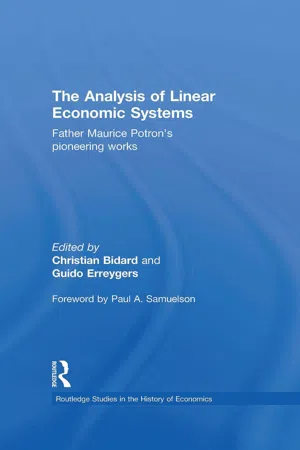 eBook - PDF
The Analysis of Linear Economic Systems
Father Maurice Potron�s Pioneering Works
- Christian Bidard, Guido Erreygers(Authors)
- 2020(Publication Date)
- Routledge(Publisher)
The agents of these four services therefore act as foremen; but they do not give any order as such to the workers; they acquaint themselves with the detailed instructions from the management; they teach and help to do the work according to these instructions. 48 It is useless to go into the details of the functioning of that organization. But it is worth noticing what the relationships between the workers and the Management become. At first sight, it seems that the worker is about to be condemned to some type of speedy and exhausting automatism. The reality is completely different. The scientific study of the job is made in order to determine experimentally the productivity that a normally skilled worker can obtain without tiredness; 49 it precisely prevents the overworking which results from an arbitrary demand for a higher and higher production. 5° From a higher point of view, idleness, lazy and slow labour are generally considered as bad for the soul. The Taylorist worker 48 This account of the main features of the mechanism essentially follows the Principes and Mr Le Chatelier' s articles. 49 C. TM, p. xii, col. 2. 50 At the Tabor factory, which is in a way the model factory of the system, all men are busy but none hurries up (C.TM, p. iv, col. 1). One does not want at all that the time devoted to some work be shorter than the scheduled time; the control is then more severe (C. TM, p. xii, col. I). The scientific organization of labour 155 finds himself trained to the practise of many natural virtues; and, if he wants to become a good Christian, he will not have to change his work habits at all, contrary to his workmate from the CGT. 51 As for the criticism of automatism, one may understand it from the worshippers of freedom for itself, from those who think it is complete only when it includes the possibility of doing wrong.
Index pages curate the most relevant extracts from our library of academic textbooks. They’ve been created using an in-house natural language model (NLM), each adding context and meaning to key research topics.

