Chemistry

Distillation
Distillation is a process used to separate components of a liquid mixture based on differences in their volatilities. It involves heating the mixture to create vapor, which is then cooled and condensed back into liquid form. This method is commonly used in the purification of liquids and the production of alcoholic beverages.
Written by Perlego with AI-assistance
Related key terms
1 of 5
12 Key excerpts on "Distillation"
 eBook - ePub
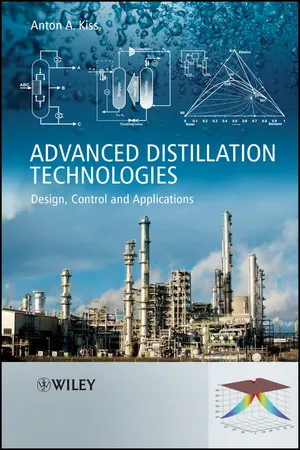
Advanced Distillation Technologies
Design, Control and Applications
- Anton A. Kiss(Author)
- 2013(Publication Date)
- Wiley(Publisher)
1 Basic Concepts in Distillation1.1 Introduction
Distillation is a thermal separation method for separating mixtures of two or more substances into its component fractions of desired purity, based on differences in volatilities of components—which are in fact related to the boiling points of these components—by the application and removal of heat. Note that the term Distillation refers to a physical separation process or a unit operation. Remarkably, Distillation can be combined with another Distillation operation, leading to a dividing-wall column (Harmsen, 2010), or with a chemical reaction, leading to reactive Distillation (Sundmacher and Kienle, 2003; Sundmacher, Kienle, and Seidel-Morgenstern, 2005; Luyben and Yu, 2008; Sharma and Singh, 2010), and/or other chemical process operations (Schmidt-Traub and Gorak, 2006).At the commercial scale, Distillation has many applications, such as the separation of crude oil into fractions (e.g., gasoline, diesel, kerosene, etc.), water purification and desalination, the splitting of air into its components (e.g., oxygen, nitrogen, and argon), and the Distillation of fermented solutions or the production of distilled beverages with high alcohol content (Forbes, 1970). Distillation underwent enormous development due to the petrochemical industry, and as such it is one of the most important technologies in the global energy supply system (Harmsen, 2010). Essentially, all transportation fuel goes through at least one Distillation column on its way from crude oil to readily usable fuel, with tens of thousands of Distillation columns in operation worldwide. In view of the foreseen depletion of fossil fuels and the switch to renewable sources of energy such as biomass, the most likely transportation fuel will be ethanol, methanol, or derivatives. The synthesis of alternative fuels leads typically to aqueous mixtures that require Distillation to separate ethanol or methanol from water. Consequently, Distillation remains the separation method of choice in the chemical process industry. The importance of Distillation is unquestionable in providing most of the products required by our modern society (e.g., transportation fuel, heat, food, shelter, clothing, etc.). No longer available |Learn more
- (Author)
- 2014(Publication Date)
- Research World(Publisher)
________________________ WORLD TECHNOLOGIES ________________________ Chapter 6 Distillation Laboratory display of Distillation: 1: A heating device 2: Still pot 3: Still head 4: Thermometer/Boiling point temperature 5: Condenser 6: Cooling water in 7: Cooling water out 8: Distillate/receiving flask 9: Vacuum/gas inlet 10: Still receiver 11: Heat control 12: Stirrer speed control 13: Stirrer/heat plate 14: Heating (Oil/sand) bath 15: Stirring means e.g.(shown), boiling chips or mechanical stirrer 16: Cooling bath. Distillation is a method of separating mixtures based on differences in their volatilities in a boiling liquid mixture. Distillation is a unit operation, or a physical separation process, and not a chemical reaction. ________________________ WORLD TECHNOLOGIES ________________________ Commercially, Distillation has a number of applications. It is used to separate crude oil into more fractions for specific uses such as transport, power generation and heating. Water is distilled to remove impurities, such as salt from seawater. Air is distilled to separate its components—notably oxygen, nitrogen, and argon—for industrial use. Distillation of fermented solutions has been used since ancient times to produce distilled beverages with a higher alcohol content. The premises where Distillation is carried out, especially Distillation of alcohol, are known as a distillery . History Distillation apparatus of Zosimus, from Marcelin Berthelot, Collection des anciens alchimistes grecs (3 vol., Paris, 1887 -1888). The first clear evidence of Distillation comes from Greek alchemists working in Alexandria in the first century AD. Distilled water has been known since at least ca. 200 AD, when Alexander of Aphrodisias described the process. Arabs learned the process from the Egyptians and used it extensively in their chemical experiments. They introduced the apparatuses (such as the alembic, still, and retort) which were able to fully purify chemical substances. No longer available |Learn more
- (Author)
- 2014(Publication Date)
- Library Press(Publisher)
____________________ WORLD TECHNOLOGIES ____________________ Chapter- 6 Distillation Laboratory display of Distillation: 1: A heating device 2: Still pot 3: Still head 4: Thermometer/Boiling point temperature 5: Condenser 6: Cooling water in 7: Cooling water out 8: Distillate/receiving flask 9: Vacuum/gas inlet 10: Still receiver 11: Heat control 12: Stirrer speed control 13: Stirrer/heat plate 14: Heating (Oil/sand) bath 15: Stirring means e.g.(shown), boiling chips or mechanical stirrer 16: Cooling bath. ____________________ WORLD TECHNOLOGIES ____________________ Distillation is a method of separating mixtures based on differences in their volatilities in a boiling liquid mixture. Distillation is a unit operation, or a physical separation process, and not a chemical reaction. Commercially, Distillation has a number of applications. It is used to separate crude oil into more fractions for specific uses such as transport, power generation and heating. Water is distilled to remove impurities, such as salt from seawater. Air is distilled to separate its components—notably oxygen, nitrogen, and argon—for industrial use. Distillation of fermented solutions has been used since ancient times to produce distilled beverages with a higher alcohol content. The premises where Distillation is carried out, especially Distillation of alcohol, are known as a distillery . History Distillation apparatus of Zosimus, from Marcelin Berthelot, Collection des anciens alchimistes grecs The first clear evidence of Distillation comes from Greek alchemists working in Alexandria in the first century AD. Distilled water has been known since at least ca. 200 AD, when Alexander of Aphrodisias described the process. Arabs learned the process from the Egyptians and used it extensively in their chemical experiments. They introduced the apparatuses (such as the alembic, still, and retort) which were able to fully purify chemical substances. No longer available |Learn more
- (Author)
- 2014(Publication Date)
- University Publications(Publisher)
________________________ WORLD TECHNOLOGIES ________________________ Chapter- 6 Distillation Laboratory display of Distillation: 1: A heating device 2: Still pot 3: Still head 4: Thermometer/Boiling point temperature 5: Condenser 6: Cooling water in 7: Cooling water out 8: Distillate/receiving flask 9: Vacuum/gas inlet 10: Still receiver 11: Heat control 12: Stirrer speed control 13: Stirrer/heat plate 14: Heating (Oil/sand) bath 15: Stirring means e.g.(shown), boiling chips or mechanical stirrer 16: Cooling bath. ________________________ WORLD TECHNOLOGIES ________________________ Distillation is a method of separating mixtures based on differences in their volatilities in a boiling liquid mixture. Distillation is a unit operation, or a physical separation process, and not a chemical reaction. Commercially, Distillation has a number of applications. It is used to separate crude oil into more fractions for specific uses such as transport, power generation and heating. Water is distilled to remove impurities, such as salt from seawater. Air is distilled to separate its components—notably oxygen, nitrogen, and argon—for industrial use. Distillation of fermented solutions has been used since ancient times to produce distilled beverages with a higher alcohol content. The premises where Distillation is carried out, especially Distillation of alcohol, are known as a distillery . History Distillation apparatus of Zosimus, from Marcelin Berthelot, Collection des anciens alchimistes grecs (3 vol., Paris, 1887-1888). The first clear evidence of Distillation comes from Greek alchemists working in Alexandria in the first century AD . Distilled water has been known since at least ca. 200 AD, when Alexander of Aphrodisias described the process. Arabs learned the process from the Egyptians and used it extensively in their chemical experiments. They introduced the apparatuses (such as the alembic, still, and retort) which were able to fully purify chemical substances. No longer available |Learn more
- (Author)
- 2014(Publication Date)
- Academic Studio(Publisher)
________________________ WORLD TECHNOLOGIES ________________________ Chapter 4 Distillation Laboratory display of Distillation: 1: A heating device 2: Still pot 3: Still head 4: Ther-mometer/Boiling point temperature 5: Condenser 6: Cooling water in 7: Cooling water out 8: Distillate/receiving flask 9: Vacuum/gas inlet 10: Still receiver 11: Heat control 12: Stirrer speed control 13: Stirrer/heat plate 14: Heating (Oil/sand) bath 15: Stirring means e.g.(shown), anti-bumping granules or mechanical stirrer 16: Cooling bath. ________________________ WORLD TECHNOLOGIES ________________________ Distillation is a method of separating mixtures based on differences in their volatilities in a boiling liquid mixture. Distillation is a unit operation, or a physical separation process, and not a chemical reaction. Commercially, Distillation has a number of applications. It is used to separate crude oil into more fractions for specific uses such as transport, power generation and heating. Water is distilled to remove impurities, such as salt from seawater. Air is distilled to separate its components—notably oxygen, nitrogen, and argon—for industrial use. Distillation of fermented solutions has been used since ancient times to produce distilled beverages with a higher alcohol content. The premises where Distillation is carried out, especially Distillation of alcohol, are known as a distillery . History Distillation apparatus of Zosimus, from Marcelin Berthelot, Collection des anciens alchimistes grecs (3 vol., Paris, 1887-1888). The first clear evidence of Distillation comes from Greek alchemists working in Alex-andria in the first century AD. Distilled water has been known since at least ca. 200 AD, when Alexander of Aphrodisias described the process. Arabs learned the process from the Egyptians and used it extensively in their chemical experiments. They introduced the apparatuses (such as the alembic, still, and retort) which were able to fully purify chemical substances.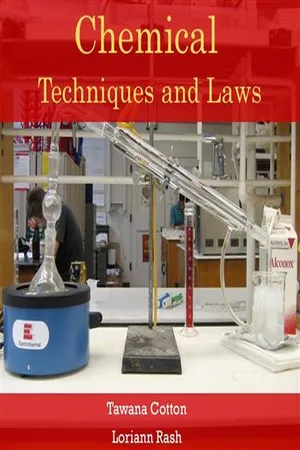 No longer available |Learn more
- (Author)
- 2014(Publication Date)
- Academic Studio(Publisher)
____________________ WORLD TECHNOLOGIES ____________________ Chapter 2 Distillation Laboratory display of Distillation: 1: A heating device 2: Still pot 3: Still head 4: Thermometer/Boiling point temperature 5: Condenser 6: Cooling water in 7: Cooling water out 8: Distillate/receiving flask 9: Vacuum/gas inlet 10: Still receiver 11: Heat control 12: Stirrer speed control 13: Stirrer/heat plate 14: Heating (Oil/sand) bath 15: Stirring means e.g.(shown), boiling chips or mechanical stirrer 16: Cooling bath. ____________________ WORLD TECHNOLOGIES ____________________ Distillation is a method of separating mixtures based on differences in their volatilities in a boiling liquid mixture. Distillation is a unit operation, or a physical separation process, and not a chemical reaction. Commercially, Distillation has a number of applications. It is used to separate crude oil into more fractions for specific uses such as transport, power generation and heating. Water is distilled to remove impurities, such as salt from seawater. Air is distilled to separate its components—notably oxygen, nitrogen, and argon—for industrial use. Distillation of fermented solutions has been used since ancient times to produce distilled beverages with a higher alcohol content. The premises where Distillation is carried out, especially Distillation of alcohol, are known as a distillery . History Distillation apparatus of Zosimus, from Marcelin Berthelot, Collection des anciens alchimistes grecs (3 vol., Paris, 1887-1888). The first clear evidence of Distillation comes from Greek alchemists working in Alexandria in the first century AD. Distilled water has been known since at least ca. 200 AD, when Alexander of Aphrodisias described the process. Arabs learned the process from the Egyptians and used it extensively in their chemical experiments. They introduced the apparatuses (such as the alembic, still, and retort) which were able to fully purify chemical substances. No longer available |Learn more
- (Author)
- 2014(Publication Date)
- Research World(Publisher)
________________________ WORLD TECHNOLOGIES ________________________ Chapter- 2 Distillation Laboratory display of Distillation: 1: A heating device 2: Still pot 3: Still head 4: Thermometer/Boiling point temperature 5: Condenser 6: Cooling water in 7: Cooling water out 8: Distillate/receiving flask 9: Vacuum/gas inlet 10: Still receiver 11: Heat ________________________ WORLD TECHNOLOGIES ________________________ control 12: Stirrer speed control 13: Stirrer/heat plate 14: Heating (Oil/sand) bath 15: Stirring means e.g.(shown), boiling chips or mechanical stirrer 16: Cooling bath. Distillation is a method of separating mixtures based on differences in their volatilities in a boiling liquid mixture. Distillation is a unit operation, or a physical separation process, and not a chemical reaction. Commercially, Distillation has a number of applications. It is used to separate crude oil into more fractions for specific uses such as transport, power generation and heating. Water is distilled to remove impurities, such as salt from seawater. Air is distilled to separate its components—notably oxygen, nitrogen, and argon—for industrial use. Distillation of fermented solutions has been used since ancient times to produce distilled beverages with a higher alcohol content. The premises where Distillation is carried out, especially Distillation of alcohol, are known as a distillery . History Distillation apparatus of Zosimus, from Marcelin Berthelot, Collection des anciens alchimistes grecs (3 vol., Paris, 1887-1888). The first clear evidence of Distillation comes from Greek alchemists working in Alexandria in the first century AD. Distilled water has been known since at least ca. 200 AD, when Alexander of Aphrodisias described the process. Arabs learned the process from the Egyptians and used it extensively in their chemical experiments. They introduced the apparatuses (such as the alembic, still, and retort) which were able to fully purify chemical substances. No longer available |Learn more
- (Author)
- 2014(Publication Date)
- Academic Studio(Publisher)
______________________________ WORLD TECHNOLOGIES ______________________________ Chapter 11 Distillation Laboratory display of Distillation: 1: A heating device 2: Still pot 3: Still head 4: Thermometer/Boiling point temperature 5: Condenser 6: Cooling water in 7: Cooling water out 8: Distillate/receiving flask 9: Vacuum/gas inlet 10: Still receiver 11: Heat control 12: Stirrer speed control 13: Stirrer/heat plate 14: Heating (Oil/sand) bath 15: Stirring means e.g.(shown), boiling chips or mechanical stirrer 16: Cooling bath. ______________________________ WORLD TECHNOLOGIES ______________________________ Distillation is a method of separating mixtures based on differences in their volatilities in a boiling liquid mixture. Distillation is a unit operation, or a physical separation process, and not a chemical reaction. Commercially, Distillation has a number of applications. It is used to separate crude oil into more fractions for specific uses such as transport, power generation and heating. Water is distilled to remove impurities, such as salt from seawater. Air is distilled to separate its components— notably oxygen, nitrogen, and argon—for industrial use. Distillation of fermented solutions has been used since ancient times to produce distilled beverages with a higher alcohol content. The premises where Distillation is carried out, especially Distillation of alcohol, are known as a distillery . History Distillation apparatus of Zosimus, from Marcelin Berthelot, Collection des anciens alchimistes grecs The first clear evidence of Distillation comes from Greek alchemists working in Alexandria in the first century AD. Distilled water has been known since at least ca. 200 AD, when Alexander of Aphrodisias described the process. Arabs learned the process from the Egyptians and used it extensively in their chemical experiments. They introduced the apparatuses (such as the alembic, still, and retort) which were able to fully purify chemical substances. No longer available |Learn more
- (Author)
- 2014(Publication Date)
- Learning Press(Publisher)
________________________ WORLD TECHNOLOGIES ________________________ Chapter- 5 Distillation Laboratory display of Distillation: 1: A heating device 2: Still pot 3: Still head 4: Thermometer/Boiling point temperature 5: Condenser 6: Cooling water in 7: Cooling water out 8: Distillate/receiving flask 9: Vacuum/gas inlet 10: Still receiver 11: Heat control 12: Stirrer speed control 13: Stirrer/heat plate 14: Heating (Oil/sand) bath 15: Stirring means e.g.(shown), anti-bumping granules or mechanical stirrer 16: Cooling bath. ________________________ WORLD TECHNOLOGIES ________________________ Distillation is a method of separating mixtures based on differences in their volatilities in a boiling liquid mixture. Distillation is a unit operation, or a physical separation process, and not a chemical reaction. Commercially, Distillation has a number of applications. It is used to separate crude oil into more fractions for specific uses such as transport, power generation and heating. Water is distilled to remove impurities, such as salt from seawater. Air is distilled to separate its components—notably oxygen, nitrogen, and argon—for industrial use. Distillation of fermented solutions has been used since ancient times to produce distilled beverages with a higher alcohol content. The premises where Distillation is carried out, especially Distillation of alcohol, are known as a distillery . History Distillation apparatus of Zosimus, from Marcelin Berthelot, Collection des anciens alchimistes grecs (3 vol., Paris, 1887 -1888). The first clear evidence of Distillation comes from Greek alchemists working in Alexandria in the first century AD. Distilled water has been known since at least ca. 200 AD, when Alexander of Aphrodisias described the process. Arabs learned the process from the Egyptians and used it extensively in their chemical experiments. They intro-duced the apparatuses (such as the alembic, still, and retort) which were able to fully purify chemical substances. No longer available |Learn more
- (Author)
- 2014(Publication Date)
- Academic Studio(Publisher)
________________________ WORLD TECHNOLOGIES ________________________ Chapter 6 Distillation Laboratory display of Distillation: 1: A heating device 2: Still pot 3: Still head 4: Thermometer/Boiling point temperature 5: Condenser 6: Cooling water in 7: Cooling water out 8: Distillate/receiving flask 9: Vacuum/gas inlet 10: Still receiver 11: Heat control 12: Stirrer speed control 13: Stirrer/heat plate 14: Heating (Oil/sand) bath 15: Stirring means e.g.(shown), boiling chips or mechanical stirrer 16: Cooling bath. ________________________ WORLD TECHNOLOGIES ________________________ Distillation is a method of separating mixtures based on differences in their volatilities in a boiling liquid mixture. Distillation is a unit operation, or a physical separation process, and not a chemical reaction. Commercially, Distillation has a number of applications. It is used to separate crude oil into more fractions for specific uses such as transport, power generation and heating. Water is distilled to remove impurities, such as salt from seawater. Air is distilled to separate its components—notably oxygen, nitrogen, and argon—for industrial use. Distillation of fermented solutions has been used since ancient times to produce distilled beverages with a higher alcohol content. The premises where Distillation is carried out, especially Distillation of alcohol, are known as a distillery . History Distillation apparatus of Zosimus, from Marcelin Berthelot, Collection des anciens alchimistes grecs (3 vol., Paris, 1887-1888). The first clear evidence of Distillation comes from Greek alchemists working in Alexandria in the first century AD. Distilled water has been known since at least ca. 200 AD, when Alexander of Aphrodisias described the process. Arabs learned the process from the Egyptians and used it extensively in their chemical experiments. They introduced the apparatuses (such as the alembic, still, and retort) which were able to fully purify chemical substances. No longer available |Learn more
- (Author)
- 2014(Publication Date)
- Academic Studio(Publisher)
WT ____________________ WORLD TECHNOLOGIES ____________________ Chapter 7 Distillation Laboratory display of Distillation: 1: A heating device 2: Still pot 3: Still head 4: Thermometer/Boiling point temperature 5: Condenser 6: Cooling water in 7: Cooling water out 8: Distillate/receiving flask 9: Vacuum/gas inlet 10: Still receiver 11: Heat control 12: Stirrer speed control 13: Stirrer/heat plate 14: Heating (Oil/sand) bath 15: Stirring means e.g.(shown), boiling chips or mechanical stirrer 16: Cooling bath. WT ____________________ WORLD TECHNOLOGIES ____________________ Distillation is a method of separating mixtures based on differences in their volatilities in a boiling liquid mixture. Distillation is a unit operation, or a physical separation process, and not a chemical reaction. Commercially, Distillation has a number of applications. It is used to separate crude oil into more fractions for specific uses such as transport, power generation and heating. Water is distilled to remove impurities, such as salt from seawater. Air is distilled to separate its components—notably oxygen, nitrogen, and argon—for industrial use. Distillation of fermented solutions has been used since ancient times to produce distilled beverages with a higher alcohol content. The premises where Distillation is carried out, especially Distillation of alcohol, are known as a distillery . History Distillation apparatus of Zosimus, from Marcelin Berthelot, Collection des anciens alchimistes grecs (3 vol., Paris, 1887-1888). The first clear evidence of Distillation comes from Greek alchemists working in Alexandria in the first century AD. Distilled water has been known since at least ca. 200 AD, when Alexander of Aphrodisias described the process. Arabs learned the process from the Egyptians and used it extensively in their chemical experiments. They introduced the apparatuses (such as the alembic, still, and retort) which were able to fully purify chemical substances.
- Kenneth Williamson, Katherine Masters(Authors)
- 2016(Publication Date)
- Cengage Learning EMEA(Publisher)
Even when energy is increased and more mol-ecules in the liquid phase have sufficient energy to escape into the vapor phase, equilibrium is maintained because the number moving from the vapor phase into the liquid phase also increases. However, the number of molecules in the vapor phase increases, which increases the vapor pressure. The number of molecules in the vapor phase depends primarily on the volume of the system, the temperature, the combined pressure of all the gaseous components, and the strength of the inter-molecular forces exerted in the liquid phase. Review the introduction to Chapter 3 about the types of intermolecular forces. Distillation is a common method for purifying liquids and can be used to determine their boiling points. Distillation CHAPTER 5 PRE-LAB EXERCISE: Predict what a plot of temperature versus the vol-ume of distillate will look like for the simple Distillation and the fractional Distillation of (a) a 50:50 cyclohexane–toluene mixture and (b) a 50:50 ethanol–water mixture. Copyright 2017 Cengage Learning. All Rights Reserved. May not be copied, scanned, or duplicated, in whole or in part. Due to electronic rights, some third party content may be suppressed from the eBook and/or eChapter(s). Editorial review has deemed that any suppressed content does not materially affect the overall learning experience. Cengage Learning reserves the right to remove additional content at any time if subsequent rights restrictions require it. 88 Macroscale and Microscale Organic Experiments S I M P L E D I S T I L L A T I O N Simple Distillation involves boiling a liquid in a vessel (a distilling flask) and direct-ing the resulting vapors through a condenser, in which the vapors are cooled and converted to a liquid that flows down into a collection vessel (a receiving flask).
Index pages curate the most relevant extracts from our library of academic textbooks. They’ve been created using an in-house natural language model (NLM), each adding context and meaning to key research topics.

