Chemistry

Ground State
Ground state refers to the lowest energy state of an atom or molecule. In this state, all electrons are in their lowest possible energy levels and the atom or molecule is in its most stable configuration. Excitation of an atom or molecule can cause it to move to a higher energy state.
Written by Perlego with AI-assistance
Related key terms
1 of 5

6 Key excerpts on "Ground State"
 eBook - PDF
- Harry G. Brittain(Author)
- 2006(Publication Date)
- CRC Press(Publisher)
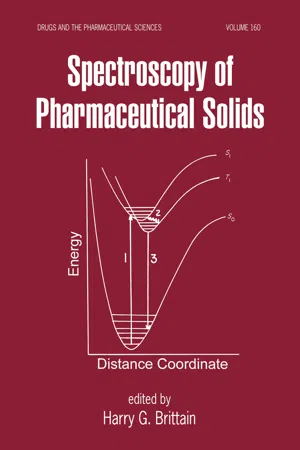
The Ground State of an atom is the one in which all electrons are in the lowest possible energy states. On the basis of the Pauli principle, this is the state in which all the lower shells are filled as far as the Pauli principle allows. We shall return to this point later, but excited states of an atom result when one or more of its electrons are raised to any of the higher orbitals. The configuration of an atom having a nuclear charge of Z þ 1 is obtained by taking the Ground State electronic configuration of the atom characterized by the nuclear charge of Z and adding an additional electron to one of the shells not yet filled. The electron configurations of the atoms belonging to the first four rows of the periodic table are dictated by the pattern of quantum numbers given in Table 4 Possible States of an Electron in a Multielectron Atom Shell Orbital type Principal quantum number ( n ) Azimuthal quantum number ( l ) Magnetic quantum number ( m l ) Spin quantum number ( m s ) K 1 s 1 0 0 þ 1 / 2 1 0 0 2 1 / 2 L 2 s 2 0 0 þ 1 / 2 2 0 0 2 1 / 2 2 p 2 1 þ 1 þ 1 / 2 2 1 þ 1 2 1 / 2 2 1 0 þ 1 / 2 2 1 0 2 1 / 2 2 1 2 1 þ 1 / 2 2 1 2 1 2 1 / 2 M 3 s 3 0 0 þ 1 / 2 3 0 0 2 1 / 2 3 p 3 1 þ 1 þ 1 / 2 3 1 þ 1 2 1 / 2 3 1 0 þ 1 / 2 3 1 0 2 1 / 2 3 1 2 1 þ 1 / 2 3 1 2 1 2 1 / 2 3 d 3 2 þ 2 þ 1 / 2 3 2 þ 2 2 1 / 2 3 2 þ 1 þ 1 / 2 3 2 þ 1 2 1 / 2 3 2 0 þ 1 / 2 3 2 0 2 1 / 2 3 2 2 1 þ 1 / 2 3 2 2 1 2 1 / 2 3 2 2 2 þ 1 / 2 3 2 2 2 2 1 / 2 50 Brittain Table 4 and are summarized in Table 5. It must be noted that interelectronic interactions can cause the relative energies of the orbitals to vary slightly from atom to atom, and the order can differ from the ideal sequence when two orbitals lie close together in energy. For example, the Ground State configuration of chromium is [Ar] 3 d 5 4 s 1 rather than [Ar] 3 d 4 4 s 2 as a result of the favorable situation of an exactly half-filled shell of d -electrons. eBook - PDF
- Ageetha Vanamudan(Author)
- 2023(Publication Date)
- Delve Publishing(Publisher)
The equations of quantum mechanics are used to generate the number of electrons that can occupy each shell and each subshell. One of the equations is the Pauli Exclusion Principle that states that no two electrons in the same atom can have the same values of the four quantum numbers. 6.2 ENERGY OF Ground State AND EXCITED STATES When studying the electron configurations of atoms, we note that energy is associated with an electron is usually associated with the orbital it is in. The sum of the energy of each electron while neglecting the electron- electron interaction is used in approximating the energy of a configuration. The term Ground State is used to refer to the configuration that corresponds to the lowest electronic-electron interactions. The other configurations are referred to as the excited state. For example, the Ground State configuration of an atom of sodium is given by 1s 2 2s 2 2p 6 3s 1 that can be deduced from the Aufbau principle. The first excited state is obtained through the promotion of a 3s electron to the 3p orbital to generate a configuration which is 1s 2 2s 2 2p 6 3p 1 and abbreviated as the 3p level. Figure 6.3: Electrons at the Ground State are those that exist in low energy levels. Source: By SVG: RehuaOriginal: Rozzychan - This file was derived from: Energylevels.png, CC BY-SA 3.0, https://commons.wikimedia.org/w/index. php?curid=35220791 Electronic Configuration and Periodic Table 99 An atom can move from one configuration to another by emitting or absorbing energy. This can be explained by the sodium-vapor lamp where the atoms of sodium are excited to the 3p level through an electrical discharge and afterwards return to the Ground State through the emission of yellow light with a wavelength of 589nm. The excitation of valence electrons usually involves energies corresponding to photons of visible or ultraviolet light (Mansour et al., 2010). eBook - PDF
Theoretical Alchemy
Modeling Matter
- Walter Harrison(Author)
- 2010(Publication Date)
- WSPC(Publisher)
1 element CHAPTER 1 Atomic States An understanding of electronic structure would seem at the outset to be an impossibly difficult task. Even in a small atom, the several electrons strongly interact with each other as well as with the nucleus, presenting an intractable dynamical problem both classically and in quantum mechanics. The only conceivable hope would be that it was possible to consider each electron by itself, in the presence of some average effect from the others. If that were somehow possible, then in quantum mechanics the wavefunction representing the many electrons, Ψ … 1 2 3 ( , , , ) r r r could be written as a product of one-electron functions ψ ψ ψ 1 2 3 ( ) ( ) ( ) r r r …. D. R. Hartree (1928) first gave that a try. Inserting this speculated form in the Schroedinger Equation he used a variational calculation to derive the self-consistent one-electron equations which have provided the basis for virtually all subsequent studies of atoms, molecules, and solids. The energy levels of individual atoms for each of the elements are absolutely central to our effort to understate the bonding energy for all types of systems. We assume a basic understanding of quantum mechanics, though only a small part of it will be necessary to our discussions. A brief introduction to the needed parts was given in Elementary Electronic Structure , Harrison (1999), and a more complete presentation in Applied Quantum Mechanics , Harrison (2000), and of course many other places. 2 1. Atomic States 1.1 Atomic Energy Levels The atomic states are of course classified by the angular momentum of the electron, s states for zero angular momentum, and p states for one unit ℏ of angular momentum. The row number n distinguishes the shells of s and p states of increasing energy, as shown here in Table 1.1 where the energies are given for the states in the shell being filled.
- Barron's Educational Series, Albert S. Tarendash(Authors)
- 2021(Publication Date)
- Barrons Educational Services(Publisher)
In 1913, Niels Bohr, a Danish physicist, proposed his own model of the hydrogen atom, a model that answered many of the questions that had confounded Rutherford. In order to do so, however, Bohr had to make a number of assumptions based on the revolutionary ideas first proposed by physicists Max Planck and Albert Einstein.Bohr proposed a planetary model of the hydrogen atom, as did Rutherford. But in Bohr’s model, the electron behaved most unusually:- The electron could orbit only in certain specified levels, each of which represented a distinct amount of energy. The more energy associated with a level, the farther it was from the nucleus. These principal energy levels were said to be quantized and were designated by the letters K, L, M, and so on. We now designate principal energy levels by numbers—1, 2, 3, 4, and so on.
- The lowest energy level (1 for hydrogen) was called the Ground State. (Other levels were called excited states.) Since the electron could have no lower energy than the Ground State, it could not come any closer to the nucleus, and therefore it remained stable.
- In a given orbit, an electron never radiated or absorbed energy. In this case, the electron was said to be in a stationary state.
- If an atom absorbed exactly the right amount of energy, the electron would rise to a higher energy level. Conversely, if the atom released energy (also in an exact amount), the electron would fall to a lower energy level. The energy that was released appeared as a photon of light.
The electron configuration in the diagram is 2-4, which means that an atom of carbon (C) in the Ground State contains two electrons in its first principal energy level and four electrons in its second principal energy level.Try It Yourself
The element aluminum has an atomic number of 13. Use the Periodic Table to determine the ground-state electron configuration of an atom of aluminum. eBook - PDF
Chemistry
The Molecular Nature of Matter
- Neil D. Jespersen, Alison Hyslop(Authors)
- 2014(Publication Date)
- Wiley(Publisher)
This attraction is called paramagnetism. Substances in which all the electrons are paired are not attracted to, but actually weakly repelled by, a magnet and are said to be diamagnetic. Paramagnetism and diamagnetism are measurable properties that provide experimental verification of the presence or absence of unpaired electrons in substances. The quantita- tive measurement of the strength of the attraction of a paramagnetic substance toward a magnetic field makes it possible to calculate the number of unpaired electrons in its atoms, molecules, or ions. 7.7 | Energy Levels and Ground State Electron Configurations The distribution of electrons among the orbitals of an atom is called the atom’s electronic structure or electron configuration. This is very useful information about an element because the arrangement of electrons in the outer parts of an atom, which is determined by its electron configuration, controls the chemical properties of the element. We are interested in the Ground State electron configurations of the elements. This is the configuration that yields the lowest energy for an atom and can be predicted for many of the elements by the use of the energy level diagram in Figure 7.18 and application of the Pauli exclusion principle. To see how we go about this, let’s begin with the simplest atom of all, hydrogen. Hydrogen has an atomic number, Z, equal to 1, so a neutral hydrogen atom has one electron. In its Ground State this electron occupies the lowest energy orbital that’s available, which is the 1s orbital. To indicate symbolically the electron configuration we list the subshells that contain electrons and indicate their electron populations by appropriate superscripts. Thus, the electron configuration of hydrogen is written as H 1s 1 Another way of expressing electron configurations that we will sometimes find useful is the orbital diagram. eBook - PDF
- Dunod Editeur, M S A Editeur, J R Lalanne(Authors)
- 1996(Publication Date)
- World Scientific(Publisher)
Of course, it includes all the subshells corresponding to this value of n. Conventionally, shells n = 1, 2, 3, ... are referred to by the capital letters K, L, M,..., and so on, in alphabetical order. n - I Each shell can contain ZJ 2 (21 + 1) = 2 n electrons. A description of an i=o atom's state on the base of the number of electrons in each subshell is called the electronic configuration. The ground configuration corresponds to the groundstate of an atom in which the lowest energy orbitals are occupied first. To write these configurations, the occupied orbitals are listed in order of increasing energies, with the number of electrons in each subshell in superscript. For example, the ground configuration of the chlorine atom (17 electrons) is (Is) 2 (2s) 2 (2p) 6 (3s) 2 (3p) 5 70 Quantum mechanics and symmetry In this example, all the subshells are saturated except the last one which lacks one electron. It is of course this lack of an electron in the 3p subshell which the cause of chlorine's reactivity and electronegativity. Sometimes, if the shell of an electronic configuration is completely filled, the corresponding subshells are replaced by the symbol for the shell, without superscript. Thus, the ground configuration of the chlorine atom may also be expressed as: (K) (L) (3s) 2 (3p) 5 . The existence of electronic spin together with the central-field approximation applied to many-electron atoms leads to a simple interpretation of Mendeleev's classification of the elements. It also yields a qualitative explanation for the chemical properties of the various classes of elements, as well as for the various ionization potentials. Comment: As a result of degeneracy, the choice of spin-orbital with respect to m and m , is not unique for a given energy. In this case, it should be remembered that the possible wave functions are linear combinations of Slater determinants. There is no ambiguity in the case of complete shells, as each orbital has an a and B function.
Index pages curate the most relevant extracts from our library of academic textbooks. They’ve been created using an in-house natural language model (NLM), each adding context and meaning to key research topics.

