Chemistry

Shapes of Molecules
Shapes of molecules refer to the spatial arrangement of atoms in a molecule, which influences its chemical and physical properties. The shape is determined by the arrangement of electron pairs around the central atom, as well as the presence of lone pairs. Understanding the shapes of molecules is crucial in predicting their behavior and reactivity in chemical reactions.
Written by Perlego with AI-assistance
Related key terms
1 of 5

8 Key excerpts on "Shapes of Molecules"
 eBook - PDF
Introductory Chemistry
An Active Learning Approach
- Mark Cracolice, Edward Peters, Mark Cracolice(Authors)
- 2020(Publication Date)
- Cengage Learning EMEA(Publisher)
Compounds that have the same molecular formulas but different structures are called isomers of one another. Isomers are distinctly different substances; each isomer has its own unique set of properties. For example, ethanol boils at 788C and is a liquid at room temperature, whereas dimethyl ether boils at 2 248 C and is a gas at room temperature. 13.3 Electron-Pair Repulsion: Electron-Pair Geometry Goal 2 Describe the electron-pair geometry when a central atom is surrounded by two, three, or four regions of electron density. The shape of a molecule plays a major role in determining the macroscopic proper- ties of a substance. We examine this role in other chapters in this book. To under- stand and predict the shape–property relationship, you first need to know what is responsible for molecular shape. This is the focus of this section and the next. Dis- cussion in these sections is limited to molecules having only single bonds. We then expand our consideration to molecules with multiple bonds in Section 13.5. No single theory or model yet developed succeeds in explaining all the molec- ular shapes observed in the laboratory. A theory that explains one group of mole- cules cannot explain another group. Each model has its advantages and limitations. Chemists, therefore, use them all within the areas to which they apply, fully recog- nizing that there is still much to learn about how atoms are assembled in molecules. In this text, we will explore one of the models used to explain molecular geometry, the more precise term used to describe the shape of a molecule. It is called the valence shell electron-pair repulsion theory or VSEPR theory. VSEPR theory applies primarily to substances in which a second-period atom is bonded to two, three, or four other atoms. You may wonder why we focus so much attention on so few elements. The answer is that the second period includes carbon, nitrogen, and oxygen. eBook - PDF
Chemistry
The Molecular Nature of Matter
- Neil D. Jespersen, Alison Hyslop(Authors)
- 2021(Publication Date)
- Wiley(Publisher)
These same principles will be extended to larger and larger molecules in your future studies of organic chemistry and biochemistry. We will also discuss how the bonding of bulk solids such as silicon imparts specific properties to solids. Molecules have three-dimensional shapes that are determined by the relative orientations of their covalent bonds, and this structure is maintained regardless of whether the substance is a solid, a liquid, or a gas. You’ve seen some of these shapes in previous chapters. Ionic sub- stances are quite different. The structure of a solid ionic compound, such as NaCl, is controlled primarily by the sizes of the ions and their charges. The attractions between the ions have no preferred directions, so if an ionic compound is melted, this structure is lost and the ordered array of ions collapses into a jumbled liquid state. Christian Koch, MicroChemicals GmbH/Science Source LEARNING OBJECTIVES After reading this chapter, you should be able to: • draw diagrams of the five basic molecular geometries, including bond angles. • predict the shape of a molecule or ion using the Valence Shell Electron Pair Repulsion (VSEPR) model. • explain how the geometry of a molecule affects its polarity. • describe how the valence bond theory views bond formation. • explain how hybridization refines the valence bond theory of bonding. • describe the nature of multiple bonds using orbital diagrams and hybridization. • use molecular orbitals to explain the bonding of simple diatomic molecules. • compare and contrast resonance structures to delocalized molecular orbitals. • use band theory to explain bonding in solids and physical properties. • use hybridization and valence bond theory to explain allotropes of nonmetallic elements. CONNECTING TO THE LEARNING OBJECTIVES As you start this chapter, please be aware that this chapter is going to require thinking in three dimensions.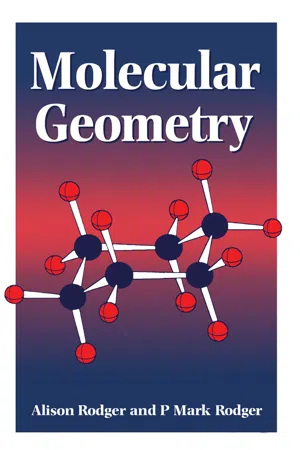 eBook - PDF
- Alison Rodger, Mark Rodger(Authors)
- 2014(Publication Date)
- Butterworth-Heinemann(Publisher)
1.1 What is Molecular Geometry? Upon being confronted by the question what is molecular geometry? most chemists would start to describe simple geometrical shapes that they associate with various molecules or parts of molecules. At the beginning of a book on molecular geometry we must consider just what we mean by a statement such as methane is tetrahedral and looks like Fig. 1.1, having four C-H bonds pointing to the vertices of an imaginary tetrahedron. Fig. 1.1 Methane. At best, such a picture is either the lowest energy arrangement of methane's atoms, or an average of the geometries methane really adopts. In reality methane is not so rigid, but has atoms that are constantly vibrating even in the solid state. In some instances, the average geometry is not an energy minimum. For example, the most stable geometry of octahedral d 9 metal complexes, e.g. [Cu(H 2 0)6] 2+ (Fig. 1.2), is tetragonal due to the Jahn-Teller effect (see §5.1.5). In other cases, a Definition and Determination of Molecular Geometry 3 molecule may adopt different geometries depending upon its environment. For example, the drug Hoechst 33258 (Fig. 1.2) adopts a more planar structure when bound to DNA than when it is free. Furthermore, there are even situations in which what we refer to as the geometry of a molecule may depend on the experimental technique used to determine it. Many transition metal cluster compounds (see Chapter 6) have two or more geometries of very similar energy, and the dominant one may depend on whether we are investigating it in the solid or in solution, and what the temperature is. Further, the geometry of a particular molecule in a sample may change during the time scale of a measurement, so that what we observe is some average of the possibilities. 78 There are various ways to describe the geometry and symmetry of such non-rigid systems. eBook - PDF
- Ageetha Vanamudan(Author)
- 2023(Publication Date)
- Delve Publishing(Publisher)
MOLECULAR STRUCTURES CHAPTER8 CONTENTS 8.1 Introduction ..................................................................................... 132 8.2 Determining Molecular Structure ..................................................... 134 8.3 VSEPR Theory................................................................................... 137 8.4 Molecular Structure: The Five Basic Shapes...................................... 139 Introduction to Molecular Science 132 8.1 INTRODUCTION Structural equations and molecular models may be used to explain the electronic structures of molecules; however, this is only possible if it is also practical to calculate the electron orbitals that are occupied by the atoms that make up the molecule. The method of determining a molecule’s structure may be utilized on a diverse collection of substances, ranging from those that are the most fundamental (diatomic oxygen or nitrogen) to those that are the most complex (organometallic complexes) (e.g., protein or DNA). Figure 8.1: Molecular Structure of Phosphorus pentoxide. Source: Public Domain, https://commons.wikimedia.org/w/index. php?curid=1397245 Around the year 1858, several scientists, including August Kekulé, Archibald Scott Couper, and Aleksander Butlerov, developed hypotheses on the composition of chemical compounds (Aidas et al., 2014). These ideas, which were the first to establish that the valency of atoms inside molecules governed the precise sequence of chemical compounds, may be used to either find or solve a structure in three dimensions. This was a groundbreaking discovery in the field of molecular chemistry , and it completely shifted the paradigm. In terms of the chemical composition, a three-dimensional arrangement that is referred to as the molecular configuration, and an accurate representation of (relative) atomic coordinates, which includes information such as chirality , one can make a significant distinction between the three. eBook - PDF
- Young, William Vining, Roberta Day, Beatrice Botch(Authors)
- 2017(Publication Date)
- Cengage Learning EMEA(Publisher)
Molecular Shape and Bonding Theories Unit Outline 7.1 Valence-Shell Electron-Pair Repulsion Theory and Molecular Shape 7.2 Valence Bond Theory and Hybrid Orbitals 7.3 Pi Bonding 7.4 Molecular Orbital Theory In This Unit… In Covalent Bonding (Unit 6) we introduced the concept of covalent bonding. In this unit we expand our description of bonding to introduce the VSEPR model, which uses rules for predicting structures that are based on observations of the geometries of many molecules, and use it to predict whether or not a molecule is polar. We also expand this discus-sion to understand why molecules have predictable shapes. This deeper understanding involves a model of chemical bonding called valence bond theory and will allow us to predict not only expected structures, but also expected exceptions to the usual rules. In the third major part of this unit, we examine a second theory of chemical bonding, called molecular orbital theory. Molecular orbital theory can be used to explain structures of molecules as well as the energetics of chemical processes, such as what happens when a molecule absorbs a photon of light. 7 © Vladmir Fedorchuk/Fotolia.com Copyright 2018 Cengage Learning. All Rights Reserved. May not be copied, scanned, or duplicated, in whole or in part. WCN 02-300 Unit 7 Molecular Shape and Bonding Theories 158 7.1 Valence-Shell Electron-Pair Repulsion Theory and Molecular Shape 7.1a VSEPR and Electron-Pair Geometry Lewis structures show the atom connectivity and number of bonds and lone pairs in a mole-cule or ion but do not provide information about the three-dimensional Shapes of Molecules. For example, numerous experiments have shown that water, H 2 O , has a bent (nonlinear) shape. The Lewis structure, however, can be drawn to show a linear arrangement of atoms. H O H The valence shell electron-pair repulsion (VSEPR) theory allows chemists to easily predict the Shapes of Molecules and ions made up of nonmetals. eBook - PDF
- David I. Bower(Author)
- 2002(Publication Date)
- Cambridge University Press(Publisher)
In constructing such models it is usual to make use of so-called ‘standard bond lengths’ and ‘standard bond angles’. In addition, certain orientations of groups of atoms around bonds are also assumed, i.e. ‘preferred torsional angles’. These standards correspond approximately to properties of the real molecules and control the possible shapes that the molecules can take. What are the reasons for these values and what are they for various types of molecule? (i) ‘Standard’ bond angles The simplest covalent bonds consist of pairs of electrons, one electron from each of the two bonded atoms, contributed by its outermost shell of elec-trons. The two electrons of each pair have the same spatial wave function, but have opposite spins to comply with the Pauli exclusion principle, which 66 Molecular sizes and shapes says that no two spin 1 2 particles in the same system can have the same total wave function. Consider now a carbon atom bonded to four other atoms of the same kind, say hydrogen atoms or chlorine atoms. The outer shell of the carbon atom now effectively has eight electrons, the maximum number that it can hold for the Pauli principle to be obeyed. These four bonds are clearly completely equivalent and, because there are no other electrons in the outer shell of the carbon atom, the mutual repulsion between the bonds and the requirements of symmetry ensure that they are all separated from each other by the same angle. This means that the hydrogen or chlorine atoms must lie at the vertices of a regular tetrahedron, as shown in fig. 3.2(a). Another way of thinking of the arrangement is shown in fig. 3.2(b). For this tetrahedral bonding , the angle between any two bonds is approxi-mately 109 : 5 8 . Another important atom for polymers is the oxygen atom. This atom has six electrons in its outer shell and this shell can be effectively completed if the oxygen atom is bonded to two other atoms. eBook - PDF
- Arne Engström, J. B. Finean(Authors)
- 2013(Publication Date)
- Academic Press(Publisher)
C H A P T E R Iii The Principles of Molecular Structure The foundations of molecular structure were laid by chemists using es-sentially chemical methods to study the composition of chemical compounds and their reactions. Long before anything was known of the structure of the atom, chemists had begun to summarize the chemical data in terms of a structural formula which showed the relative proportions in which the ele-ments combined. Each element was represented by a letter, and the constit-uent atoms were linked by a line which symbolized a definite chemical union. The development of stereochemistry indicated that these links be-tween atoms had definite orientations in space, and it was soon clear that each atom had a specific number of valencies directed at specific angles with respect to each other. Thus developed the field of study of structural chemistry in which the aim was to describe individual structures in terms of the precise relationships between its constituent atoms. This study involves both the spatial or geometrical relationships among the constituent atoms and the forces holding them in these fixed relative positions. The field of biological ultrastructure is formally concerned with the spatial relation-ships, but as these are a direct result of the forces acting between the sim-pler constituents, a preliminary appreciation of these forces is essential to the understanding of structural data. The modern concept of these forces is summarized in the electronic theory of valency, which is treated in detail in textbooks on structural chemistry, but here will be abbreviated to a de-scription of the aspects important for general structural considerations. eBook - PDF
- William H. Brown, Thomas Poon(Authors)
- 2017(Publication Date)
- Wiley(Publisher)
Third-period elements, such as sulfur and phosphorus, may have up to 12 electrons in their valence shells. 3. The positions of all nuclei must be the same; that is, contributing structures differ only in the distribution of valence electrons. 4. All contributing structures must have the same total number of paired and unpaired electrons. 20 C H A P T E R 1 Covalent Bonding and Shapes of Molecules P R O B L E M 1.11 Use curved arrows to show the redistribution of valence electrons in converting resonance contributing structure (a) to (b) and then (b) to (c). Also show, using curved arrows, how (a) can be converted to (c) without going through (b). O O CH 3 C O O CH 3 C CH 3 C O O + ‒ ‒ ‒ ‒ (a) (b) (c) 1.6 What Is the Orbital Overlap Model of Covalent Bonding? As much as the Lewis and VSEPR models help us to understand covalent bonding and the geometry of molecules, they leave many questions unanswered. The most important of these questions is the relation between molecular structure and chemical reactivity. For example, carbon–carbon double bonds are different in chemical reactivity from carbon– carbon single bonds. Most carbon–carbon single bonds are quite unreactive but carbon– carbon double bonds, as we will see in Chapter 5, react with a wide variety of reagents. The Lewis model and VSEPR give us no way to account for these differences. Therefore, let us turn to a newer model of covalent bonding, namely, the formation of covalent bonds by the overlap of atomic orbitals. A. Shapes of Atomic Orbitals One way to visualize the electron density associated with a particular orbital is to draw a boundary surface around the region of space that encompasses some arbitrary percentage of the charge density associated with that orbital. Most commonly, we draw the boundary surface at 95%. Drawn in this manner, all s orbitals have the shape of a sphere with its center at the nucleus (Figure 1.13).
Index pages curate the most relevant extracts from our library of academic textbooks. They’ve been created using an in-house natural language model (NLM), each adding context and meaning to key research topics.

