Chemistry

Intramolecular Force and Potential Energy
Intramolecular forces are the attractive and repulsive forces between atoms within a molecule. These forces determine the molecule's shape, stability, and physical properties. Potential energy is the energy stored within a molecule due to the arrangement of its atoms and the strength of its intramolecular forces. It is a key factor in understanding chemical reactions and molecular behavior.
Written by Perlego with AI-assistance
Related key terms
1 of 5

12 Key excerpts on "Intramolecular Force and Potential Energy"
 eBook - ePub
Molecular Simulations
Fundamentals and Practice
- Saman Alavi(Author)
- 2020(Publication Date)
- Wiley-VCH(Publisher)
In quantum mechanics, all aspects of the molecular potential energy surface (neglecting magnetic spin effects) originate from electrostatic interactions among electrons and nuclei in the system. In the classical representation, the total potential energy of the system is approximated as a sum of intra‐ and intermolecular contributions, which are described by different functional forms:(3.15)The classical intramolecular potential energy terms are required to maintain proper bond lengths, bond angles, and dihedral angles in the molecule, while at the same time giving the molecule the possibility of some shape flexibility. If these contributions are not modeled correctly, the molecular structure can be distorted in unphysical ways leading to incorrect representations of molecular behavior in the simulation. Classical intramolecular potentials are usually not designed to allow breaking and formation of chemical bonds. During bond breaking and formation, the electronic distributions in the molecule in the vicinity of the affected chemical bond are severely disrupted and the Born–Oppenheimer approximation will no longer hold. Simple classical representations of the atom–atom bond interactions cannot capture these changes.Intermolecular potential energy terms model the interactions between molecules that maintain the proper gas, liquid, or solid physical state of the system at the temperature of the simulation. These interactions are usually modeled as a sum of electrostatic and van der Waals potentials.The total energy in a mechanical system is the sum of the kinetic and potential energies. The average kinetic energy gives a rough measure of the energy available for interconversion to intra‐ or intermolecular potential energy. At relatively low temperatures, say up to 500 K, the average atomic kinetic energy in molar units is shown in Chapter 4 eBook - ePub
- Andrea R. Tao(Author)
- 2023(Publication Date)
- Wiley-VCH(Publisher)
Intermolecular forces are responsible for these “weak” or secondary bonds that occur between molecules, particles, and surfaces. The bonds that result from intermolecular forces lack specificity, stoichiometry, and directionality. These forces can also result in interactions that occur over long distances – much longer than interatomic bond lengths.As we will see throughout Chapter 1 , intermolecular forces play an important role in dictating materials and molecular behavior at the nanoscale. We will cover five different types of intermolecular forces: electrostatic, hydrogen bonding, van der Waals (vdW ), hydrophobic, and steric forces. For each of these, we will derive and discuss their universal force laws. We will also discuss the differences between these forces for molecules versus nanoscale objects. Finally, we will develop an understanding of how potential energy diagrams can be used to predict the overall intermolecular interactions between two objects as a function of separation distance. This knowledge will be applied toward understanding the behavior of nanosystems ranging from atoms and molecules (e.g. DNA and polymers) to particles and other nanomaterials (e.g. liposomes, metal nanoparticles, C60 ).1.1 The Pairwise Potential
Intermolecular forces can lead to attraction or repulsion between atoms, molecules, particles, and surfaces, and contribute significantly to how nanoscale materials and systems behave. These forces are classified as conservative forces, meaning that they satisfy the relationship:(1.1)where F is the force, V(r) is the potential energy of the object, and r is distance. Because of this relationship, potential energy can be used as a descriptor of whether the force between two objects is attractive or repulsive.We often consider pairwise potentials that describe V(r) as a function of separation distance to determine attraction or repulsion. For example, two possible pairwise potentials between two spherical particles of radius Rsare depicted in Figure 1.2 eBook - PDF
- Iam Torrens(Author)
- 2012(Publication Date)
- Academic Press(Publisher)
The greater part of this book will be devoted to the various approximations which render the many-body problem of atomic interactions less intractable. For most purposes the force between two atoms is expressed in terms of their potential energy of interaction, or interatomic potential. It depends to a first approximation on the separation r between the atoms; the relation be-tween the force F(r) and the potential V(r) is F^^Z.Z^jr 2 ( 1 . 1 ) F(r)=-(d/dr)[V(r)] (1.2) Strictly speaking, the potential may also depend on the relative positions of 1.2 Concept of an Atomic Potential Energy 5 the atoms (in some types of solid or molecule), but the restriction to r-depen-dence is usually a good approximation. In this chapter we shall first define in more detail the many-body problem, the potential energy of the atom, and the interaction of an ensemble of atoms. We shall then discuss the types of interatomic force or potential which apply at different atom-atom separations, and the ways in which these interactions lead to various physical phenomena. Rigorously, the potential energy of an atom is the work done in bringing all components of the atom from infinity to their equilibrium positions in the atom. We shall here remain within the realm of atomic physics and exclude subnuclear phenomena. The potential energy baseline then is that of a system with the nucleus already fully constituted. Then we must calculate the work required to attach the atomic electrons to the nucleus under the force-fields of the nucleus and of each other. The simplest example with which to introduce the concept is the semi-classical picture of the hydrogen atom. eBook - ePub
- Jacob N. Israelachvili(Author)
- 2010(Publication Date)
- Academic Press(Publisher)
2 Thermodynamic and Statistical Aspects of Intermolecular Forces2.1 The Interaction of Molecules in Free Space and in a Medium
While this book is not primarily concerned with thermodynamics or statistical mechanics, it is nevertheless appropriate to begin by considering some fundamental thermodynamic and statistical principles without which a mere knowledge of interaction forces will not always be very meaningful. In this chapter we shall introduce a number of simple but important thermodynamic relations and then illustrate how these, when taken together with the strengths of intermolecular forces, determine the properties of a system of many molecules. Analyses of more complex “self-assembling” structures are considered in Part III.At the most basic molecular level we have the interaction potential w (r ) between two molecules or particles. This is usually known as the pair potential or, especially when an interaction takes place in a solvent medium, the potential of mean force . The interaction potential w (r ) is related to the force between two molecules or particles by F = −dw (r )/dr . Since the derivative of w (r ) with respect to distance r gives the force, and thus the maximum work that can be done by the force, w (r ) is often referred to as the free energy or available energy .In considering the forces between two molecules or particles in liquids, several effects are involved that do not arise when the interaction occurs in free space. This is because an interaction in a medium always involves many solvent molecules—that is, it is essentially a many-body interaction . Some of these effects are illustrated in Figure 2.1 and will now be described.- 1. For two solute molecules in a solvent, their pair potential w (r ) includes not only the direct solute-solute interaction energy but also any changes in the solute-solvent and solvent-solvent interaction energies as the two solute molecules approach each other. A dissolved solute molecule can approach another only by displacing solvent molecules from its path (Figure 2.1
 eBook - ePub
Theoretical Mass Spectrometry
Tracing Ions with Classical Trajectories
- Kihyung Song, Riccardo Spezia(Authors)
- 2018(Publication Date)
- De Gruyter(Publisher)
4 Interaction Energy In order to theoretically describe the collision process and the subsequent energy transfer and (eventually) fragmentation mechanisms, a key step is to describe the interaction energy between the ion and the projectile and of the ion (and the projectile if nonmonoatomic gases are used) itself. The quality and reliability of the subsequent results will (also) depend on the potential used. At this end the total interaction potential is partitioned as V = V ion + V proj + V ion-proj (4.1) where V ion and V proj are the intramolecular potential of the ion and the projectile, respectively, and the V ion–proj is the interaction potential between the ion and the projectile. Note that in the case of setups without a projectile (as in internal energy activation or post-TS dynamics) the total potential ≡ V ion and the discussion holds identical. The use of different forms of interaction potentials is very important in order to define the properties that can be observed and the quality of such properties. We know review the most common kinds of interaction potentials. 4.1 Classical Intramolecular Potential In order to describe the intramolecular potential of extended molecules (first term of equation (4.1)), a possibility is to use an explicit potential defined in terms of bonds, angles and dihedrals, similar to what used in biomolecular simulations [ 161 – 163 ]. In particular, Hase and coworkers have used an Amber potential [ 161 ] to study collisional energy transfer in peptides. [ 10, 164 ] V ion = ∑ bonds K r (r − r e q) 2 + ∑ angels K θ (θ − θ e q) 2 + ∑ dihedrals V n 2 [ 1 − cos (n ϕ − γ) ] + ∑ i > j [ A i j r i j 12 − B i j r i j 6 + q i q j ϵ r i j ] ([--=PLGO-SE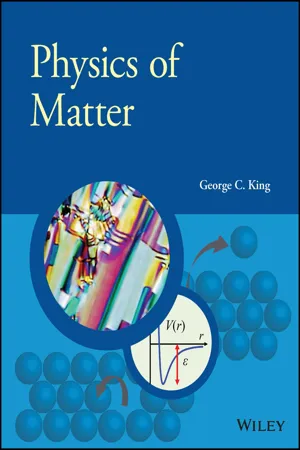 eBook - PDF
- George C. King(Author)
- 2023(Publication Date)
- Wiley(Publisher)
2 The forces that bind atoms together At the beginning of Chapter 1, we made the statement that atoms attract each other when they are a little distance apart, but repel when they are squeezed together. Evidence that atoms are attracted to each other comes from the fact that atoms combine together to form solids and liquids. Evidence that atoms repel each other comes from the fact that solids and liquids resist being compressed. These physical properties arise from the forces that act between the atoms. These forces and the resulting bonding of the atoms are the subjects of the present chapter. We will describe the general characteristics of the forces that bind atoms together and the resulting potential energy of the atoms. And we will describe the principal kinds of inter- atomic bonding: van der Waals, ionic, covalent, and metallic bonding. We will see that all bonding is a con- sequence of the electrostatic interaction between nuclei and electrons. And we will see that the interatomic interactions that we will describe on the microscopic scale relate directly to the properties of matter that are observed in the laboratory. 2.1 General characteristics of interatomic forces Before going into detail about particular types of interatomic force, we describe some general features of such forces. We are interested in whether the force acting between atoms is attractive or repulsive. We are also interested in the way the strength of the force varies with interatomic separation. To discuss these two aspects, we imagine an atom fixed in place at the origin (r = 0) of a coordinate system and a second atom a distance r away, where r is the distance between the centres of the two atoms. This arrangement is illus- trated in Figure 2.1. We make the assumption that the force depends only on distance r. If the force is repul- sive, the force acts to increase the separation of the two atoms, i.e. eBook - PDF
Introduction to Computational Materials Science
Fundamentals to Applications
- Richard LeSar(Author)
- 2013(Publication Date)
- Cambridge University Press(Publisher)
This energy could be calculated by solving the quantum mechanics of all the nuclei and electrons in a system, as discussed in Chapter 4. In this chapter, however, we discuss a less computationally intensive approach, in which we develop and use models for the interactions between atoms, which are generally based on simple functional forms that reflect the various types of bonding seen in solids. We shall see that these functions are, by their nature, approximate, and thus the calculations based on them are also approximations of the materials they are designed to describe. However, the use of these potentials, though lower fidelity, will enable us to model much larger systems over much larger times than possible with the more accurate quantum mechanical methods. 5.1 THE COHESIVE ENERGY . . . . . . . . . . . . . . . . . . . . . . . . . . . . . . . . . . . . . . . . . . . . . . . . . . . . . . . . . . . . . . . . . . . . . . . . . . . . . . . . . . . . . . . . . . . . . The goal of most atomistic-level simulations is, in part, to calculate quantities that define the energetics and thermodynamics of materials. The most fundamental of those quantities is the potential energy, which is the sum of the energetic interactions between the atoms. At 0 K, that energy is the cohesive energy, which is defined as the energy required to assemble a solid from its constituent atoms and molecules. Consider a system of N atoms. The cohesive energy, U , is the negative of the energy needed to take all the atoms and move them infinitely far apart, i.e., U = E(all atoms) − N i =1 E i , (5.1) where E(all atoms) is the total energy of the system and E i is the energy of an individual isolated atom. Our goal is to develop simple analytical potentials that approximate the interaction energies between atoms. 1 The fundamental entities are the atoms and molecules that make up the solid, with the details of the electrons and nuclear charges being approximated in the analytical potentials. eBook - PDF
- Kalyan Annamalai, Ishwar K. Puri, Milind A. Jog(Authors)
- 2011(Publication Date)
- CRC Press(Publisher)
Upon further compression, the attractive forces become so strong that the vapor changes phase to become liquid. According to liquid cell theory, each molecule is confined to a small cell of volume v ′ (which is the total volume divided by the number of molecules contained in it). If the molecular diameter is small compared to the cell volume, a molecule is free to move within its cell without interacting with its nearest neighbors. Therefore, the translational energy of that molecule decreases, although it possesses the same rotational and vibrational energies. As the liq-uid is further compressed it becomes a solid. The interactions of a molecule with its neighbors are strongest when motion is restricted to conditions corresponding to the minimum potential energy (i.e., when ϕ = ϕ min ). At this state, the molecules possess most of their energy in the vibrational mode. The relative position of molecules (or their configuration) is fixed in solids. Gases corre-spond to the other extreme and contain a chaotic molecular distribution and motion. Liquids fall in a regime intermediate between gases and solids, since their molecular kinetic energies are com-parable to the maximum potential energies. Therefore, the molecular energy changes significantly with compression and phase change. Thermal energy is stored internally (vibrational + rotational) and externally (translational). There is also constant exchange of energy between internal and external modes. As energy is transferred in, the energy in internal and external modes increases in equal proportions. Typically internal and external temperatures are equal. 38 ◾ Advanced Thermodynamics Engineering, Second Edition The position of an atom within a molecule can be fixed by three spatial coordinates (say, x, y, and z). A polyatomic molecule containing δ atoms requires 3 δ coordinate values in order to fix the atomic positions, and, consequently, has 3 δ degrees of freedom. No longer available |Learn more
- (Author)
- 2014(Publication Date)
- Library Press(Publisher)
Energy of Keesome interaction depends on the inverse sixth power of the distance, unlike the interaction energy of two spatially fixed dipoles, which depends on the inverse third power of the distance. Often, molecules have dipolar groups within them, but have no overall dipole moment. This occurs if there is symmetry within the molecule, causing the dipoles to cancel each other out. This occurs in molecules such as tetrachloromethane. Note that the dipole-dipole interaction between two atoms is usually zero, because atoms rarely carry a permanent dipole. ________________________ WORLD TECHNOLOGIES ________________________ Hydrogen bonding An example of intermolecular hydrogen bonding in a self-assembled dimer complex reported by Meijer and coworkers. Intramolecular hydrogen bonding in acetylacetone helps stabilize the enol tautomer A hydrogen bond is the attractive interaction of a hydrogen atom with an electronegative atom, such as nitrogen, oxygen or fluorine, that comes from another molecule or chemical group. The hydrogen must be covalently bonded to another electronegative atom to create the bond. These bonds can occur between molecules ( intermolecularly ), or within different parts of a single molecule ( intramolecularly ). The hydrogen bond (5 to 30 kJ/mole) is stronger than a van der Waals interaction, but weaker than covalent or ionic bonds. This type of bond occurs in both inorganic molecules such as water and organic molecules such as DNA. Intermolecular hydrogen bonding is responsible for the high boiling point of water (100 °C) compared to the other group 16 hydrides that have no hydrogen bonds. Intra-molecular hydrogen bonding is partly responsible for the secondary, tertiary, and ________________________ WORLD TECHNOLOGIES ________________________ quaternary structures of proteins and nucleic acids. It also plays an important role in the structure of polymers, both synthetic and natural. eBook - PDF
Materials Science and Engineering
An Introduction
- William D. Callister, Jr., David G. Rethwisch(Authors)
- 2018(Publication Date)
- Wiley(Publisher)
• Bonding force and bonding energy are related to one another according to Equa- tions 2.5a and 2.5b. • Attractive, repulsive, and net energies for two atoms or ions depend on interatomic separation per the schematic plot of Figure 2.10b. • For ionic bonds, electrically charged ions are formed by the transference of valence electrons from one atom type to another. • There is a sharing of valence electrons between adjacent atoms when bonding is covalent. • Electron orbitals for some covalent bonds may overlap or hybridize. Hybridization of s and p orbitals to form sp 3 and sp 2 orbitals in carbon was discussed. Configurations of these hybrid orbitals were also noted. • With metallic bonding, the valence electrons form a “sea of electrons” that is uni- formly dispersed around the metal ion cores and acts as a form of glue for them. • Relatively weak van der Waals bonds result from attractive forces between electric dipoles, which may be induced or permanent. • For hydrogen bonding, highly polar molecules form when hydrogen covalently bonds to a nonmetallic element such as fluorine. • In addition to van der Waals bonding and the three primary bonding types, covalent– ionic, covalent–metallic, and metallic–ionic mixed bonds exist. • The percent ionic character (%IC) of a bond between two elements (A and B) depends on their electronegativities (X’s) according to Equation 2.16. • Correlations between bonding type and material class were noted: Polymers—covalent Metals—metallic Ceramics—ionic/mixed ionic–covalent Molecular solids—van der Waals Semi-metals—mixed covalent–metallic Intermetallics—mixed metallic–ionic Electrons in Atoms The Periodic Table Bonding Forces and Energies Primary Interatomic Bonds Secondary Bonding or van der Waals Bonding Mixed Bonding Bonding Type- Material Classification Correlations eBook - PDF
Intermolecular Interactions
Physical Picture, Computational Methods and Model Potentials
- Ilya G. Kaplan(Author)
- 2006(Publication Date)
- Wiley(Publisher)
18 GENERAL CLASSIFICATION OF INTERMOLECULAR INTERACTIONS classified according to the three ranges of interatomic separation for a typical interatomic potential. These three ranges are: I. A range of short distances at which the potential has a repulsive nature and the electronic exchange, due to the overlap of the molecular electronic shells, dominates. II. A range of intermediate distances with the van der Waals minimum, which is a result of the balance of the repulsive and attractive forces. III. A range of large distances at which the electronic exchange is neg-ligible and the intermolecular forces are attractive. Range I In this region, the perturbation theory (PT) for calculating the intermolecular inter-actions cannot be applied. To some extent, the interacting atoms (molecules) lose their individuality because of a large overlap of their electronic shells. The same variational methods, which are used for molecular calculations, can be applied to the calculation of the total energy of interacting system, which can be considered as a ‘supermolecule’. The interaction energy is found as a difference: E int = E tot − n a = 1 E a (1.23) where E a is the energy of isolated subsystems (molecules or atoms) that have to be calculated at the same approximation as a whole system. In this region we can separate only two types of interaction energies: the Coulomb energy and the exchange energy . If we put to zero all integrals containing the exchange or overlap of electron densities, we obtain E Coul . Then, the exchange energy is defined as the difference: E exch = E int − E Coul (1.24) Range II Both repulsive and attractive forces exist in this region. This causes the minimum of intermolecular potential energy and provides a stability of the system.
- Frank H. Stillinger(Author)
- 2015(Publication Date)
- Princeton University Press(Publisher)
Such reductions can substantially speed up computer calculations based on that class of models. (2) INTACT MOLECULES Many applications in the study of condensed-matter phenomena concern neutral molecules or polyatomic ions whose chemical structures remain stable in the physical circumstances of interest (temperature, pressure, irreversible flows). Nuclei continue to be chemically bonded within the same molecular or ionic groupings throughout the observation “time window.” For these applica-tions, it is unnecessary, even undesirable, to consider the entire Born-Oppenheimer potential energy hypersurface throughout its full configuration space. Instead, the relevant chemical sub-space of the full configuration space is identified, and model potential functions are then gener-ated for just that subspace. In doing so, the model functions should be chosen to ensure that the desired chemical bonding patterns cannot be violated by chance nuclear excursions. In these cir-cumstances, it is natural to subtract the intramolecular ground-state minimum energies for the molecules or ions from Φ , which then measures only the combination of internal distortion ener-gies of the stable molecules or ions, the potentials of interaction they have with any walls present, and the interactions between neighboring intact molecules or ions. Water offers a representative and obviously important example. Its condensed-phase proper-ties and their molecular interpretations form the subject of Chapter IX. A system comprising N oxygen nuclei and 2 N hydrogen nuclei, in the presence of 10 N electrons so as to be electrostati-cally neutral overall, can form N H 2 O molecules. The Born-Oppenheimer electronic ground state for one such molecule has C 2 v symmetry at its own potential energy minimum, with a structure illustrated in Figure I.4. The dipole moment for the molecule in isolation points along the direc-tion of the symmetry axis and has magnitude (in Debye) 1.855 D [Dyke and Muenter, 1973].
Index pages curate the most relevant extracts from our library of academic textbooks. They’ve been created using an in-house natural language model (NLM), each adding context and meaning to key research topics.

