Chemistry

Variable Oxidation State of Transition Elements
Transition elements exhibit variable oxidation states due to the presence of incompletely filled d orbitals in their electronic configurations. This allows them to lose or gain different numbers of electrons, resulting in multiple oxidation states. The variable oxidation states of transition elements make them versatile in forming a wide range of compounds and participating in various chemical reactions.
Written by Perlego with AI-assistance
Related key terms
1 of 5
6 Key excerpts on "Variable Oxidation State of Transition Elements"
 eBook - PDF
The Chemistry of the Metallic Elements
The Commonwealth and International Library: Intermediate Chemistry Division
- David J. Steele, J. E. Spice(Authors)
- 2017(Publication Date)
- Pergamon(Publisher)
This general trend in transitional characteristics to a maximum in the centre of the series to zero at each end will be apparent in the general discussion of each of these properties in turn. VARIABLE OXIDATION STATES TABLE 8.2. THE KNOWN OXIDATION STATES OF THE ELEMENTS IN THE FIRST TRANSITION SERIES Sc + 3 T-T, +2 + 3 +4 V + 2 + 3 +4 + 5 Cr + 2 + 3 + 6 Mn + 1 + 2 + 3 +4 (+5) + 6 + 7 Fe +2 + 3 + 6 Co + 2 + 3 Ni +2 + 3 (+4) Cu +i +2 (+3) Zn +2 The states in parentheses are not well characterised. The maximum at manganese decreasing on either side is obvious. The variety in valency states is due to the small difference in energy between the 4y, 3d and Ap subshells. This makes the electrons in these subshells very versatile in forming chemical bonds; also the unoccupied subshells of similar energy bestow upon the atoms good acceptor properties in the formation coordination compounds. It will be noted that, scandium excepted, all the elements have a stable +2 state, formed by the loss of the two 4y-electrons; other states result from the loss of sharing of some or all of the 3d-electrons. For example, in order to form the +7 compounds such as the permanganate ion, MnOj, manganese makes use of two 4s-electrons and five 3d-electrons in forming the four bonds with oxygen to give a tetrahedral ion; the eighth electron needed comes, of course, from the metal forming the cation in the ionic bond. For a given element in the higher oxidation states the oxides are acidic; the compounds are more covalent, often easily hydrolysed and readily reduced (i.e. electrons easily gained), they are consequently good oxidising agents. The reverse is true of the lower oxidation states: they are ionic, the oxides are basic, and the compounds often are reducing agents. Chromium might be briefly considered here as an example. The +6 state is acidic appearing most commonly as the complex eBook - PDF
- John Jr. Boor(Author)
- 2012(Publication Date)
- Academic Press(Publisher)
11 Oxidation State of Catalysts and Active Centers I. Introduction While the measured oxidation state probably often describes the oxidation state of individual active centers, conclusive proof is lacking. Indirect evidence suggests that, for many of the important transition metals, for example Ti, V, and Cr, more than one oxidation state leads to an active catalyst. The ligand environment of the active center plays a dominant role in deciding which oxidative state is active for a particular monomer. Because the oxidation state of the transition metal of the active center significantly affects the structure of that center, much work has been done to establish its value for different Ziegler-Natta catalysts. It is, however, important to distinguish between the measured average oxidation state of the whole catalyst and the oxidation state or states of the individual centers. The first can usually be determined easily, but a direct assignment of oxida-tion state of the active centers is more difficult. First of all, the fraction of the total transition metal atoms that are active centers is small, about 1% or less. Suggestions that traces of the transition metal in an unmeasured oxidation state actually form the active centers in some catalysts cannot be lightly dismissed. Yet, evidence is accumulating that the measured oxidation state reflects the oxidation state of active centers in many of the investigated Ziegler-Natta catalysts. There is justification, then, to devoting a chapter on the various experimental efforts made by different workers to establish the oxidation state of the active centers and to describe the consequences of this data. 261 262 11 / OXIDATION STATE OF CATALYSTS AND ACTIVE CENTERS Selected examples are presented to show the range of oxidation states that have been found for some of the more important or more widely investigated catalysts. The findings are given according to the transition metal.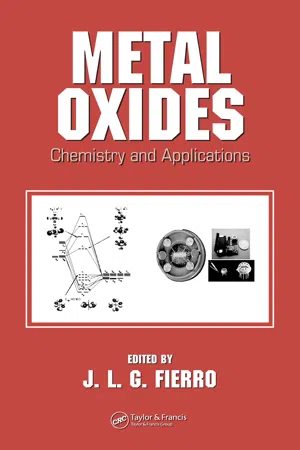 eBook - PDF
Metal Oxides
Chemistry and Applications
- J.L.G. Fierro(Author)
- 2005(Publication Date)
- CRC Press(Publisher)
4 Cation Valence States of Transitional Metal Oxides Analyzed by Electron Energy-Loss Spectroscopy Zhong Lin Wang School of Materials Science and Engineering, Georgia Institute of Technology, Atlanta, GA C ONTENTS 4.1 Introduction ............................................................... 87 4.2 Principle of EELS Measurements ........................................ 89 4.3 In Situ Observation of Valence State Transition ........................ 91 4.4 Quantification of Oxygen Vacancies in CMR Oxides .................. 94 4.5 Refining the Crystal Structures of Nonstoichiometric Oxides .......... 95 4.6 Identifying the Structure of Nanoparticles ............................... 98 4.7 Experimental Approach for Mapping the Valence States of Co and Mn ............................................................. 99 4.8 Mapping the Valence States of Co Using the White-Line Ratio ....... 102 4.9 In Situ Observation of Valence State Transition of Mn ................. 106 4.10 Phase Separation Using the Near-Edge Fine Structure ................. 107 4.11 Summary .................................................................. 108 Acknowledgments ............................................................... 109 References ....................................................................... 109 4.1 I NTRODUCTION Transition and rare earth metal oxides are the fundamental ingredients for the advanced smart and functional materials. Many functional properties of inor-ganic materials are determined by the elements with mixed valences in the structure unit [1], by which we mean that an element has two or more dif-ferent valences while forming a compound. The discovery of high-temperature superconductors is a successful example of the mixed valence chemistry, and 87 88 Metal Oxides: Chemistry and Applications the colossal magnetoresistivity (CMR) [2,3] observed in the perovskite structured La 1 − x A x MnO 3 (A = Ca, Sr, or Ba) is another example. eBook - ePub
Inorganic Chemistry for Geochemistry and Environmental Sciences
Fundamentals and Applications
- George W. Luther, III(Authors)
- 2016(Publication Date)
- Wiley(Publisher)
(an inner sphere electron transfer process).10.2 Factors Governing Metal Speciation in the Environment and in Organisms
Many factors affect the reactivity of a metal ion in the environment. Section 1.8.2 indicated that the oxidation state of a metal [e.g., Fe(II) versus Fe(III)] depends on the redox condition of the environment. For example, once dissolved and are consumed, microbes decompose organic matter with other oxidants such as and FeOOH, resulting in reduction to and . Metal ions can exist as inorganic complexes with the following common inorganic ligands: chloride, carbonate, sulfate, phosphate, and sulfide. However, there are a variety of organic ligands that are naturally produced and that outcompete the inorganic ligands for bonding with metal ions. Ligands also affect the redox and spin state of a metal couple such as Fe(III)/Fe(II) (Section 8.7.3 for Co; Table 10.1 for Fe), and nature uses ligand–metal bonding to affect reactivity and catalysis. The left of Figure 10.1 shows potentials for several reduction couples that are important in life processes (sometimes termed a redox spectrum). An oxidized partner of a redox couple at the top such as can be reduced by the reduced partner of any couple below it as . Thermodynamically, the couple is one of the most efficient, but it also shows the energy needed for water splitting (the reverse reaction that requires photochemistry; Section 10.7 ). The FeS proteins (see Section 12.6.4 ) have different oxidation states and ligand attachments that tune their redox potential over 1 volt; reduction of to is possible for some redox centers (ferredoxins). Selected aspects of the redox chemistry for the metal redox centers in Figure 10.1 are described below and in Chapter 12
- Pandurang Ashrit, Ghenadii Korotcenkov(Authors)
- 2017(Publication Date)
- Elsevier(Publisher)
d electrons in its outer shell.The interesting properties in these oxides stem from these outer or frontier d electrons. For example, as per the scheme of filling the electronic orbits, the element tungsten (W), with an atomic number of 72, has the following electronic configuration: 1s 2 2s 2 2p 6 3s 2 3p 6 4s 2 3d 10 4p 6 5s 2 4d 10 5p 6 6s 2 4f 14 5d 4 . Hence, this leads to the facile formation of the trioxide of tungsten (WO3 ) by sharing the six outer electrons with three oxygen atoms, shell 6 with two electrons in subshell s and the outermost shell (5) with four electrons in subshell d . The W atom becomes W6+ and each oxygen atom becomes O2−. Similarly, vanadium dioxide (VO2 ), with vanadium's atomic number of 23 and electronic configuration of 1s 2 2s 2 2p 6 3s 2 3p 6 4s 2 3d 3 , is formed by giving off two of its electrons from subshell 4s and two from the 3d subshell. The vanadium atom thus becomes V4+ and each oxygen atom becomes O2−. Thus, in all the TMOs it is these outer d bands and the oxygen p bands that are the most significant in determining the electronic properties of TMOs. In addition to this oxide formation with a single or multiple transition element it is possible to have other alkaline or rare earth metal atoms that can also provide the needed electrons to the oxygen atoms. A wide range of transition metal-based oxides can thus be formed from the simple monoxides (MO) to the complex oxides of the form Rx Mm On , where M represents the transition metal and R can be any other suitable atom that can be included. These TMOs can thus be created by adjusting the number of each atom in the compound (x , m , n ) and having different numbers of electrons in the outer d bands of the transition metal. This variation in the number of electrons in the d eBook - PDF
- S. David Jackson, Justin S. J. Hargreaves, S. David Jackson, Justin S. J. Hargreaves(Authors)
- 2008(Publication Date)
- Wiley-VCH(Publisher)
Their electronic structure was comprehensively studied by several research groups [50, 61–67]. Zimmermann and coworkers [63] demon- strated a strong hybridization between the V 3d and O 2p orbitals, and owing to the covalency in bonding, such early transition metal oxides (e.g. V x O y ) cannot be considered as simple Mott–Hubbard compounds. Density-functional theory(DTF) 256 6 Photoelectron Spectroscopy of Catalytic Oxide Materials calculations [64, 67] confirmed the strong hybridization of the valence oxygen and vanadium orbitals in V 2 O 5 , and related the distortion of the VO 6 octahedra to the unique electronic structure of the conduction band. A recent DFT cluster study [50] mimicking V 2 O 5 has clearly indicated that the local charges (Mulliken) of the different cluster atoms are much smaller than formal valence charges (V +1.4 ; O −0.26 , O −0.58 , O −0.78 for the three different lattice O positions), in line with the suggested covalent bonding contribution. DFT calculations on other oxides reported similar discrepancies between partial and formal charges [68–71]. It is well known among quantum chemists, and we would also stress, that although Mulliken charges and formal valence charges may yield the same qualitative picture, they cannot be compared on a quantitative basis. Formal valence charges may be useful in certain cases, but if considered as a universal tool, they can easily lead to erroneous con- clusions and reaction models, as often observed in the heterogeneous catalysis community. In what follows, we will use integer valence charges (e.g. V 5+ ) to rep- resent formal oxidation states, while fractional numbers (e.g. V +1.4 ) will indicate local charges calculated by DFT methods. The electronic structure of vanadium oxides is crucial to their reactivity. Deter- mination of even the formal oxidation state of vanadium from XPS can, however, be non-trivial, owing to a variety of factors.
Index pages curate the most relevant extracts from our library of academic textbooks. They’ve been created using an in-house natural language model (NLM), each adding context and meaning to key research topics.

