Economics

Low Wage Workers
Low wage workers are individuals who earn wages at or near the minimum wage level. They often work in industries such as retail, food service, and hospitality. Low wage workers may face challenges such as financial instability, limited access to benefits, and difficulty in meeting basic needs due to their low earnings.
Written by Perlego with AI-assistance
Related key terms
1 of 5
6 Key excerpts on "Low Wage Workers"
 eBook - PDF
Industrial Relations
Theory and Practice
- Paul Edwards(Author)
- 2009(Publication Date)
- Wiley-Blackwell(Publisher)
Low pay is thus best defined in terms that are independent of family or household living standards. Even though we have argued that low pay should be defined by reference to wage norms, several definitions and approaches to the measurement of low pay can still be used. The most common approach is to define low pay as covering all those working at a wage below a certain percentage of the average earnings level; the level most frequently chosen, and adopted as the Council of Europe’s standard of decency, is around two-thirds of average (mean) wages. In practice many studies adopt the more modest definition of two-thirds of median earnings. Another approach is to look at what has been happening over time to the lowest LOW PAY AND THE NATIONAL MINIMUM WAGE 449 10 per cent of the labour force: has their pay been increasing or decreasing over time relative to median or average pay? Low Pay in the UK in Comparative Perspective To assess the extent of the problem of low pay in the UK it is important to place the distribution of earnings in a comparative context (Dex et al. 1999). However, a major problem with data on earnings is that even the most comprehensive data fail to provide a fully integrated distribution of earnings in the labour market. These problems apply both to UK sources of data and to international comparative data. Most data refer only or mainly to full-time employees, even though low pay is often common among part-timers. Moreover, both the share of part-time workers and their concentration among the low-paid varies between countries (Gornick and Jacobs 1996; Rubery 1998; Grimshaw and Rubery 1997). Comparisons that only include full-time employees are therefore inadequate to give a full picture of the relative extent and the form of the low-pay problem in the UK. It is therefore necessary to provide separate comparisons for full-time and part-time employees. eBook - ePub
Work Matters
Critical Reflections on Contemporary Work
- Sharon Bolton, Maeve Houlihan(Authors)
- 2009(Publication Date)
- Bloomsbury Academic(Publisher)
Since 2000, the US has lost 3.5 million jobs in manufacturing – jobs that were once considered a stepping stone to the middle-class (Greenhouse, 2008a). Reflecting this trend, in our state of Connecticut, as is the pattern elsewhere within the US, thousands of manufacturing jobs have been replaced by service sector jobs; and currently, the income distribution of Connecticut residents is among the most unequal in the nation. Recent projections through 2008, prepared by the Connecticut Department of Labour, describe an economy that will continue to fracture, producing greater inequality, instability, and insecurity in the workforce. While manufacturing employment is historically associated with good jobs, with good wages, benefits, and job security, service sector employment is generally associated with poor jobs with low wages and few benefits. But as the Connecticut Centre for a New Economy (2001) points out, there is nothing inherent in these jobs that presupposes high or low pay – these ‘good jobs’ are the result of collective action and workers organising to better their conditions. In this chapter we present an overview of the different components of the low-wage workforce (the very poor, the working poor, the near-poor and middle-skilled jobs, and the ‘disposable American’) and the experiences of individuals working in these jobs. We also comment on the political economy that has created the current situation and future prospects for change.Low Wage Workers
The very poor
There are now 37 million people in the US living in poverty and half of all families living in poverty are single mothers with children. US Census data from 2005 documents that minority communities (especially African-Americans and Latinos) are disproportionately poor; and women and their children are disproportionately poor. Single mothers are more likely to be very poor than other families with children; and households with children maintained by women of colour alone have the highest rates of income inadequacy (i.e. unable to meet basic needs) (IWPR, 2007). Poverty rates have been rising since l999 and are now above where they stood in l973. Education reduces the rate of income inadequacy, especially for people of colour and/or women. As Pearce argues, ‘families are not poor because they lack workers or work hours ... but because their wages within their occupations are inadequate to meet basic expenses’ (2007, p. 3).The very poor, mainly female-headed households, are affected by neoliberal public policies that limit welfare and other government safety-net programmes which have often been necessary for survival. These very low-income women are likely to be precariously attached to the labour market and their work experience is generally unstable, with low wages, without benefits, and without worker rights. Working in minimum wage jobs, we have noted above how low their income is. eBook - ePub
Living Wage Movements
Global Perspectives
- Deborah M. Figart(Author)
- 2004(Publication Date)
- Routledge(Publisher)
Advocates justify this market intervention by arguing that public tax dollars should not be used to subsidize employers who pay poverty-level wages – echoing the parasitic industries argument advanced by the Webbs a century earlier. By 2003, over 100 US cities, counties, school boards, and other public entities have passed such living wage ordinances. 1 In other countries, policy responses include campaigns to raise the minimum wage (wage floors), engaging in low pay campaigns, and securing better wages, benefits, and working conditions for workers in part-time, contingent, temporary, or casual employment. All of these efforts have required coalitions and cooperation among government, labor, and community groups. While hours of work play a role in determining low pay, low-paid workers can also be found in year-round full-time jobs. The issue of poverty-level wages is especially crucial for women and workers from racial and ethnic minority groups (Sklar et al. 2001). Across the globe, the share of low-income workers is disproportionately female, and most likely employed in less-skilled sales and service occupations. These workers are cleaning buildings, preparing and serving food, tending to children, the elderly, and the sick, performing routine office tasks, or selling and sewing garments. Three recent studies underscore the seriousness of the problem. About one in six non-elderly Americans lives in a working poor family (see Kazis and Miller 2001). Depending on the definition, about one in seven employees in the European Union is low paid (European Foundation for the Improvement of Living and Working Conditions 2002). The incidence of low pay is greater for women than men in the USA, the European Union, Canada, Australia, and New Zealand (Jepsen 2000: Table 1)
- Oren M Levin-Waldman(Author)
- 2010(Publication Date)
- Routledge(Publisher)
et al. 2008). Similarly, in France which, unlike the United Kingdom has had a high minimum wage, strong employment protective legislation, and a highly restrictive immigration policy, on average the numberTable 6.8 Variables likely to affect whether one is unemployed by decadesof low-wage workers who were women was greater than the number of lowwage workers who were men. France also differs from the United Kingdom in that low-wage work, being defined as those earning less than two-thirds of median hourly wages, is not considered to be the same as poverty. Although unemployment tends to be higher in France, it is the existence of a minimum wage in France, i.e. a wage policy, which provides a key explanation for the small number of low-wage workers in France (Caroli and Gautie 2008).In the bottom contour, however, the minimum wage variable does appear to have an effect in the 1960s, 1970s, and 1990s. In the 1980s, the effect was negative, meaning that those earning above the median wage of the first contour who were in the bottom were not more likely to be unemployed. In the 2000s the effect was small and not statistically significant. And yet where there is an effect, it is still smaller than the positive effect of having low educational attainment. Those who are more likely to be unemployed among the bottom contour are those workers with no diploma who obtained no more than a twelfth-grade education. This, of course, lends credence to the notion that the most vulnerable are low-skilled workers, to the extent that educational attainment can serve as a proxy for skills. Do these coefficients not also suggest that contrary to the neoclassical model that posits the disemployment effect due to minimum wage increases, it really is the failure to educate? The neoclassical, however, will offer two possible responses. First, if skills deficiencies are what render workers vulnerable, the onus is effectively on them to improve themselves. Second, that those lacking in educational accomplishment are more likely to be unemployed, by no means disproves the disemployment effects due to minimum wage increases. Neoclassicals still assert disemployment effects on the assumption that employers following an increase are more likely to lay those lacking in skills first. In other words, disemployment is occurring, particularly among those lacking in skills. And yet, the fact that those earning wages higher than the median wage of the first contour are not necessarily more likely to be unemployed, even among the bottom contour, suggests that the predicted textbook effects of wage policy is not sufficient justification for not having it. Even if the data does not establish conclusively that minimum wage increases will lead to employment consequences, it is sufficiently ambiguous on the effects that it effectively opens the door to legislative/policy experimentation on the basis of what best serves the public interest. eBook - PDF
Poverty and Insecurity
Life in Low-Pay, No-Pay Britain
- Shildrick, Tracy, MacDonald, Robert(Authors)
- 2012(Publication Date)
- Policy Press(Publisher)
In the overall economy, wages are determined by the relative bargaining power of firms and workers, which cannot be determined by the market.Workers cannot freely choose between work and leisure as leisure cannot be enjoyed without income. In reality, the only ‘leisure activity’ which one can devote more time to with less income is sleeping.Work is not an option for most but a necessity, at least in the absence of a very generous social security system, and Keen’s (2011, p 139) conclusion about labour market economics is that: … economists are forever opposing ‘market interventions’ which might raise the wages of the poor, while defending astronomical salary levels for top executives on the basis that if the market is willing to pay them that much, they must be worth it. This is consistent with Offe’s (1985, p 37) analysis of marginal labour markets, that those who are exempted or excluded from the labour market are not in a position to place ‘excessive demands’ and ‘expectations’ on work offers. He goes on to argue that ‘the labour market cannot absorb “everyone”; that would only lead to its self destruction’. By this he means the loss of the capacity of employers to recruit and select among competing jobseekers. Every hiring of an employee entails fixed costs of recruitment, training and the risks entail whether the employee performs.These costs are considerably lowered 35 Poor work, welfare and poverty when processes of familiarisation and qualification are shortened or dispensed with, substitution or sacking at short notice and turnover high, the wages low, the chances of advancement slim and working conditions restrictive (that is, the exact sort of processes and conditions that confronted many people in our study). This leads employers to actively target and recruit marginal categories of workers as a ‘marginal workforce’ to which employers return again and again, subsidised by the welfare system.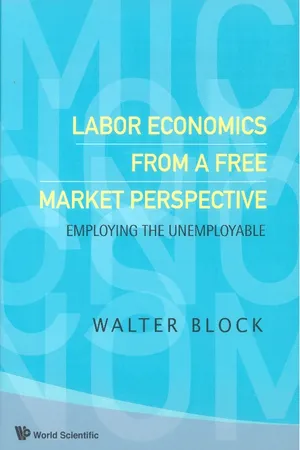 eBook - PDF
Labor Economics From A Free Market Perspective: Employing The Unemployable
Employing the Unemployable
- Walter Block(Author)
- 2008(Publication Date)
- World Scientific(Publisher)
A “wageflool;” moreover, implies that when the minimum wage level rises, it pulls wages up with it. @we must use mechanical analogies to economic phenomena, a far better one would be that of the barrier over which one has to jump in order to land a job; and, the higher is this hurdle, the fewer those who can catapult over it. “In so doing, the minimum wage helps to equalize the imbalance in bargaining power that low-wage workers face in the labor market.” When wages are below their equilibrium (productivity) levels, market forces push them up, as the demand for labor exceeds the supply. When wages are above their equilibrium (productivity) levels, market forces push them down, as the supply of labor exceeds the demand. It matters not that there are more employees than employers. What determines wages (assuming that worker productivity is the same for many potential employers, which is typically true for low-skilled workers) is thus productivity, not “bargaining power ’’ (DiLorenzo, 2004) “The minimum wage is also an important tool in fighting poverty.” It impossible to “fight ’’ poverty by preventing unskilled workers from landing jobs. 161 “The value of the 1997 increase in the federal minimum wage has been fully eroded. The real value of today’s federal minimum wage is less than it has been since 1951. Moreover, the ratio of the minimum wage to the average hourly wage of non-supervisory workers is 3 1 %, its lowest level since World War 11. This decline is causing hardship for low-wage workers and their families.” The,facts cited here are all correct. And, thanks to the erosion of the real value of the minimum wage, unemployment for the poorest laborers is lower than it otherwise would have been. This decline, then, reduces hardship. “We believe that a modest increase in the minimum wage would improve the well- being of low-wage workers and would not have the adverse effects that critics have claimed.
Index pages curate the most relevant extracts from our library of academic textbooks. They’ve been created using an in-house natural language model (NLM), each adding context and meaning to key research topics.

