Geography

Deciduous Woodlands
Deciduous woodlands are ecosystems dominated by trees that shed their leaves annually. These woodlands are characterized by a diverse range of plant and animal species, and are found in temperate regions with distinct seasons. They play a crucial role in maintaining biodiversity and providing habitats for various wildlife. Additionally, deciduous woodlands are important for carbon sequestration and soil conservation.
Written by Perlego with AI-assistance
Related key terms
1 of 5
7 Key excerpts on "Deciduous Woodlands"
 eBook - ePub
- Brian R. Chapman, Eric G. Bolen(Authors)
- 2015(Publication Date)
- Wiley(Publisher)
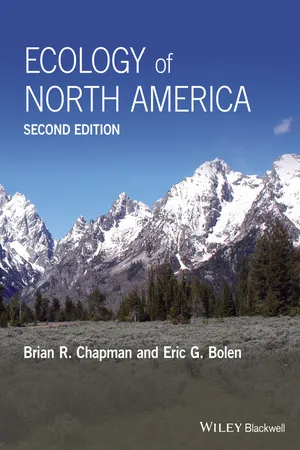
CHAPTER 4 Eastern Deciduous ForestYou see, the forests are the sanctuaries not only of wildlife, but also of the human spirit. And every tree is a compact between generations.George H.W. Bush, 41st President of the USThe magnificent autumn coloration of Eastern Deciduous Forest was not lost on Henry David Thoreau (1817–1862), Concord’s leading friend of woodchucks and nemesis of government. In his journal, the philosopher-naturalist took full note of the light shining through the forest, rendering to its leaves rich tinges “surpassing cathedral windows.” These eastern woodlands also are known as the “summer green forest” because of the seasonal rhythm in their deciduous foliage (Fig. 4.1 ). The prominent trees are often called “hardwoods” and, while this is certainly true of the diverse collection of maples, oaks, hickories, and beech, it is not of others (e.g., basswood is easily whittled). In places, various species of pines represent distinctive units within the biome.Bedecked in “summer green” foliage, an Eastern Deciduous Forest canopy filters light before it can reach the layers beneath. Shortened photoperiods in autumn signal a decrease in chlorophyll production and photosynthesis, and the coloration of hardwood leaves gradually shift to reds and yellows (inset). Eventually, the leaves dry, fall to the forest floor, and become part of the decomposer food chain. Reproduced by permission of Brian R. Chapman.Figure 4.1Eastern Deciduous Forest covers essentially all of the eastern United States except for the subtropical vegetation at the southern tip of Florida and an intrusion of grassland known as the prairie peninsula (Chapter 5 ). The irregular western edge of the forest runs from central Texas to Minnesota (Fig. 1.3 ). The Boreal Forest Biome forms its northern border.This biome is listed as either Temperate Deciduous Forest or Temperate Broadleaf Deciduous Forest in most classifications of worldwide ecological units. In Asia and parts of Europe, most of these forests were cleared long ago and the remnants are species-poor. The only expression of this biome in the southern hemisphere occurs on the drier slopes of the southern Andes. In eastern North America, almost all of the forests are second growth yet still preserve the best example of biodiversity among the world’s temperate deciduous forests. The richness of species in the Great Smoky Mountains underlies its designation as a World Biosphere Reserve. eBook - PDF
The World Atlas of Trees and Forests
Exploring Earth's Forest Ecosystems
- Herman Shugart, Peter White, Sassan Saatchi, Jérôme Chave(Authors)
- 2022(Publication Date)
- Princeton University Press(Publisher)
Mixed forests of deciduous trees and broad-leaved evergreens (for instance, beech–magnolia on more nutrient-rich soils and live oak maritime forests) occur but don’t form a continuous vegetation zone. In Europe, the southern transition is marked by pine and oak woodlands, a climatic shift to winter rainfall and landscapes dominated by sclerophyllous forests and shrublands, and the Mediterranean Sea. Westward in North America and Asia and eastward in Europe, increasing continentality and decreasing rainfall result in a shift to open woodlands, savannas, and, ultimately, mid-continent grasslands, with grazing animals and fire setting the precise position of the forest–grassland boundary. Continental aridity, familiar from the prairies and Great Plains of North America and steppes of Eurasia, sweeps almost to the coast of China at the latitude of Beijing and separates the moist deciduous forest there into northern and southern parts. p Bald Cypress Bald cypress (Taxodium distichum) are deciduous conifers that dominate the bottomland swamps of southeastern North America. The swollen trunk bases and the vertical root growth (“cypress knees”) are distinctive. It has been speculated that the cypress knees function for mechanical support, root aeration, carbon storage, and nutrient cycling, but their function has not yet been definitively proven. 279 THE TEMPERATE DECIDUOUS FOREST Conifers Everywhere within the deciduous forest, needle-leaved coniferous trees can be found in a wide variety of environments and can sometimes dominate. eBook - PDF
- Alan F. Arbogast(Author)
- 2017(Publication Date)
- Wiley(Publisher)
Midlatitude Deciduous Forest Biome The midlat- itude deciduous forest biome is found across the midlatitudes of North America, northeastern Asia, and western and central Europe (Figure 10.6) where the climate has a distinct seasonal temperature cycle with cold winters. This plant community consists of a dense network of broadleaf trees that forms a nearly continuous canopy in the summer. In the eastern United States, the dominant species are oak, elm, and maple, to name a few trees you may be familiar with (see Figure 9.10). These trees have a distinct seasonal cycle in which the leaves change color and fall during the autumn months. The midlatitude deciduous forest is associated with a variety of climate regions where average annual precipita- tion ranges between about 75 cm and 150 cm (30 in. and 60 in.), including the humid subtropical hot-summer climates (Cfa, Cwa), the humid continental hot-summer climates (Dfa), and the warmer parts of the humid continental mild-summer regions (Dwa, Dwb). Although these climates vary in some significant ways, each has sufficient moisture to support trees, either because average annual rainfall is abundant or evapo- ration is low because average annual temperatures are cool. In eastern North America, the midlatitude deciduous forest biome extends across a broad area from the Gulf of Mexico into southeastern Canada. Elsewhere, it occurs in an arc that extends from Europe to eastern Asia. This plant assemblage is also found in southeastern Australia and northern New Zealand (see Figure 10.6 again). Mediterranean Woodland and Shrub Forest Biome A second subdivision in the midlatitude forest biome is the Mediterranean woodland and shrub forest. This plant assemblage is closely associated with the Mediterranean dry-summer climate (Csa, Csb) and is found on the west coast of continents in the lower middle latitudes (see Figure 10.6 again). Average annual precipitation in these areas ranges from 25 cm to 65 cm (10 in. to 26 in.).
- Sergio A. Molina-Murillo, Carlos Rojas Alvarado, Sergio A. Molina-Murillo, Carlos Rojas Alvarado(Authors)
- 2018(Publication Date)
- CRC Press(Publisher)
Many forests show a complex vertical structure, where different strata are present. Most light is intercepted, reflected, irradiated, and filtrated by the most external layer, the canopy, and little energy reaches the lower strata. Only a small fraction (approximately two percent) reaches the bottom layer of the forest, the understory, and the ground (Montgomery and Chazdon 2001). The complexity of the intermediate area between the canopy and the understory is highly variable and depends on many factors, especially the forest height. Climatic conditions related to seasonality can modify the dynamics of light within a forest. Deciduous forests occur in both tropical and temperate regions. In the tropics they occur due to seasonally dry conditions. Although they allow the entrance of larger percentages of light during dry periods of the year, the use of this energy input can be limited by the stressed hydric conditions of the plants in these ecosystems in some areas, limiting their growth to the wet season. In temperate regions, the deciduous lifestyle of trees is due to the moderately cold, low light conditions during the winter period. Warm spring conditions allow ephemeral plants (geophytes) to grow in these regions before the trees are able to reestablish a canopy cover. A number of these have evolved unique adaptations to ensure rapid spring growth.Forest Classification: Spatial Changes
In order to understand and manage forests, we need classification systems to sort out their diversity and predict their properties. Today, fine-scale forest type mapping is used by forest managers to predict properties such as timber yield, fire hazards, problems in stand development, and the success of planted stock. Since the late 1800s, as part of an overall plant community classification, the classification of forests developed under a very broad array of approaches. Over half a century ago the renowned plant ecologist Robert Whittaker lamented that “probably in no other field of natural science has there been such a proliferation of local schools with distinct viewpoints and techniques” (Whittaker 1962). Most classification systems were developed for specific geographic regions and ignore the properties of other regions. At the broadest scale most classification systems tend to focus on the form of the dominant vegetation rather than the species present. The most commonly recognized of these systems would be biome classification. Most classification systems also have an emphasis on the influence of climate and edaphic conditions on the distribution of vegetation. They also tend to focus on vegetation that is historically present, and on the climax community that should develop in a particular region, excluding human influences (Rowe 1972). At finer spatial scales, classification systems differ in their emphasis on which edaphic conditions to consider, successional trajectories, the presence of particular species, and subdominant vegetation. An exhaustive discussion of forest classification systems is beyond the scope of this chapter. Alternatively, as an introduction to this book we will describe two major distinction of forests, the angiosperm dominated versus gymnosperm dominated forests and the three major forest biomes, the boreal, temperate, and tropical forests.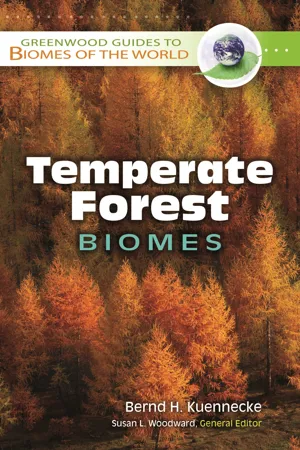 eBook - PDF
- Bernd H. Kuennecke(Author)
- 2008(Publication Date)
- Greenwood(Publisher)
(The suffix ‘‘-loh’’ is attached to a multitude of place names across northern Germany, indicating that the village was a clearing in the forest at one time.) Only after the invention of the steel plow in the eighteenth century, were farmers able to successfully turn over the sod of temperate grasslands and expose even richer soils. In East Asia, agricultural activities are intense and have been so for a long time in the history of humankind. As a direct result of such activities very little of the original natural forests of the region remain intact. The same is true of most regions of European deciduous forests. Only small ‘‘pockets’’ of natural forests are pre- served (often because they were formerly feudal hunting preserves). However, even Figure 3.3 Pleistocene glaciations in the Northern Hemisphere. (Map by Bernd Kuennecke.) Temperate Broadleaf Deciduous Forest Biome 85 though the label ‘‘natural forest’’ or even ‘‘wilderness’’ is used at times to denote such small pockets of ‘‘natural old forests,’’ these stands probably are not truly nat- ural. The very nature of keeping such stands as game preserves required a purpose- ful selection of all plants, including the trees, permitted to remain on such sites. Today, the largest tracts of this forest biome are found in eastern North Amer- ica. Although extensive, most of the temperate broadleaf deciduous forests in North America are second growth forests. This is the result of past logging and the clearing of forests for agricultural lands, followed later by a conversion back to for- ests when agricultural areas were abandoned. Climate Throughout all areas of their occurrence, temperate broadleaf deciduous forests are associated with temperate climate conditions. These are expressed as humid subtrop- ical (Cfa and Cfb in the Koeppen classification of climate types) (see Figure 3.4) and hot summer, humid continental climates (Dfa climate types) (see Figure 3.5; see also Table 1.1). eBook - ePub
- Yeqiao Wang(Author)
- 2020(Publication Date)
- CRC Press(Publisher)
Disturbance regimes, which refer to the type, intensity, and frequency of disturbances in a particular region, have a substantial impact on the composition and age structure of vegetation [39–41]. In temperate forests, eolic events such as hurricanes, tornadoes, and thunderstorm downbursts are a major contributor to forest dynamics. Fire was once an important natural regulator. With land use changes and suppression of fire by humans, many temperate forests have become increasingly dominated by late successional species [42]. Other natural disturbances include pest/disease outbreaks, flood or drought, and snow and landslides.Temperate Deciduous Forests
The temperate deciduous forest canopy is composed mostly of broadleaved angiosperm tree species with the inclusion of some coniferous tree species. Temperate deciduous broadleaved forests are often defined by species associations. Association names are most useful for distinguishing broad differences in forest type and are often representative of variation in soils, topography, and climate. For example, in eastern North America, some common associations are oak–hickory and beech–maple [43]. The temperate deciduous broadleaved forest that extends across East Asia (from 30° to 60°N) displays the greatest diversity of vegetation, a result of being less severely glaciated during the last ice age. In North America, the Florida peninsula and Gulf of Mexico coastal region was the southern limit for temperate forest refuge, while in Europe, the east to west mountain range of the Alps limited southern migration. Other locations of deciduous broadleaved forests include areas around the eastern Black Sea, mountainous regions in Iran and Caspian Sea, and a narrow strip of South America including southern Chile and Argentina [35,44–46].The composition of deciduous temperate forest depends on latitude. In North America, birches (Betula spp.), aspen (Populus spp.), and maples (Acer spp.) are common, along with needle-leaved conifers such as pines (Pinus spp.). Coniferous species tend to decline in abundance further south, but they remain in localized areas that exhibit drier, more nutrient-poor conditions and higher altitudes. In Europe, forests at higher elevations are composed mainly of conifers (Picea spp. and Abies spp.) and Fagus spp., as well as larch (Larix decidua eBook - PDF
- Singh, M P(Authors)
- 2021(Publication Date)
- Daya Publishing House(Publisher)
Other Forests Although the greater part of the remaining forest area is contained within the boreal and tropical forest belts, forests in intermediate latitudes have been or primary imporotance as the hearths of modern silviculture and forest This ebook is exclusively for this university only. Cannot be resold/distributed. management. Temperate Deciduous Forest To the south of the boreal forest zone lies temperate mixed and deciduous forest. Wide belts of transition occur in both Eurasia and North America, with the detailed pattern of distribution of conifers depending on local conditions of relief, soil and drainage. The deciduous forests of Europe stretched from the Atlantic to the Urals and were dominated by the pedunculate oak over vast reas. Depending on soils, climate and drainage, the oak was usually associated with a number of species including elm, as and beech. Beech, for example, was prominent or dominant on some calcareous areas and on areas of well-drained and rich soils as far north as the south of Sweden. It also occurred widely at intermediate altitudes in the Alps and the Mediterranean peninsulas, where it frequently occupied a zone below the coniferous mountain forest. In the southern part of the temperate belt of Europe, oak often remained dominant (for example in areas such as norther Spain and Italy), but was represented by species different from those of north-west Europe. In North America prior to the arrival of European settlers, the deciduous forest occupied a block of country between the Atlalntic and the Mississippi. Much of this forest has now been removed or modified, as in Europe, but it seems that many structural similarities existed between the two continents. The upper storey of trees usually formed a canopy suffiently open to allow sunlight to penetrate and support a rich shrub layer. On the dother hand the American formation is characterized by a wider range of species.
Index pages curate the most relevant extracts from our library of academic textbooks. They’ve been created using an in-house natural language model (NLM), each adding context and meaning to key research topics.

