Geography

Tropical Rainforest
Tropical rainforests are dense, lush forests found near the equator, known for their high levels of biodiversity and consistent rainfall. They are characterized by a variety of plant and animal species, as well as complex ecosystems. These forests play a crucial role in regulating the Earth's climate and are important for maintaining global ecological balance.
Written by Perlego with AI-assistance
Related key terms
1 of 5

10 Key excerpts on "Tropical Rainforest"
 eBook - ePub
- Alan Grainger(Author)
- 2013(Publication Date)
- Routledge(Publisher)
1Tropical rain forests and deforestationTropical rain forests thrive in the warm, wet environments of the humid tropics. The superb conditions for plant growth there allow a profusion of forests with a great diversity in species composition, but at the same time give rise to poor soils that make it difficult for farmers to capitalize on them. Farming can easily become unsustainable if practised too intensively on low quality deforested land. The great contribution that tropical rain forests make to the world’s biological diversity is not just in their huge species content but in the variety of different types of tropical rain forest. The next section looks at each of the main types of rain forest in turn, and is followed by a review of the distribution of forests in the humid tropics. We lack estimates of the global and national areas of tropical rain forest and are forced instead to list areas of ‘tropical moist forest’ – the collective term for all closed forest in the humid tropics, including both tropical rain forest and the tropical moist deciduous forest found in seasonal areas. Crucial to the debate about tropical deforestation is the rate at which it occurs, but since estimates are influenced by the way in which deforestation is defined the final section of the chapter examines this matter and suggests the need to widen the usual definition, which requires forest clearance to encompass less severe human impacts.Humid tropical environmentsClimate and vegetationThe humid tropics forms a belt straddling the Equator that has high rainfall and moderately high temperatures throughout the year. The high rainfall, generally averaging 1,800 to 4,000 mm per annum and at least 1,200 mm, results from the ascent of warm moist air due to thermal convection and the meeting of the two sets of Trade Winds that flow towards the Equator from subtropical latitudes (30–40°N and S). The fairly even distribution of solar radiation during the year leads to constant high temperatures with little variation: mean monthly temperatures are generally 24–28°C and it never freezes.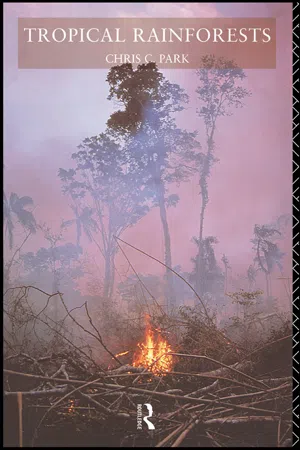 eBook - ePub
- Chris C. Park(Author)
- 2002(Publication Date)
- Routledge(Publisher)
Figure 1.1 ).Most of the tropical countries with surviving rainforests are developing countries, for whom the forests provide a valuable capital asset.The total area presently covered by Tropical Rainforests is estimated at 12 million km2 , which accounts for nearly a third of the world’s forests (covering roughly 30 million km2 ).5 The distribution of forests within the tropics is uneven, reflecting the distribution of land and sea and the impacts of this on climatic boundaries. The latitudinal boundaries of the rainforest are determined mainly by precipitation, while altitudinal limits are determined more by temperature. Some rainforests thrive beyond the 10° north and south latitudes, where high rainfall encourages forest growth. Such patches occur in Central America, the north-east coast of Australia and the great valleys of southern China.The main rainforests today are found in three areas (Figure 1.1 and Table 1.2 )—Latin America, Western Equatorial Africa and South-East Asia. Latin America houses the American Formation which is dominated by the Amazon and Orinoco Basins. It has over half (56 per cent) of the world total, much of it (3.31 million km2 , 48 per cent of the area’s total) in Brazil and the rest in Peru, Ecuador, Colombia, Venezuela and French Guiana. Amazonia is the world’s largest and most important surviving rainforest.6The remaining rainforests are scattered in sixteen countries in West and Central Africa (18 per cent of the world total) and South-East Asia (25 per cent of the world total). The African Formation includes the Cameroons and the Congo Basin in countries such as Gabon, Zaïre and Madagascar. The Indo-Malaysian Formation in South-East Asia includes parts of western and southern India, the Far East (especially in Indonesia—particularly Borneo and Papua New Guinea—which now has about 10 per cent of the world’s remaining Tropical Rainforest) and north Australia. eBook - ePub
- Stanley Rice(Author)
- 2020(Publication Date)
- Facts On File(Publisher)
tropical rain forests and deforestation
Tropical forests have no winter and receive abundant rainfall during at least part of the year. Tropical seasonal forests have a rainy season and a dry season, while tropical rain forests receive rain all year. In some rain forests, the rain comes predictably every afternoon. Tropical forests exist just north and south of the equator and are called tropical because they are found between the tropic of Cancer (23.5° N) and the tropic of Capricorn (23.5° S). Temperatures remain relatively constant, within the range of 68–77°F (20–25°C). Precipitation (all of it rain) exceeds 78 inches (200 cm) per year. Along with the lack of temperature variation, the tropical forests have relatively little wind. Tropical rain forests cover less than 5 percent of the land surface of the Earth but contain nearly half of its species and can therefore be considered the most important repositories of biodiversity in the world. However, only a few of the small biodiversity hotspots are tropical.These trees in the Olympic rain forest in Washington began their growth on a log that decomposed long ago. Source: Stanley A. Rice.Biodiversity in Tropical Forests
Tropical rain forest trees are evergreen. Up to half of the rain that falls comes from the transpiration of water vapor from the leaves of the trees themselves. Deforestation interrupts transpiration and allows water that would otherwise have transpired back up into the sky to flow out into the ocean instead. Extensive deforestation of rain forests may therefore produce a drier climate that will not support the regrowth of those forests, resulting in a destruction of the rain forest that is permanent over a time span meaningful to the human economy.Tropical rain forests have the greatest productivity of plant growth (in weight of plant material produced per area per year) as well as the highest biodiversity of species of any region of the Earth. A few acres or hectares of rain forest near Manaus, Peru, may contain as many tree and bird species as all of Europe. Each tree species may be separated from the nearest other member of its species by up to a mile (1.4 km). Borneo has 2,500 species of orchids, and it has at least 60 different tree species in an acre of forest. Among the reasons that rain forests have such prodigious species diversity are the following: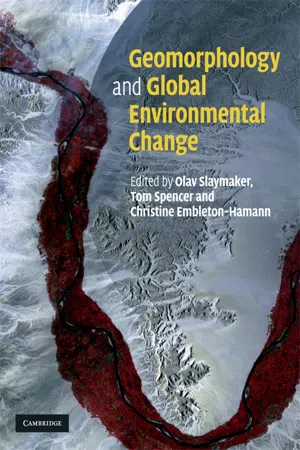
- Olav Slaymaker, Thomas Spencer, Christine Embleton-Hamann(Authors)
- 2012(Publication Date)
- Cambridge University Press(Publisher)
8 Tropical Rainforests Rory P. D. Walsh and Will H. Blake 8.1 The Tropical Rainforest ecological and morphoclimatic zone This chapter focusses on the likely geomorphological impacts of global warming on the zone with a hot – wet climate covered or formerly covered by Tropical Rainforest. De fi ned by Schimper ( 1903 , p. 260) as ‘ Evergreen, hygro-philous in character, at least 30 m high, but usually much taller, rich in thick-stemmed lianes and in woody as well as herbaceous epiphytes ’ , Tropical Rainforest represents the veg-etational climax of the ever-wet tropical zone (Richards, 1996 ). It is the biome renowned for its very high species diversity, high biological productivity, continuity of exis-tence extending back to the early Cretaceous (Morley, 2000 ) and its pivotal role (depending upon how much of it survives) in in fl uencing the future of the world climatic system. Climatic diversity within the zone, a history of climate change and the profound in fl uences which tectonic history and lithology exert within the region mean that old simplistic ideas about a humid tropical morphoclimatic region have been largely discounted (Thomas, 1994 ; 2006 ). This chapter, therefore, adopts a modi fi ed climatic geomorpholog-ical approach, which stresses: (a) the distinctiveness of some climate-linked features of the Tropical Rainforest zone; (b) the in fl uence of diversity in geomorphologically impor-tant climatic and bioclimatic variables within the zone; (c) the in fl uence of climate change and sequences of cli-mate at many different timescales; and (d) the acute sensitivity of many of its processes, landforms and landscapes to combinations of human activities and climate change. The importance of changes in extremes as well as means of climate is emphasised. eBook - PDF
Tropical Rain Forests
An Ecological and Biogeographical Comparison
- Richard T. Corlett, Richard B. Primack(Authors)
- 2011(Publication Date)
- Wiley-Blackwell(Publisher)
We can and do speculate, but identifying functional differences requires comparisons between sites that have been carefully matched for the major environmental factors. These comparisons have not yet been made. Identifying which of the numerous biological differences between regions are responsible for particular differences in function will require the experimental removal or addition of the organisms in question. In some cases, such experiments could be done quite easily (e.g. the exclusion of browsing herbivores from an area of rain forest), in others they have already been done by accident (e.g. the introduction of honeybees to tropical America), while many more would be too dangerous to carry out in practice and should remain forever as “thought experiments” (e.g. the introduction of leaf-cutter ants to the Old World). Many rain forests For the reasons outlined above, the tropical rain forests of each region have distinctive characteristics and elements that give each a quality all its own. These differences were first formally recognized by Wallace 140 years ago (Fig. 1.13). The Neotropical rain forest is the most extensive, most diverse, and in many ways the most distinctive. The richest Neotropical rain forest sites have more tree species (see Chapter 2), more bird species (see Chapter 5), more bat species (see Chapter 6), and more butterfly species (see Chapter 7) living together than rain forests elsewhere, and the same pattern is found in many, but not all, other groups of organisms. The effects of South America’s long isolation have not been erased by the influx from the north after the formation of the Panama land bridge, Chapter 1 30 and many characteristic groups of plants and mammals are found in no other rain forest region. The epiphytic plant family Bromeliaceae gives an unmistak-able appearance to the forest and their water tanks provide a unique canopy resource that is exploited by numerous species (see Chapter 2). eBook - ePub
Tropical Rain Forests
An Ecological and Biogeographical Comparison
- Richard T. Corlett, Richard B. Primack(Authors)
- 2011(Publication Date)
- Wiley-Blackwell(Publisher)
Deep, old, highly leached, and weathered soils are acid and infertile, with very low levels of plant-available phosphorus, calcium, potassium, and magnesium, and high levels of potentially toxic aluminum (Nortcliff 2010). Such soils are unsuitable for most forms of permanent agriculture, yet can support tall, dense, hyperdiverse rain forests. This apparent paradox reflects the ability of undisturbed rain forests on poor soils to recycle nutrients with very little loss. Most nutrients are withdrawn before leaves are dropped and the nutrients released in the litter layer are rapidly taken up by a dense mat of roots and their associated mycorrhizal fungi. If there is no unweathered parent material left within the root zone, the inevitable small losses of nutrients from the forest ecosystem must be replenished from the atmosphere, in dust and rain, and by biological nitrogen fixation.Tropical rain forests occur on a wide range of soil types, by no means all of which are unsuitable for permanent agriculture. Relatively fertile soils occur in a variety of situations, such as in the volcanic areas of Java and on the flood-plains of whitewater rivers in the Amazon region. Unsurprisingly, rain forests on these more fertile soils are particularly prone to clearance, while long-term protection is most likely for forests on the least fertile sites. Deforestation is thus concentrated in the areas that support the highest plant and animal biomass, so the impact on biodiversity and carbon storage is even greater than crude estimates of percentage area loss imply.Variations in soil texture, drainage, and chemistry affect the botanical composition of the rain forest, but only the most extreme soil types support distinctly different vegetation types. Most distinctive are the heath forests, which are also known by a variety of different local names, such as caatinga in Amazonia and kerangas eBook - PDF
Tropical Rain Forest Ecosystems
Biogeographical and Ecological Studies
- H. Lieth, M.J.A. Werger(Authors)
- 2012(Publication Date)
- Elsevier Science(Publisher)
Soil-moisture content in the tropical rain forest While the quantity and particularly the seasonal distribution of the precipitation are the determin-ing factors for the tropical rain forests, the soil moisture is of decisive importance for the forma-tion of the forest type. There is a number of locations with restricted, free or excessive drainage. Very often, the water storage capacity of the soil is of decisive importance for the forest vegetation, particularly in those cases when the potential evapotranspiration exceeds the amount of precipi-tation for a certain period of time, so that the water reserves stored in the soil need to be drawn upon and the plants may be temporarily subject to moisture stress. The soil moisture and its storage capacity are closely correlated with the soil texture. In the case of sandy to loamy humus podzols of medium depth under the heath forest in Sarawak, Bruenig (1969) found field capacities of less than 10 to 15% — which, moreover, were available for only three-fourths of the plants. During extremely dry periods, such as occurred in 1982 and 1983, large portions of the evergreen forest may die, since the critical point of water supply has been exceeded. The critical point will be reached when the capacity of the soil to provide water available for the plants is no longer sufficient to maintain the required transpiration of the forest. In other words, evapotranspiration and the water available for the plants often represent the limiting condi-tions for tropical rain forests. Climatic types of the rain forests according to the water budget In the following, an attempt is made to distinguish climatic types of the tropical rain forest on the basis of the annual cycle of the water budget. Rain forests can only exist if the water budget shows a suitable balance under given megathermal conditions. When optimally devel-oped, they can only bear a short-term water stress. eBook - PDF
- Patrick L. Osborne(Author)
- 2012(Publication Date)
- Cambridge University Press(Publisher)
However, Wright and Muller-Landau ( 2006 ) suggested that rates of deforestation may decline as rates of human population growth slow and as rural to urban migration (urbanisation) accelerates. These trends would result in lower biodiversity losses than other authors have predicted (e.g. Dirzo and Raven 2003 ). Laurance ( 2007 ), however, cautions that Wright and Muller-Landau ( 2006 ) may have underestimated potential losses to biodiversity through deforestation (see section 8.21 ) and stresses the importance of implementing a precautionary principle to conserve biodiversity. Through the movement of human populations from rural areas to cities in many tropical countries, the main drivers of deforestation have switched from slash-and-burn agriculture by rural farmers to large, commercial logging, agriculture and mining operations (Butler and Laurance 2008a ). This switch is being fuelled by the increasing demand for commodities produced in the tropics, and is challenging the efforts of individuals and organisations striving to conserve biodiversity. 8.20 Rain-forest conservation and restoration Tropical rain forest is the most biologically diverse terrestrial biome and therefore deserves special environmental attention. A consequence of this high diversity is that many species occur at very low densities. In some forests a few species are common and many are rare but, in others, no species stand out as more common than others. The low density of tree species and their high endemicity means that many species are threatened with extinction through deforestation. Many habitats in tropical rain forest occur in patches and these patches are not stable through time. This patchiness results from variations in soil type, topography, climate and from the degree and frequency of disturbance. Many species are highly localised in their distribution and occur in only one region. In part this is because many species are rare and do not spread very far.
- Pedro A. Sanchez(Author)
- 2019(Publication Date)
- Cambridge University Press(Publisher)
• Agricultural systems cover 52 percent of the land with 1.2 billion people. The fact that croplands hold 25 percent of the world’s tree cover indicates the importance of agroforestry. • Urban settlements from villages to cities cover 1 billion hectares or 7 percent of the land, hosting over 80 percent of the world’s population. We are facing a different world from just a few decades ago. Two key issues are biodiver- sity and climate change. Biodiversity • Biodiversity is now well recognized as a major global public good. About 80 percent of the world’s terrestrial species occur in the tropics, mostly in the humid tropics. Tropical Rainforests are the world’s most species-rich ter- restrial ecosystem, with 66 percent of the estimated 250 000 of the world’s plant species and 90 percent of the world’s insect species. The subhumid tropics probably come in as a distant second, with the East and southern African savannas having spectacularly large mammal and bird biodiversity. 1.10 SUMMARY AND CONCLUSIONS 31 • The number of vascular plant species ranges from 30 000 to 90 000 in humid tropical forests, while the subhumid savannas harbor less than 1000 vascular plant species. Other natural tropical ecosystems, such as deserts, mangroves and semiarid ones, have much less biodiversity than tropical forests and savannas. Plant species richness (the number of species/unit area) increases with annual rainfall, and also increases with decreasing latitude. Bio- diversity is drastically reduced when people transform these natural systems. It is now necessary to distinguish these fragmented forests that are extremely prone to deforestation from the “frontier forests,” those that are large, ecologically intact, relatively undisturbed and capable of supporting wide-ranging animal species, like the South American panther. Only about 37 percent of tropical forests may qualify as frontier forests.
- Bill Peel(Author)
- 2010(Publication Date)
- CSIRO PUBLISHING(Publisher)
pers. comm. ).Because of the very strong correlation between the physical and ecological factors that govern rainforest distribution, a systematic compilation of these factors creates a very powerful and reliable tool for predicting the distribution of rainforest. This is possible because of the sensitivity of rainforests to recurrent fire. In south-eastern Australia, any site where the elevation is less than 1200 m, soils (as apposed to rock outcrops only) are present, and rainfall exceeds 750 mm per annum (and, on average, no month has less than 50 mm of rainfall), then, in the absence of fire, rainforest would be likely to occur there. Conversely, within this broad climatic envelope, given the prevalence of fire in the Australian landscape, rainforest will be restricted to fire refuges in such areas. Therein lays the power of our Divination Tool.However, avoid the temptation of believing that rainforest once occurred everywhere across the landscape before 1750: it did not. This is especially important where there can be no black and white rule that ‘fire was or was not present’ in a particular locality. Such ambiguity exists on the broad floodplains of lowland rivers (and to a lesser degree in steep gully systems), where many rainforest stands may have a ‘temporal existence’. So, based on the chance event of one or more fires (or other disturbance), rainforests may be old, medium aged, young, recolonising or absent at any particular place in a suitable habitat ‘envelope’ at any particular time. In other words, to a long-term observer, rainforest would appear to move around the landscape wherever fire or other disturbance intervals were not optimal for the development and maintenance of mature rainforest stands.At such sites, rainforests probably did not occupy the entire habitat all of the time (unless there was exceptional Koori fire protection). This is why in pre-1750s modelling, rainforest stands on floodplains are not mapped as discrete islands in areas where fire had infrequent access, or was mediated by the frequency of other events such as flooding or a particular critical landform (a river’s course for instance). In these circumstances, rainforests are instead mapped as a mosaic (mixed in with other floodplain vegetation). One example of a mobile landform that causes rainforests to move around the landscape is the presence of the river’s course. This recognises the fire-protective role of a nearby permanent stream. When the stream changes course the rainforest will persist beside the billabong
Index pages curate the most relevant extracts from our library of academic textbooks. They’ve been created using an in-house natural language model (NLM), each adding context and meaning to key research topics.
