Geography

Dependency Ratio
The dependency ratio is a demographic measure that compares the size of the economically dependent population (children and elderly) to the working-age population. It provides insight into the potential burden on the working population to support dependents. A high dependency ratio can strain social welfare systems and economic productivity, while a low ratio may indicate a more favorable demographic structure.
Written by Perlego with AI-assistance
Related key terms
1 of 5
6 Key excerpts on "Dependency Ratio"
 No longer available |Learn more
- (Author)
- 2012(Publication Date)
- United Nations Publications(Publisher)
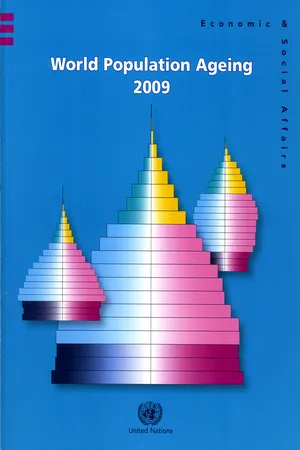
Seven of those countries are in Latin America and the Caribbean and another four are the Asian successor States of the former USSR. The countries or areas with the largest differences, amounting to 6 percentage points, are Australia and Puerto Rico. Rural areas usually have more children as well as older persons in relation to the working-age population Large numbers of children and older persons, supported by relatively few adults, imply high Dependency Ratios in rural areas, especially in developing countries. Figure 33 shows the child Dependency Ratio (the number of children under age 15 per one hundred persons aged 15 to 64) and the old-age Dependency Ratio (the number of persons aged 65 or over per one hundred persons aged 15 to 64) in the rural and urban areas of the major areas of the world. The total Dependency Ratio, that is, the sum of the child and the old-age Dependency Ratios, is higher in rural than in urban areas by at least 10 points in all major areas of the world with the exception of Northern America. In Africa and Latin America and the Caribbean, the rural Dependency Ratio is higher by over 20 points, due to a high child Dependency Ratio. The rural areas of Africa and Latin America and the Caribbean have the highest total Dependency Ratios, at 92 and 74 dependants per 100 adults of working age, respectively. Asia’s total urban Dependency Ratio is the lowest, at 43 dependants per 100 adults of working age, largely because of the low Dependency Ratio in China. The old-age Dependency Ratio is higher in rural than in urban areas in all major areas except Oceania. Thus, rural areas typically face the double demographic burden of having a higher child Dependency Ratio and a higher old-age Dependency Ratio than urban areas. Added to this demographic disadvantage is the limited access to basic social and health services in rural areas and higher poverty rates than in urban areas (Montgomery and others, 2003; United Nations, 2008b). eBook - PDF
- Yves Charbit(Author)
- 2022(Publication Date)
- Wiley-ISTE(Publisher)
We therefore need to calculate a Dependency Ratio that assesses the ratio between people who are financially self-sufficient and those who are not. This ratio is usually called a support ratio (see Cutler et al. 1990; United Nations 2013), and it focuses on the evolution of the ratio between workers and consumers. However, this ratio is defined in different ways. Some count each person in the 15–64 age range as one worker and each member of the population as one consumer (the demographic approach). The National Transfer Accounts (NTAs) use a more economic approach: the effective number of workers, the numerator, is a composite number that incorporates age variation in labor force participation, hours worked, unemployment and productivity or wages, while the effective number of consumers, the denominator, incorporates age-specific variation in consumption. 32 Demographic Dynamics and Development To assess the ratio between the people who benefit from a financial assistance and those who do not, we use the “socioeconomic Dependency Ratio” (SDR), which we define as the number of people who have a total consumption higher than their total income – and therefore need to be financially supported – divided by the number of people who have a total income – generated by an economic activity higher than their total consumption. In other words, the dependents under the SDR are all of the people who are not self-sufficient and need some financial assistance to cover their basic needs. No longer available |Learn more
Population and Strategies for National Sustainable Development
A guide to assist national policy makers in linking population and environment in strategies for development
- Gayl D Ness, Meghan V Golay(Authors)
- 2020(Publication Date)
- Routledge(Publisher)
The pyramid for Germany traces clearly the massive losses in two world wars. In the United Arab Emirates, 1985, we see reflections of the worker migration noted above, and we also can see a condition that is not uncommon in many urban areas of the developing regions: young males migrate in search of work, leaving women behind to tend the fields. The social condition may be as unstable as the figure appears.Population pyramids can be constructed for the nation as a whole, and for any smaller unit for which there is a reasonable count of the population by age and sex. As we show in the companion volume on local communities, they can be done easily with a portable computer for a small community as well, providing the participants of the assessment with one type of picture of their current and future conditions.Dependency Ratios
The age structure of a population makes considerable difference in what that population can do. Part of this is captured by what is called the total Dependency Ratio. This is the ratio of those in the ‘dependent’ ages (usually under 15 years and 60 or above)20 to those in the ‘active’ ages, 15–60. Table 2 provides data for four countries to show how the Dependency Ratio moves with changes in the age structure.For a society with high fertility and moderate or low mortality, the high proportion of young people in the population implies a high Dependency Ratio: many people in dependent ages to those in the active ages. This is often considered an obstacle to economic development. It implies, for example, that each person of working age must support a larger number of dependants. A low Dependency Ratio, on the other hand, means that each person of working age needs to support fewer dependants.Figure 11 Age/sex compositions of populationsA high Dependency Ratio in a poor country often produces something similar to what has been called the low income trap. If a country has a large proportion of the population in the young age groups, it will have a higher cost for education. If it is poor and cannot bear that cost, many of those children will not receive an education, and will remain less productive, thus helping to keep the country poor. A wealthy country, with a low Dependency Ratio, on the other hand, has more resources to spend on education, and a smaller population to educate. Thus it can provide higher levels of education to its population, which will increase the productivity and allow the society to increase its wealth. eBook - PDF
World Population Prospects 2017
Demographic Profiles
- (Author)
- 2021(Publication Date)
- United Nations(Publisher)
They are presented as number of dependants per 100 persons of working age (15-64). b The child Dependency Ratio is the ratio of the population aged 0-14 to the population aged 15-64. They are presented as number of dependants per 100 persons of working age (15-64). c The old-age Dependency Ratio is the ratio of the population aged 65 years or over to the population aged 15-64. They are presented as number of dependants per 100 persons of working age (15-64). d The population doubling time corresponds to the number of years required for the total population to double in size if the annual rate of population change would remain constant. Doubling time is computed only for fast growing populations with growth rates exceeding 0.5 per cent. e Adult mortality is expressed as deaths under age 60 per 1,000 alive at age 15 and represents the probability of dying between age 15 and age 60 (45q15). f The net reproduction rate is expressed as number of daughters per woman and represents the average number of daughters a hypothetical cohort of women would have at the end of their reproductive period if they were subject during their whole lives to the fertility rates and the mortality rates of a given period. United Nations Department of Economic and Social Affairs/Population Division 328 World Population Prospects: The 2017 Revision, Volume II: Demographic Profiles Germany Total population: Estimated to be consistent with official population estimates through 2015, and with estimates of the subsequent trends in fertility, mortality and international migration. Total fertility: Based on official estimates of total fertility through 2015. Infant and child mortality: Based on births and infant deaths registered through 2015. Life expectancy at birth: Based on official estimates of life expectancy available through 2015. eBook - ePub
- (Author)
- 2014(Publication Date)
- Asian Development Bank(Publisher)
Population living in urban areas, defined in accordance with the national definition or as used in the most recent population census. Because of national differences in the characteristics that distinguish urban from rural areas, the distinction between urban and rural populations is not amenable to a single definition that would be applicable to all countries. National definitions are most commonly based on size of locality. Population that is not urban is considered rural.Urban population (as % of total population) The estimated population living in urban areas at midyear as a percentage of the total midyear population in a country. Age Dependency RatioRatio of the nonworking-age population to the working-age population. Since countries define working age differently, a straightforward application of the definition will lead to noncomparable data. ADB therefore uses the following UN definition that can be computed directly from an age distribution:Labor Force and Employment Labor Force Participation RatePercentage of the labor force to the working-age population. The labor force is the sum of those in employment and those unemployed but looking for it. The labor force participation rate measures the extent an economy’s working-age population is economically active. It provides an indication of the relative size of the supply of labor available for the production of goods and services in the economy. It must be noted that definition of working-age population varies across countries.Unemployment RatePercentage of unemployed to the labor force. Unemployed are persons without work but available and actively seeking it. This is probably the best known labor market measure. Together with the employment rate, it provides the broadest indicator of the status of the country’s labor market. It must be noted that definition of unemployed varies across countries for some of them do not consider availability to work as part of the definition. eBook - ePub
- Steven Langdon, Archibald R.M. Ritter, Yiagadeesen Samy(Authors)
- 2018(Publication Date)
- Routledge(Publisher)
This increase in the relative magnitude of the labor force or the decline of Dependency Ratio then may promote more rapid economic growth and development. This has clearly been the case of China and Mauritius with 72.1 percent and 70.1 percent of the labor force respectively. The Dependency Ratio then begins to rise for countries when the working age demographic “bulge” begins to enter old age and increase the “seniors” cohorts. In Kenya’s case, and for most countries of Africa, when fertility and birth rates decline and when the children’s age cohorts begin to shrink, the proportion of the population of working age will increase as well, as illustrated in Figure 5.6. By 2050 for Kenya, the cohorts for children will have fallen from 42.4 percent of total population in 2000 to 23.2 percent by 2050 and those for senior citizens will rise from 2.6 percent to 8.6 percent, partly negating the impact of the declining children’s cohort. But the working age cohorts will increase from 54.9 percent of the total population in 2000 to 67.6 percent in 2050, as illustrated by the “bulge” in the middle of Kenya’s population pyramid for 2050 (all data, past and forecasxt, from the U.S. Bureau of Census). Will these workers be productively absorbed into the economy, so that the working age demographicc “bulge” results in accelerated development and the “demographic dividend” can be harnessed effectively for the countries of Africa? If so, then there will be a positive impulse for development, a true “demographic bonus.” If not, then growing ranks of the unemployed, especially unemployed youth, will generate economic miseries and potential social tensions. Whether effective use of this prospective “demographic dividend” can be achieved will depend ultimately on the wisdom of economic and social policy
Index pages curate the most relevant extracts from our library of academic textbooks. They’ve been created using an in-house natural language model (NLM), each adding context and meaning to key research topics.

