Geography

Energy Pathways
Energy pathways refer to the routes through which energy is transferred and distributed. In the context of geography, this can include the transportation of energy resources such as oil, natural gas, and electricity from production sites to consumption areas. Understanding energy pathways is crucial for analyzing the geographical distribution of energy resources and the impacts of energy transportation on the environment and society.
Written by Perlego with AI-assistance
Related key terms
1 of 5


3 Key excerpts on "Energy Pathways"
 eBook - ePub
Conceptualizing Germany’s Energy Transition
Institutions, Materiality, Power, Space
- Ludger Gailing, Timothy Moss, Ludger Gailing, Timothy Moss(Authors)
- 2016(Publication Date)
- Palgrave Pivot(Publisher)
2012 ). Overall, the value of energy geography lies in the insights it provides into the social production of space via energy transitions, including impacts of uneven spatial development and the scalar relations and socio-spatial materiality of energy.6.3.2 Political Science
In political science, a discussion on urban energy and climate governance began over a decade ago. Although much of the literature is descriptive and policy-oriented, it makes a number of important contributions to the wider academic discussion on energy transitions. New forms of governance (Bulkeley and Kern 2006 ; Betsill and Bulkeley 2007 ), such as ‘governance by experiment’ (Bulkeley and Castán Broto 2013 ; Bulkeley et al. 2014a ), are addressed, as is the interplay of urban, national and international scales of energy and climate politics (Kern and Aber 2008 ). Further studies have provided knowledge on the institutionalization and outputs of energy governance (Monstadt 2007 ). Numerous case studies on the transformation of urban governance via climate protection and energy efficiency initiatives generate insights on the highly varied local and regional contexts of energy transitions (Emelianoff 2014 ). In addition, work on city regions and urban networks (Lee and van de Meene 2012 ) explores the spatial scope of energy transitions beyond the individual city. Finally, critical reflection on catchy keywords such as ‘smart’, ‘resilient’ or ‘low carbon ’ cities is enriching the debate on urban energy transitions in terms of its goals, discourses and representations, particularly given the very different theoretical perspectives employed, such as multi-level governance (Kern and Bulkeley 2009 ) and governmentality (Rutland and Aylett 2008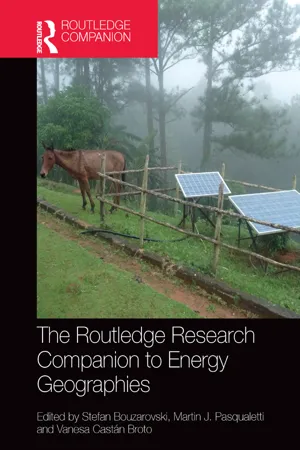
- Stefan Bouzarovski, Martin J Pasqualetti, Vanesa Castán Broto(Authors)
- 2017(Publication Date)
- Routledge(Publisher)
The changing role of energy in society is shaped by complex interactions between social and technological innovations. Through these interactions, physical entities that have certain energetic become energy resources, and the material nature of those resources play an active, if unintentional, role in shaping human-environment encounters and social relations (see Bakker and Bridge, 2006). Mitchell (2011), for example, suggests that modern democracy was both enabled and disabled by the particular biophysical characteristics of different energy regimes that have developed over the last 200 years. On the one hand, he argues that the biophysical characteristics of the coal regime (e.g. mined, transported by rail and ships, lots of workers needed, etc.) helped to create the conditions for development of large labour movements who could block key transit points until their demands were met (e.g. wages, work conditions, suffrage, etc.). On the other side, Mitchell claims that these labour pressures facilitated governments, especially in the US, to envision and implement a future based on oil resources, which have very different biophysical features that limit the ability of labor to choke supply (e.g. extracted from wells, transported mostly by underground pipeline, fewer workers, etc.). In other words, energy transitions are best understood as a dynamic interplay between social institutions, technologies/infrastructures, and the form and spatial distribution of the resource base (see also Jiusto, 2009; Birch and Calvert, 2015).Geographers have increasingly weighed in on the discussion of energy transitions, in order to better understand how energy transitions vary across space, (re)connect places, and are implicated in our relationship with our surroundings (Bridge et al., 2013). One prevalent contribution has been to ‘energize’ the concept of landscape — defined simply as a geographic area perceived by people (see Howard, 2011 for elaboration) — as in the concept of ‘energy landscape’. The concept of energy landscape attends to the role of energy production, distribution, and use in shaping landscape form and livelihood arrangements (material spatial expressions of energy regimes) as well as how energy is implicated in representations of, and emotional connections to, landscape form and livelihood arrangements (immaterial spatial expressions of energy regimes) (Pasqualetti et al., 2002; Pasqualetti, 2011; Nadaï and van der Horst, 2010). According to Pasqualetti (2013), energy landscapes can be understood in terms of the energy system constructs (i.e., resource types; infrastructures that access, process, and use resources; geophysical context; and socio-political institutions) that become layered as direct or indirect landscape impacts (e.g., transmission wires; hydroelectric reservoir; a remediation site). In this way, the material nature of the resource base is considered in combination with social, institutional, and geographical structures and processes when trying to understand the role of energy in changing sociospatial and society–environment relationships.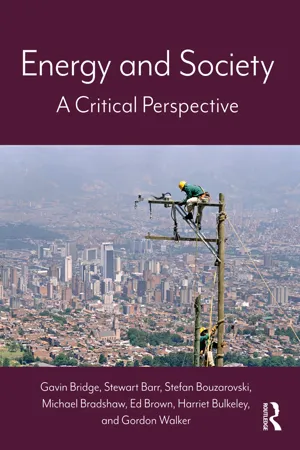 eBook - ePub
Energy and Society
A Critical Perspective
- Gavin Bridge, Stewart Barr, Stefan Bouzarovski, Michael Bradshaw, Ed Brown, Harriet Bulkeley, Gordon Walker(Authors)
- 2018(Publication Date)
- Routledge(Publisher)
Chapter 3 ) focuses on the networks that circulate, store and transform energy at a range of scales, from localised off-grid solutions to expansive transnational systems. It explores how energy infrastructure has become embedded in material and social life in different ways; and how moments of infrastructural breakdown (pipeline ruptures, electricity blackouts) reveal their underlying spatialities and vulnerabilities. The chapter considers the qualities of permanence, obduracy, modular growth, and invisibility that characterise these networks, and shows how they co-evolve with economic, political and technological change. The chapter highlights how, in the context of climate change, energy’s infrastructure landscapes both sustain and lock in high energy ways of living, as well as offering possibilities of change towards a low carbon future.Geopolitical landscapes (Chapter 4 ) focuses on how energy production, distribution and consumption shape international relations, and are embedded in the geopolitics of inter- and intra-state competition, co-operation and conflict. It considers the ways in which energy has been integral to the making of political projects in the broadest sense, including the creation of the nation state and the making of the modern citizen. It examines how the geopolitics of the contemporary carbon-intensive energy system are increasingly connected to the responses of states and cities to climate change, and the process of economic globalisation. The chapter reflects on emerging geopolitical relations around low-carbon energy, and how these are shaped by the different geographies, temporalities and scalability of low-carbon energy capture and generation technologies.Note
1 Energy consumption features extensively within Part 2 (particularly Chapters 5 and 6 ), and elements of it appear in Chapters 2, 3 and 4 .References
Bridge, G., S. Bouzarovski, M. Bradshaw and N. Eyre. 2013. Geographies of energy transition: space, place and the low-carbon economy. Energy Policy 53: 331–340.Castán Broto, V., D. Salazar and K. Adams. 2014. Communities and urban energy landscapes in Maputo, Mozambique. People, Place & Policy 8(3): 192–207.Frantál, B., M.J. Pasqualetti and D. van Der Horst. 2014. New trends and challenges for energy geographies: introduction to the Special Issue. Moravian Geographical Reports 22(2): 2–6.Haarstad, H. and T. Wanvik. 2016. Carbonscapes and beyond: conceptualizing the instability of oil landscapes. Progress in Human Geography
Index pages curate the most relevant extracts from our library of academic textbooks. They’ve been created using an in-house natural language model (NLM), each adding context and meaning to key research topics.
