Geography

Human Rights Intervention
Human rights intervention refers to the actions taken by states or international organizations to protect human rights in other countries. These interventions can take various forms, including diplomatic pressure, economic sanctions, or military intervention. The goal of human rights intervention is to promote and protect human rights around the world.
Written by Perlego with AI-assistance
Related key terms
1 of 5

3 Key excerpts on "Human Rights Intervention"
 eBook - PDF
- Susan J Smith, Rachel Pain, Sallie A Marston, John Paul Jones III, Susan J Smith, Rachel Pain, Sallie A Marston, John Paul Jones III(Authors)
- 2009(Publication Date)
- SAGE Publications Ltd(Publisher)
Human rights abuses occur every-where. Although differing patterns have been identified, it is also clear that all types of bodies are subjected to abuses. It is a popular assertion that the present era is among the most violent, qualitatively and quantitatively, in recorded human history. That seems a dif-ficult, and perhaps specious, case to prove. The shifting notion of what constitutes a ‘human right’ and therefore what constitutes a ‘human rights violation’ makes it difficult to assess whether the contemporary period has seen an escalation of such violence. Regardless of whether the present era is exceptionally violent (in relation to human history), what is most relevant is the need to A SOCIAL GEOGRAPHY OF HUMAN RIGHTS 489 unpack and interrogate the social perceptions of what counts as a human right (and there-fore what counts as a human rights violation) and how these perceptions influence human security and well-being. This chapter seeks to critically examine the idea of human rights, as well as its dialec-tical relationship to geography. By analyzing human rights as an idea situated in particular spaces at particular times, this essay uses social geography to illuminate the uneven development of human rights. A social geog-raphy of human rights reveals what counts as a human right, and a human rights violation across space, rather than reifying the already-existing, taken-for-granted, assumptions of what human rights ‘are’. Rethinking the idea of human rights as situated in particular times/places helps illuminate the power-rela-tions wrapped up in the concept of human rights; the failure to recognize human rights as situated and contingent disguises the intense power-relations that determine what counts as a human right and who makes that designation. Central to the analysis is the dialectical relationship between geographies and human rights. In this approach, geogra-phy is more than just a ‘backdrop’ to events of human society.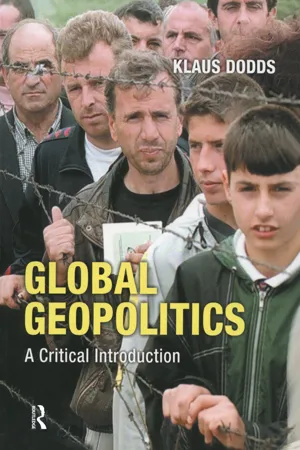 eBook - ePub
Global Geopolitics
A Critical Introduction
- Klaus J. Dodds(Author)
- 2014(Publication Date)
- Routledge(Publisher)
This chapter concentrates on the position of human rights within the global political agendas of the post-Cold War era due to the growing international profile of human rights and the increasing demands of humanitarian assistance. The first part of this investigation will consider some of the serious political problems relating to the conceptualization and defence of human rights in the absence of universal consensus on the meaning of human rights. The meanings attached to human rights are contested. For post-colonial critics, human rights are considered to be part and parcel of a Western doctrine of rights which is insufficiently sympathetic to the diverse cultures and communities of the world. From that vantage point, human rights can only be culturally specific rather than universally applied.The second part of this chapter considers humanitarian intervention in world politics and questions whether any intervention can be justified on the basis of human rights (see Vincent 1974). Should poverty and underdevelopment be grounds for non-violent interventions of the kind that some countries and observers demanded for places suffering from genocide, ethnic cleansing and famine? It could be argued that the humanitarian needs of many citizens have been seriously neglected, considering that around 2 million children have been killed since 2000 and that over 2 billion people lack clean and regular drinking water.The chapter concludes with the problem of how to incorporate these issues into political agendas dominated by states, international organizations and national interests. Human rights and the practices surrounding humanitarian intervention demonstrate that our understandings of global politics need to be broadened.Conceptualizing human rights: the problem of definition and implementationHuman rights have long occupied a place in Western political thought, from the thirteenth-century British document the Magna Carta to the eighteenth-century Bill of Rights in the USA. This sustained interest in rights, responsibilities and natural law encouraged humanitarian organizations such as the Anti-Slavery Society in the nineteenth century to extend Western conceptions of human rights to non-European peoples. While the spread of humanitarianism is frequently described as a Western phenomenon, it is nonetheless important to recognize that non-Western societies and faiths have demonstrated considerable compassion and responsibility towards the vulnerable, weak and endangered. For the purpose of this chapter, however, attention will concentrate on international law and practice which has evolved since 1945. eBook - PDF
The Political Economy of Human Rights Enforcement
Moral and Intellectual Leadership in the Context of Global Hegemony
- I. Manokha(Author)
- 2008(Publication Date)
- Palgrave Macmillan(Publisher)
1. Humanitarian intervention The literature on humanitarian intervention can be broken down into four categories: 1. Strategies and techniques, which brings together analyses which focus on techniques and strategies of intervention, and ways of improving them; 2. National interests, which groups texts adopting a Realist-type view on the subject; 3. Sovereignty and law, which assembles arguments concerning the legality of human-rights enforcement and its compatibility with existing norms of the international order; and The Existing Analyses of Human Rights Enforcement 27 4. Radical critiques, which contains works of all those who seek to show how human-rights enforcement is related to the ‘imperialism’ of the West in general, and of the US in particular. Strategies and techniques This section groups together policy-oriented and prescriptive writings aimed at developing or improving the strategies and methods of humanitarian intervention. Such studies do not analyse the practice of humanitarian intervention as such, that is, they do not discuss its origins, historical development and relationships with other practices, institutions and social relations, but focus exclusively on its technical/ instrumental side. For example, Weiss (1994; 1996; 1998; 1999), who has written extensively on humanitarian intervention, has attempted to contribute to an improvement in techniques of enforcement. To sum up his arguments, today the international community has recognized that ‘to halt abuses of human rights is absolutely essential’ and that ‘humanitar- ian intervention becomes a reality’ (Weiss, 1994, pp. 59, 62), but short- comings or outright failures in Bosnia, Croatia, Somalia, Haiti and Rwanda demonstrate that ‘much remains to be done’ (Weiss, 1998, p. 25).
Index pages curate the most relevant extracts from our library of academic textbooks. They’ve been created using an in-house natural language model (NLM), each adding context and meaning to key research topics.

