Politics & International Relations

Western Intervention
Western intervention refers to the involvement of Western countries, particularly the United States and European nations, in the affairs of other countries. This involvement can take various forms, including military intervention, economic aid, or diplomatic efforts. Western intervention has been a subject of debate, with proponents arguing for humanitarian assistance and stability, while critics raise concerns about imperialism and neocolonialism.
Written by Perlego with AI-assistance
Related key terms
1 of 5


11 Key excerpts on "Western Intervention"
 eBook - PDF
- A. Hurrelmann, S. Leibfried, K. Martens, P. Mayer, A. Hurrelmann, S. Leibfried, K. Martens, P. Mayer(Authors)
- 2007(Publication Date)
- Palgrave Macmillan(Publisher)
Internationalization of intervention politics Although military interventions are by no means a novel phenomenon, their scope, aims and strategies as well as the number of actors involved have changed profoundly since the early 1990s (Czempiel 1994; Crocker 2001). 44 Transforming the Golden-Age Nation State Traditionally, states, by and large, had undertaken interventions to pre- serve their vital interests, to widen their national spheres of influence and to expand their territory. While material or geo-strategic conside- rations still play a role, Western interveners nowadays in addition perceive their non-military security to be threatened by external conflicts, and they respond to morally motivated demands to prevent human suffering abroad. Geographical distance no longer provides adequate protection against new threats emerging from transnational terrorism, collapsed states, or organized crime (Zangl and Zürn 2003). Intensified by the 9/11 terrorist attacks, a stated objective of Western security politics lies in the strengthening of democratic state structures, the pacification of global trouble spots and if necessary, the (re)construction of fragile, conflict- torn states. To cope with the multidimensional challenges of such ambitious peacebuilding objectives, the toolbox interveners draw on exceeds military means and requires cooperation with a multitude of actors. Strikingly, interventions have been increasingly conducted within the framework of international organizations. While there is surely no com- prehensive trend towards a supranationalization of security politics that would lead towards the establishment of a world monopoly of force (Senghaas 2007), we find indications of an increase in responsibilities at the international level. eBook - ePub
Destabilising Interventions in Somalia
Sovereignty Transformations and Subversions
- Debora Valentina Malito(Author)
- 2019(Publication Date)
- Routledge(Publisher)
911). Economic, military and political external interventions in domestic politics are conventionally understood as pervasive and intrusive ways of regulating conflicts and cohabitation among unequal members of the International Community. There is a problem and ambiguity in the vocabulary employed in this study that needs a conceptual caveat. ‘International Community’ and ‘international intervention’ presuppose the existence of a post-national community that is founded on a common ethos and identity, where such an idea of commonality is the result of hegemonic elaborations on the moral superiority of capitalism, Western liberal democracy and human rights regimes. As they advance an idealised vision of a ‘common humanity’ (Newman, 2016, p. 32) that departs from and generalises ‘Western experience’ and ontological categories about political agency (Grovogui, 2005), they remain problematic. Cosmopolitan assumptions at the root of this elaboration see the construction of a global moral order as a viable solution to particularistic (national and geopolitical) interests, and to hegemonic and power competitions. Based on the assumption that the progress of a global moral order is universal and universally acceptable as it goes hand in hand with a decrease in competition and power inequalities, the construction of this moral order chimes with the fact that a globalised market economy does not necessarily reduce power contentions. The transcendence of nation states does not necessarily mean the transcendence of group and elite interests (Cox, 1997), and their role in shaping the global political architecture and economy. As power emerges and evolves alongside competition laws, the expansion of the global market or its institution will not reduce power competition (Palermo, 2016) but rather foment it eBook - ePub
- Felix Berenskoetter, Felix Berenskoetter, Author, Felix Berenskötter, Felix Berenskotter(Authors)
- 2016(Publication Date)
- SAGE Publications Ltd(Publisher)
16 InterventionDavid ChandlerThis chapter seeks to analyse fundamental shifts in the concept of intervention since the end of the Cold War by tracing the political and ideational context through which the normative perception, function and performance of intervention has been transformed. It does this with the view, highlighted in the introductory chapter to this volume, that concept analysis is not so much concerned with changes in formal definitions as with the semantic fields within which a concept operates. Indeed, concepts can maintain their broad definitional “meaning” while being understood very differently in different socio-historical contexts. Complementing broader historical overviews, such as that by Reus-Smit (2013), this chapter shines light on shifts in Western understandings of the concept of intervention since the end of the Cold War in relation to both traditional disciplinary understandings of sovereignty in IR and to Western, liberal or modernist forms of knowledge. It thus adopts elements from both the historical and the political (critical) approach, highlighting changes in meaning over time and how these changes are embedded in Western foreign policies seeking to order the world, including understandings of conflict and effective forms of governance.In international law, intervention is a legal term for the use of force by one country in the internal or external affairs of another. In most cases, intervention is considered to be an unlawful act but some interventions may be considered lawful, as acts of self-defence or when supported by the UN Security Council to uphold international security. This chapter is not concerned with the legal debates surrounding this issue, not least because it holds that the traditional focus on military intervention must be complemented by an understanding of intervention through practices falling under the broad label of development. At a deeper level, this chapter shows how debates over international intervention have seen a shift from political concerns of sovereign rights under international law to concerns of knowledge claims of cause and effect highlighted through the problematisation of interventions’ unintended consequences. This can be illustrated by contrasting the difference between the confidence – today, critics would say “hubris” (Mayall and Soares de Oliviera, 2011) – of 1990s’ understandings of the transformative nature of external intervention and current, much more pessimistic, approaches. eBook - ePub
Terror, Insecurity and Liberty
Illiberal Practices of Liberal Regimes after 9/11
- Didier Bigo, Anastassia Tsoukala, Didier Bigo, Anastassia Tsoukala(Authors)
- 2008(Publication Date)
- Routledge(Publisher)
6 Military interventions and the concept of the politicalBringing the political back into the interactions between external forces and local societies
Christian Olsson
The ‘global war against terrorism’ is the overarching rationale, if not the main motivation, of two major, international, but US-led, military interventions in Afghanistan since 2001, and in Iraq since 2003. These anti-terrorist interventions, although they both have been justified discursively or legally by ‘exceptional circumstances’, have in many ways challenged and changed our common understanding of the place of interventionist behaviour in international politics. But what is less frequently underscored, is that these interventions have seen major developments in military practices on the ground. The shift from ‘wars between states’ to ‘wars within states’ has highlighted the importance of the relation between intervening forces and local populations: the relational dimension of the political seems to prevail over the purely strategic relation of interstate war. One could have asked whether we are talking about wars at all (in the historical sense of the term), if it were not for the justification of these interventions by a ‘global war’, the long-term implications of which are still difficult to assess. Therefore any political analysis of these interventions would have to start with the concept of war. There are two ways of grasping the relation between the political and war.The first consists of analysing the political through the specific field of practices called politics.1 In this case, the central problem is to identify which one of the two fields of practices, politics or war, can be inferred from the other. Several classical insights can be mentioned here. In the Clausewitzian perspective, war as a practical reality – as opposed to war as a theoretical category – ought to be considered as ‘the continuation of politics by other means’. According to this insight, the political dimension of war is to be found in the political ends of which war is a means. In other words, the political refers to the ends, other than the military ends themselves of course that are pursued by war.2 Hence, in interstate wars, which are the ones that interest Clausewitz, the political refers to the state, or rather to the will and the practices of the professionals of politics, who speak and act in the name of the state. Michel Foucault has formulated a more provocative perspective in his analyses of the political theory of Hobbes. He simply reverses the first adage.3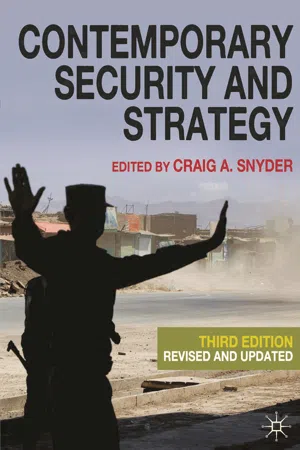 eBook - PDF
- Craig A. Snyder(Author)
- 2011(Publication Date)
- Red Globe Press(Publisher)
In this chapter I will: define military interventions, describe the types of military inter-ventions, overview the debate on when an intervention is appropriate, outline the requirements for a successful intervention and finally, comment on the future of military interventions. Definition of intervention By intervention I am referring to action by one state or group of states against another state or group of states designed to halt or change a course of action or policy deemed undesirable by the intervening state or group of states. Such interventions feature regularly throughout the history of humankind and seem to be a permanent feature of the anar-chic international system where states continually vie with each other to gain an advantage in their security – that is, a combination of favourable economic circumstances and freedom from military based threats including those posed by other states and non-state actors such as terrorist groups. Interventions can be roughly divided into those that are essentially military in nature, which in turn can involve the direct or indirect use of force; and those that are non-military, that is, primarily political, diplomatic or economic in nature. Non-military economic interven-tions include can be inducements, such as one state or group of states offering another state access to markets, on favourable terms, in return for a change in its behaviour and so forth. They can be punitive trade sanctions designed to affect adversely that state’s economy. In addition, they can involve so-called smart sanctions designed to impact on the 266 Michael Arnold ruling elite such as freezing of personal financial assets and barring international travel. Diplomatic efforts usually precede other forms of intervention and are akin to lobbying or pressuring of a target state’s key constituents (that is, its ruling elite, business elite, or even the civilian population).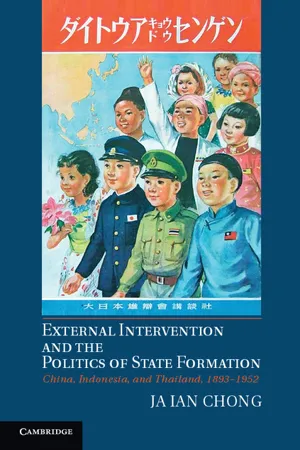 eBook - PDF
External Intervention and the Politics of State Formation
China, Indonesia, and Thailand, 1893–1952
- Ja Ian Chong(Author)
- 2012(Publication Date)
- Cambridge University Press(Publisher)
Based on dissimilar expectations about the net gains of investing in access denial over a state relative to an alternative goal, foreign powers may intervene in the state to subjugate, fragment, destabilise, or even bolster governance, rule, and political authority. My study highlights how intervention can go beyond the conquest, mediation, reconstruction, or extension of loans often associated with outside involvement in domestic politics. 6 Apart from adding a consideration of outside intervention to the literature on state formation, this book speaks to a wider discussion on the potential for change in the units that constitute the international system. My second image- reversed perspective extends the claim that membership in the international system rests on external, great power recognition. Specifically, it highlights the influence of major powers on the nature of governance and political authority in a weak polity, especially as they respond to shifting systemic pressures. 7 Accounting for external intervention may also present a way to understand the effects of anticolonial and self-determinationist norms on the propagation of sovereign statehood around the mid twentieth century. 8 After all, these norms predated World War II. The majority of anticolonial and self-determination 6 See Centeno, 1997, 2002; Centeno and López-Alves, 2001; Herbst, 2000; Hui, 2004, 185–94, 2005, 50–108; Taylor and Botea, 2008. 7 For examples of work on the roles of external powers on international system membership, see Coggins, 2006; Fazal, 2004, 2007. 8 For a discussion on the roles that anticolonial and self-determination norms played in promoting sovereign statehood after World War II, see Fazal, 2004, 2007. 230 External Intervention and the Politics of State Formation movements also did not attain their avowed goals of independence during World War II, when major colonial powers faced significant economic, political, and strategic stress. eBook - PDF
Human Rights and Humanitarian Intervention
Legitimizing the Use of Force since the 1970s
- Norbert Frei, Daniel Stahl, Annette Weinke, Norbert Frei, Daniel Stahl, Annette Weinke(Authors)
- 2017(Publication Date)
- Wallstein Verlag(Publisher)
22 By the late 1980 s, Western human rights policy had begun to make headway in its efforts to promote and protect democratic transformation. This moment would remain the highpoint of its transformative potential. Building a New World Order in the Name of Humanitarian Protection: The Interventions of the 1990s Viewed within its historical context, the practice of humanitarian inter-vention is emblematic of some of the key changes in Western foreign policy after the end of the Cold War. First, the use of military resources to protect civilians from state persecution or prevent the collapse of state structures represented a shift in Western strategies of intervention. How-ever, this shift had more to do with larger changes in the international political arena than with an increasingly bellicose spirit – indeed, these missions were often the subject of intense domestic controversy and de-bate. On the most basic level, it was the uncontested geopolitical power of the United States that made the new kind of »just wars« possible. While many other countries did lend at least some support, the political initia-tive almost invariably came from the U.S., and the U.S. nearly always played the dominant military role. Once the American government had decided to launch a military response, any objections from other coun-tries were swiftly dispensed with. In 1999 , for example, the UN Security Council withheld authorization for a military action on behalf of Kosovo, but the U.S. proceeded with its military operation anyway – a decision that sparked major controversy. Four years later, a resolution on Iraq was 22 On Chile, see Eckel, Ambivalenz , 677 -692 ; on the Soviet Union, see Snyder, Activism ; Peterson, Globalizing ; Saal, »Folgen.«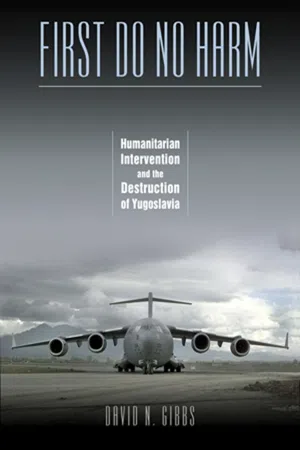 eBook - PDF
First Do No Harm
Humanitarian Intervention and the Destruction of Yugoslavia
- David N. Gibbs, David Gibbs(Authors)
- 2009(Publication Date)
- Vanderbilt University Press(Publisher)
And in key instances, the United States and to some extent Europe were willing to use air strikes as an additional means of advancing their interests. If we define intervention broadly, as the deliberate manipulation of the internal politics of one state by another state, then external intervention in the Yu-goslav case was extensive, and it commenced early in the conflict. Previous analyses not only understate the extent of Western Intervention but also fail to recognize the self-interested character of this intervention. From a humanitarian standpoint, external involvement in Yugoslavia had negative and even disastrous consequences. Indeed, Western Intervention was a major factor in triggering the country’s breakup in the first place and thus set the stage for war. Successive waves of intervention that followed the initial breakup helped spread the fighting and augment the level of suffer-ing. Intervention in the Balkan crisis did not help alleviate the humanitarian emergency. Some will be surprised by my contentions, since they go against a widely accepted consensus about what happened in Yugoslavia. Serious readers will of course insist on substantiation for my claims, based on reasonable sources. I present such substantiation in subsequent chapters. For now, I simply re-mind readers that our understanding of many past conflicts has been revised 14 First Do No Harm based on new source materials, as well as on new interpretations of these materials. Historical interpretation is always evolving, and many previous consensus viewpoints have been reconsidered or debunked altogether. There are many examples: The traditional view of the Korean War as a clear-cut case of communist aggression is now considered overly simplistic, given new evidence regarding the origins of that conflict presented by Bruce Cumings and other scholars.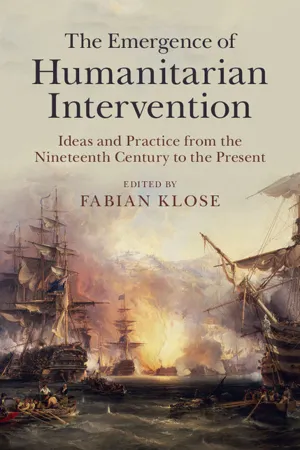 eBook - PDF
The Emergence of Humanitarian Intervention
Ideas and Practice from the Nineteenth Century to the Present
- Fabian Klose(Author)
- 2015(Publication Date)
- Cambridge University Press(Publisher)
66 In addition, the inter- ventions generated a huge debate on the ‘Westphalian Model’ of state sovereignty, which concluded that the current model and the historical reality were two quite different things. 67 Everyone was preoccupied by what appeared to be a new condition of international relations after the Cold War and decided that new conditions needed a new theory and a new practice. This new theory and this new practice were captured by the label ‘humanitarian intervention’. The label was hotly contested. ‘Saying “humanitarian intervention” . . . is a little bit like crying “fire” in a crowded theater: it can create a clear and present danger to everyone within earshot.’ 68 The debate was about the future of international rela- tions, not about the past. The ahistoricity of this 1990s debate did not sit well with historians. They quickly discovered that there was a history of humanitarian inter- ventions after all. They expressed their amazement that anyone could possibly have overlooked the rich history of humanitarian intervention in the first place. 69 In the past few years, a rapidly growing wave of articles, books, and conferences has come to see humanitarian interven- tion as a long-standing practice of international relations. It is typical for this kind of historiography to push the origins ever further back in time. If initially the nineteenth century was seen as the point of departure, simply because this is when the term ‘humanitarian intervention’ was used for the first time, the temporal boundaries have since been pushed back into the sixteenth century. No doubt, they can be pushed even further back, much as they can be pushed across space into non-Western cultures and civil- izations. For at bottom, intervention on behalf of the weak, the oppressed, or the suffering is, as Aristotle would have put it, a virtue of humanity. However, the historical argument we are concerned with here is rather more pointed. eBook - PDF
Waging Humanitarian War
The Ethics, Law, and Politics of Humanitarian Intervention
- Eric A. Heinze(Author)
- 2009(Publication Date)
- SUNY Press(Publisher)
intervention. 76 Multilateralism matters, but in this case it matters less. The problematic position occupied by Western powers in the prevailing political context is thus inescapably intertwined with the highly controversial Iraq invasion and a global uneasiness about the war on terror in general, at least for the foreseeable future. While certain Western powers may otherwise be in the best position to undertake humanitarian interventions in places like Darfur, the position of Western agents of intervention in the prevailing political context is such that they would be increasingly likely to have to wage two conflicts if they were to intervene in Darfur: an offensive one against those committing atroci- ties, and a defensive one against forces provoked by a perceived Western invasion of the Muslim world, á la the Iraq invasion. This contextual dynamic would not be present, however, if the intervening agents were non-Western or comprised of an otherwise regional force. Intervening in Darfur would therefore seem to be a job for which other African or Middle-Eastern actors would be best suited. Challenges to an African Solution The idea of an African solution to this crisis is one that gained much trac- tion in the debates over the Darfur crisis. There are good reasons to prefer that the agents of intervention in Darfur be African, or at least non-Western, given the profound difficulties outlined above that a Western Intervention in Darfur would likely face. The African Union Mission in Sudan (AMIS) currently patrolling Darfur is not conducting a humanitarian intervention as that term is understood here. That is, AMIS has yet to conduct combat operations that employ offensive force against those committing atrocities against civilians. eBook - ePub
International Intervention in the Post-Cold War World
Moral Responsibility and Power Politics
- Michael C. Davis, Wolfgang Dietrich, Bettina Scholdan(Authors)
- 2017(Publication Date)
- Routledge(Publisher)
Critics of intervention have focused on instances of humanitarian intervention where strategic or economic interests are involved. However, advocates for humanitarian interventions highlight that the more vexing problem is the lack of political will to intervene in parts of the world where geopolitical or business interests are not at stake. UN secretary-general Annan has been admonishing member states that “the collective interest is the national interest.” 124 The threat of global terrorism shows unequivocally that state-building, national security, and international security are highly interconnected. It is unfortunate that the world’s superpower remains averse to the notion of state-building—even in the case of Afghanistan. Apparently, although sovereignty has evolved from the right of territorial conquest to the norm of territorial integrity, its further transformation into the norm of humanitarian intervention still has a long way to go. Notes I would like to thank the Center for International Security and Cooperation at Stanford University for sponsoring the initial research and writing of this chapter. I also want to express my gratitude for faculty members of the Department of Politics and Public Administration at the Hong Kong University for their helpful comments. 1. Humanitarian justifications for forcible interventions are not new. See Martha Finnemore, “Constructing Norms of Humanitarian Intervention,” in Peter J. Katzenstein, ed., The Culture of National Security: Norms and Identity in World Politics (New York: Columbia University Press, 1996), pp. 153–185. However, “the idea that complex humanitarian disasters of the type experienced by Somalia and Liberia must… be the responsibility of the international community is a new phenomenon in international relations.” See Jeffrey Herbst, “Responding to State Failure in Africa,” International Security 21, no. 3 (Winter 1996–1997): 144. 2. Finnemore, “Constructing Norms of Humanitarian Intervention,” p
Index pages curate the most relevant extracts from our library of academic textbooks. They’ve been created using an in-house natural language model (NLM), each adding context and meaning to key research topics.

