Politics & International Relations

US Intervention
US intervention refers to the involvement of the United States in the affairs of other countries, often through military, economic, or diplomatic means. This can include actions such as military interventions, peacekeeping operations, or providing aid and support to foreign governments. US intervention has been a significant aspect of global politics and has sparked debate and controversy both domestically and internationally.
Written by Perlego with AI-assistance
Related key terms
1 of 5


4 Key excerpts on "US Intervention"
 eBook - PDF
- Craig A. Snyder(Author)
- 2011(Publication Date)
- Red Globe Press(Publisher)
In this chapter I will: define military interventions, describe the types of military inter-ventions, overview the debate on when an intervention is appropriate, outline the requirements for a successful intervention and finally, comment on the future of military interventions. Definition of intervention By intervention I am referring to action by one state or group of states against another state or group of states designed to halt or change a course of action or policy deemed undesirable by the intervening state or group of states. Such interventions feature regularly throughout the history of humankind and seem to be a permanent feature of the anar-chic international system where states continually vie with each other to gain an advantage in their security – that is, a combination of favourable economic circumstances and freedom from military based threats including those posed by other states and non-state actors such as terrorist groups. Interventions can be roughly divided into those that are essentially military in nature, which in turn can involve the direct or indirect use of force; and those that are non-military, that is, primarily political, diplomatic or economic in nature. Non-military economic interven-tions include can be inducements, such as one state or group of states offering another state access to markets, on favourable terms, in return for a change in its behaviour and so forth. They can be punitive trade sanctions designed to affect adversely that state’s economy. In addition, they can involve so-called smart sanctions designed to impact on the 266 Michael Arnold ruling elite such as freezing of personal financial assets and barring international travel. Diplomatic efforts usually precede other forms of intervention and are akin to lobbying or pressuring of a target state’s key constituents (that is, its ruling elite, business elite, or even the civilian population). eBook - ePub
Terror, Insecurity and Liberty
Illiberal Practices of Liberal Regimes after 9/11
- Didier Bigo, Anastassia Tsoukala, Didier Bigo, Anastassia Tsoukala(Authors)
- 2008(Publication Date)
- Routledge(Publisher)
6 Military interventions and the concept of the politicalBringing the political back into the interactions between external forces and local societies
Christian Olsson
The ‘global war against terrorism’ is the overarching rationale, if not the main motivation, of two major, international, but US-led, military interventions in Afghanistan since 2001, and in Iraq since 2003. These anti-terrorist interventions, although they both have been justified discursively or legally by ‘exceptional circumstances’, have in many ways challenged and changed our common understanding of the place of interventionist behaviour in international politics. But what is less frequently underscored, is that these interventions have seen major developments in military practices on the ground. The shift from ‘wars between states’ to ‘wars within states’ has highlighted the importance of the relation between intervening forces and local populations: the relational dimension of the political seems to prevail over the purely strategic relation of interstate war. One could have asked whether we are talking about wars at all (in the historical sense of the term), if it were not for the justification of these interventions by a ‘global war’, the long-term implications of which are still difficult to assess. Therefore any political analysis of these interventions would have to start with the concept of war. There are two ways of grasping the relation between the political and war.The first consists of analysing the political through the specific field of practices called politics.1 In this case, the central problem is to identify which one of the two fields of practices, politics or war, can be inferred from the other. Several classical insights can be mentioned here. In the Clausewitzian perspective, war as a practical reality – as opposed to war as a theoretical category – ought to be considered as ‘the continuation of politics by other means’. According to this insight, the political dimension of war is to be found in the political ends of which war is a means. In other words, the political refers to the ends, other than the military ends themselves of course that are pursued by war.2 Hence, in interstate wars, which are the ones that interest Clausewitz, the political refers to the state, or rather to the will and the practices of the professionals of politics, who speak and act in the name of the state. Michel Foucault has formulated a more provocative perspective in his analyses of the political theory of Hobbes. He simply reverses the first adage.3 eBook - PDF
Studying 'Effectiveness' in International Relations
A guide for students and scholars
- Hendrik Hegemann, Regina Heller, Martin Kahl, Hendrik Hegemann, Regina Heller, Martin Kahl(Authors)
- 2012(Publication Date)
- Verlag Barbara Budrich(Publisher)
In this chapter we present an assessment of military intervention out-comes, distinguishing between various types of motivations and historical contexts; these are mainly divided into the ‘Cold War’ and post-Cold War periods since World War II. We begin by parsing the intervention concept itself further, and then we go on to present empirical findings and draw con-clusions from some of the major studies in the relevant literature about when, where and for what purposes various types of military engagement have been most successful. 2. Conceptual Patterns Paradoxically, intervention as a concept is at once a ‘realist’ form of applied intrusive power in international affairs designed to achieve interveners’ goals and interests, and is increasingly a pivotal factor in the ‘liberal international-ist’ quest for world order, including the evolving norm of ‘Responsibility to Protect’ (R2P) enunciated by the United Nations (see ICISS 2001). The joint collaboration of multilateral organizations – the United Nations, the Arab League and NATO – in authorizing and implementing the ‘humanitarian’ Libyan intervention in 2011, for example, bears witness to both the impulse and difficulty of using force to stabilize a regional conflagration. Indeed, many of the intervening organizations and states had mixed feelings and mixed advice about taking military action against a problematic regime that nevertheless had reportedly co-operated in many respects with world powers (e.g. with the West on nuclear proliferation, oil supplies and opposition to Islamist terrorism) and was arguably resisting an internal rebellion. Elsewhere we read accounts (Gettleman 2011) of unexpected interventionist successes, as when the African Union (AU) expeditionary force of some 10,000 troops reportedly achieved greater success than expected, although at high cost, than previous Western and unilateral interventions had in combating the seemingly popular Islamic Shabab militia in Somalia.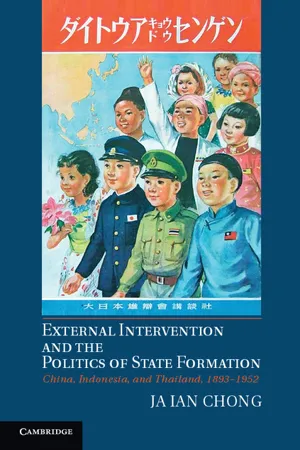 eBook - PDF
External Intervention and the Politics of State Formation
China, Indonesia, and Thailand, 1893–1952
- Ja Ian Chong(Author)
- 2012(Publication Date)
- Cambridge University Press(Publisher)
Based on dissimilar expectations about the net gains of investing in access denial over a state relative to an alternative goal, foreign powers may intervene in the state to subjugate, fragment, destabilise, or even bolster governance, rule, and political authority. My study highlights how intervention can go beyond the conquest, mediation, reconstruction, or extension of loans often associated with outside involvement in domestic politics. 6 Apart from adding a consideration of outside intervention to the literature on state formation, this book speaks to a wider discussion on the potential for change in the units that constitute the international system. My second image- reversed perspective extends the claim that membership in the international system rests on external, great power recognition. Specifically, it highlights the influence of major powers on the nature of governance and political authority in a weak polity, especially as they respond to shifting systemic pressures. 7 Accounting for external intervention may also present a way to understand the effects of anticolonial and self-determinationist norms on the propagation of sovereign statehood around the mid twentieth century. 8 After all, these norms predated World War II. The majority of anticolonial and self-determination 6 See Centeno, 1997, 2002; Centeno and López-Alves, 2001; Herbst, 2000; Hui, 2004, 185–94, 2005, 50–108; Taylor and Botea, 2008. 7 For examples of work on the roles of external powers on international system membership, see Coggins, 2006; Fazal, 2004, 2007. 8 For a discussion on the roles that anticolonial and self-determination norms played in promoting sovereign statehood after World War II, see Fazal, 2004, 2007. 230 External Intervention and the Politics of State Formation movements also did not attain their avowed goals of independence during World War II, when major colonial powers faced significant economic, political, and strategic stress.
Index pages curate the most relevant extracts from our library of academic textbooks. They’ve been created using an in-house natural language model (NLM), each adding context and meaning to key research topics.

